Tapticom® bc
Ukraine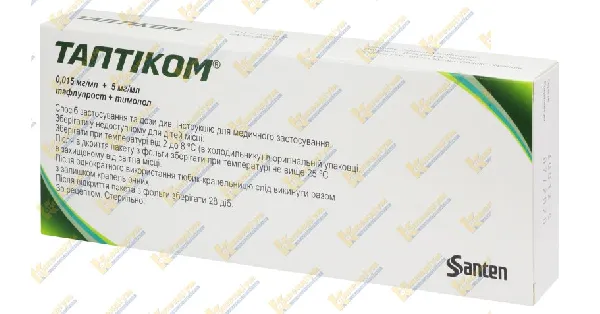
Table of Contents
INSTRUCTIONS FOR MEDICAL USE OF THE MEDICINAL PRODUCT TAPTIQOM® PF (TAPTIQOM® PF)
Composition:
Active substances: tafluprost, timolol;
1 ml of ophthalmic solution contains 0.015 mg tafluprost and 5 mg timolol, equivalent to 6.84 mg timolol maleate;
Excipients: glycerin; sodium hydrogen phosphate dodecahydrate; disodium edetate; polysorbate 80; sodium hydroxide and/or hydrochloric acid concentrated; water for injections.
One ophthalmic drop (approximately 30 μl) contains about 0.45 μg tafluprost and 0.15 mg timolol.
Pharmaceutical form. Ophthalmic solution.
Main physicochemical properties: clear, colorless solution, practically free from visible particles.
Pharmacotherapeutic group.
Ophthalmological agents. Antiglaucoma and miotic agents. Beta-adrenergic blockers. ATC code S01ED51.
Pharmacological Properties
Pharmacodynamics
Mechanism of Action
Tapcom® BK is a fixed-combination product containing two active substances: tafluprost and timolol. These two active substances reduce intraocular pressure (IOP) through complementary mechanisms of action, and their combined effect results in an additive reduction of IOP compared to either agent alone.
Tafluprost is a fluorinated analogue of prostaglandin F2ɑ. Tafluprost acid, the biologically active metabolite of tafluprost, is a highly potent and selective agonist at the human prostaglandin FP receptor.
Pharmacodynamic studies in animals indicate that tafluprost reduces intraocular pressure by increasing uveoscleral outflow of aqueous humor.
Timolol maleate is a non-selective beta-adrenergic blocker. The precise mechanism of timolol maleate in reducing intraocular pressure has not been fully established, although fluorescein studies and tonographic data suggest that its primary action may be related to reduced aqueous humor production. However, slight increases in outflow facility have also been observed in some studies.
Clinical Efficacy
In a 6-month study (n = 400) involving patients with open-angle glaucoma or ocular hypertension and an untreated mean IOP between 24 and 26 mmHg, the IOP-lowering effect of Tapcom® BK (once daily in the morning) was compared with that of concomitant administration of 0.0015% tafluprost (once daily in the morning) and 0.5% timolol (twice daily). Tapcom® BK was non-inferior in effect to the combination of 0.0015% tafluprost and 0.5% timolol. The mean diurnal reduction in IOP from baseline was 8 mmHg in both groups at the primary endpoint of 6 months (reduction ranged from 7 to 9 mmHg in both groups at various time points during the day at physician visits).
In another 6-month study (n = 564), Tapcom® BK was compared with monotherapy in patients with open-angle glaucoma or ocular hypertension and an untreated mean IOP between 26 and 27 mmHg. Patients whose condition was inadequately controlled on 0.0015% tafluprost (IOP ≥20 mmHg on treatment) or 0.5% timolol (IOP ≥22 mmHg on treatment) were randomized to treatment with Tapcom® BK or continued monotherapy. The mean diurnal reduction in IOP with Tapcom® BK was statistically greater than that achieved with once-daily morning tafluprost or twice-daily timolol at visits at week 6, month 3 (primary efficacy endpoint), and month 6. The mean diurnal reduction in IOP from baseline with Tapcom® BK was 9 mmHg, compared to 7 mmHg observed with either monotherapy. The reduction in IOP with Tapcom® BK varied from 8 to 9 mmHg throughout the day, compared to 7–9 mmHg in the tafluprost monotherapy group and 7–9 mmHg in the timolol monotherapy group.
Pooled data from patients treated with Tapcom® BK who had a high baseline IOP of 26 mmHg (mean diurnal) or higher in these two pivotal studies (n = 168) showed a mean diurnal IOP reduction of 10 mmHg at the primary endpoint (3 or 6 months), ranging from 9 to 12 mmHg at different time points during the day.
Pharmacokinetics
Absorption
Plasma concentrations of tafluprost acid and timolol were evaluated in healthy volunteers after single and repeated administration of Tapcom® BK once daily for eight days, 0.0015% tafluprost (once daily), and 0.5% timolol (twice daily). The plasma concentration of tafluprost acid reached its maximum level 10 minutes after dosing and decreased below the lower limit of quantification (10 pg/mL) within 30 minutes after administration of Tapcom® BK. Accumulation of tafluprost acid was minimal, and the mean urinary concentration of tafluprost acid (mean AUC0-last) (monotherapy: 4.45 ± 2.57 pg·h/mL; Tapcom® BK: 3.60 ± 3.70 pg·h/mL) and mean maximum concentration (Cmax) (monotherapy: 23.9 ± 11.8 pg/mL; Tapcom® BK: 18.7 ± 11.9 pg/mL) were slightly lower with Tapcom® BK treatment compared to tafluprost monotherapy on day 8. The plasma concentration of timolol reached peak levels at a median Tmax (median time to peak concentration) of 15 minutes and 37.5 minutes after dosing on days 1 and 8, respectively. On day 8, the mean urinary concentration of timolol (mean AUC0-last) (monotherapy: 5750 ± 2440 pg·h/mL; Tapcom® BK: 4560 ± 2980 pg·h/mL) and mean Cmax (monotherapy: 1100 ± 550 pg/mL; Tapcom® BK: 840 ± 520 pg/mL) were slightly lower with Tapcom® BK compared to timolol monotherapy. The lower plasma levels of timolol with Tapcom® BK are likely due to once-daily dosing compared to twice-daily dosing of timolol monotherapy.
Tafluprost and timolol are absorbed through the cornea. In animals, after single-dose administration, corneal penetration of tafluprost with Tapcom® BK was similar to that with tafluprost monotherapy, whereas penetration of timolol was slightly lower with Tapcom® BK compared to timolol monotherapy. For tafluprost acid, the AUC4h was 7.5 ng•h/mL after Tapcom® BK and 7.7 ng•h/mL after tafluprost monotherapy. For timolol, the AUC4h was 585 ng•h/mL and 737 ng•h/mL after Tapcom® BK and timolol monotherapy, respectively. The Tmax for tafluprost acid was 60 minutes with both Tapcom® BK and tafluprost monotherapy, while the Tmax for timolol was 60 minutes with Tapcom® BK and 30 minutes with timolol monotherapy.
Distribution
Tafluprost
In animal studies, there was no specific distribution of radiolabeled tafluprost in the iris-ciliary region or choroid, or in the retinal pigment epithelium, indicating low melanin pigment affinity. In a whole-body autoradiography study in animals, the highest radioactivity concentrations were observed in the cornea, followed by the eyelids, sclera, and iris. Outside the eye, radioactivity was distributed to the lacrimal glands, palate, esophagus, gastrointestinal tract, kidneys, liver, gallbladder, and urinary bladder. In vitro, binding of tafluprost acid to human serum albumin was 99% at a tafluprost acid concentration of 500 ng/mL.
Timolol
In animals, peak levels of timolol-related radioactivity in ocular fluid were reached 30 minutes after a single instillation of radiolabeled 3H-timolol (0.5% solution; 20 µL/eye) in both eyes. Timolol is eliminated from ocular fluid significantly faster than from pigmented tissues of the iris and ciliary body.
Biotransformation
Tafluprost
The primary metabolic pathway of tafluprost in humans, studied in vitro, is hydrolysis to the pharmacologically active metabolite tafluprost acid, which is further metabolized via glucuronidation or beta-oxidation. The beta-oxidation products, 1,2-dinor and 1,2,3,4-tetranor tafluprost acid, which are pharmacologically inactive, may undergo glucuronidation or hydroxylation. The cytochrome P450 (CYP) enzyme system is not involved in the metabolism of tafluprost acid. Based on studies using purified enzymes in animal corneal tissue, carboxylesterase is the primary esterase responsible for the cleavage of the ethyl ester to tafluprost acid. Butyrylcholinesterase, but not acetylcholinesterase, may also contribute to hydrolysis.
Timolol
Timolol is metabolized in the liver, primarily by the CYP2D6 enzyme, into inactive metabolites, which are excreted predominantly by the kidneys.
Elimination
Tafluprost
After daily instillation of radiolabeled 3H-tafluprost (0.005% ophthalmic solution; 5 µL/eye) for 21 days in both eyes of animals, approximately 87% of the total radioactive dose was eliminated from the body. The cumulative amount excreted in urine was approximately 27–38% of the dose, and approximately 44–58% of the dose was excreted in feces.
Timolol
The established elimination half-life from human plasma is approximately 4 hours. Timolol is extensively metabolized in the liver, and metabolites are excreted in urine, along with about 20% of unchanged timolol following oral administration.
Clinical characteristics.
Indications.
The medicinal product Tappticom® BC is used to reduce intraocular pressure (IOP) in adult patients with open-angle glaucoma or ocular hypertension who do not respond adequately to local monotherapy with beta-blockers or prostaglandin analogs.
Contraindications.
Hypersensitivity to the active substances or to any of the excipients of the medicinal product.
Respiratory tract irritation, as well as bronchial asthma or history of bronchial asthma, severe chronic obstructive pulmonary disease.
Sinus bradycardia, sick sinus syndrome, sinoatrial block, second- or third-degree atrioventricular block not controlled by a pacemaker, severe heart failure, or cardiogenic shock.
Interaction with other medicinal products and other forms of interaction.
No specific studies on interactions with other medicinal products have been conducted.
Decreased arterial pressure and/or marked bradycardia may be potentiated when ophthalmic beta-blocker solution is used concomitantly with oral calcium antagonists (calcium channel blockers), beta-adrenergic blockers, antiarrhythmic agents (including amiodarone), digitalis glycosides, parasympathomimetics, or guanethidine.
In addition, patients receiving systemic alpha-blocking agents, reserpine, antiarrhythmic agents of class I (e.g., quinidine), or clonidine should be monitored for possible exacerbation of adverse reactions.
Oral beta-adrenergic blockers may intensify rebound hypertension occurring after discontinuation of clonidine.
During combined treatment with CYP2D6 inhibitors (e.g., quinidine, fluoxetine, paroxetine) and timolol, potential systemic beta-blockade (e.g., reduced heart rate, depression) has been reported.
Concomitant treatment with barbiturates, analgesics, or ergot alkaloids may enhance adverse reactions affecting the central nervous system.
Rarely, mydriasis has been reported with concomitant use of ophthalmic beta-blockers and adrenaline (epinephrine).
Special precautions for use
Systemic effects
As with other topically applied ophthalmic agents, tafluprost and timolol are absorbed systemically. Due to the presence of the beta-adrenergic blocking component — timolol — the same cardiovascular, pulmonary and other adverse reactions as those associated with systemic beta-blockers may occur. The frequency of systemic adverse reactions following topical ophthalmic administration is lower than with systemic administration. For information on reducing systemic absorption, see section "Dosage and administration".
Cardiac disorders
Beta-blockers should be used with caution in patients with cardiovascular disorders (such as ischemic heart disease/coronary insufficiency, Prinzmetal's angina, and heart failure) and in patients with hypotension. The benefit-risk ratio of beta-blocker therapy should be carefully evaluated, and alternative treatment with other active substances should be considered.
Patients with cardiovascular disorders should be monitored for worsening of their condition and for any adverse reactions.
Due to the negative effect on impulse conduction time, beta-blockers should be administered with great caution to patients with first-degree heart block.
Vascular disorders
Patients with severe peripheral circulatory disturbances (e.g., severe forms of Raynaud's disease or Raynaud's syndrome) should be treated with caution.
Respiratory disorders
Adverse respiratory reactions, including fatal bronchospasm in asthmatic patients, have been reported after administration of certain ophthalmic beta-blockers. Taptoptim® BC should be used with caution in patients with mild to moderate chronic obstructive pulmonary disease (COPD), and only if the expected benefit outweighs the potential risk.
Hypoglycemia / diabetes mellitus
Beta-blockers should be used with caution in patients prone to spontaneous hypoglycemia or with labile diabetes mellitus, as beta-blockers may mask the symptoms of acute hypoglycemia.
Hyperthyroidism
Beta-blockers may mask the symptoms of hyperthyroidism.
Abrupt withdrawal of beta-blocker therapy may exacerbate symptoms of hyperthyroidism.
Corneal disorders
Ophthalmic beta-blockers may cause dry eye. Patients with corneal disorders should be treated with caution.
Other beta-blockers
The effect on intraocular pressure or the known systemic effects of beta-blockers may be enhanced when timolol (a component of Taptoptim® BC) is administered to patients already receiving systemic beta-blockers. Such patients should be closely monitored for response to therapy. Concomitant use of two topical beta-adrenergic blocking agents is not recommended.
Angle-closure glaucoma
In patients with angle-closure glaucoma, the primary goal of treatment is to reopen the angle. This requires pupillary constriction with a miotic agent. Timolol has little or no effect on the pupil. When timolol is used to reduce elevated intraocular pressure in the presence of angle-closure glaucoma, it should be used in combination with a miotic agent, not as monotherapy.
Anaphylactic reactions
Patients with a history of atopy or severe anaphylactic reactions to a variety of allergens may be less responsive to epinephrine used to treat anaphylactic reactions while taking beta-blockers.
Choroidal detachment
Choroidal detachment has been reported with the use of aqueous humor suppressants (such as timolol, acetazolamide) following filtering surgeries.
Surgery and anesthesia
Ophthalmic beta-blockers may block the systemic effects of beta-agonists such as epinephrine. The anesthesiologist should be informed that the patient is receiving timolol.
Myasthenia gravis
Worsening of the general condition has been reported in patients with myasthenia gravis using timolol eye drops.
Before initiating treatment, patients should be informed about the possibility of eyelash growth, darkening of eyelid skin, and increased pigmentation of the iris associated with tafluprost therapy. Some of these changes may be permanent and may lead to a difference in eye appearance when only one eye is treated.
Iris pigmentation changes occur gradually and may go unnoticed for several months. Changes in eye color are primarily observed in patients with mixed-color irises, such as blue-brown, gray-brown, yellow-brown, or green-brown. The risk of irreversible heterochromia is evident when the drug is administered in only one eye.
There is potential for increased hair growth in areas where tafluprost solution repeatedly contacts the skin surface.
There is no experience with tafluprost in neovascular, angle-closure, narrow-angle, or congenital glaucoma. Experience with tafluprost in patients with aphakia or pseudoexfoliative glaucoma is limited.
Caution should be exercised when prescribing tafluprost to patients with aphakia, pseudophakia with a ruptured posterior lens capsule, or anterior chamber lenses, or in patients with known risk factors for cystoid macular edema or iritis/uveitis.
Use during pregnancy or breastfeeding
Pregnancy
There are no adequate data or the data are limited on the use of Taptoptim® BC in pregnant women.
Women of childbearing potential should use effective contraception during treatment with Taptoptim® BC.
Taptoptim® BC should not be used during pregnancy except in cases of clear medical necessity.
Tafluprost
There are no adequate data on the use of tafluprost in pregnant women. Tafluprost may have harmful pharmacological effects on pregnancy and/or the fetus/newborn. Animal studies have shown toxicity on reproductive function. The risk in humans is unknown.
Timolol
There are no adequate data on the use of timolol in pregnant women. Timolol should not be used during pregnancy except in cases of clear medical necessity. For information on reducing systemic absorption, see section "Dosage and administration".
Epidemiological studies have not shown a teratogenic effect, but have demonstrated a risk of intrauterine growth retardation with oral use of beta-blockers. In addition, newborns have shown signs and symptoms of beta-blockade (e.g., bradycardia, hypotension, respiratory distress/dyspnea, and hypoglycemia) when beta-blockers were administered before delivery. If Taptoptim® BC is used before delivery, the newborn should be closely monitored by a physician during the first days of life.
Breastfeeding
Beta-blockers are excreted in breast milk. However, when therapeutic doses of timolol in the form of eye drops are used, it is unlikely that the amount present in breast milk would cause clinical signs of beta-blockade in the infant. For information on reducing systemic absorption, see section "Dosage and administration".
It is unknown whether tafluprost and/or its metabolites are excreted in human breast milk. Available toxicological data have shown excretion of tafluprost and/or its metabolites into animal milk. However, when therapeutic doses of tafluprost in the form of eye drops are used, it is unlikely that the amount of tafluprost present in human breast milk would cause clinical symptoms in the infant.
As a precautionary measure, breastfeeding is not recommended if treatment with Taptoptim® BC is necessary.
Fertility
There are no data on the effect of Taptoptim® BC on human fertility.
Ability to drive and use machines
No studies on the effect of Taptoptim® BC on the ability to drive or operate machinery have been conducted. If adverse reactions such as transient blurred vision occur after instillation, the patient should wait until vision clears before driving or operating machinery.
Method of Administration and Dosage
Doses
The recommended therapy is the instillation of 1 drop of the ophthalmic solution into the conjunctival sac of the affected eye(s) once daily.
If a dose is missed, treatment should be continued with the next scheduled dose. The dose should not exceed 1 drop in the affected eye(s) once daily.
Tapticom® BK is a sterile preservative-free solution in a multidose container.
Elderly Patients
No dosage adjustment is required for elderly patients.
Renal and Hepatic Impairment
The use of tafluprost and timolol ophthalmic solutions in patients with renal/hepatic impairment has not been studied; therefore, Tapticom® BK should be used with caution in such patients.
Method of Administration
For ophthalmic use only.
Patients should be instructed on the proper handling of the bottle. At first use, before instilling a drop into the eye, patients should practice using the bottle. To do this, the bottle should be gently squeezed to release one drop onto a surface other than the eye. Patients should continue practicing until they are confident they can administer one drop at a time.
Patients should be advised to avoid direct contact between the eye and the bottle tip, as this may lead to eye injury.
Patients should be instructed not to touch the eyelids, surrounding areas, or any other surfaces with the dropper tip of the bottle. Any residual liquid on the dropper tip after administration should be removed immediately by tapping the bottle downward once. The dropper tip must not be touched or wiped.
Patients should be informed that improper handling of ophthalmic solutions may result in contamination with common bacteria known to cause eye infections. The use of contaminated solutions may lead to serious ocular damage and subsequent vision loss.
To reduce the risk of eyelid skin pigmentation, patients should wipe away excess liquid from the skin.
Systemic absorption can be minimized by applying digital pressure to the inner corner of the eye to close the nasolacrimal duct, or by keeping the eyes closed for two minutes. This may reduce systemic side effects and enhance local action.
If more than one ophthalmic medicinal product is prescribed, an interval of at least 5 minutes should be maintained between the administration of each product.
Contact lenses must be removed prior to instillation of the eye drops and at least 15 minutes should elapse after administration before reinserting them.
Children
The safety and efficacy of Tapticom® BK in children (under 18 years of age) have not been established. There are no available data. Tapticom® BK is not indicated for use in children.
Overdose
Overdose with topical tafluprost is unlikely to occur or be associated with toxicity.
There have been reports of accidental timolol overdose resulting in symptoms of systemic poisoning similar to those observed with systemic beta-adrenergic blockers. Even a few drops of timolol-containing solution may cause arrhythmia, transient slowing of pulse rate, decreased blood pressure, and bronchospasm (see also section "Adverse Reactions").
In case of Tapticom® BK overdose, treatment should be symptomatic and supportive, using adrenergic agonists (e.g., isoprenaline, dobutamine, and possibly dopamine). Timolol is not effectively removed by hemodialysis.
Adverse Reactions
In clinical studies, over 484 patients were treated with Tapticom® BK. The most frequently reported treatment-related adverse reaction was conjunctival/ocular hyperemia. It occurred in approximately 7% of patients participating in clinical trials; in most cases, it was mild and led to discontinuation of treatment in 1.2% of patients.
Adverse reactions reported in clinical studies with Tapticom® BK were limited to those previously reported with one of the active substances—tafluprost or timolol. No new adverse reactions specific to Tapticom® BK were observed in clinical studies. Most of the reported adverse reactions were ocular, mild to moderate in severity, and not serious.
As with other topically applied ophthalmic medicinal products, tafluprost and timolol are systemically absorbed. This may cause similar adverse reactions as those observed with systemic beta-blockers. The incidence of systemic adverse reactions after topical ophthalmic administration is lower than with systemic administration. The adverse reactions listed below include those observed within the class of ophthalmic beta-blockers.
The following adverse reactions have been reported with Tapticom® BK during clinical studies (within each frequency category listed below, adverse reactions are presented in decreasing order of frequency).
The frequency of possible adverse reactions listed below was determined using the following criteria: very common (≥ 1/10); common (≥ 1/100 to < 1/10); uncommon (≥ 1/1000 to < 1/100); rare (≥ 1/10,000 to < 1/1000); very rare (< 1/10,000); not known (frequency cannot be estimated from available data).
Tapticom® BK (tafluprost/timolol combination)
Nervous system disorders
Uncommon: headache.
Eye disorders
Common: conjunctival/ocular hyperemia, eye pruritus, eye pain, eyelash changes (increased length, thickness, and number of eyelashes), eyelash discoloration, eye irritation, foreign body sensation in the eye, blurred vision, photophobia (light sensitivity).
Uncommon: unusual eye sensation, dry eye, eye discomfort, conjunctivitis, eyelid erythema, eye allergy, eyelid edema, superficial punctate keratitis, increased lacrimation, anterior chamber inflammation, asthenopia (eye strain), blepharitis (inflammation of the eyelids).
Additional adverse reactions observed with one of the active substances (tafluprost or timolol) and which may also occur with Tapticom® BK are listed below.
Tafluprost
Eye disorders: decreased visual acuity, increased iris pigmentation, eyelid pigmentation, conjunctival edema, eye discharge, cellular reaction in aqueous humor, aqueous flare, allergic conjunctivitis, conjunctival pigmentation, conjunctival follicles, deepening of eyelid sulcus, iritis/uveitis, macular edema/cystoid macular edema.
Skin and subcutaneous tissue disorders: eyelid hypertrichosis.
Respiratory system disorders: exacerbation of bronchial asthma, dyspnea (shortness of breath/difficult breathing).
Timolol
Immune system disorders: signs and symptoms of allergic reactions including angioedema, urticaria, single and multiple rashes, anaphylactic reaction, pruritus.
Metabolism and nutrition disorders: hypoglycemia.
Psychiatric disorders: depression, sleep disturbances (insomnia), nightmares, memory loss, nervousness, hallucinations.
Nervous system disorders: dizziness, syncope, paresthesia, worsening of myasthenia gravis, hemorrhagic stroke, cerebral ischemia.
Eye disorders: keratitis, decreased corneal sensitivity, visual disturbances including changes in refraction (due to the miotic effect in some cases), ptosis (eyelid drooping), diplopia (double vision), choroidal detachment following filtering surgery, lacrimation, corneal erosion.
Ear and labyrinth disorders: tinnitus (ringing in the ears).
Cardiac disorders: bradycardia, chest pain, palpitations, edema, arrhythmia, congestive heart failure, cardiac arrest, heart block, atrioventricular block, heart failure.
Vascular disorders: hypotension, claudication, Raynaud's phenomenon, cold extremities (hands and feet).
Respiratory, thoracic and mediastinal disorders: dyspnea (shortness of breath/difficult breathing), bronchospasm (especially in patients with pre-existing bronchospastic disease), respiratory disorders, cough.
Gastrointestinal disorders: nausea, dyspepsia (indigestion), diarrhea, dry mouth, dysgeusia (taste disturbance), abdominal pain, vomiting.
Skin and subcutaneous tissue disorders: alopecia (hair loss), psoriasiform rash or exacerbation of psoriasis, skin rash.
Musculoskeletal and connective tissue disorders: systemic lupus erythematosus, myalgia (muscle pain), arthropathy (joint disease).
Reproductive system and breast disorders: Peyronie's disease (fibrous induration of the penis), decreased libido, sexual dysfunction.
General disorders and administration site conditions: asthenia (general weakness)/fatigue, thirst.
Rare cases of corneal calcification have been reported with use of ophthalmic solutions containing phosphate in some patients with significant corneal pathology.
Reporting of suspected adverse reactions
Reporting suspected adverse reactions after medicinal product authorization is important. It allows continued monitoring of the benefit-risk balance of the medicinal product. Healthcare professionals, pharmacists, patients, and their legal representatives are encouraged to report all suspected adverse reactions and lack of efficacy via the Automated Pharmacovigilance Information System at: https://aisf.dec.gov.ua.
Shelf life.
3 years. After first opening, do not store for more than 3 months.
Storage conditions.
Store at 2–8 °C in the original packaging to protect from light. Keep out of reach of children. Do not freeze.
After first opening of the container, store at a temperature not exceeding 25 °C in the original packaging to protect from light. Do not freeze.
Keep out of reach of children.
Packaging.
3 mL in a bottle with a dispenser and a cap with a first-opening control, 1 bottle in a cardboard box.
Prescription status.
Prescription only.
Manufacturer.
Santen Oy, Finland
Manufacturer's location and address of place of business.
Kellonportinkatu 1, 33100 Tampere, Finland.