Tantum verde®
Ukraine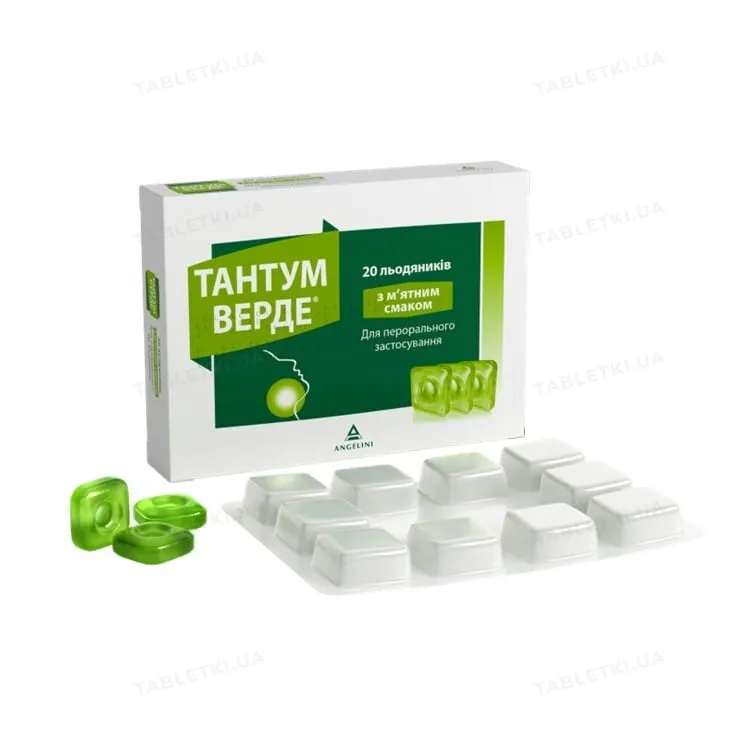
Table of Contents
- INSTRUCTIONS FOR MEDICAL USE OF THE MEDICINAL PRODUCT Tantum Verde® (TantumVerde®)
- Composition:
- Pharmacological properties.
- Clinical characteristics.
- Special precautions for use.
- Dosage and Administration.
- Adverse Reactions
- Composition:
- Pharmacological properties.
- Clinical characteristics.
- Special precautions for use
- Dosage and Administration.
- Side effects
INSTRUCTIONS FOR MEDICAL USE OF THE MEDICINAL PRODUCT Tantum Verde® (TantumVerde®)
Composition:
Active substance: benzidamine hydrochloride;
1 lozenge contains: benzidamine hydrochloride 3 mg (equivalent to 2.68 mg of benzidamine);
Excipients: isomalt (E 953); aspartame (E 951); levomenthol; citric acid monohydrate; lemon flavor; peppermint flavor; quinoline yellow (E 104); indigo carmine (E 132).
Pharmaceutical form. Lozenges.
Main physico-chemical properties: green square-shaped lozenges with a depression in the center, having a characteristic mint-lemon taste; the lozenges must not stick to paraffin paper (for packaging in blisters).
Pharmacotherapeutic group. Agents acting on the respiratory system. Preparations used in throat disorders. Other preparations used in throat disorders. Benzidamine.
ATC code R02A X03.
Pharmacological properties.
Pharmacodynamics.
Clinical studies show that benzidamine is effective in the treatment of inflammatory conditions in the oral cavity and pharynx. In addition, benzidamine exerts a moderate local anesthetic effect.
In a 7-day, multicenter, randomized, open-label, phase IV non-inferiority study, the efficacy and safety of 0.3% oromucosal benzidamine hydrochloride spray and benzidamine hydrochloride 3 mg lozenges were compared in 363 patients with acute sore throat. The primary objective of the study was to evaluate the efficacy of benzidamine hydrochloride (in the form of spray and lozenges) in relieving throat pain at 2 minutes (T2) after administration of a single dose (3 mg lozenge vs. 4 sprays of benzidamine) using the STRRS scale (7-point Sore Throat Relief Rating Scale).
The secondary objective was to evaluate the efficacy of benzidamine hydrochloride (in the form of spray and lozenges) in relieving throat pain at 1 minute (T1) after administration of a single dose using the STRRS scale.
At least slight pain relief (STRRS score > 1) was observed at 1 minute after complete dissolution of the lozenge (mean dissolution time 9.12 minutes) in 87% of patients and at 2 minutes in 91% of patients. Moderate pain relief (STRRS score > 3) was observed at 15 minutes in approximately 83% of patients. Improvement in painful swallowing and reduction in the sensation of swelling were also observed. Improvement in painful swallowing and reduction in throat swelling were observed at 5 minutes after complete dissolution of the lozenge (mean dissolution time 9.12 minutes) by 22% and 25%, respectively, with both parameters reaching 42% at 2 hours.
The safety profile of benzidamine has been confirmed.
Pharmacokinetics.
Absorption through the mucous membranes of the oral cavity and pharynx has been demonstrated by measurable concentrations of benzidamine in human plasma. Approximately 2 hours after administration of a 3 mg lozenge, the maximum plasma concentration of benzidamine is 37.8 ng/mL, and the AUC value is 367 ng/mL∗h. However, these concentrations are too low to produce systemic pharmacological effects.
Excretion occurs primarily via urine, mainly in the form of inactive metabolites or conjugated compounds.
It has been shown that with local application, benzidamine accumulates in inflamed tissues, where effective concentrations are achieved due to its ability to penetrate the epithelial lining.
Clinical characteristics.
Indications. Symptomatic treatment of pain, irritation, and inflammation of the oropharynx.
Contraindications. Hypersensitivity to the active substance or to other components of the medicinal product.
Interaction with other medicinal products and other forms of interaction. Interactions have not been studied.
Special precautions for use.
It is not recommended to use benzidamine in patients with hypersensitivity to acetylsalicylic acid or other non-steroidal anti-inflammatory drugs (NSAIDs).
The drug may provoke bronchospasm in patients with bronchial asthma, including those with a history of asthma. Therefore, this medicinal product should be used with caution in such patients.
In some patients, oral or pharyngeal mucosal ulcers may be caused by serious underlying pathological conditions. Therefore, patients whose symptoms worsen or do not improve within 3 days, or who develop fever or other new symptoms, should seek medical advice (or consult a dentist).
This medicinal product contains aspartame, a source of phenylalanine synthesis. It may be harmful for patients with phenylketonuria.
This medicinal product contains isomalt; therefore, it should not be used in patients with rare hereditary fructose intolerance disorders.
This medicinal product contains a mint flavor, which in turn contains benzyl alcohol, citronellol, D-limonene, eugenol, geraniol, and linalool, which may cause allergic reactions.
This medicinal product contains a lemon flavor, which in turn contains benzyl alcohol, citral, citronellol, D-limonene, geraniol, and linalool, which may cause allergic reactions. Additionally, butylated hydroxyanisole (E 320), present in the lemon flavor, may cause local skin reactions (e.g., contact dermatitis) or irritation of the eyes and mucous membranes.
Use during pregnancy or breastfeeding.
Currently, there are insufficient available data on the use of benzidamine in pregnant or breastfeeding women. The ability of this product to pass into breast milk has not been studied. Animal studies provide insufficient data to draw conclusions regarding the effects of this product on pregnancy or lactation. There are no data on the potential risk during pregnancy or breastfeeding.
The use of Tantum Verde® is not recommended during pregnancy and breastfeeding.
Ability to influence reaction rate while driving or operating machinery.
When used at recommended doses, this medicinal product has no effect or has a negligible effect on the ability to drive or operate machinery.
Dosage and Administration.
Lozenges should be slowly dissolved in the mouth.
Adults and children aged 6 years and older: 1 lozenge 3 times daily.
Do not swallow the lozenges. Do not chew the lozenges.
The duration of treatment should not exceed 7 days.
Children. This medicinal form is intended for use in children aged 6 years and older.
Children aged 6–11 years should use this medicinal product under adult supervision.
Overdose.
There have been no reports of benzidamine overdose with topical administration.
However, it is known that benzidamine, when ingested in large quantities (hundreds of times higher than the possible doses of this medicinal form), particularly in children, may cause excitation, convulsions, tremor, nausea, excessive sweating, ataxia, and vomiting. Such acute overdose requires immediate gastric lavage, treatment of water-electrolyte imbalances, symptomatic therapy, and adequate hydration.
Adverse Reactions
Adverse reactions are classified by frequency of occurrence as follows: very common (≥ 1/10); common (from ≥ 1/100 to < 1/10); uncommon (from ≥ 1/1000 to < 1/100); rare (from ≥ 1/10,000 to < 1/1000); very rare (< 1/10,000); frequency not known (cannot be estimated based on available data).
Gastrointestinal system disorders – rare: burning sensation in the mouth, dry mouth; frequency not known: oral hypoaesthesia.
Immune system disorders – rare: hypersensitivity reaction; frequency not known: anaphylactic reaction.
Respiratory, thoracic and mediastinal disorders – very rare: laryngospasm.
Skin and subcutaneous tissue disorders – uncommon: photosensitivity; very rare: angioneurotic edema.
Reporting of suspected adverse reactions.
Reporting of suspected adverse reactions after marketing authorization of the medicinal product is of great importance. It enables continuous monitoring of the benefit-risk balance of the medicinal product. Healthcare professionals and patients or their legal representatives are encouraged to report any suspected adverse reactions and lack of efficacy of the medicinal product via the Automated Pharmacovigilance Information System at the following link: https://aisf.dec.gov.ua
Shelf life. 4 years.
Storage conditions.
Store the product at a temperature not exceeding 25°C. The product should be stored in its original packaging to protect from moisture (for packaging in blisters). Keep out of reach and sight of children.
Packaging. Each lozenge is wrapped in paraffin paper labeled “TANTUM VERDE®”, 10 lozenges form a blister, which is wrapped in a polyethylene/paper/aluminum foil laminate. Two or three blisters are placed in a cardboard box together with the instructions for medical use. Alternatively, lozenges are packaged in PVC/PE/PVdC-aluminum blister, 10 lozenges per blister. Two or three blisters are supplied in a cardboard box together with the instructions for medical use.
Supply category. Over-the-counter (without prescription).
Manufacturer
PIERRE FABRE MÉDICAL PRODUCTS (responsible for the entire cycle).
Manufacturer's address and place of business
Zone Industrielle de Coudet, Aignan, 32290, France.
Marketing Authorization Holder
Aziende Chimiche Riunite Angelini Francesco A.C.R.A.F. S.p.A.
Address of the Marketing Authorization Holder
Viale Amelia, 70 – 00181 (Rome), Italy.
INSTRUCTIONS
for medical use of the medicinal product
Tantum Verde®
(TantumVerde®)
Composition:
Active ingredient: benzidamine hydrochloride;
1 lozenge contains: benzidamine hydrochloride 3 mg (equivalent to 2.68 mg of benzidamine);
Excipients: isomalt (E 953); aspartame (E 951); levomenthol; citric acid monohydrate; lemon flavoring; mint flavoring; quinoline yellow (E 104); indigotine (E 132).
Pharmaceutical form. Lozenges.
Main physicochemical properties: green square-shaped lozenges with a central indentation, having a characteristic lemon-mint taste; the lozenges must not adhere to paraffin paper (for packaging in blisters).
Pharmacotherapeutic group. Medicinal products affecting the respiratory system. Preparations used in throat disorders. Other preparations used in throat disorders. Benzidamine.
ATC code R02A X03.
Pharmacological properties.
Pharmacodynamics.
Clinical studies show that benzidamine is effective in the treatment of inflammatory conditions in the oral cavity and pharynx. In addition, benzidamine exerts a moderate local anesthetic effect.
In a 7-day, multicenter, randomized, open-label, phase IV non-inferiority study, the efficacy and safety of 0.3% oromucosal spray of benzidamine hydrochloride were compared with benzidamine-containing lozenges (3 mg benzidamine hydrochloride per lozenge) in 363 patients with acute sore throat. The primary objective of the study was to evaluate the efficacy of benzidamine hydrochloride (in the form of spray and lozenges) in relieving sore throat pain at 2 minutes (T2) after administration of a single dose (3 mg lozenge vs. 4 sprays of benzidamine) using the STRRS scale (7-point Sore Throat Relief Rating Scale).
The secondary objective was to evaluate the efficacy of benzidamine hydrochloride (in the form of spray and lozenges) in relieving sore throat pain at 1 minute (T1) after administration of a single dose using the STRRS scale.
At least slight relief of pain (STRRS score > 1) was observed at 1 minute after complete dissolution of the lozenge (mean dissolution time 9.12 minutes) in 87% of patients and at 2 minutes in 91% of patients. Moderate pain relief (STRRS score > 3) was observed at 15 minutes in approximately 83% of patients. Improvement in painful swallowing and reduction in the sensation of swelling were also observed. Improvement in painful swallowing and reduction in throat swelling were observed at 5 minutes after complete dissolution of the lozenge (mean dissolution time 9.12 minutes) by 22% and 25%, respectively, with both parameters reaching 42% improvement at 2 hours.
The safety profile of benzidamine has been confirmed.
Pharmacokinetics.
Absorption through the mucous membranes of the oral cavity and pharynx has been demonstrated by the presence of measurable amounts of benzidamine in human plasma. Approximately 2 hours after administration of a 3 mg lozenge, the maximum plasma concentration of benzidamine is 37.8 ng/mL, and the AUC value is 367 ng/mL∗h. However, these concentrations are too low to produce systemic pharmacological effects.
Excretion occurs primarily via urine, mainly in the form of inactive metabolites or conjugated compounds.
It has been shown that with local application, benzidamine accumulates in inflamed tissues, where effective concentrations are achieved due to its ability to penetrate the epithelial lining.
Clinical characteristics.
Indications. Symptomatic treatment of pain, irritations, and inflammations of the oropharynx.
Contraindications. Hypersensitivity to the active substance or to other components of the medicinal product.
Interaction with other medicinal products and other forms of interaction. Interaction studies have not been conducted.
Special precautions for use
It is not recommended to use benzidamine in patients who are hypersensitive to acetylsalicylic acid or other nonsteroidal anti-inflammatory drugs (NSAIDs).
In patients with bronchial asthma, including a history of bronchial asthma, the drug may provoke bronchospasm. Therefore, this medicinal product should be used with caution in such patients.
In some patients, oral or oropharyngeal mucosal ulcers may be caused by serious underlying pathological conditions. Therefore, patients whose symptoms worsen or do not improve within 3 days, or who develop fever or other new symptoms, should seek medical advice (from a dentist or physician).
This medicinal product contains aspartame, which is a source of phenylalanine. It may be harmful for patients with phenylketonuria.
This medicinal product contains isomalt and therefore should not be used in patients with rare hereditary fructose intolerance.
This medicinal product contains a mint flavor, which in turn contains benzyl alcohol, citronellol, D-limonene, eugenol, geraniol, and linalool, which may cause allergic reactions.
This medicinal product contains a lemon flavor, which in turn contains benzyl alcohol, citral, citronellol, D-limonene, geraniol, and linalool, which may cause allergic reactions. In addition, butylated hydroxyanisole (E 320), contained in the lemon flavor, may cause local skin reactions (e.g., contact dermatitis) or irritation of the eyes and mucous membranes.
Use during pregnancy or breastfeeding
Currently, there are insufficient data available on the use of benzidamine in pregnant or breastfeeding women. It has not been studied whether this drug passes into breast milk. Animal studies are insufficient to allow conclusions regarding the effects of this drug on pregnancy and lactation. There are no data on the potential risk during pregnancy or breastfeeding.
The use of Tantum Verde® should be avoided during pregnancy and breastfeeding.
Ability to influence the speed of reaction when driving or operating machinery
When used at the recommended doses, this medicinal product does not affect or has negligible influence on the ability to drive vehicles or operate machinery.
Dosage and Administration.
The lozenges should be slowly dissolved in the mouth.
Adults and children aged 6 years and older: 1 lozenge 3 times daily.
The lozenges must not be swallowed or chewed.
The treatment course should not exceed 7 days.
Children. This medicinal formulation is intended for use in children aged 6 years and older.
Children aged 6–11 years should use this medicinal product under adult supervision.
Overdose.
There have been no reports of overdose with benzidamine when used topically.
However, it is known that benzidamine, if ingested in large quantities (hundreds of times higher than the possible doses of this medicinal formulation), particularly in children, may cause excitation, convulsions, tremor, nausea, excessive sweating, ataxia, and vomiting. Such acute overdose requires immediate gastric lavage, correction of water-electrolyte imbalances, symptomatic treatment, and adequate hydration.
Side effects
Adverse reactions are classified by frequency of occurrence as follows: very common (≥ 1/10); common (≥ 1/100 to < 1/10); uncommon (≥ 1/1000 to < 1/100); rare (≥ 1/10,000 to < 1/1000); very rare (< 1/10,000); frequency not known (cannot be estimated from available data).
Gastrointestinal disorders – rare: burning sensation in the mouth, dry mouth; frequency not known: oral hypoaesthesia.
Immune system disorders – rare: hypersensitivity reaction; frequency not known: anaphylactic reaction.
Respiratory, thoracic and mediastinal disorders – very rare: laryngospasm.
Skin and subcutaneous tissue disorders – uncommon: photosensitivity; very rare: angioneurotic oedema.
Reporting of suspected adverse reactions
Reporting of suspected adverse reactions after registration of the medicinal product is important. It allows continued monitoring of the benefit-risk balance of the medicinal product. Healthcare professionals and patients, as well as their legal representatives, should report any suspected adverse reactions and lack of efficacy via the Automated Pharmacovigilance Information System at the following link: https://aisf.dec.gov.ua
Shelf life: 4 years.
Storage conditions
Store the medicinal product at a temperature not exceeding 25°C. The product should be stored in its original packaging to protect from moisture (for packaging in sticks). Keep out of reach and sight of children.
Packaging
Each lozenge is wrapped in paraffin-coated paper with the label “TANTUM VERDE®”, 10 lozenges form a stick, which is wrapped in a polyethylene/paper/aluminium foil wrapper. Two or three sticks are placed in a cardboard box together with the instructions for medical use. Alternatively, lozenges are packaged in PVC/PE/PVdC-aluminium blisters, 10 lozenges per blister. Two or three blisters are placed in a cardboard box together with the instructions for medical use.
Release category: Over-the-counter (without prescription).
Manufacturer
ACRIMA (Azienede Chimiche Riunite Angelini Francesco A.C.R.A.F. S.p.A.) – responsible for quality control and batch release;
DISH AG – responsible for manufacturing of unpackaged product, primary and secondary packaging.
Manufacturer’s address and place of business
Via Vecchio del Pincio, 22 – 60131 Ancona (AN), Italy;
Bahnhofstrasse 21, 5504 Otmarshingen, Switzerland.
Marketing Authorisation Holder
Azienede Chimiche Riunite Angelini Francesco A.C.R.A.F. S.p.A.
Address of the Marketing Authorisation Holder
Viale Amelia, 70 – 00181 Rome, Italy.