Tanakan
Ukraine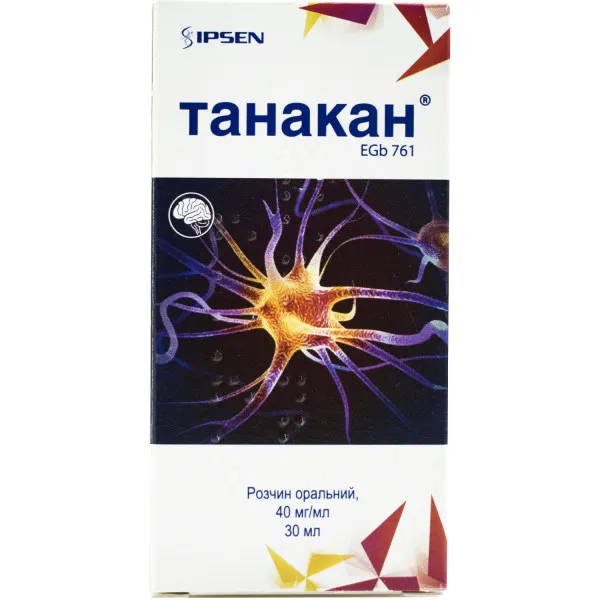
Table of Contents
INSTRUCTIONS FOR MEDICAL USE OF THE MEDICINAL PRODUCT TANAKAN® (TANAKAN®)
Composition:
Active substance: Ginkgo biloba
1 ml of oral solution contains 40 mg of dry extract of Ginkgo biloba, purified and quantitatively standardized (EGb 761), obtained from Ginkgo biloba L. folium (leaves of Ginkgo)
(35 – 67:1), corresponding to:
- 8.8 – 10.8 mg flavonoids, expressed in terms of flavonoid glycosides
- 1.1 – 1.4 mg ginkgolides A, B and C
- 1.0 – 1.3 mg bilobalide;
first extraction solvent: acetone 60% (m/m);
Excipients: sodium saccharin, orange flavoring solution, lemon flavoring solution, ethanol 96%, purified water.
Pharmaceutical form. Oral solution.
Main physicochemical properties: brownish-orange solution with a characteristic odor; when diluted in water, it forms an almost clear, aromatic liquid.
Pharmacotherapeutic group.
Medicinal products used in disorders of the nervous system. Other agents for the treatment of dementia. ATC code: N06DX02.
Pharmacological Properties
Pharmacodynamics
The mechanism of action is unknown.
Pharmacological data indicate increased alertness in elderly patients based on electroencephalography findings, reduced blood viscosity and enhanced vascularization in certain areas of the brain in healthy men (aged 60–70 years), as well as decreased platelet aggregation. Furthermore, a vasodilatory effect on forearm blood vessels has been observed, leading to an increase in circulating blood volume.
Pharmacokinetics
After oral administration of 120 mg of Ginkgo extract (in solution form), the mean bioavailability of terpene lactones was 80% for ginkgolide A, 88% for ginkgolide B, and 79% for bilobalide. Following administration of the medicinal product in tablet form, maximum plasma concentrations of terpene lactones reached 16–22 ng/mL for ginkgolide A, 8–10 ng/mL for ginkgolide B, and 27–54 ng/mL for bilobalide. The corresponding elimination half-life of ginkgolides A and B and bilobalide was 3–4, 4–6, and 2–3 hours, respectively. Plasma concentrations after administration of a solution containing 120 mg of Ginkgo extract were 25–33 ng/mL for ginkgolide A, 9–17 ng/mL for ginkgolide B, and 19–35 ng/mL for bilobalide. The elimination half-life of ginkgolide A was 5 hours, ginkgolide B was 9–11 hours, and bilobalide was 3–4 hours.
Clinical characteristics.
Indications.
The herbal medicinal product is indicated for symptomatic treatment of cognitive disorders in elderly patients, excluding patients with confirmed dementia, Parkinson's disease, iatrogenic cognitive disorders, or those caused by depression or metabolic disturbances.
TAНАКАN® is indicated for use in adults and elderly patients.
Contraindications.
Hypersensitivity to the active substance or to any of the excipients listed in the section "Composition".
Pregnancy (see section "Use during pregnancy or breastfeeding").
Interaction with other medicinal products and other forms of interaction.
Concomitant use of this medicinal product with anticoagulants (phenprocoumon, warfarin) or antiplatelet agents (clopidogrel, acetylsalicylic acid or other nonsteroidal anti-inflammatory drugs) may affect the action of these agents.
In studies conducted with warfarin, no interaction between warfarin and Ginkgo-containing medicinal products was observed; however, appropriate monitoring is recommended when initiating or discontinuing concomitant treatment with warfarin and Ginkgo-based products, or when changing the medicinal product.
An interaction study suggests that Ginkgo may inhibit P-glycoproteins in the small intestine, potentially increasing gastrointestinal exposure to medicinal products sensitive to P-glycoprotein, such as dabigatran etexilate. Ginkgo should be used with caution when taken concomitantly with dabigatran.
An interaction study demonstrated that the Cmax of nifedipine may increase by up to 100% during Ginkgo administration in some patients, who experienced dizziness and increased frequency of hot flushes.
Concomitant use of Ginkgo-containing medicinal products with efavirenz is not recommended due to the potential for reduced plasma concentrations of efavirenz as a result of induction of cytochrome CYP3A4 (see section "Special precautions for use").
Interaction with other medicinal products due to alcohol content (0.45 g per 1 dose), with medicinal products that depress central nervous system function, should be considered when concomitantly using this medicinal product together with:
- medicinal products causing disulfiram-like reaction upon alcohol consumption (sensation of warmth, flushing, vomiting, tachycardia): disulfiram, cefamandole, cefoperazone, latamoxef (a cephalosporin antibacterial agent), chloramphenicol (a phenicol antibacterial agent), chlorpropamide, glibenclamide, glipizide, tolbutamide (antidiabetic sulfonylurea hypoglycemic agents), griseofulvin (antifungal agent), nitro-5-imidazoles (metronidazole, ornidazole, secnidazole, tinidazole), ketoconazole, procarbazine (cytostatic);
- agents that depress central nervous system function.
Special precautions for use
This medicinal product contains 57% ethanol (alcohol) by volume, i.e. up to 450 mg per dose (1 ml), which is equivalent to 11.3 ml of beer or 4.7 ml of wine per dose. The use of this medicinal product is hazardous for patients suffering from alcoholism and should be taken into account when administering it to pregnant women, breastfeeding women, children, and patients in high-risk groups, such as those with hepatic insufficiency or epilepsy.
Patients with a tendency to bleeding (hemorrhagic tendency), who are receiving concomitant therapy with anticoagulants or antiplatelet medicinal products, should consult their physician before using this medicinal product.
Medicinal products containing Ginkgo may increase the risk of bleeding. As a precautionary measure, treatment with this medicinal product should be discontinued 3–4 days prior to any surgical intervention.
In patients with epilepsy, the possibility of increased seizure frequency during treatment with Ginkgo-containing medicinal products cannot be excluded.
Concomitant use of Ginkgo-containing medicinal products with efavirenz is not recommended (see section "Interaction with other medicinal products and other forms of interaction").
Use during pregnancy or breastfeeding
Pregnancy
Ginkgo extract may reduce platelet aggregation capacity. This may increase the risk of bleeding. Animal studies are insufficient to draw conclusions regarding reproductive toxicity.
This medicinal product is contraindicated during pregnancy.
Lactation
There are no data available on whether Ginkgo metabolites are excreted in breast milk. Risk to newborns and infants cannot be excluded.
Due to the lack of sufficient data, the use of this medicinal product during breastfeeding is not recommended.
Fertility
No specific studies on the effect of Ginkgo on human fertility have been conducted. However, certain effects were observed in female mice.
Ability to influence reaction speed when driving or operating machinery
No studies on the influence of this medicinal product on the ability to drive or operate machinery have been conducted.
Dosage and Administration.
Dosage
3 doses (3 ml) per day, taken in divided doses throughout the day.
Administration method
For oral use.
Use the dosing device: 1 dose = 1 ml of oral solution = 40 mg of pure extract.
Dilute the doses in half a glass of water and take with food.
Children.
Do not use in children.
Overdose.
There is no information available regarding overdose with this medicinal product.
Adverse reactions.
Summary of safety profile
In a 5-year clinical trial evaluating the efficacy and safety of the medicinal product TANAKAN® at a dose of 120 mg twice daily in patients aged over 70 years (GuidAge study 2-31-00240-011), the most commonly reported adverse reactions (≥ 5%) were abdominal pain, diarrhoea, and dizziness.
Table of adverse reactions
Table 1 presents data on adverse reactions reported for the medicinal product TANAKAN® during clinical trials and the post-marketing period. The frequency of adverse reactions is categorized as follows: common (≥1/100 to <1/10); uncommon (≥1/1000 to <1/100); rare (≥1/10000 to <1/1000). The frequencies are based on the number of adverse reactions reported during the 5-year clinical study assessing the efficacy and safety of TANAKAN® at a dose of 120 mg twice daily in patients aged over 70 years (GuidAge study 2-31-00240-011).
Table 1
| System organ class |
Frequency |
Adverse reactions |
| Immune system disorders |
Common Uncommon Rare |
Hypersensitivity reactions, dyspnea Urticaria Angioedema |
| Nervous system disorders |
Common |
Dizziness, headache, syncope |
| Gastrointestinal disorders |
Common |
Abdominal pain, diarrhea, dyspepsia, nausea |
| Skin and subcutaneous tissue disorders |
Common Uncommon |
Eczema, pruritus Rash |
Description of adverse reaction selection
Table 2 presents the comparative frequency of common adverse events identified in a 5-year clinical study evaluating the efficacy and safety of the medicinal product TANAKAN® at a dose of 120 mg twice daily in patients over 70 years of age (GuidAge study 2-31-00240-011):
Table 2
Adverse reactions |
TANAKAN® (n=1406) |
PLACEBO (n=1414) |
| Hypersensitivity reactions |
1.1% |
1.2% |
| Dyspnea |
3.2% |
1.8% |
| Dizziness |
9.0% |
9.2% |
| Headache |
3.8% |
3.5% |
| Syncope |
1.6% |
1.0% |
| Vasovagal syncope |
2.8% |
1.8% |
| Abdominal pain |
3.3% |
3.8% |
| Upper abdominal pain |
5.4% |
6.6% |
| Diarrhea |
6.1% |
5.9% |
| Dyspepsia |
3.9% |
3.6% |
| Nausea |
1.8% |
1.8% |
| Exema |
4.6% |
4.7% |
| Pruritus |
2.7% |
2.8% |
| Generalized pruritus |
1.4% |
1.2% |
Reporting of suspected adverse reactions
Reporting of adverse reactions after authorization of a medicinal product is important. It ensures continuous monitoring of the benefit/risk balance of the medicinal product. Healthcare professionals are requested to report any suspected adverse reactions through the national reporting system.
Shelf life. 3 years.
Storage conditions.
Store in the original packaging at a temperature not exceeding 25 ºC.
Keep out of reach of children.
Packaging.
30 ml of oral solution in a bottle with a screw cap; the bottle supplied with a dosing device in a cardboard box.
Prescription status.
Prescription only.
Manufacturer.
BOUFOUR IPSEN INDUSTRIE / BEAUFOUR IPSEN INDUSTRIE.
Address of manufacturer and site of operation.
Rue Ethe Virton 28100 DREUX, France.
Marketing authorization holder.
IPSEN CONSUMER HEALTHCARE
Simplified joint-stock company
Address of the marketing authorization holder
65 Quai Georges Gorse, 92100 Boulogne-Billancourt, France