Tamveler
Ukraine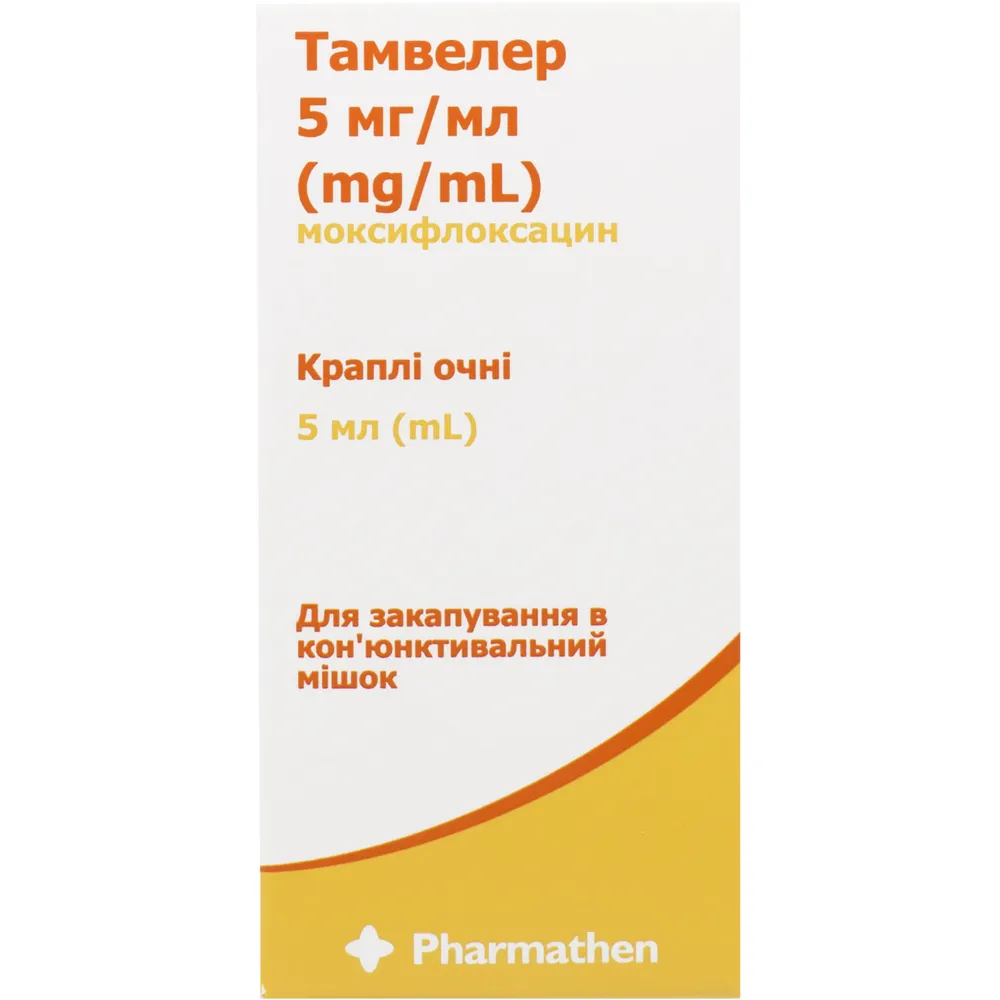
Table of Contents
INSTRUCTIONS FOR MEDICAL USE OF THE MEDICINAL PRODUCT TAMVELIER (TAMVELIER)
Composition:
Active substance: moxifloxacin;
1 ml of solution contains 5 mg of moxifloxacin (as moxifloxacin hydrochloride);
Excipients: sodium chloride, boric acid, sodium hydroxide, water for injections.
Medicinal form: Eye drops.
Main physicochemical properties: clear greenish-yellow solution, free from foreign particles.
Pharmacotherapeutic group: Medicinal products used in ophthalmology. Antibacterial agents. ATC code: S01AE07.
Pharmacological properties.
Pharmacodynamics.
Mechanism of action
Moxifloxacin, a fourth-generation fluoroquinolone, inhibits DNA gyrase and topoisomerase IV, which are essential for bacterial DNA replication, repair, and recombination.
Mechanism of resistance
Resistance to fluoroquinolones, including moxifloxacin, typically arises from chromosomal mutations in genes encoding DNA gyrase and topoisomerase IV. In Gram-negative bacteria, resistance to moxifloxacin may also occur due to mutations in the mar (multiple antibiotic resistance) and qnr (quinolone resistance) systemic genes. Cross-resistance with beta-lactams, macrolides, and aminoglycosides is unlikely due to differences in mechanisms of action.
Breakpoints
The European Committee on Antimicrobial Susceptibility Testing (EUCAST) has established the following minimum inhibitory concentration (MIC) breakpoints (mg/l):
| Microorganisms |
Susceptibility |
Resistance |
| Staphylococcus strains |
≤ 0.5 mg/l |
> 1 mg/l |
| Streptococcus A,B,C,G |
≤ 0.5 mg/l |
> 1 mg/l |
| Streptococcus pneumoniae |
≤ 0.5 mg/l |
> 0.5 mg/l |
| Haemophilus influenzae |
≤ 0.5 mg/l |
> 0.5 mg/l |
| Moraxella catarrhalis |
≤ 0.5 mg/l |
> 0.5 mg/l |
| Enterobacteriaceae |
≤ 0.5 mg/l |
> 1 mg/l |
| Nonspecific strains |
≤ 0.5 mg/l |
> 1 mg/l |
The in vitro breakpoints are used to predict the clinical efficacy of moxifloxacin when administered systemically. These breakpoints may not be appropriate when the drug is applied topically to the eye, as higher concentrations are used with local administration and local physical/chemical conditions may influence the activity of the drug at the site of application.
Susceptibility
The prevalence of acquired resistance may vary geographically and over time for relevant microbial strains; therefore, local information on microbial resistance should be sought, especially when treating severe infections.
If necessary, expert advice should be sought when local resistance prevalence renders the activity of moxifloxacin, at least against certain types of infections, questionable.
| Susceptible strains |
| Aerobic gram-positive microorganisms |
| Corynebacterium strains, including Corynebacterium diphtheriae |
| Staphylococcus aureus (methicillin-susceptible) |
| Streptococcus pneumoniae |
| Streptococcus pyogenes |
| Streptococcus viridans group |
| Aerobic gram-negative microorganisms |
| Enterobacter cloacae |
| Haemophilus influenzae |
| Klebsiella oxytoca |
| Moraxella catarrhalis |
| Serratia marcescens |
| Anaerobic microorganisms |
| Propionibacterium acnes |
| Other microorganisms |
| Chlamydia trachomatis |
| Conditionally resistant strains |
| Aerobic gram-positive microorganisms |
| Staphylococcus aureus (methicillin-resistant) |
| Staphylococcus, coagulase-negative strains (methicillin-resistant) |
| Aerobic gram-negative microorganisms |
| Neisseria gonorrhoeae |
| Other microorganisms |
| Absent |
| Resistant microorganisms |
| Aerobic gram-negative microorganisms |
| Pseudomonas aeruginosa |
| Other microorganisms |
| Absent |
Pharmacokinetics.
After topical administration, moxifloxacin was absorbed into the systemic circulation. Plasma concentrations of moxifloxacin were measured in 21 subjects—both men and women—who received the medicinal product as topical eye drops in both eyes three times daily for 4 days. The mean steady-state Cmax and AUC values in plasma were 2.7 ng/mL and 41.9 ng·h/mL, respectively. These values are approximately 1600 and 1200 times lower than the mean Cmax and AUC values reported after oral administration of therapeutic doses of moxifloxacin at 400 mg. The plasma elimination half-life of moxifloxacin was 13 hours.
Clinical characteristics.
Indications.
Local treatment of bacterial conjunctivitis caused by moxifloxacin-susceptible bacterial strains.
For information on the appropriate use of antibacterial agents, refer to official guidelines.
Contraindications.
Hypersensitivity to the active substance, other quinolones, or to any of the excipients of the medicinal product.
Interaction with other medicinal products and other forms of interaction.
No interaction studies with other medicinal products have been conducted. Interaction with other medicinal products is unlikely due to low systemic concentrations of moxifloxacin following topical ophthalmic administration.
If several topical ophthalmic medicinal products are prescribed simultaneously, the interval between their administration should be at least 5 minutes. Ophthalmic ointments should be administered last.
Special precautions for use
For ophthalmic use only. Not for injection. Subconjunctival injection or direct injection into the anterior chamber of the eye is contraindicated.
In patients receiving systemic quinolone therapy, severe, sometimes fatal, hypersensitivity reactions (anaphylactic reactions) have been reported, occasionally following the first dose. Some of these reactions were accompanied by cardiovascular collapse, loss of consciousness, angioedema (including swelling of the larynx, pharynx, and face), airway obstruction, dyspnea, urticaria, and pruritus.
If an allergic reaction to moxifloxacin occurs, the drug should be discontinued immediately. Severe acute hypersensitivity reactions to moxifloxacin or any component of this medicinal product may require emergency treatment. If clinically indicated, airway patency should be re-established and oxygen therapy administered.
As with other antibiotics, prolonged use of the drug may result in overgrowth of non-susceptible microorganisms, including fungi. If superinfection occurs, the drug should be discontinued and alternative therapy initiated.
With systemic therapy using fluoroquinolones, including moxifloxacin, tendinitis and tendon rupture may occur, particularly in elderly patients and in those receiving concomitant corticosteroid therapy. At the first sign of tendon inflammation, treatment with moxifloxacin ophthalmic drops should be discontinued.
Wearing of contact lenses is not recommended during treatment of eye inflammation/infection.
The drug is not indicated for children under 2 years of age for the treatment of eye diseases caused by Chlamydia trachomatis, as its efficacy has not been studied in this patient population. Children aged 2 years and older with eye diseases caused by Chlamydia trachomatis should receive appropriate systemic therapy. Newborns should receive appropriate systemic therapy in case of eye infections caused by Chlamydia trachomatis or Neisseria gonorrhoeae.
Use during pregnancy or breastfeeding
Reproductive function
No studies on the effect of moxifloxacin on human reproductive function following topical administration have been conducted.
No adverse effects on the reproductive function of men or women have been reported during treatment with moxifloxacin ophthalmic drops.
Pregnancy
As adequate and well-controlled studies of the use of the drug in pregnant women have not been conducted, the drug should not be used during pregnancy unless the potential benefit justifies the potential risk to the fetus.
Breastfeeding period
It is not known whether moxifloxacin or its metabolites are excreted in human breast milk. Animal studies have shown low levels of excretion of moxifloxacin after oral administration. The drug should be used with caution in breastfeeding women.
Ability to affect the speed of reactions while driving or operating machinery.
The drug has no effect or a negligible effect on the ability to drive or operate machinery. Transient blurred vision or other visual disturbances may affect the ability to drive or operate machinery. If blurred vision occurs after instillation, patients should wait until vision clears before driving or operating machinery.
Method of Administration and Dosage
For ophthalmic use.
Adults, including elderly patients
Instill 1 drop into the affected eye(s) 3 times daily.
Improvement is usually observed within 5 days; treatment should then be continued for an additional 2–3 days. If no improvement is seen after 5 days of treatment, consult a physician for reassessment of diagnosis and/or therapy. The duration of treatment depends on the severity of the condition and the clinical and bacteriological response.
Children
No dose adjustment is required for this patient group.
Patients with hepatic or renal impairment
No dose adjustment is required for this patient group.
To prevent contamination of the dropper tip and the contents of the bottle, care must be taken not to touch the eyelids, surrounding areas, or any other surfaces with the tip of the dropper bottle.
To minimize systemic absorption of the drops through the nasal mucosa, especially in newborns and children, it is recommended to press gently with a finger on the nasolacrimal duct for 2–3 minutes after instillation.
Not for injection. The product must not be administered by subconjunctival injection or directly into the anterior chamber of the eye.
Children
Moxifloxacin ophthalmic solutions have been shown to be safe when used in children, including newborns. In patients under 18 years of age, adverse reactions such as eye irritation and eye pain have been observed.
Overdose
Due to the characteristics of the medicinal product, a toxic effect is not expected in case of overdose when the product is administered to the eye or if the contents of one bottle are accidentally swallowed.
Adverse Reactions
The most commonly observed adverse reactions are eye pain and ocular irritation.
The following adverse reactions have been reported during treatment with moxifloxacin ophthalmic drops.
Blood and lymphatic system disorders: decreased hemoglobin levels.
Nervous system disorders: headache, paresthesia, dizziness.
Eye disorders: eye pain, eye irritation, punctate keratitis, dry eye syndrome, conjunctival hemorrhage, conjunctival hyperemia, ocular hyperemia, eye pruritus, abnormal sensation in the eye, eyelid edema, ocular discomfort, corneal epithelial defect, corneal disorder, corneal discoloration, conjunctivitis, blepharitis, eye swelling, eyelid pain, conjunctival edema, blurred vision, decreased visual acuity, asthenopia, eyelid disorder, eyelid erythema, ulcerative keratitis, keratitis, increased lacrimation, photophobia, eye discharge.
Respiratory, thoracic and mediastinal disorders: nasal discomfort, pharyngolaryngeal pain, foreign body sensation (in the throat), dyspnea.
Gastrointestinal disorders: dysgeusia, vomiting, nausea.
Hepatobiliary disorders: increased alanine aminotransferase levels, increased gamma-glutamyl transferase levels.
Immune system disorders: hypersensitivity.
Cardiac disorders: tachycardia.
Skin and subcutaneous tissue disorders: erythema, pruritus, rash, urticaria.
In patients receiving systemic quinolone therapy, serious and sometimes fatal hypersensitivity reactions (anaphylactic reactions) have been observed, occasionally after the first dose. Some of these reactions were accompanied by cardiovascular collapse, loss of consciousness, tinnitus, pharyngeal or facial edema, dyspnea, urticaria, and pruritus (see section "Special Warnings and Precautions for Use").
Tendon inflammation and tendon ruptures may occur with systemic administration of fluoroquinolones. Clinical studies and post-marketing experience with systemic quinolones indicate that the risk of such ruptures may be increased in patients receiving corticosteroids, particularly elderly patients, and with excessive physical strain on tendons, including the Achilles tendon (see section "Special Warnings and Precautions for Use").
Pediatric Population
In pediatric patients, including neonates, the type and severity of adverse reactions are similar to those observed in adults.
Shelf Life.
3 years.
Do not use after the expiry date stated on the packaging. Do not use more than 4 weeks after first opening of the bottle.
Storage Conditions.
No special storage conditions are required.
Keep out of reach and sight of children.
Packaging.
5 ml of solution in dropper bottles closed with caps with a tamper-evident seal. One dropper bottle in a cardboard box.
Prescription Category. Prescription only.
Manufacturer.
Pharmathen S.A.
Manufacturer's Address and Place of Business.
Dervenakion 6, Pallini Attiki 15351, Greece.