Tad-600
Ukraine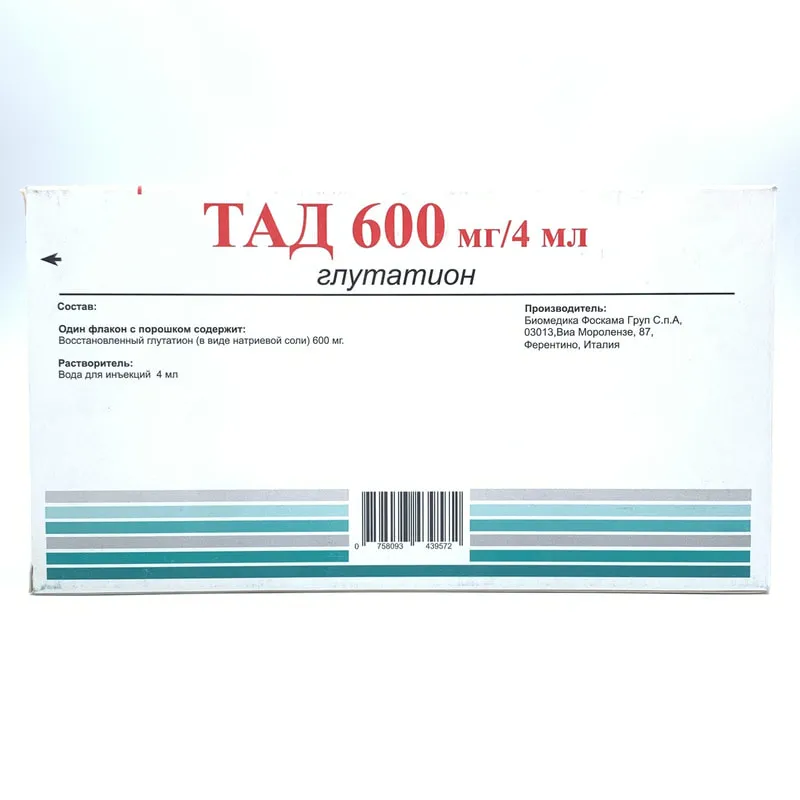
Table of Contents
INSTRUCTIONS FOR MEDICAL USE OF THE MEDICINAL PRODUCT TAD-600 (TAD-600)
Composition:
Active substance: glutathione;
One vial of powder contains 646 mg of sodium glutathione salt, which corresponds to 600 mg of glutathione on a glutathione basis;
One ampoule of solvent contains 4 ml of water for injections;
Excipients: none.
Pharmaceutical form. Powder and solvent for solution for injection.
Main physicochemical characteristics:
Powder: white powder free from foreign impurities visible to the naked eye;
Solvent: clear, colorless, odorless liquid.
Pharmacotherapeutic group. Antidotes. ATC code V03A B32.
Pharmacological properties.
Pharmacodynamics.
Mechanism of action
Glutathione is a physiological tripeptide composed of glutamic acid, cysteine, and glycine. It participates in numerous biological processes and plays an important role in detoxification reactions, protecting cells against the harmful effects of xenobiotics, external and intracellular oxidants (free radicals, activated oxygen species), and radiation.
Preclinical and clinical studies have demonstrated the protective role of glutathione in pathological conditions causing cellular damage (intoxication by substances such as ethanol, paracetamol, salicylates, phenobarbital, tricyclic antidepressants, organophosphorus insecticides, etc.). It has also been observed that most chemotherapeutic agents reduce the levels of endogenous glutathione (GSH) in tissues and cells, thereby increasing oxidative stress induced by tumors.
Regarding neurotoxicity specifically caused by chemotherapeutic agents such as cisplatin and its derivatives, it is believed that this results from the accumulation of platinum in the peripheral nervous system, particularly in the dorsal root ganglia. With oxaliplatin, platinum accumulation likely occurs due to delayed elimination rather than increased uptake. Therefore, substances such as glutathione, which can prevent the initial accumulation of platinum in the dorsal root ganglia, are used.
Several clinical studies have confirmed that glutathione infusion prior to the administration of anticancer agents in patients with ovarian carcinoma, gastric carcinoma, and colorectal tumors provides effective protection against nephro- and neurotoxicity induced by cisplatin and oxaliplatin, allowing, if necessary, the achievement of higher cumulative doses of the anticancer agent.
Pharmacokinetics.
Absorption
After intravenous infusion of glutathione at a dose of 2 g/m² in healthy volunteers, plasma total glutathione concentration increased from 17.5 ± 13.4 µmol/L (mean value ± standard deviation (SD)) to 823 ± 326 µmol/L.
Distribution
The volume of distribution of exogenous glutathione was 176 ± 107 mL/kg, and the plasma half-life was 14.1 ± 9.2 minutes. Plasma cysteine concentration increased from 8.9 ± 3.5 µmol/L to 114 ± 45 µmol/L after infusion. Despite the increase in cysteine levels, the total plasma concentration of total cysteine, cystine, and mixed disulfides decreased, indicating enhanced intracellular transport of cysteine.
Elimination
Ninety minutes after infusion, urinary excretion of glutathione and cysteine increased by 300% and 10%, respectively.
These data indicate that intravenous administration of glutathione significantly increases the concentration of sulfhydryl-containing compounds in the urinary tract and, consequently, cellular levels of cysteine. The high intracellular concentration of cysteine explains the protective effect against xenobiotics, as it directly or indirectly enhances glutathione biosynthesis.
Preclinical safety data.
Preclinical studies revealed no special hazard for humans based on standard pharmacological safety assessments, repeated-dose toxicity, genotoxicity, carcinogenic potential, and toxic effects on reproductive function.
Clinical characteristics.
Indications.
The medicinal product TAD-600 is indicated for the prevention of neuropathy induced by chemotherapy with cisplatin or other similar substances.
Contraindications.
Hypersensitivity to the active substance or to any of the excipients of the medicinal product.
Interaction with other medicinal products and other forms of interaction.
There are no published data on pharmacological interactions with glutathione.
At recommended doses, TAD-600 does not affect the therapeutic efficacy of chemotherapy with cisplatin or related compounds.
Special precautions for use.
Warning: Parenteral preparations should be visually inspected for particulate matter and unusual discoloration prior to administration.
Use during pregnancy or breastfeeding.
Available data indicate that since glutathione is a substance physiologically present in cells, it does not exert adverse effects in women during pregnancy or breastfeeding.
Preclinical studies have not revealed any direct or indirect adverse effects on reproductive function, pregnancy, embryofetal development, parturition, or postnatal development.
Although glutathione showed no signs of embryotoxic or fetotoxic effects in experimental studies, its use is not recommended in pregnant women or women who are breastfeeding.
Ability to affect reaction rate when driving or operating machinery.
TAD-600 has no effect or has a negligible effect on the ability to drive vehicles or operate machinery.
Method of Administration and Dosage
In the most severe degree of injury: 600–1200 mg (1–2 vials) per day by intramuscular or slow intravenous injection.
For moderate injury, half the above dose should be administered.
When glutathione is used concomitantly with chemotherapy agents, intravenous infusion of the medicinal product TAD-600 should be administered 15–30 minutes prior to the start of chemotherapy.
Instructions for Reconstitution
Reconstitute the powder in the vial with water for injections from the ampoule provided, using a syringe with an appropriate needle. First, remove the aluminum seal from the vial and disinfect the stopper. Insert the needle of the syringe through the center of the rubber stopper into the vial, directing the stream of water onto the vial wall. Then gently shake the vial until the contents are completely dissolved. The resulting solution should be administered by intramuscular or slow intravenous injection.
The reconstituted solution must be clear and free from visible particles. It should be used only for a single, continuous administration.
Any unused product and waste materials derived from it must be disposed of in accordance with local regulations.
Children. Safety and efficacy of TAD-600 in children have not been established.
Overdose.
There are no published reports of overdose. If necessary, symptomatic treatment may be administered.
Adverse Reactions
Rare cases of skin rashes, which resolved after discontinuation of therapy, have been reported following intramuscular administration. Moderate pain at the injection site has also been reported.
As with any other intravenous solutions, febrile reactions, injection site infections, venous thrombosis or phlebitis, and extravasation may occur.
If an adverse reaction occurs during intravenous administration, infusion of the medicinal product should be stopped immediately, and, if possible, the unused solution should be retained for further analysis.
Reporting of suspected adverse reactions
Reporting suspected adverse reactions after medicinal product authorization is important. It allows continued monitoring of the benefit-risk balance of the medicinal product. Healthcare professionals and patients or their legal representatives are encouraged to report all suspected adverse reactions and lack of efficacy via the Automated Pharmacovigilance Information System at: https://aisf.dec.gov.ua.
Shelf life
Medicinal product: 3 years.
Solvent: 4 years.
Storage conditions
The medicinal product does not require special storage conditions. The reconstituted solution is stable for 8 hours at a temperature not exceeding 25 °C. Keep out of reach of children.
Incompatibilities
Since compatibility studies are lacking, this medicinal product must not be mixed with other medicinal products.
Packaging
5 vials of powder and 5 ampoules of solvent (4 ml each) in a blister pack. One or two blister packs in a carton.
Prescription status
Prescription only.
Manufacturer
BIOMEDICA FOSCAMA INDUSTRIA CHIMICO FARMACEUTICA S.P.A. / BIOMEDICA FOSCAMA INDUSTRIA CHIMICO FARMACEUTICA S.P.A.
Manufacturer's address and place of business
Via Morolense 87, Ferentino, 03013, Italy / Via Morolense 87, Ferentino, 03013, Italy.