Sintus
Ukraine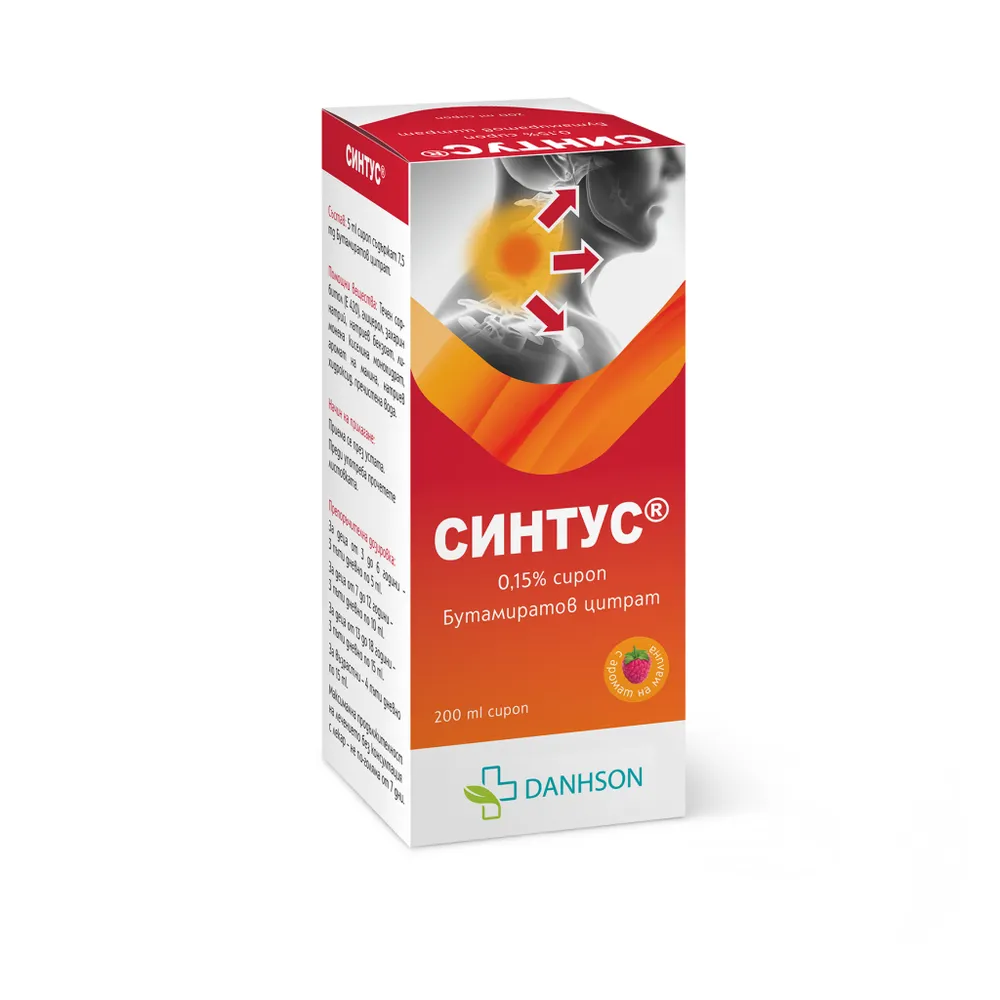
Table of Contents
INSTRUCTIONS FOR MEDICAL USE OF THE MEDICINAL PRODUCT SINTUS
Composition:
active substance: butamirate citrate;
1 ml of syrup contains 1.5 mg of butamirate citrate;
excipients: sorbitol solution 70% (E 420); glycerin; sodium saccharin; sodium benzoate; raspberry flavoring; sodium hydroxide; citric acid, monohydrate; purified water.
Pharmaceutical form. Syrup.
Main physicochemical properties: clear, colorless or pale yellow viscous solution.
Pharmacotherapeutic group. Medicinal products used in cough and colds. Antitussives. ATC code R05DB13.
Pharmacological properties.
Pharmacodynamics.
A non-opioid antitussive agent with central action. However, the exact mechanism of action is unknown.
The active ingredient of Synthus is butamirate citrate, which suppresses cough and differs in its structure and pharmacological action from opium alkaloids. It is believed that this substance acts on the central nervous system. Butamirate citrate produces a nonspecific anticholinergic and bronchospasmolytic effect, which improves respiratory function. Synthus does not cause habituation or dependence.
Butamirate citrate has a wide therapeutic range; therefore, Synthus is well tolerated at therapeutic doses and is well suited as an antitussive agent for children.
Pharmacokinetics.
Butamirate is rapidly absorbed, distributed throughout the body, and subsequently hydrolyzed predominantly to 2-phenylbutyric acid and diethylaminoethoxyethanol, both of which also possess antitussive activity. 2-Phenylbutyric acid is further partially metabolized via hydroxylation. Butamirate and 2-phenylbutyric acid are highly bound to plasma proteins in the body.
The effect of food on bioavailability has not been confirmed. The metabolism of butamirate to 2-phenylbutyric acid and diethylaminoethoxyethanol is completely proportional within the dose range of 22.5 mg – 90 mg.
Measurable plasma concentrations of butamirate appear within 5 to 10 minutes after administration of 22.5 mg, 45 mg, 67.5 mg, and 90 mg. Maximum plasma concentrations are reached within 1 hour for all four doses, with a mean maximum plasma concentration of 16.1 ng/mL after administration of the 90 mg dose.
The mean maximum plasma concentration of 2-phenylbutyric acid is reached within 1.5 hours, with the highest exposure observed after the 90 mg dose (3052 nanograms/mL).
The mean maximum plasma concentration of diethylaminoethoxyethanol is reached within
0.67 hours, with the highest exposure observed after the 90 mg dose (160 nanograms/mL).
Metabolites are excreted mainly via the kidneys. Butamirate is detectable in urine up to 48 hours after administration. Based on measurements, the elimination half-life of butamirate ranges from 1.48 to 1.93 hours, of 2-phenylbutyric acid from 23.26 to 24.42 hours, and of diethylaminoethoxyethanol from 2.72 to 2.90 hours.
There is no evidence of the influence of impaired liver or kidney function on the pharmacokinetic parameters of butamirate.
Clinical characteristics.
Indications.
Symptomatic treatment of cough (including dry cough) of various origins.
Contraindications.
Hypersensitivity to the active or excipient substances of the drug, hereditary fructose intolerance, due to the presence of sorbitol in the medicinal product.
Interaction with other medicinal products and other forms of interaction.
Concomitant use of expectorants and mucolytics should be avoided. The exact mechanism of interaction with other medicinal products has not been studied, but the central cough-suppressant mechanism of action of the drug may be enhanced by strong depressants, including alcohol.
Special precautions for use.
Since butamirate suppresses the cough reflex, concomitant use of expectorants should be avoided, as this may lead to mucus stasis in the airways, increasing the risk of bronchospasm and respiratory tract infection.
The syrup contains sweeteners – sodium saccharin and sorbitol, therefore it can be prescribed to patients with diabetes mellitus. Sorbitol may cause gastrointestinal discomfort and mild diarrheal effects. Sorbitol is a source of fructose; therefore, the product should not be used in patients with hereditary fructose intolerance. It should not be administered to patients with rare hereditary problems of lactose intolerance or glucose-galactose malabsorption.
If cough persists for more than 7 days, or if fever, dyspnea, or chest tightness develops, medical advice should be sought.
In patients whose symptoms worsen or do not improve within 7 days and/or are accompanied by fever, rash, or persistent headache, additional investigations should be performed to identify the underlying cause.
If cough persists after treatment according to the recommended therapeutic regimen, the dose should not be increased; instead, the patient's clinical condition should be re-evaluated.
When administering the drug to patients with renal and/or hepatic impairment, increased risk of adverse reactions due to potential accumulation of the active substance should be considered.
The syrup contains sorbitol; therefore, if a patient has established intolerance to certain sugars, consultation with a physician is recommended before taking this medicinal product.
This medicinal product should be administered to children under 2 years of age only under medical supervision.
Keep out of reach and sight of children.
Use during pregnancy or breastfeeding.
The safety of Synthus during pregnancy or breastfeeding has not been evaluated in specific clinical studies. Animal studies have not indicated any direct or indirect harmful effects on pregnancy or fetal health.
Synthus may be used during pregnancy only if clearly needed and under medical supervision. Treatment should be considered only when the expected benefit to the mother outweighs the potential risk to the fetus. In such cases, the lowest effective dose and shortest possible duration of treatment should be used.
It is unknown whether the active substance and/or its metabolites are excreted in breast milk.
For safety reasons, the benefits and risks of using Synthus during breastfeeding must be carefully weighed. Use during breastfeeding is possible only on the advice of a physician, if in the physician’s opinion the expected benefit to the mother outweighs the potential risk to the infant. In such cases, the lowest effective dose and shortest possible duration of treatment should be considered.
Effect on ability to drive and use machines.
Synthus rarely may cause drowsiness, which could affect the ability to drive or operate machinery. Patients should be advised not to drive or operate machinery if they experience drowsiness.
It may cause fatigue and affect reaction ability while driving or operating machinery.
Dosage and Administration.
For oral use only.
Children aged 3 to 6 years: 5 ml (7.5 mg) three times daily; maximum daily dose: 15 ml (22.5 mg);
Children aged 6 to 12 years: 10 ml (15 mg) three times daily; maximum daily dose: 30 ml (45 mg);
Children aged 12 to 18 years: 15 ml (22.5 mg) three times daily; maximum daily dose: 45 ml (67.5 mg);
Adults: 15 ml (22.5 mg) four times daily; maximum daily dose: 60 ml (90 mg).
The measuring cup should be washed and dried after each use and after use by another person.
The maximum duration of treatment without a doctor's prescription should not exceed 1 week.
The medicine should preferably be taken before meals.
The lowest effective dose should be used for the shortest duration necessary to achieve the desired effect.
Do not exceed the stated dose.
Children.
Do not use in children under 3 years of age.
Overdose.
Overdose may cause the following symptoms: drowsiness, nausea, vomiting, diarrhea, dizziness, and arterial hypotension.
Further treatment should be carried out according to clinical indications.
There is no specific antidote for butamirate overdose. In case of overdose, symptomatic treatment and monitoring of vital functions are required.
Adverse reactions.
Central nervous system: (rare: ≥ 1/10,000, < 1/1,000) – somnolence, dizziness.
Gastrointestinal disorders: (rare: ≥ 1/10,000, < 1/1,000) – nausea, diarrhea.
Immune system disorders: (rare: ≥ 1/10,000, < 1/1,000) – anaphylactic shock.
Skin and subcutaneous tissue disorders: (rare: ≥ 1/10,000, < 1/1,000) – angioneurotic edema, skin rashes, urticaria, pruritus.
Reporting suspected adverse reactions.
Reporting suspected adverse reactions after marketing authorization is important. It allows continued monitoring of the benefit-risk balance of the medicinal product. Healthcare professionals and patients, as well as their legal representatives, are encouraged to report any suspected adverse reactions and lack of efficacy via the Automated Information System for Pharmacovigilance at the following link: https://aisf.dec.gov.ua.
Shelf life. 2 years.
Shelf life after first opening of the bottle – 4 months.
Storage conditions.
Store in the original packaging at a temperature not exceeding 25 °C.
Keep out of reach and sight of children.
Packaging.
200 ml in a bottle, 1 bottle with a measuring cup in a cardboard box.
Availability category.
Over-the-counter (without prescription).
Manufacturer.
VETPROM AD, production unit Vpharma / VETPROM AD, the Vpharma site.
Manufacturer's address and location of operations.
26 Otec Paisiy Str., Radomir 2400, Bulgaria.
Date of last review.