Symdax
Ukraine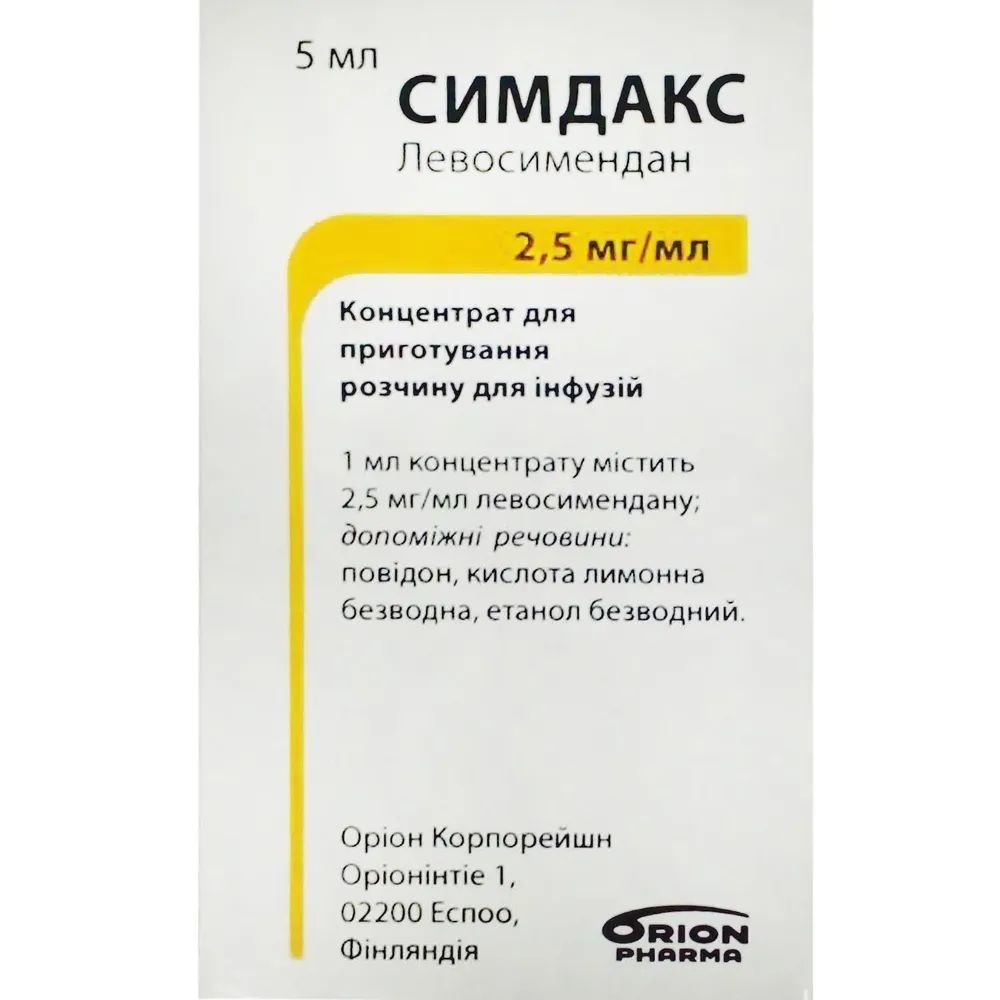
Table of Contents
INSTRUCTIONS FOR MEDICAL USE OF THE MEDICINAL PRODUCT SIMDAX (SIMDAX)
Composition:
Active substance: levosimendan;
1 ml of solution contains 2.5 mg of levosimendan;
Excipients: povidone, citric acid anhydrous, ethanol anhydrous.
Pharmaceutical form. Concentrate for solution for infusion.
Main physicochemical properties: clear solution, yellow, orange-yellow to orange in color.
Pharmacotherapeutic group. Medicinal products used in cardiovascular diseases. Medicinal products used in heart diseases. Non-glycoside cardiotonic agents. Other cardiotonic agents. Levosimendan.
ATC Code C01CX08.
Pharmacological Properties.
Pharmacodynamics. Levosimendan enhances the calcium sensitivity of contractile proteins by binding to cardiac troponin C in a calcium-dependent manner. Levosimendan increases myocardial contractility without impairing ventricular relaxation. Additionally, levosimendan opens ATP-sensitive potassium channels in vascular smooth muscle, thereby promoting vasodilation of systemic arteries, coronary arteries, and systemic veins. Levosimendan is a selective inhibitor of phosphodiesterase III in vitro. In patients with heart failure, the positive inotropic and vasodilatory effects of levosimendan lead to increased myocardial contractile force and reduced preload and afterload, without adverse effects on diastolic function. Levosimendan activates impaired myocardium in patients following coronary angioplasty or thrombolysis.
Pharmacodynamic studies involving healthy volunteers and patients with stable and unstable heart failure demonstrated dose-dependent effects of intravenous levosimendan administered as a loading dose (3 to 24 mcg/kg) followed by continuous infusion at 0.05–0.2 mcg/kg/min. Compared with placebo, levosimendan increases cardiac output, stroke volume, ejection fraction, and heart rate, while reducing systolic and diastolic pressure, pulmonary capillary wedge pressure, right atrial pressure, and systemic vascular resistance.
Drug infusion increases coronary blood flow in patients recovering from coronary surgery and improves myocardial perfusion in patients with heart failure. These benefits are achieved without significant increase in myocardial oxygen consumption. Levosimendan treatment significantly reduces circulating endothelin-1 levels in patients with congestive heart failure. It does not cause an increase in plasma catecholamine levels at recommended infusion rates.
Pharmacokinetics. The pharmacokinetics of levosimendan are linear within the therapeutic dose range of 0.05–0.2 mcg/kg/min.
Distribution. The volume of distribution (Vss) of levosimendan is approximately 0.2 L/kg. Levosimendan is 97–98% bound to plasma proteins, primarily albumin. The protein binding of the metabolites OR-1855 and OR-1896 is 39% and 42%, respectively.
Metabolism. Levosimendan is primarily metabolized via conjugation into cyclic or N-acetylated cysteinylglycine and cysteine conjugates. Approximately 5% of the dose is metabolized in the gut to aminophenylpyridazinone (OR-1855), which upon reabsorption is further metabolized by N-acetyltransferase to the active metabolite acetylaminophenylpyridazinone (OR-1896). Concentrations of the OR-1896 metabolite are somewhat higher in patients with genetically high acetylation capacity compared to those with lower acetylation capacity. However, this has no significant impact on the clinical hemodynamic effect at recommended doses.
Only two metabolites—OR-1855 and OR-1896—are present in significant amounts in systemic circulation. These metabolites reach equilibrium in vivo through acetylation and deacetylation processes regulated by the polymorphic enzyme N-acetyltransferase-2. In patients with genetically low acetylation capacity, the OR-1855 metabolite predominates, whereas in patients with genetically high acetylation capacity, the OR-1896 metabolite predominates. The total amount of these two metabolites and the incidence of hemodynamic effects are similar in both patient groups. These metabolites may exert prolonged effects on hemodynamic parameters (lasting 7–9 days after discontinuation of a 24-hour Simdax infusion).
Elimination. The clearance of levosimendan is approximately 3 mL/min/kg, and its elimination half-life is about one hour. 54% of the dose is excreted in urine and 44% in feces. Over 95% of the dose is eliminated within one week. Negligible amounts of unchanged levosimendan (< 0.05% of dose) are excreted in urine. The circulating metabolites OR-1855 and OR-1896 are formed slowly and eliminated slowly. Peak plasma concentrations of the metabolites occur approximately 2 days after discontinuation of levosimendan infusion. The elimination half-life of the metabolites is 75–80 hours. The active metabolites OR-1855 and OR-1896 undergo conjugation or renal filtration and are primarily excreted in urine.
Patients with renal impairment.
The pharmacokinetics of levosimendan have been studied in patients with various degrees of renal dysfunction in the absence of heart failure. The effect of levosimendan was similar in patients with mild to moderate renal impairment and in those undergoing hemodialysis, whereas the effect of levosimendan may be slightly lower in patients with severe renal impairment.
Compared to healthy volunteers, the free fraction of levosimendan was slightly increased and the AUC (area under the plasma concentration-time curve) of the metabolites (OR-1855 and OR-1896) was 170% higher in patients with severe renal impairment and in those on hemodialysis. The pharmacokinetic effects of OR-1855 and OR-1896 are expected to be less pronounced in patients with mild and moderate renal impairment than in those with severe impairment. The impact of hemodialysis on the pharmacokinetics of levosimendan has not been established. Although OR-1855 and OR-1896 are dialyzable, their clearance is low (approximately 8–23 mL/min), and the overall elimination effect of these metabolites during a 4-hour dialysis session is very low.
Patients with hepatic impairment.
No differences in the pharmacokinetics or protein binding of levosimendan were observed in patients with mild to moderate hepatic cirrhosis compared to healthy volunteers. The pharmacokinetics of levosimendan, OR-1855, and OR-1896 are similar to those in healthy volunteers and patients with moderate hepatic impairment (Child-Pugh class B), except that the elimination half-life of OR-1855 and OR-1896 is slightly prolonged in patients with moderate hepatic impairment.
Children.
Limited data suggest that in children (aged 3 months to 6 years), the pharmacokinetics of levosimendan after a single dose are similar to those in adults. The pharmacokinetics of the active metabolite in children have not been studied.
Population analysis did not reveal any influence of age, ethnicity, or gender on the pharmacokinetics of levosimendan. However, this same analysis indicated that volume of distribution and total clearance depend on the child's body weight.
Clinical characteristics.
Indications.
Short-term treatment of acute decompensated chronic heart failure of severe degree when traditional therapy is ineffective and in conditions requiring inotropic support.
Contraindications.
Hypersensitivity to levosimendan or to any of the excipients.
Severe arterial hypotension and tachycardia.
Significant mechanical obstructions affecting ventricular filling and/or impeding blood outflow from the ventricles.
Severe renal dysfunction (creatinine clearance < 30 mL/min).
Severe hepatic dysfunction.
History of torsades de pointes ventricular tachycardia.
Interaction with other medicinal products and other forms of interaction.
Levosimendan should be used with caution when administered concomitantly with other intravenous vasoactive drugs due to an increased risk of developing arterial hypotension.
Cydax can be used effectively in patients receiving β-blockers and digoxin. Concomitant administration of isosorbide mononitrate and levosimendan in healthy volunteers resulted in significant potentiation of orthostatic hypotension.
Special precautions for use.
The initial hemodynamic effect of levosimendan may cause a decrease in systolic and diastolic blood pressure; therefore, levosimendan should be administered with caution to patients with low systolic or diastolic blood pressure or at risk of arterial hypotension episodes. Severe hypovolemia must be corrected prior to initiating levosimendan infusion. If excessive changes in blood pressure or heart rate occur, the infusion rate should be reduced or the infusion discontinued.
The favorable hemodynamic effect on cardiac output and pulmonary capillary wedge pressure persists for at least 24 hours after termination of a 24-hour infusion. The exact duration of all hemodynamic effects has not been fully established, but overall, the effect typically lasts from 7 to 10 days. This is partly due to the circulation of the active metabolite, whose plasma concentration reaches a maximum approximately 48 hours after the end of infusion. Non-invasive monitoring is recommended for at least 4–5 days after stopping the infusion, until arterial blood pressure begins to rise again following its maximal decline. The monitoring period may exceed 5 days if arterial hypotension persists, but may also be shorter than 5 days if the patient's condition stabilizes. Patients with mild or moderate hepatic or renal impairment should undergo a longer monitoring period.
Simdax should be administered with caution in patients with mild to moderate renal or hepatic impairment. Limited data are available regarding elimination of active metabolites in patients with renal dysfunction. Impaired liver or kidney function may lead to increased metabolite concentrations, potentially resulting in a more pronounced and prolonged effect on heart rhythm.
Infusion of the drug may lead to decreased serum potassium concentrations. Therefore, low serum potassium levels should be corrected before administration, and serum potassium levels should be monitored during treatment. As with other drugs used in the treatment of heart failure, infusion of the drug may be associated with decreases in hemoglobin and hematocrit; thus, caution is advised when administering to patients with ischemic heart disease and concomitant anemia.
Infusion of Simdax should be performed cautiously in patients with tachycardia, tachycardic atrial fibrillation, or potentially life-threatening arrhythmias.
Patients with sustained ventricular tachycardia, non-reperfusion-related transient tachycardia, or life-threatening arrhythmias should be treated for arrhythmia prior to initiation of drug administration.
Experience with repeated administration of the drug is limited. Experience with concomitant or subsequent use of other vasoactive agents, including inotropic agents (except digoxin), with or after levosimendan infusion is also limited. The benefits and risks of concomitant use must be evaluated individually for each patient.
Simdax must be administered with caution and under close ECG monitoring in patients with coronary ischemia, prolonged QT interval regardless of etiology, or when administered concomitantly with medicinal products that prolong the QT interval.
Simdax should be used with caution in patients with tachycardia, atrial fibrillation with rapid ventricular response, or potentially life-threatening arrhythmias.
The use of levosimendan in cardiogenic shock has not been studied.
There are no data on the use of Simdax in the following conditions: restrictive cardiomyopathy, hypertrophic cardiomyopathy, severe mitral valve insufficiency, myocardial rupture, cardiac tamponade, or right ventricular infarction.
Limited experience exists with the use of the drug in the following situations: acute heart failure due to non-cardiac causes, severe worsening of heart failure after surgery, and severe heart failure in patients awaiting heart transplantation. Therefore, special safety measures are required.
Simdax contains ethanol as an excipient at a concentration of 785 mg/mL; therefore, use of the drug may be harmful in patients with alcoholism. Caution should be exercised when administering the medicinal product to pregnant women, breastfeeding women, children, and patients with liver disease or epilepsy.
Use during pregnancy or breastfeeding.
There is no experience with the use of levosimendan in pregnant women. Levosimendan should be used during pregnancy only if the expected benefit to the woman outweighs the potential risk to the fetus.
Since it is unknown whether levosimendan is excreted in breast milk, women receiving the drug should avoid breastfeeding.
Ability to affect reaction speed when driving or operating machinery.
Given the clinical condition for which the drug is prescribed, it should not be expected that patients will be capable of driving or operating machinery.
Method of administration and doses.
Simdax is intended only for use in specialized medical facilities. It can be administered in hospitals where appropriate equipment for monitoring and assessing the patient's condition is available, and the staff has experience in using inotropic agents.
The concentrate is sterile. The concentrate must be diluted before administration. Dilution should be performed under aseptic conditions.
The Simdax infusion solution is intended for administration into central and peripheral veins.
As with all parenteral medicinal products, the diluted solution should be carefully inspected prior to administration for the presence of particulate matter and discoloration.
The dose and duration of treatment are determined individually according to the patient's clinical condition and response to therapy.
Treatment should be initiated with a loading dose of 6–12 mcg/kg administered over at least 10 minutes, followed by continuous infusion at a rate of 0.1 mcg/kg/min. Reducing the loading dose to 6 mcg/kg is recommended for patients receiving concomitant intravenous vasodilator and/or inotropic therapy at the start of infusion. Higher loading doses will result in a more pronounced hemodynamic response, which may be associated with a transient increase in the frequency of adverse reactions. The patient's clinically evident response to treatment should be assessed during administration of the loading dose or within 30–60 minutes after dose adjustment.
If the patient's clinical response to administration is considered excessive (hypotension, tachycardia), the infusion rate may be reduced to 0.05 mcg/kg/min or infusion may be discontinued. If the initial dose is well tolerated and a stronger hemodynamic effect is required, the infusion rate may be increased to 0.2 mcg/kg/min.
The recommended duration of administration in acute decompensated severe chronic heart failure is 24 hours. After discontinuation of the drug, no signs of tachyphylaxis or rebound phenomenon have been observed. Hemodynamic effects persist for at least 24 hours and may be observed up to 9 days after termination of the 24-hour infusion.
Elderly patients.
Dose adjustment is not required.
Patients with renal impairment.
Simdax should be administered with caution to patients with mild to moderate renal impairment. It is contraindicated in patients with severe renal impairment (creatinine clearance < 30 mL/min).
Patients with hepatic impairment.
Simdax should be administered with caution to patients with mild to moderate hepatic impairment. It is contraindicated in patients with severe hepatic impairment.
Repeated administration.
Experience with repeated administration is limited. Experience with concomitant or subsequent administration of other vasoactive agents, including inotropic agents (except digoxin), together with or after levosimendan infusion is limited. In the REVIVE study, the lowest loading dose of 6 mcg/kg was used with concomitant administration of vasoactive agents.
To prepare an infusion solution with a concentration of 0.05 mg/mL, mix 10 mL of concentrate with 500 mL of 5% glucose solution. Table 1 shows the infusion rates for the 0.05 mg/mL solution for the loading and maintenance doses.
Table 1
| Patient body weight, kg |
Loading infusion rate for at least |
Maintenance infusion rate (ml/hour) |
|||
| loading dose 6 mcg/kg |
loading dose 12 mcg/kg |
0.05 mcg/kg/min |
0.1 mcg/kg/min |
0.2 mcg/kg/min |
|
| 40 |
29 |
58 |
2 |
5 |
10 |
| 50 |
36 |
72 |
3 |
6 |
12 |
| 60 |
43 |
86 |
4 |
7 |
14 |
| 70 |
50 |
101 |
4 |
8 |
17 |
| 80 |
58 |
115 |
5 |
10 |
19 |
| 90 |
65 |
130 |
5 |
11 |
22 |
| 100 |
72 |
144 |
6 |
12 |
24 |
| 110 |
79 |
158 |
7 |
13 |
26 |
| 120 |
86 |
173 |
7 |
14 |
29 |
To prepare an infusion solution with a concentration of 0.025 mg/mL, mix 5 mL of concentrate with 500 mL of 5% glucose solution. Table 2 shows the infusion rates for the solution with a concentration of 0.025 mg/mL for the loading dose and maintenance dose.
Table 2
| Patient weight, kg |
Speed of loading infusion for at least |
Speed of maintenance infusion (ml/hour) |
|||
| loading dose 6 mcg/kg |
loading dose 12 mcg/kg |
0.05 mcg/kg/min |
0.1 mcg/kg/min |
0.2 mcg/kg/min |
|
| 40 |
58 |
115 |
5 |
10 |
19 |
| 50 |
72 |
144 |
6 |
12 |
24 |
| 60 |
86 |
173 |
7 |
14 |
29 |
| 70 |
101 |
202 |
8 |
17 |
34 |
| 80 |
115 |
230 |
10 |
19 |
38 |
| 90 |
130 |
259 |
11 |
22 |
43 |
| 100 |
144 |
288 |
12 |
24 |
48 |
| 110 |
158 |
317 |
13 |
26 |
53 |
| 120 |
173 |
346 |
14 |
29 |
58 |
Drugs such as furosemide 10 mg/mL, digoxin 0.25 mg/mL, and nitroglycerin 0.1 mg/mL may be administered simultaneously with Simdax.
During storage, the concentrate may develop an orange color, but this does not indicate loss of efficacy. The product may be used up to the indicated expiration date if there has been a color change, provided that storage conditions have been maintained.
The shelf life of the prepared solution after dilution must not exceed 24 hours. Responsibility for storage conditions and duration of the diluted product rests with the medical personnel.
Children.
Simdax is not recommended for use in children (under 18 years of age) due to limited experience with the drug in this age group.
Overdose.
Levosimendan overdose may cause arterial hypotension and tachycardia. Arterial hypotension caused by levosimendan observed in clinical studies was successfully corrected with vasoconstrictors (e.g., dopamine in patients with chronic heart failure and adrenaline in patients after cardiac surgery). Excessive reduction in ventricular filling pressure may limit the clinical response to Simdax and may be corrected by parenteral fluid administration. High doses of levosimendan (0.4 mcg/kg/min or higher) administered by infusion for more than 24 hours increase pulse rate and may occasionally lead to QT interval prolongation.
In case of levosimendan overdose, prolonged ECG monitoring, repeated determination of serum electrolytes, and invasive hemodynamic monitoring are required. Levosimendan overdose may lead to increased plasma concentrations of the active metabolite, resulting in a more pronounced and prolonged effect on pulse rate, thus requiring an extended observation period.
Adverse Reactions
The adverse reactions listed below were observed in more than 1% of patients during clinical trials.
Frequency of adverse reactions is classified as follows: very common (≥ 1/10);
common (≥ 1/100, < 1/10).
Metabolism and nutrition disorders
Common: hypokalemia.
Psychiatric disorders
Common: insomnia.
Nervous system disorders
Very common: headache.
Common: dizziness.
Cardiovascular disorders
Very common: ventricular tachycardia, arterial hypotension.
Common: atrial fibrillation, tachycardia, ventricular extrasystoles, heart failure, myocardial ischemia, extrasystoles.
Gastrointestinal disorders
Common: nausea, constipation, diarrhea, vomiting.
General disorders
Hypersensitivity reactions, injection site reactions.
Laboratory investigations
Common: decreased hemoglobin levels.
During post-marketing use, ventricular fibrillation has been reported in patients treated with Simdax.
Shelf life. 2 years.
Storage after reconstitution. The prepared solution can be stored for 24 hours at 25 °C. From a microbiological standpoint, the solution should be used immediately after preparation.
Storage conditions. Store at 2–8 °C. Keep out of reach of children. Do not freeze.
Incompatibilities. Simdax must not be mixed with other medicinal products or solvents except those mentioned in the section "Instructions for use and dosage".
Packaging. 5 ml in a vial. 1 vial in a cardboard box.
Prescription category. Prescription only.
Manufacturer. Orion Corporation.
Manufacturer's address. Orionintie 1, 02200 Espoo, Finland.