Signicef
Ukraine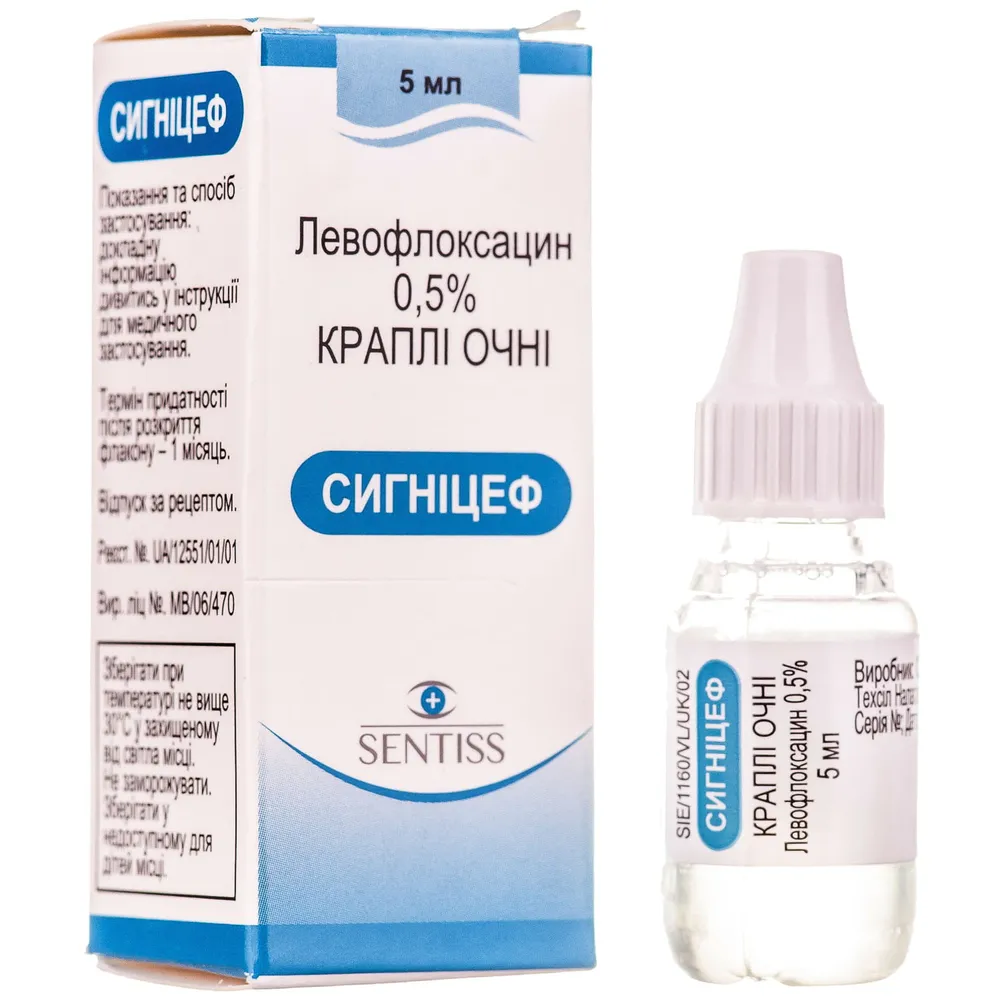
Table of Contents
INSTRUCTION for medical use of the medicinal product SIGNIcef (signicef)
Composition:
Active substance: levofloxacin;
1 ml of the preparation contains levofloxacin hemihydrate equivalent to 5 mg of levofloxacin;
Excipients: benzalkonium chloride, hypromellose, sodium chloride, sodium hydroxide, hydrochloric acid, water for injections.
Pharmaceutical form. Eye drops.
Main physicochemical properties: clear, light yellow liquid.
Pharmacotherapeutic group. Ophthalmological agents. Levofloxacin. ATC code S01AE05.
Pharmacological properties.
Pharmacodynamics.
Levofloxacin – the active substance of the medicinal product Signicef – is a synthetic broad-spectrum antibacterial agent, a third-generation fluoroquinolone, and the S-enantiomer of ofloxacin. It inhibits bacterial enzymes essential for DNA replication, transcription, repair, and recombination—DNA topoisomerase IV and DNA gyrase (type II topoisomerases)—thereby preventing further bacterial proliferation. It is active against aerobic gram-positive bacteria.
Antibacterial spectrum – categories of susceptibility and characteristics of resistance according to EUCAST requirements.
| Category I: Commonly susceptible species |
|
| Aerobic Gram-positive microorganisms |
|
| Staphylococcus aureus (MSSA)* |
|
| Streptococcus pneumoniae |
|
| Streptococcus pyogenes |
|
| Viridans group streptococci |
|
| Aerobic Gram-negative microorganisms |
|
| Escherichia coli |
|
| Haemophilus influenzae |
|
| Moraxella catarrhalis |
|
| Pseudomonas aeruginosa |
Isolates from community settings |
| Other microorganisms |
|
| Chlamydia trachomatis |
When treating patients with chlamydial conjunctivitis, systemic antimicrobial therapy should be administered concomitantly |
| Category II: Species that may pose problems due to acquired resistance |
|
| Aerobic Gram-positive microorganisms |
|
| Staphylococcus aureus (MRSA)** |
|
| Staphylococcus epidermidis |
|
| Aerobic Gram-negative microorganisms |
|
| Pseudomonas aeruginosa |
Isolates from hospital settings |
* MSSA – Staphylococcus aureus strains, sensitive to methicillin.
** MRSA – Staphylococcus aureus strains, resistant to methicillin.
The resistance data presented above are based on results from a multicenter study on resistance prevalence in bacterial isolates obtained from patients with ocular infections in Germany. Microorganisms were classified as levofloxacin-sensitive based on in vitro susceptibility testing and plasma concentrations achieved after systemic therapy. With topical ocular administration, maximum concentrations in the tear film were higher than those measured in plasma; however, it is unknown whether this affects the antibacterial properties of levofloxacin.
Cross-resistance.
Cross-resistance among fluoroquinolones may occur. A single mutation does not lead to clinical resistance, but multiple mutations usually result in clinical resistance to all agents within the fluoroquinolone class. Alterations in outer membrane porins and efflux systems may have broad substrate specificity, act against several classes of antibacterial agents, and lead to the development of multidrug resistance.
MIC (minimum inhibitory concentration) breakpoints used to differentiate susceptible and moderately resistant microorganisms from resistant ones:
Pseudomonas spp., Staphylococcus spp., Streptococcus A,B,C,G: susceptible ≤ 1 mg/L, resistant > 2 mg/L;
Streptococcus pneumoniae: susceptible ≤ 2 mg/L, resistant > 2 mg/L;
Haemophilus influenzae, Moraxella catarrhalis: susceptible ≤ 1 mg/L, resistant > 1 mg/L.
All other pathogenic microorganisms: susceptible ≤ 1 mg/L, resistant > 2 mg/L.
Pharmacokinetics.
After administration, levofloxacin is well maintained in the tear film. Mean concentrations of levofloxacin in the tear film measured at 4 and 6 hours after topical application were 17 µg/mL and 6.6 µg/mL, respectively. Four hours after dosing, concentrations were ≥ 2 µg/mL in five of six subjects studied; this concentration was observed in four of six subjects even at 6 hours post-dose.
Plasma concentrations of levofloxacin were measured in 15 healthy volunteers at various time points during a 15-day treatment course. Mean plasma concentration of levofloxacin one hour after dosing ranged from 0.86 ng/mL on Day 1 to 2.05 ng/mL on Day 15. The highest peak concentration of levofloxacin – 2.25 ng/mL – was recorded on Day 4, following two days of hourly dosing every 2 hours (total of 8 doses per day).
Peak plasma concentrations of levofloxacin increased from 0.94 ng/mL on Day 1 to 2.15 ng/mL on Day 15, which is 1000-fold lower than the known concentrations achieved after standard oral doses of levofloxacin.
The plasma concentration of levofloxacin following administration into the affected eye has not yet been determined.
Clinical characteristics.
Indications.
Local treatment of ocular infections caused by microorganisms sensitive to levofloxacin.
Contraindications.
Hypersensitivity to levofloxacin or other quinolones, or to any of the other components of the medicinal product.
Interaction with other medicinal products and other forms of interaction.
No specific studies on interactions with other medicinal products have been conducted.
However, systemic administration of some quinolones has demonstrated increased plasma concentrations of theophylline, interference with caffeine metabolism, enhancement of the effect of the oral anticoagulant warfarin and its derivatives, as well as association with transient increases in serum creatinine in patients receiving systemic cyclosporine concomitantly.
Since the maximum plasma concentration of levofloxacin after administration in the therapeutic dose is at least 1000 times lower than those observed after standard systemic doses, clinically significant interactions reported for systemically administered quinolones are unlikely to occur with ocular administration of Signicef eye drops. To avoid potential interactions, when applying multiple ophthalmic medicinal products locally to the eye, a 15-minute interval should be maintained between the administration of each medicinal product.
Special precautions for use
The drug is not intended for subconjunctival injections or direct administration into the anterior chamber of the eye.
Systemic fluoroquinolones have been associated with serious and sometimes fatal allergic (anaphylactic) reactions, even after administration of a single dose. Some of these reactions have been accompanied by cardiovascular collapse, loss of consciousness, angioedema (including swelling of the larynx, pharynx, or facial swelling), airway obstruction, dyspnea, urticaria, and pruritus.
Like other fluoroquinolones, levofloxacin is associated with an increased risk of hypersensitivity reactions, even after a single dose. If hypersensitivity reactions occur, the drug should be discontinued immediately.
If the expected therapeutic effect is not achieved during treatment and/or the patient's condition worsens, treatment with the drug should be discontinued and alternative therapies should be considered.
As with other antimicrobial agents, prolonged use of the drug may result in overgrowth of resistant microorganisms, including fungal flora, necessitating a change in treatment strategy. When clinically indicated, additional instrumental examinations, such as slit-lamp biomicroscopy, with or without the use of a contrast agent (fluorescein), should be performed.
Use in elderly patients. Dose adjustment is not required in elderly patients.
Contact lenses. Patients with symptoms of bacterial conjunctivitis are generally advised not to wear contact lenses. The drug contains benzalkonium chloride as a preservative, which may cause irritation and discoloration of soft contact lenses. Therefore, patients should remove their contact lenses before instillation and wait 15 minutes after administration of the drug before reinserting the lenses.
Fertility.
Levofloxacin had no effect on fertility or reproductive performance in rats at oral doses up to 360 mg/kg/day, which is approximately 16,000 times higher than the plasma concentration observed in humans after 8 eye drops.
Effect on women of reproductive age.
There is no information available regarding the effects of topical ocular administration of levofloxacin 5 mg/mL eye drops on women of reproductive age.
Contraception in men and women.
There is no information available regarding the effects of topical ocular administration of levofloxacin 5 mg/mL eye drops on contraception in men and women.
Use during pregnancy or breastfeeding.
The drug should not be used during pregnancy or breastfeeding.
Ability to affect reaction speed when driving or operating machinery.
Transient visual disturbances (blurred vision, blurred vision) may occur after administration of the drug. Therefore, driving and operating machinery should only be resumed after visual acuity has returned to normal.
Method of administration and dosage.
For use in children from 1 year of age and adults. During the first 2 days after onset of the disease, instill 1–2 drops into the affected eye(s) every 2 hours up to 8 times a day; then from day 3 to day 5, at the same dose, reduce the frequency to 4 times a day.
The duration of treatment depends on the severity of the infection and the clinical and bacteriological course of the disease. Usually, treatment lasts for 5 days.
Method of administration.
Tilt the head backward, gently pull down the lower eyelid of the affected eye with a finger, instill 1–2 drops of the medication, and close the eyes. Press gently with a finger on the inner corner of the eye for 1–2 minutes to prevent the medication from entering the tear duct and to reduce the possibility of systemic absorption. Do not blink. Remove any excess medication around the eye with a clean tissue, avoiding contact with the eye.
To prevent contamination of the dropper tip, avoid contact with the eyelids or surrounding areas.
When using different topical ophthalmic medicinal products simultaneously, the interval between administrations should be at least 15 minutes.
Children. The medication is not recommended for children under 1 year of age.
Overdose .
Symptoms. The amount of levofloxacin in the eye drop bottle is too small to cause a toxic effect after accidental oral ingestion. With overdose during topical application, an increase in the frequency or severity of adverse effects is possible.
Treatment. Discontinue the medication. Symptomatic therapy: if the medication has been instilled into the eye(s), rinse thoroughly with a large amount of water. In case of accidental oral ingestion, if necessary, examine the patient and provide supportive care.
Adverse Reactions
Adverse effects are observed in approximately 10% of patients using the medicinal product. These reactions are usually mild to moderate in severity, transient in nature, and most commonly localized to the eye area.
Ophthalmological disorders
Burning sensation in eyes, visual disturbances, formation of mucus strands, temporary decrease in visual acuity, eye irritation, swelling, transient epithelial complications, corneal epithelial disorders, eyelid clouding, chemosis, conjunctivitis, conjunctival papillary reaction, eyelid edema, eye discomfort, itching of eyes and/or eyelids, eye pain, conjunctival injection, conjunctival follicles, dry eye, eyelid erythema and photophobia, blepharitis, keratitis, punctate keratitis, corneal erosion, accommodation disorders, foreign body sensation in the eye, conjunctival pigmentation, conjunctival hyperemia, episcleritis, increased lacrimation.
Corneal deposit formation was not observed in clinical studies.
Non-ophthalmological disorders
Allergic reactions (skin rash, urticaria, breathing difficulty, chest tightness, swelling of the mouth, face, lips, or tongue), anaphylactic reaction; headache, dizziness, rhinitis, pharyngitis, diarrhea, nausea, dysgeusia, contact dermatitis, decreased oral sensitivity, laryngeal edema.
Since the product contains benzalkonium chloride, the active ingredient of this preservative may cause contact eczema and/or irritation.
Shelf life. 2 years.
Shelf life after first opening of the container: 1 month.
Storage conditions. Store at temperatures not exceeding 25 °C, in a light-protected place. Do not freeze. Keep out of reach of children.
Packaging. 5 ml in a dropper bottle with a scarifier cap, 1 bottle per carton.
Prescription status. Prescription only.
Manufacturer
SENTISS PHARMA PVT. LTD., India / SENTISS PHARMA PVT. LTD., India.
Manufacturer's address
Village Khera Nihla, Tehsil Nalagarh, Distt. Solan, Himachal Pradesh, 174 101, India /
Village Khera Nihla, Tehsil Nalagarh, Distt. Solan, Himachal Pradesh, 174 101, India.
Marketing Authorization Holder
SENTISS PHARMA PVT. LTD., India / SENTISS PHARMA PVT. LTD., India.
Address of the Marketing Authorization Holder
212/D-1, Ashirwad Commercial Complex, Green Park, New Delhi, 110016, India /
212/D-1, Ashirwad Commercial Complex, Green Park, New Delhi, 110016, India.