Supran
Ukraine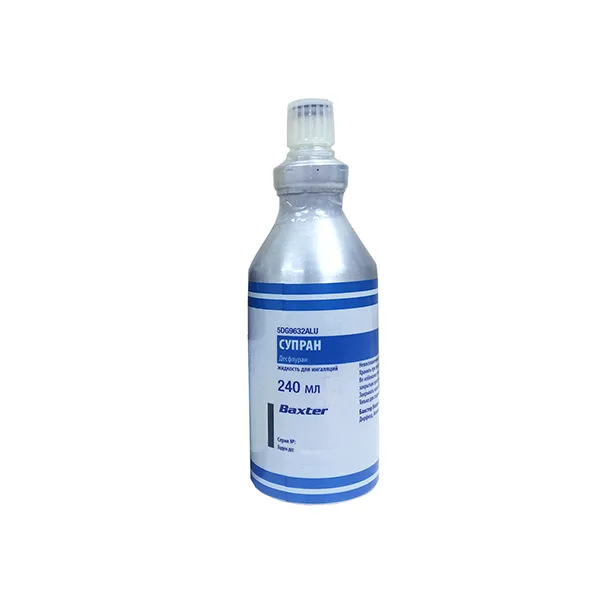
Table of Contents
INSTRUCTIONS FOR MEDICAL USE OF THE MEDICINAL PRODUCT SUREN (SUPRANE)
Composition:
Active substance: desflurane;
1 vial (240 ml) contains desflurane 100%.
Pharmaceutical form. Vapour for inhalation, liquid 100%.
Main physicochemical properties: clear, colorless liquid.
Pharmacotherapeutic group. Agents acting on the nervous system. Anaesthetics. General anaesthetics, halogenated hydrocarbons.
ATC code N01A B07.
Pharmacological properties.
Pharmacodynamics.
Desflurane belongs to the family of halogenated methyl ethyl ethers, which, when administered by inhalation, cause dose-dependent, reversible loss of consciousness and pain sensation, suppression of voluntary motor activity, reduction of autonomic reflexes, and depression of respiration and the cardiovascular system.
This family includes enflurane and isoflurane, which are halogenated with chlorine and fluorine.
Desflurane is halogenated with fluorine only.
Pharmacodynamic effects
Due to its structure, the blood/gas partition coefficient of desflurane (0.42) is lower than that of other potent inhalational anesthetics such as isoflurane (1.4), and even lower than that of nitrous oxide (0.46). These factors explain the rapid recovery following desflurane anesthesia.
The pharmacological effect is proportional to the inhaled dose. The main adverse effect is the prolongation of pharmacological action.
Clinical efficacy and safety
Animal studies have demonstrated faster induction and recovery with desflurane compared to isoflurane, with an identical cardiorespiratory profile. However, clinical studies have not yet confirmed faster recovery with desflurane. During desflurane anesthesia, epileptogenic or other adverse effects on the electroencephalogram (EEG) were not observed, nor were unexpected or toxic effects on EEG noted when additional medications were administered.
Studies in swine susceptible to malignant hyperthermia show that desflurane is a potent trigger.
Pharmacokinetics.
Absorption
As expected from its physicochemical profile, pharmacokinetic studies in animals and humans indicate that desflurane is absorbed more rapidly than other volatile agents, resulting in faster induction.
Elimination
Elimination also occurs more rapidly, leading to quick recovery and greater flexibility in adjusting the depth of anesthesia. Desflurane is eliminated via the lungs after minimal metabolism (0.02%).
Special patient populations
Minimum alveolar concentration (MAC) decreases with age. Doses should be reduced in patients with hypovolemia, hypotension, and in debilitated patients, as described in the section "Special precautions for use."
Preclinical safety data
Preclinical studies on safety pharmacology, repeated-dose toxicity, genotoxicity, and carcinogenicity revealed no specific risk for humans. Reproductive toxicity studies in rats showed reduced fertility index and increased post-implantation losses, but only at high doses and in the presence of maternal toxicity.
Published animal studies (including primates), using doses that produce mild to moderate anesthesia, demonstrate that administration of anesthetic agents during periods of rapid brain growth or synaptogenesis results in developing brain cell loss, which may be associated with long-term cognitive deficits. The clinical relevance of these preclinical findings is unknown.
Clinical characteristics.
Indications.
The medicinal product Supran is indicated for induction and maintenance of general anesthesia in adults. It is also indicated for maintenance of general anesthesia in infants and children.
The use of desflurane in dentistry should be restricted to inpatient settings or ambulatory surgery (see section "Contraindications").
Contraindications.
Desflurane must not be administered to patients for whom general anesthesia is contraindicated.
Desflurane is contraindicated in patients with known hypersensitivity to halogenated anesthetics or with known or suspected susceptibility to malignant hyperthermia.
Desflurane is contraindicated in patients with a history of confirmed hepatitis caused by a halogenated inhalational anesthetic, or with unexplained moderate to severe hepatic dysfunction in the past (e.g., jaundice associated with fever and/or eosinophilia) following anesthesia with a halogenated inhalational anesthetic.
Desflurane is contraindicated as an agent for inhalational induction in pediatric patients due to the frequent occurrence of coughing, spontaneous apnea, apnea, laryngospasm, and increased secretions.
Desflurane is contraindicated for dental procedures in patients (adults and children) outside of inpatient or ambulatory surgical settings (see section "Special precautions for use").
Interaction with other medicinal products and other types of interactions.
Concentration of other gases
The MAC of desflurane is reduced when administered concomitantly with N2O (see Table 3 in section "Dosage and administration").
Neuromuscular blocking agents
The effects of commonly used neuromuscular blocking agents are potentiated under desflurane.
At equilibrated anesthetic concentrations, desflurane reduces the dose producing 95% effect (ED95) of succinylcholine chloride by approximately 30%, and of atracurium and pancuronium by approximately 50%, compared to N2O/opioid anesthesia. The doses of pancuronium, atracurium, succinylcholine, and vecuronium required to achieve 95% neuromuscular blockade (ED95) at various desflurane concentrations are shown in Table 1. The doses, except for vecuronium, are identical to those of isoflurane. The ED95 of vecuronium is 14% lower with desflurane compared to isoflurane. Furthermore, recovery from neuromuscular blockade takes longer with desflurane than with isoflurane.
Studies with commonly used neuromuscular blocking agents have not demonstrated clinically significant adverse interactions.
Table 1
Doses (mg/kg) of muscle relaxants causing 95% inhibition of neuromuscular transmission
| Desflurane concentration |
Pancuronium |
Atracurium |
Succinylcholine |
Vecuronium |
| 0.65 MAC/60% N2O/O2 |
0.026 |
0.133 |
No data available |
No data available |
| 1.25 MAC/60% N2O/O2 |
0.018 |
0.119 |
No data available |
No data available |
| 1.25 MAC/O2 |
0.022 |
0.120 |
0.360 |
0.019 |
Medications for Premedication
In clinical studies, there have been no reports of clinically significant interactions with commonly used premedication drugs or medications administered during anesthesia (intravenous agents and local anesthetics). The impact of desflurane on the bioavailability of other drugs has not been determined.
Opioids and Benzodiazepines
In patients anesthetized with desflurane at various concentrations who received increasing intravenous doses of fentanyl or midazolam, a reduction in anesthetic requirement or MAC was observed. Results are presented in Table 2. A similar effect on MAC can be expected with the use of other opioids and sedative agents.
Table 2
Effect of Fentanyl or Midazolam on the MAC of Desflurane
| Drug |
MAC (%) |
Reduction of MAC (%) |
| Without fentanyl |
6.33–6.35 |
‒ |
| Fentanyl (3 mcg/kg) |
3.12–3.46 |
46–51 |
| Fentanyl (6 mcg/kg) |
2.25–2.97 |
53–64 |
| Without midazolam |
5.85–6.86 |
‒ |
| Midazolam (25 mcg/kg) |
4.93 |
15.7 |
| Midazolam (50 mcg/kg) |
4.88 |
16.6 |
* Includes values for patients aged 18–65 years.
Elevation of glucose levels
Like other halogenated anesthetics, desflurane has been associated with intraoperative elevation of glucose levels.
Special precautions for use.
Malignant hyperthermia
In susceptible individuals, potent inhalational anaesthetic agents may trigger a hypermetabolic state in skeletal muscles, leading to high oxygen demand and a clinical syndrome known as malignant hyperthermia. Desflurane has been identified as a potential triggering agent for malignant hyperthermia. The clinical syndrome is characterized by hypercapnia and may include muscle rigidity, tachycardia, tachypnea, cyanosis, arrhythmias, and/or unstable arterial pressure. Some of these nonspecific signs may also occur during light anaesthesia: acute hypoxia, hypercapnia, and hypovolemia. Treatment of malignant hyperthermia includes immediate discontinuation of triggering agents, intravenous administration of sodium dantrolene, and supportive therapy. Renal failure may develop later; therefore, urine output should be monitored and maintained whenever possible. Desflurane is contraindicated in patients with known susceptibility to malignant hyperthermia. Fatal outcomes of malignant hyperthermia have been reported with desflurane use.
Perioperative hyperkalemia
Rarely, the use of inhalational anaesthetics, including desflurane, has been associated with elevated serum potassium levels leading to cardiac arrhythmias, sometimes fatal, in the postoperative period. The most vulnerable patients are those with latent or overt muscle dystrophies, particularly Duchenne muscular dystrophy. Most, but not all, of these cases were associated with concomitant use of succinylcholine chloride. These patients also exhibited marked increases in serum creatine kinase levels and, in some cases, urinary changes consistent with myoglobinuria. Despite symptom similarity to malignant hyperthermia, none of these patients showed signs or symptoms of muscle rigidity or hypermetabolic state.
Early and aggressive treatment of hyperkalemia and refractory arrhythmias is recommended, along with further evaluation for latent neuromuscular disorders.
Induction of anaesthesia in children
Desflurane is contraindicated for induction of inhalational anaesthesia in children and infants due to frequent occurrence of coughing, spontaneous apnea, apnea, laryngospasm, and increased secretions.
Use in children with bronchial hyperreactivity
Desflurane should be used with caution in children with asthma or recent upper respiratory tract infection due to the potential for airway narrowing and increased airway resistance.
Maintenance of anaesthesia in children
Desflurane is contraindicated for maintenance of anaesthesia in non-intubated children under 6 years of age due to increased frequency of airway-related reactions. Caution should be exercised when using desflurane for maintenance of anaesthesia with a laryngeal or face mask, particularly in children under 6 years of age, due to increased risk of respiratory adverse reactions such as coughing and laryngospasm, especially during removal of the laryngeal mask under deep anaesthesia.
QT interval prolongation
QT interval prolongation has been reported, very rarely associated with torsade de pointes ventricular tachycardia (see section "Adverse reactions"). Caution should be exercised when administering desflurane to susceptible patients.
Precautionary measures
Hepatic dysfunction, jaundice, and fatal hepatic necrosis have been reported following administration of halogenated anaesthetics; such reactions suggest increased sensitivity. Desflurane may cause allergic hepatitis in patients sensitized by prior exposure to halogenated anaesthetics. Liver cirrhosis, viral hepatitis, or other pre-existing liver diseases may warrant the choice of a non-halogenated anaesthetic agent.
Desflurane may cause dose-dependent increases in cerebrospinal fluid pressure when administered to patients with space-occupying intracranial lesions. In such patients with known or suspected elevated cerebrospinal fluid pressure, desflurane should be administered at a maximum dose of 0.8 MAC in combination with barbiturate induction and hyperventilation (hypocapnia) until cerebral decompression is achieved. Adequate attention must be paid to maintaining cerebral perfusion pressure.
In patients with ischemic heart disease, maintaining normal hemodynamics is crucial to avoid myocardial ischemia. Rapid increases in desflurane concentration are associated with significant increases in pulse rate, mean arterial pressure, and circulating levels of adrenaline and noradrenaline. Desflurane should not be used as the sole agent for induction of anaesthesia in patients at risk of developing ischemic heart disease or in those for whom increases in heart rate or arterial pressure are contraindicated. This medicinal product should be used in combination with other medicinal products, preferably intravenous opioids and sedatives.
During maintenance of anaesthesia, increases in heart rate and arterial pressure following rapid and stable elevation of end-tidal desflurane concentration do not necessarily indicate inadequate anaesthesia. Changes due to sympathetic activation resolve within approximately 4 minutes. Increases in heart rate and arterial pressure occurring before or without rapid increases in desflurane concentration may indicate light anaesthesia.
Arterial hypotension and respiratory depression increase with deeper anaesthesia.
Desflurane, like other inhalational anaesthetics, may react with dehydrated carbon dioxide (CO2) absorbents to form carbon monoxide, potentially leading to elevated carboxyhemoglobin levels in some patients. Reports indicate that barium or calcium hydroxide lime becomes dehydrated when fresh gas flows through a CO2 canister at high flow rates for several hours or days. If the clinician suspects that the CO2 absorbent is dehydrated, it should be replaced before administering desflurane.
As with other fast-acting anaesthetics, the rapid emergence from desflurane anaesthesia should be considered in cases where postoperative pain is anticipated. Appropriate analgesia should be administered at the end of the procedure or at the beginning of the post-anaesthesia care unit stay.
In children, transient agitation may occur upon emergence from anaesthesia, potentially interfering with patient cooperation.
As with all halogenated anaesthetics, repeated anaesthesia within a short period should be approached with caution.
Equipment for maintaining airway patency, ventilation, supplemental oxygen delivery, and circulatory resuscitation should be readily available.
The use of desflurane in patients with hypovolemia, arterial hypotension, or in debilitated patients has not been adequately studied. Lower concentrations are recommended for such patients, as with other potent inhalational anaesthetics.
Arrhythmias have been observed with the use of desflurane. All patients undergoing desflurane anaesthesia must be under continuous monitoring. Parameters such as ECG, arterial pressure, oxygen saturation, and end-tidal pCO2 should be monitored in settings with full resuscitation capabilities, and personnel should be trained in resuscitation techniques. Other existing risk factors should also be considered (see section "Adverse reactions").
Use during pregnancy or breastfeeding.
Pregnancy
Animal studies have demonstrated reproductive and embryotoxic effects at high doses associated with maternal toxicity. Therefore, desflurane should not be used except in cases of extreme necessity in pregnant women or women of childbearing potential who are not using contraceptive measures (see section "Preclinical safety data").
Breastfeeding
Data on the excretion of desflurane into breast milk are insufficient.
A decision should be made whether to discontinue breastfeeding or to discontinue/abstain from desflurane use, taking into account the benefit of breastfeeding for the child compared to the benefit of treatment for the woman.
A risk to newborns/infants cannot be excluded.
Fertility
Effects on fertility were observed in rats following administration of high doses and in the presence of systemic toxicity (see section "Preclinical safety data").
Ability to affect reaction speed when driving vehicles or operating machinery.
There is no information available on the effect of desflurane on the ability to drive vehicles or operate machinery. However, patients should be warned about impaired ability to drive after general anaesthesia. Any active tasks should be avoided for 24 hours after anaesthesia.
Administration and Dosage
Vaporizer
Desflurane is administered by inhalation. The concentration of desflurane delivered is regulated using a vaporizer specifically designed and designated for use with desflurane.
Individualized Approach
General anesthesia should be individualized according to the patient's response.
Effect of Concomitant Therapy
Opioids and benzodiazepines reduce the amount of desfluranе required to maintain anesthesia.
Desflurane reduces the required doses of neuromuscular blockers (see Table 1). If additional muscle relaxation is needed, supplementary doses of muscle relaxants may be administered (see section "Interaction with other medicinal products and other forms of interaction").
Premedication
Premedication should be selected according to individual patient needs. In studies involving children, premedication did not affect airway responses during anesthesia induction.
Dosage
The minimum alveolar concentration (MAC) of desflurane varies with age, as shown in Table 3 below.
Table 3
MAC of desflurane depending on patient age and inhalation mixture
(mean value ± standard deviation (SD))
| Age |
N* |
100 % oxygen |
N* |
60 % nitrous oxide / |
| 2 weeks |
6 |
9.2 % ± 0.0 |
- |
- |
| 10 weeks |
5 |
9.4 % ± 0.4 |
- |
- |
| 9 months |
4 |
10.0 % ± 0.7 |
5 |
7.5 % ± 0.8 |
| 2 years |
3 |
9.1 % ± 0.6 |
- |
- |
| 3 years |
- |
- |
5 |
6.4 % ± 0.4 |
| 4 years |
4 |
8.6 % ± 0.6 |
- |
- |
| 7 years |
5 |
8.1 % ± 0.6 |
- |
- |
| 25 years |
4 |
7.3 % ± 0.0 |
4 |
4.0 % ± 0.3 |
| 45 years |
4 |
6.0 % ± 0.3 |
6 |
2.8 % ± 0.6 |
| 70 years |
6 |
5.2 % ± 0.6 |
6 |
1.7 % |
*N = number of cross-over pairs (up-and-down method, outcome with a finite number of possible responses).
Induction of anesthesia in adults
For adults, an initial concentration of 3% is recommended, increased by 0.5–1.0% every 2–3 breaths. Inhalation of desflurane at concentrations of 4–11% produces surgical anesthesia within 2–4 minutes. However, concentrations up to 15% may be used. Such desflurane concentrations proportionally reduce oxygen concentration; therefore, it is recommended to administer at least 30% oxygen or higher from the beginning. During induction in adults, the overall incidence of desaturation of oxyhemoglobin (SpO2 < 90%) was 6%. Higher concentrations of desflurane may cause undesirable effects on the upper respiratory tract (see section "Adverse Reactions"). After induction of anesthesia in adults with an intravenous agent such as thiopental or propofol, desflurane may be initiated at approximately 0.5–1 MAC, regardless of the composition of the breathing mixture (O2 or N2O/O2).
In patients with known or suspected increased intracranial pressure, desflurane should be administered at a maximum rate of 0.8 MAC in combination with barbiturate induction and hyperventilation (hypocapnia) prior to brain decompression. Special attention must be paid to maintaining cerebral perfusion pressure (see section "Special precautions").
Equipment for oxygen administration and resuscitation must be readily available.
Transient continuous excitement may occur during induction of anesthesia.
Induction of anesthesia in children
Desflurane is contraindicated for induction of inhalational anesthesia in children and infants due to the frequent occurrence of coughing, spontaneous apnea, apnea, laryngospasm, and increased secretions.
Maintenance of anesthesia in adults
Desflurane concentrations of 2–6% are sufficient to maintain surgical anesthesia in combination with nitrous oxide. Occasionally, desflurane concentrations of 2.5–8.5% may be required when administered with oxygen or oxygen-enriched air.
Maintenance of anesthesia in children
Desflurane is indicated for maintenance of anesthesia in infants and children. Surgical anesthesia in children can be maintained using an end-tidal concentration of desflurane of 5.2–10%, with or without nitrous oxide. Although desflurane concentrations up to 18% have been used for short periods, it is important to ensure that the administered mixture contains at least 25% oxygen, especially when such high concentrations are used in combination with nitrous oxide.
Arterial pressure and heart rate during maintenance of anesthesia
Arterial pressure and heart rate should be monitored during maintenance of anesthesia to assess the depth of anesthesia (see section "Special precautions").
Dosing in renal and hepatic impairment
Desflurane concentrations of 1–4% in nitrous oxide/oxygen have been successfully used in patients with chronic renal or hepatic insufficiency and during kidney transplantation surgery. Due to minimal metabolism, dosage adjustment is not expected to be necessary in patients with impaired renal or hepatic function.
Method of administration
Desflurane should be administered only by trained personnel experienced in the administration of general anesthesia, using a vaporizer specifically designed and intended for desflurane.
Children.
The medicinal product is used in children according to the information in the section "Dosage and administration".
Overdose.
Symptoms and treatment of overdose
Symptoms of desflurane overdose may include deepening of anesthesia, depression of cardiac function and/or respiration in spontaneously breathing patients, and depression of cardiac function in patients on mechanical ventilation, in whom hypercapnia or hypoxia may subsequently develop.
In case of overdose or suspected overdose, the following measures should be taken:
- Discontinue or reduce administration of desflurane.
- Ensure airway patency and initiate assisted or controlled ventilation with 100% oxygen.
- Maintain adequate hemodynamic support.
Adverse reactions
Below are the adverse reactions associated with the use of desflurane, reported during clinical trials and post-marketing surveillance.
The frequency of adverse drug reactions (ADRs) is defined according to the following criteria:
- very common (≥ 1/10);
- common (≥ 1/100 to < 1/10);
- uncommon (≥ 1/1000 to < 1/100);
- rare (≥ 1/10,000 to < 1/1000);
- very rare (< 1/10,000);
- frequency not known (cannot be estimated from the available data).
| MedDRA System Organ Class (SOC) |
Adverse Reactions |
MedDRA frequency category |
| Infections and infestations |
Pharyngitis |
Common |
| Blood and lymphatic system disorders |
Coagulopathy |
Frequency unknown |
| Metalbolism and nutrition disorders |
Hyperkalemia Hypokalemia Metabolic acidosis |
Frequency unknown Frequency unknown Frequency unknown |
| Psychiatric disorders |
Spontaneous apnea+ Agitation Delirium |
Common Uncommon Frequency unknown |
| Nervous system disorders |
Headache Dizziness Seizures |
Common Uncommon Frequency unknown |
| Eye disorders |
Conjunctivitis Scleral icterus |
Common Frequency unknown |
| Cardiac disorders |
Nodal arrhythmia Bradycardia Tachycardia Arterial hypertension Myocardial infarction Myocardial ischemia Arrhythmia Cardiac arrest Torsades de pointes Ventricular dysfunction Hypokinesia of the cardiac ventricles Atrial fibrillation |
Common Common Common Common Uncommon Uncommon Uncommon Frequency unknown Frequency unknown Frequency unknown Frequency unknown Frequency unknown |
| Vascular disorders |
Vasodilation Malignant hypertension Bleeding Arterial hypotension Shock |
Uncommon Frequency unknown Frequency unknown Frequency unknown Frequency unknown |
| Respiratory, thoracic and mediastinal disorders |
Apnea+ Cough+ Laryngospasm* Hypoxia+ Respiratory arrest Respiratory failure Respiratory distress syndrome Bronchospasm Hemoptysis |
Common Common Common Uncommon Frequency unknown Frequency unknown Frequency unknown Frequency unknown Frequency unknown |
| Gastrointestinal disorders |
Vomiting Nausea+ Increased salivation+ Acute pancreatitis Abdominal pain |
Very common Very common Common Frequency unknown Frequency unknown |
| Hepatobiliary disorders |
Hepatic failure Liver necrosis Hepatitis Cytolytic hepatitis Cholestasis Jaundice Liver function abnormalities Liver disorder |
Frequency unknown Frequency unknown Frequency unknown Frequency unknown Frequency unknown Frequency unknown Frequency unknown Frequency unknown |
| Skin and subcutaneous tissue disorders |
Urticaria Erythema |
Frequency unknown Frequency unknown |
| Musculoskeletal and connective tissue disorders |
Myalgia Rhabdomyolysis |
Uncommon Frequency unknown |
| General disorders and administration site conditions |
Malignant hyperthermia Asthenia Malaise |
Frequency unknown Frequency unknown Frequency unknown |
| Investigations |
Increased creatine phosphokinase level ECG abnormal ST-T segment change on ECG T wave inversion on ECG Elevated alanine aminotransferase level Elevated aspartate aminotransferase level Elevated blood bilirubin level Coagulation parameter abnormal Elevated ammonia concentration |
Common Common Frequency unknown Frequency unknown Frequency unknown Frequency unknown Frequency unknown Frequency unknown Frequency unknown |
| Injury, poisoning and procedural complications* |
Postoperative agitation Dizziness° Migraine° Tachyarrhythmia° Palpitations° Burning eyes° Transient blindness° Encephalopathy° Ulcerative keratitis° Conjunctival hyperemia° Decreased visual acuity° Eye irritation° Eye pain° Fatigue° Skin burning sensation° |
Frequency unknown Frequency unknown Frequency unknown Frequency unknown Frequency unknown Frequency unknown Frequency unknown Frequency unknown Frequency unknown Frequency unknown Frequency unknown Frequency unknown Frequency unknown Frequency unknown Frequency unknown |
* recorded during desflurane anesthesia induction.
- recorded during desflurane anesthesia induction and maintenance.
- reactions occurred as a result of accidental exposure in individuals who were not patients.
Other adverse reactions reported with the use of similar medicinal products:
Cardiac disorders: QT interval prolongation on ECG (see section "Special warnings and precautions for use").
Like all potent inhalational anesthetics, desflurane may cause dose-dependent cardiorespiratory depression. Most other adverse effects are mild and transient. In the postoperative period, nausea and vomiting were observed, which are common consequences of any surgical procedure and general anesthesia, and may be related to the inhalational anesthetic or other medicinal products administered during or after the procedure, as well as to the patient's response to the procedure.
Children
The frequency, type, and severity of these adverse reactions in children are the same as in adults.
Reporting suspected adverse reactions
Reporting of suspected adverse reactions after medicine authorization is important. It allows ongoing monitoring of the benefit-risk balance of the medicine. Healthcare professionals, pharmacists, patients, and their legal representatives should report all suspected adverse reactions and lack of efficacy through the automated pharmacovigilance information system at the following link: https://aisf.dec.gov.ua.
Shelf life.
3 years.
Storage conditions.
Store the vial in an upright position with the cap tightly closed. No special temperature storage conditions required. Keep out of reach and sight of children.
Packaging.
240 ml in an aluminum vial internally coated with a protective lacquer based on epoxy-phenolic resin, closed with an integrated compression valve (for use with a vaporizer) and a cap made of low-density polyethylene (LDPE), 6 vials per cardboard box.
Prescription status. Prescription only.
Manufacturer. Baxter S.A.
Manufacturer's address and location of operations.
Boulevard Rene Brancart, 80, Lessines, 7860, Belgium.