Sulfadimethoxine-zdorovya
Ukraine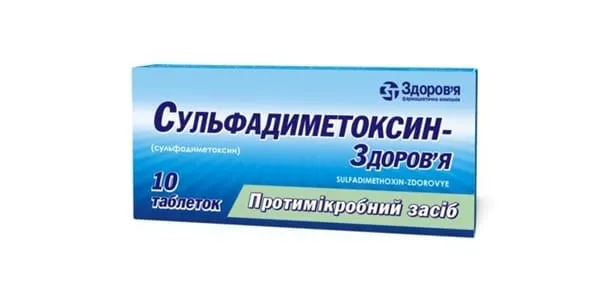
Table of Contents
INSTRUCTION FOR MEDICAL USE OF THE MEDICINAL PRODUCT SULFADIMETHOXIN-ZDOROVYE (SULFADIMETHOXIN-ZDOROVYE)
Composition:
Active substance: sulfadimethoxine;
1 tablet contains 500 mg of sulfadimethoxine;
Excipients: sodium starch glycolate (type A), pregelatinized starch, calcium stearate.
Medicinal form. Tablets.
Main physicochemical characteristics: white or almost white tablets, flat cylindrical shape, with bevel and score line.
Pharmacotherapeutic group. Antimicrobial agents for systemic use. Long-acting sulfonamides. ATC code J01ED01.
Pharmacological properties.
Pharmacodynamics.
Antimicrobial bacteriostatic agent with broad-spectrum activity, containing a long-acting sulfonamide—sulfadimethoxine.
The mechanism of action of sulfadimethoxine is due to competitive antagonism with para-aminobenzoic acid, inhibition of dihydropteroate synthetase, and disruption of tetrahydrofolic acid synthesis, which is essential for purine and pyrimidine synthesis in bacterial cells. Active against Gram-positive and Gram-negative microorganisms: Staphylococcus spp., Streptococcus spp., including Streptococcus pneumoniae, Friedländer's bacillus, Escherichia coli, Shigella spp., Chlamydia trachomatis.
Pharmacokinetics.
After oral administration, it appears in the blood within 30 minutes; the time to reach maximum plasma concentration (Tmax) is 8–12 hours. Poorly penetrates the blood-brain barrier. Therapeutic concentrations in adults are achieved with doses of 1–2 g on the first day and 0.5–1 g on subsequent days. Unlike other sulfonamides, in most cases metabolism occurs via microsomal glucuronidation associated with cytochrome P450. It is primarily excreted in the urine. The half-life (T½) is 16 hours.
Clinical characteristics.
Indications.
Infectious and inflammatory diseases caused by microorganisms sensitive to the drug: tonsillitis, bronchitis, pneumonia, sinusitis, otitis, dysentery, inflammatory diseases of the biliary and urinary tracts, gonorrhea, pertussis, pyoderma, meningitis, wound infections, trachoma, toxoplasmosis, shigellosis, resistant forms of malaria (in combination with antimalarial agents).
Contraindications.
Hypersensitivity to any component of the drug, history of severe toxic-allergic reactions to sulfonamides, bone marrow suppression, agranulocytosis, hemolytic anemia, renal and/or hepatic insufficiency, decompensated chronic heart failure, glucose-6-phosphate dehydrogenase deficiency, porphyria, azotemia, drug-induced exanthema, severe dermatitis.
Interaction with other medicinal products and other types of interactions.
With concomitant use:
- with nonsteroidal anti-inflammatory drugs, sulfonylurea derivatives, antithrombotic agents, vitamin K antagonists – the effect of these drugs is enhanced;
- with folic acid, bactericidal antibiotics (including penicillins, cephalosporins) – the efficacy of sulfadimethoxine is reduced;
- with bactericidal antibiotics, oral contraceptives – the effect of these drugs is reduced;
- with para-aminosalicylic acid (PAS) and barbiturates – the activity of sulfadimethoxine is enhanced;
- with pyrazolone derivatives, indomethacin, and salicylates – the activity and toxicity of sulfadimethoxine are increased;
- with methotrexate and phenytoin – the toxicity of sulfadimethoxine is increased;
- with erythromycin, lincomycin, tetracycline – mutual enhancement of antibacterial activity and broadening of the spectrum of action;
- with rifampicin, streptomycin, monomycin, kanamycin, gentamicin, oxochinoline derivatives (nitroxoline) – antibacterial action of the drugs is unchanged;
- with nalidixic acid (negramon) – antagonism may occasionally occur;
- with chloramphenicol, nitrofurans – reduction of total effect.
Sulfadimethoxine must not be administered simultaneously with hexamethylenetetramine (urotropine), antidiabetic agents (sulfonylurea derivatives), phenytoin, neodicoumarin, and other indirect anticoagulants.
Special precautions.
During treatment with the drug, it is necessary to systematically monitor kidney function, peripheral blood parameters, and blood glucose levels.
Sulfonamides, including sulfadimethoxine, should not be used for the treatment of infections caused by group A beta-hemolytic streptococci, as they do not eradicate this pathogen and therefore cannot prevent complications such as rheumatic fever and glomerulonephritis.
The drug should be administered with caution to patients with chronic heart failure, liver disorders, or impaired kidney function. Sulfadimethoxine should be used cautiously in patients with severe allergic diseases or bronchial asthma, as well as in those with blood system disorders. Sulfonamides, including sulfadimethoxine, should be used with caution in patients with diabetes mellitus, since sulfonamides may affect blood glucose levels.
Since sulfonamides are bacteriostatic rather than bactericidal agents, a full course of therapy is required to prevent infection relapse and the development of resistant microbial strains.
Patients should maintain adequate fluid intake to prevent crystalluria and the development of urolithiasis.
The drug should not be prescribed to patients aged 65 years and older due to an increased risk of severe adverse reactions.
Exposure to direct sunlight and artificial ultraviolet radiation should be avoided due to the potential for photosensitization during sulfonamide therapy.
During treatment, the prescribed dosing regimen must be strictly followed, with the recommended dose administered at 24-hour intervals, without missing doses. If a dose is missed, the next dose should not be doubled.
Use during pregnancy or breastfeeding.
The drug is contraindicated during pregnancy and breastfeeding.
Ability to affect reaction speed when driving or operating machinery.
There is no available information on the effect of the drug on the ability to drive or operate complex machinery.
Until the individual patient's response to the drug is established, patients should refrain from driving or operating machinery, considering that adverse reactions of the nervous system such as dizziness, seizures, ataxia, drowsiness, depression, and psychosis may occur during sulfadimethoxine therapy.
Dosage and Administration
Take orally once daily with 24-hour intervals between doses.
Adults: On the first day, administer 1–2 g of sulfadimethoxine (2–4 tablets); on subsequent days, 0.5–1 g of sulfadimethoxine (1–2 tablets) per day.
Children aged 12 years and older: On the first day, administer 1 g of sulfadimethoxine (2 tablets); on subsequent days, 0.5 g of sulfadimethoxine (1 tablet) per day.
Children aged 3 to 12 years: Administer sulfadimethoxine at a dosage of: 25 mg/kg body weight on the first day; 12.5 mg/kg body weight per day on subsequent days.
After normalization of body temperature, continue the drug at maintenance doses for another 2–3 days.
The duration of treatment depends on the nature and severity of the disease. On average, the treatment course lasts 7–14 days.
Children
The drug is indicated for children aged 3 years and older.
Overdose
Symptoms: Thirst, dry mouth, anorexia, pain in the right subcostal region and lumbar area, spasmodic abdominal pain, nausea, vomiting, dizziness, headache, drowsiness, loss of consciousness, oliguria, change in urine color (intense yellow-brown). Hyperthermia, hematuria, and crystalluria may occur. Biochemical analysis may reveal increased activity of liver enzymes (alanine aminotransferase [ALT], aspartate aminotransferase [AST], alkaline phosphatase). Hematological abnormalities (leukopenia, agranulocytosis, hemolytic anemia) and jaundice are later manifestations of overdose. Methemoglobinemia, tachycardia, paresthesia, dermatitis, diarrhea, and cholestasis may also develop.
Treatment: Discontinue the drug. If necessary, induce vomiting, perform gastric lavage, administer activated charcoal, and give a cleansing enema and alkaline fluids. In confirmed cases of methemoglobinemia, intravenous administration of 1% methylene blue is indicated. In severe cases, forced diuresis is recommended. Peritoneal dialysis is ineffective; hemodialysis is only moderately effective in treating sulfonamide overdose.
Adverse Reactions.
Blood and lymphatic system disorders: leukopenia, agranulocytosis, aplastic anemia, thrombocytopenia, hypoprothrombinemia, eosinophilia, hemolytic anemia in glucose-6-phosphate dehydrogenase deficiency.
Nervous system and psychiatric disorders: headache, neurological reactions including aseptic meningitis, ataxia; mild intracranial hypotension, seizures, dizziness, somnolence/insomnia, fatigue, depression, peripheral or optic neuropathies, psychosis.
Respiratory system disorders: pulmonary infiltrates, fibrosing alveolitis.
Gastrointestinal disorders: thirst, dry mouth, dyspeptic symptoms, nausea, vomiting, diarrhea, anorexia, pancreatitis, pseudomembranous colitis.
Renal and urinary system disorders: change in urine color (intense yellow-brown color), crystalluria; possible nephrotoxic reactions: interstitial nephritis, tubular necrosis, renal failure.
Skin and subcutaneous tissue disorders: skin rashes, urticaria, allergic dermatitis, photosensitization, exfoliative dermatitis, nodular erythema.
Allergic reactions: toxic epidermal necrolysis (Lyell's syndrome), Stevens-Johnson syndrome, systemic lupus erythematosus, serum sickness-like syndrome, anaphylactic reactions, swelling of the tongue, upper lip, swallowing difficulties.
General disorders: drug fever, pain in the right hypochondrium and lumbar region.
Hepatobiliary disorders: increased liver enzyme activity (ALT, AST, alkaline phosphatase), cholestatic hepatitis, hepatonecrosis, hepatomegaly, jaundice.
Other: myocarditis, nodular periarteritis, hypothyroidism, hypoglycemia.
Reporting of suspected adverse reactions.
Reporting suspected adverse reactions after marketing authorization is an important procedure. It allows continuous monitoring of the benefit-risk ratio of the medicinal product. Healthcare professionals are required to report any suspected adverse reactions through the national pharmacovigilance system.
Shelf life. 5 years.
Storage conditions. Store in the original packaging at a temperature not exceeding 25 °C.
Keep out of reach and sight of children.
Packaging. Tablets № 10 (10×1), № 100 (10×10) in blisters in a box; № 10 in a blister.
Prescription status. Prescription only.
Manufacturer. Limited Liability Company "Pharmaceutical Company "Zdorovya".
Manufacturer's address and place of business.
22, Shevchenka Street, Kharkiv, Kharkiv Oblast, 61013, Ukraine.