Strophanthin-darnitsa
Ukraine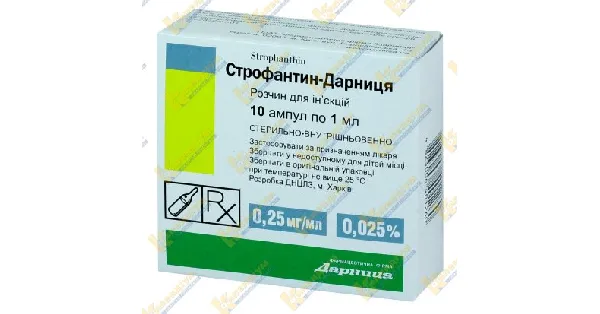
Table of Contents
INSTRUCTIONS FOR MEDICAL USE OF THE MEDICINAL PRODUCT STROPHANTHIN-DARNITSA (STROPHANTHIN-DARNITSA)
Composition:
Active substance: g-strophanthin;
1 ml of solution contains 0.25 mg of g-strophanthin;
Excipients: disodium phosphate dodecahydrate, sodium dihydrogen phosphate dihydrate, disodium edetate, water for injections.
Pharmaceutical form. Solution for injection.
Main physicochemical properties: clear, colorless liquid.
Pharmacotherapeutic group.
Cardiotonic agents. Cardiac glycosides. G-strophanthin. ATC code C01A C01.
Pharmacological Properties.
Pharmacodynamics.
Strofantin-Darnitsya is a cardiac glycoside isolated from Strophanthus gratus. It is one of the main "polar" cardiac glycosides. The drug exerts a cardiotonic effect, increasing the force and rate of myocardial contractions (positive inotropic effect), reducing heart rate (negative chronotropic effect), and decreasing atrioventricular conduction (negative dromotropic effect). In heart failure, it increases stroke volume and cardiac output, improves ventricular emptying, thereby enhancing circulation.
The mechanism of action of strophanthin G involves partial inhibition of the sodium/potassium-ATPase in myocardial cell membranes, resulting in reduced potassium uptake into cardiomyocytes and decreased sodium efflux. It promotes a vagotrophic effect (bradycardia) by delaying impulse conduction through the heart's conducting system. ECG changes during Strofantin-Darnitsya administration include QT interval prolongation, ST segment depression below the isoelectric line, PP interval prolongation, PQ interval prolongation, flattening of the T wave, which may become inverted.
Pharmacokinetics.
After intravenous administration, approximately 40% of the administered dose binds to plasma proteins. The time to reach maximum plasma concentration (Tmax) ranges from 0.5 to 2 hours. The drug undergoes negligible biotransformation. It is excreted unchanged by the kidneys at 70–90%, with the remainder eliminated via bile into the intestine. The elimination half-life (T1/2) averages 23 hours; the drug's effect lasts 2–3 days. In patients with chronic renal insufficiency, the elimination half-life of the drug is prolonged.
Clinical characteristics.
Indications.
Acute heart failure, chronic heart failure stages IIb−III (III−IV stages according to the New York Heart Association (NYHA) classification), supraventricular tachycardia, atrial fibrillation.
Contraindications.
Hypersensitivity to the components of the drug. Glycoside intoxication, constrictive pericarditis, acute myocardial infarction, ventricular tachycardia, pronounced bradycardia, second- and third-degree atrioventricular block, sick sinus syndrome, hypercalcemia, hypokalemia, isolated mitral stenosis, hypertrophic obstructive cardiomyopathy, pericarditis, acute myocarditis, endocarditis, pronounced cardiac sclerosis, carotid sinus syndrome, aneurysm of the thoracic aorta, Wolff−Parkinson−White syndrome.
Interaction with other medicinal products and other types of interactions.
Sympathomimetics, methylxanthines, reserpine, tricyclic antidepressants, phosphodiesterase inhibitors (e.g., theophylline) – when used concomitantly with Strofantin-Darnytsia, increase the risk of cardiac rhythm disturbances.
Methyldopa, clonidine, spironolactone, verapamil, quinidine, amiodarone, captopril, calcium antagonists, erythromycin, tetracyclines – when used concomitantly increase the plasma concentration of Strofantin-Darnytsia.
Diuretics (especially thiazide and carbonic anhydrase inhibitors), glucocorticoids, catecholamines, insulin, calcium preparations – when used concomitantly with Strofantin-Darnytsia increase the risk of glycoside intoxication.
Glucocorticoids and diuretics – when used concomitantly with Strofantin-Darnytsia increase the risk of hypokalemia and hypomagnesemia.
Angiotensin-converting enzyme (ACE) inhibitors, angiotensin receptor blockers – when used concomitantly with Strofantin-Darnytsia reduce the risk of hypokalemia and hypomagnesemia.
Beta-adrenoblockers and antiarrhythmic medicinal products of class Ia, verapamil, magnesium sulfate – when used concomitantly with Strofantin-Darnytsia more pronounced reduction in atrioventricular conduction occurs.
Special precautions for use.
Strofantin-Darnytsia has a narrow therapeutic index, therefore the individual dose must be carefully selected.
ECG monitoring is required during intravenous administration of the drug and for 1 hour thereafter. If frequent grouped or polytopic ventricular extrasystoles occur, administration must be discontinued and the next dose should be reduced by half.
In renal insufficiency, the dose of the drug should be slightly reduced to prevent glycoside intoxication. Hypokalemia, hypomagnesemia, and hypercalcemia increase the risk of relative drug overdose.
Dosage adjustment is required in patients with marked cardiac chamber dilation, cor pulmonale, alkalosis, and in elderly patients to prevent overdose.
When first-degree atrioventricular conduction disturbance is present, drug administration must be accompanied by ECG monitoring.
If the patient has previously received other cardiac glycoside drugs, a washout period is necessary before starting Strofantin-Darnytsia, since its effect may be additive to that of accumulated digitalis glycosides. The washout period should be 5 days; however, if drugs with strong cumulative effects (e.g., digoxin) were used, the washout period should be extended to 10–14 days.
In patients with impaired renal function and in elderly and senile patients, the drug should be administered in slightly reduced doses, starting from 0.125–0.15–0.2 mg, and the daily dose should not exceed 0.25 mg (except in emergency conditions).
The drug should be used with particular caution in patients with thyrotoxicosis and atrial extrasystoles.
Rapid intravenous administration may lead to the development of bradyarrhythmias, ventricular tachycardia, atrioventricular block, or cardiac arrest. To prevent these effects, the daily dose should be divided into 2–3 administrations, or one of the doses may be administered intramuscularly.
This medicinal product contains less than 1 mmol (23 mg) of sodium per dose, i.e., it is practically sodium-free.
Use during pregnancy or breastfeeding.
The drug is contraindicated during pregnancy and breastfeeding.
Ability to affect reaction rate when driving or operating machinery.
Patients should refrain from driving and operating machinery.
Administration and Dosage
The medicinal product should be administered intravenously to adults at a dose of 1–2 mL (dissolved in 10–20 mL of 0.9% sodium chloride solution). It should be injected slowly over 5–6 minutes. Administer once or twice daily. If possible, it is preferable to administer the medicinal product by intravenous infusion. For this purpose, 1 mL of the medicinal product should be dissolved in 100 mL of 5% glucose solution or 0.9% sodium chloride solution. Infusion administration reduces the risk of toxic effects. An ECG monitoring should be performed 1 hour after intravenous administration. If frequent, grouped, or polymorphic ventricular extrasystoles occur, administration of the medicinal product must be discontinued, and the next dose should be reduced by half. In patients with renal insufficiency and elderly patients, the medicinal product should be administered in reduced doses, starting with 0.125 mg, and subsequently not exceeding 0.25 mg per day (except in urgent conditions).
If necessary, the single dose may be increased by administering additional 0.1–0.15 mg (0.2–0.3 mL) at intervals of 0.5–2 hours, while the maximum single dose should not exceed 0.25 mg and the daily dose should not exceed 1 mg (4 mL).
Children
There is no experience with the use of this medicinal product in children; therefore, it is not prescribed to pediatric patients.
Overdose
Symptoms:
Cardiovascular system: atrioventricular block and cardiac arrhythmias, including bradycardia, ventricular paroxysmal tachycardia, ventricular extrasystoles, bigeminy, polymorphic ventricular tachycardia, SA block, ventricular fibrillation; in severe cases, ventricular flutter and cardiac arrest may develop;
Gastrointestinal tract: anorexia, nausea, vomiting, diarrhea, intestinal wall necrosis;
Nervous system: headache, dizziness, paresthesia, neuritis, radiculitis, rarely seeing surrounding objects in green or yellow hues, flickering "floaters" before the eyes, decreased visual acuity, scotoma, macropsia and micropsia; very rarely, confusion, syncope, manic-depressive syndrome may occur.
Treatment: discontinue the medicinal product, administer potassium and magnesium preparations, and parenterally administer unithiol. Further treatment is symptomatic; for ectopic arrhythmias, antiarrhythmic drugs (lidocaine, diphenin, amiodarone) should be prescribed.
Side effects.
The development of adverse reactions is mainly associated with overdosage, too rapid intravenous administration, or increased individual sensitivity of the patient to cardiac glycosides. The following clinical symptoms may occur:
Eye disorders: visual disturbances;
Gastrointestinal disorders: decreased appetite, nausea, vomiting, diarrhea; in severe cases – mesenteric infarction;
Endocrine system disorders: gynecomastia in males (in isolated cases);
Nervous system disorders: headache, dizziness, confusion, increased fatigue, drowsiness, sleep disturbances, psychiatric disorders (depression, hallucinations, delirious psychosis);
Cardiovascular disorders: cardiac arrhythmias (bradyarrhythmia, ventricular tachycardia) and conduction disturbances (atrioventricular block);
Blood and lymphatic system disorders: thrombocytopenic purpura, petechiae, epistaxis;
Immune system disorders: anaphylactic reactions, urticaria, allergic reactions;
General disorders and administration site reactions: changes at the injection site.
Reporting of suspected adverse reactions.
Reporting of suspected adverse reactions after marketing authorization is an important procedure. It allows continuous monitoring of the benefit-risk ratio of the medicinal product. Healthcare professionals are required to report any suspected adverse reactions through the national reporting system.
Shelf life. 2 years.
Storage conditions.
Store in the original packaging at a temperature not exceeding 25 °C. Do not freeze.
Keep out of reach and sight of children.
Incompatibility.
The medicinal product is incompatible when administered in the same syringe or infusion with the following solutions: sodium bicarbonate, aminazine. Such combinations reduce the pharmacological activity of strophanthin.
Packaging.
1 ml in an ampoule;
5 ampoules in a blister pack, 2 blisters per carton;
10 ampoules in a blister pack; 1 blister per carton.
Prescription status. Prescription only.
Manufacturer. JSC "Pharmaceutical company "Darnytsia".
Manufacturer's address and location of its operations.
13, Borispilska Street, Kyiv, 02093, Ukraine.