Sterocort®
Ukraine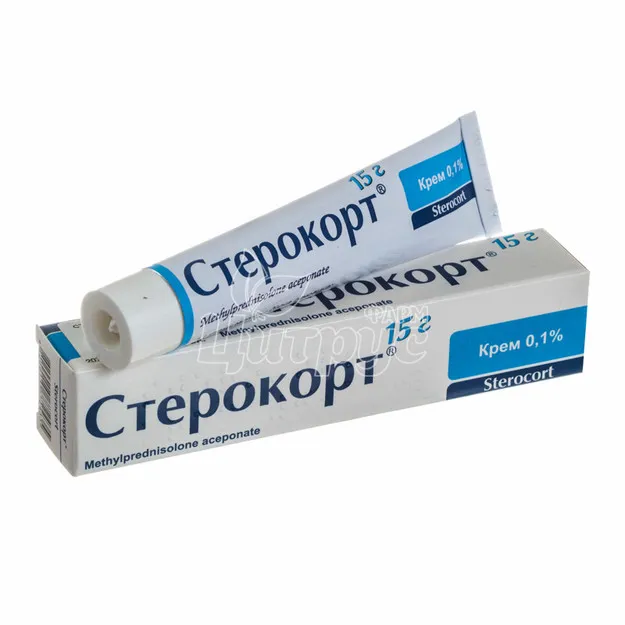
Table of Contents
- INSTRUCTIONS FOR MEDICAL USE OF THE MEDICINAL PRODUCT STEGEROCORT® (STEROCORT)
- Composition:
- Pharmacological Properties
- Clinical characteristics.
- Special precautions for use
- Method of Administration and Dosage
- Adverse reactions.
- Composition:
- Pharmacological Properties
- Clinical characteristics.
- Special precautions for use
- Dosage and Administration
- Adverse reactions.
INSTRUCTIONS FOR MEDICAL USE OF THE MEDICINAL PRODUCT STEGEROCORT® (STEROCORT)
Composition:
Active substance: 1 g of cream contains 1 mg of methylprednisolone aceponate (calculated as 100% substance);
Excipients: phenoxylethanol and ethylhexylglycerin calculated as phenoxylethanol, isopropyl myristate, octyldodecanol, glycerol monostearate, cetylstearyl alcohol, dimethicone, propylene glycol, hexyldecyl stearate, polyethylene glycol (macrogol) stearate, disodium edetate, potassium dihydrogen phosphate, disodium phosphate dodecahydrate, purified water.
Pharmaceutical form. Cream.
Main physicochemical characteristics: white-colored cream.
Pharmacotherapeutic group. Corticosteroids for dermatological use.
ATC code D07AC14.
Pharmacological Properties
Pharmacodynamics
Methylprednisolone aceponate (6α-methylprednisolone aceponate) suppresses inflammatory and allergic skin reactions as well as reactions associated with cellular hyperproliferation when applied topically, thereby alleviating both objective symptoms (erythema, edema, maceration) and subjective complaints (pruritus, burning, pain).
It is known that methylprednisolone aceponate binds directly to intracellular glucocorticoid receptors. This particularly applies to its main metabolite—6α-methylprednisolone-17-propionate—which is formed following cleavage in the skin.
Binding of the "receptor–steroid" complex to a specific region of the DNA molecule initiates a cascade of biological effects.
The binding of the "receptor–steroid" complex induces the synthesis of macrocortin. Macrocortin inhibits the release of arachidonic acid, thereby reducing the formation of inflammatory mediators such as prostaglandins and leukotrienes.
The immunosuppressive effect of glucocorticosteroids can be explained by inhibition of cytokine synthesis and by an antimitotic effect, which has not yet been fully elucidated.
Inhibition of the synthesis of vasodilatory prostaglandins or potentiation of the vasoconstrictive effect of adrenaline ultimately results in the vasoconstrictive activity of glucocorticosteroids.
Methylprednisolone aceponate (6α-methylprednisolone aceponate) is a non-halogenated synthetic corticosteroid molecule characterized by a high degree of dissociation between its local and systemic effects.
The 6α-methyl group enhances activity, while the lipophilic ester groups ensure better penetration through the skin.
The local anti-inflammatory effect, confirmed by pharmacological and clinical-pharmacological studies, is comparable to that of more potent corticosteroids. Systemic effects of methylprednisolone aceponate following topical application are minimal, according to study data.
Pharmacokinetics
Methylprednisolone aceponate is hydrolyzed in the epidermis and dermis to form 6α-methylprednisolone-17-propionate, its main metabolite, which binds more strongly to corticosteroid receptors than the parent compound—clear evidence of cutaneous bioactivation.
The percentage and total extent of transdermal absorption of a topical corticosteroid depend on several factors, including the chemical structure of the compound, excipients, concentration of the compound in the vehicle, conditions of application (surface area treated, duration of exposure, open or occlusive application), and skin characteristics (type and severity of pathology, anatomical location).
Transdermal absorption of methylprednisolone aceponate in cream form was studied in healthy volunteers. With the use of occlusive dressings containing 15 g of methylprednisolone aceponate cream applied twice daily for 7 days, the mean transdermal absorption was approximately 2.5%, corresponding to a systemic corticosteroid load of approximately 10 μg/kg/day. Transdermal absorption of methylprednisolone aceponate was significantly increased under conditions of experimentally damaged skin, such as removal of the stratum corneum.
After entering the bloodstream, the main hydrolysis product of methylprednisolone aceponate, 6α-methylprednisolone-17-propionate, rapidly conjugates with glucuronic acid and is thus inactivated.
Metabolites of methylprednisolone aceponate (mainly 6α-methylprednisolone-17-propionate-21-glucuronide) are primarily excreted via urine, with a half-life of approximately 16 hours. Following intravenous administration, complete elimination via urine and feces occurs within 7 days. No accumulation of the active substance or its metabolites in the body has been observed.
Clinical characteristics.
Indications.
Atopic dermatitis (neurodermatitis, endogenous eczema); true (actual) eczema; simple contact dermatitis and allergic contact dermatitis; dyshidrotic eczema, infantile eczema.
Contraindications.
- Hypersensitivity to methylprednisolone aceponate or to any other component of the drug;
- tuberculous or syphilitic processes in the area of application; viral infections (e.g., varicella, herpes zoster), rosacea, perioral dermatitis, ulcerative skin lesions, common acne, atrophic dermatitis, skin reactions following vaccination at the site of application; skin diseases associated with bacterial or fungal infections (see section "Special precautions").
Interaction with other medicinal products and other forms of interaction.
No data available.
Due to absorption when treating large skin areas or prolonged therapy, interactions similar to those observed during systemic therapy may occur. However, to date, no such interactions have been reported.
If it is necessary to use any other medicinal products simultaneously, consult a physician.
Special precautions for use
Glucocorticoids should be used only at the lowest possible doses, especially in children, and only for the minimal duration necessary to achieve and maintain the desired therapeutic effect.
When treating pathological processes affecting large areas of skin, the duration of therapy should be strictly defined by the physician and kept as short as possible.
In cases of bacterial skin infections and/or fungal skin involvement, additional specific treatment with antibacterial and/or antifungal agents is required.
Local skin infections may worsen during topical application of glucocorticoids.
The use of this medicinal product should be avoided in facial areas affected by rosacea or perioral dermatitis.
When using Sterocort® cream, contact with the eyes and application to deep open wounds or mucous membranes should be avoided.
In healthy adults, application of methylprednisolone aceponate to 60% of the body surface under occlusive dressing for 22 hours has been associated with reduced plasma cortisol levels and disruption of its circadian rhythm. Such treatment regimens should be used as infrequently as possible. In children, application of the drug to large skin areas (40–90% of body surface), without occlusion (in newborns, diapers may act as occlusive dressings), has not been associated with adrenal suppression. Nevertheless, when applying the drug to large skin areas, treatment duration should be kept as short as possible.
The risk of adverse effects significantly increases when topical corticosteroids are applied over large body areas or for prolonged periods, particularly under occlusive dressings. Treatment with occlusive dressings should be avoided unless specifically indicated. It should be remembered that diapers, nappies, and areas prone to intertrigo may produce effects similar to those of occlusive dressings.
When treating large body surface areas, treatment duration should be kept as short as possible, since complete exclusion of systemic absorption and systemic effects is not possible.
Inappropriate use of this medicinal product, as with all other corticosteroids, may mask clinical symptoms.
If skin becomes excessively dry during prolonged use of Sterocort® cream, switching to a different pharmaceutical form with a higher fat content is recommended.
As with systemic corticosteroid use, topical application may lead to glaucoma (e.g., after high-dose or long-term use on large areas, use under occlusive dressings, or application around the eyes).
Prolonged use of topically applied medicinal products may lead to sensitization. In such cases, treatment should be discontinued and appropriate therapy initiated.
The product contains cetostearyl alcohol, which may cause local skin reactions such as contact dermatitis.
The product contains propylene glycol, which may cause skin irritation.
Use during pregnancy or breastfeeding
Currently, there are no reliable data on the use of Sterocort® in pregnant women; however, the risk is expected to be minimal due to the very low likelihood of systemic effects from topically applied corticosteroids.
Animal studies using methylprednisolone aceponate at doses exceeding the therapeutic dose have shown embryotoxic and/or teratogenic effects.
This product should not be used during pregnancy or breastfeeding unless clearly necessary and under strict medical supervision.
During the first trimester of pregnancy, topical use of corticosteroid-containing products should preferably be avoided. Throughout pregnancy, large skin areas should not be treated, prolonged use should be avoided, and use under occlusive dressings is not recommended.
Some epidemiological studies suggest a possible increased risk of cleft palate in newborns whose mothers received corticosteroid treatment during the first trimester of pregnancy.
Sterocort® cream should be prescribed to pregnant women only after careful assessment of the benefit-risk ratio.
Mouse studies have shown that methylprednisolone aceponate does not penetrate into breast milk. However, it is unknown whether methylprednisolone aceponate passes into human breast milk, as systemically administered corticosteroids have been detected in women's breast milk. It is also unknown whether topical application of Sterocort® cream could lead to systemic absorption of methylprednisolone aceponate in amounts detectable in human breast milk. Therefore, Sterocort® cream should be used with caution in breastfeeding women.
During breastfeeding, the product should not be applied to the mammary glands. Particular care should be taken to avoid prolonged use, application to large skin areas, or use under occlusive dressings.
There is no information available on the effect of methylprednisolone aceponate on fertility.
Ability to affect reaction speed when driving or operating machinery
Not established.
Method of Administration and Dosage
The product should usually be applied once daily as a thin layer to the affected areas of skin, unless otherwise directed by a physician.
The Sterocort® cream formulation (1 g of Sterocort® cream contains 1 mg of methylprednisolone aceponate), due to its increased water content, promotes exudate drainage and is therefore particularly suitable for the treatment of weeping eczematous lesions in the acute phase, as well as areas of skin with maceration, whether or not covered with hair.
The duration of treatment in typical cases should not exceed 12 weeks for adults and 4 weeks for children. There are no data on the safety of using Sterocort® cream in children under 4 months of age.
When using Sterocort® cream to treat children aged 4 months and older, no dose adjustment is required.
Children. There are no data on the safety of using Sterocort® cream in children under 4 months of age. It is recommended to consult a physician before using the cream in children aged 4 months to 3 years.
When using Sterocort® cream to treat children aged 4 months and older, no dose adjustment is required.
The duration of treatment in children should not exceed 4 weeks in typical cases.
Sterocort® cream must not be used under occlusive dressings in children. It should be remembered that diapers and nappies may produce the same effect as an occlusive dressing.
Overdose.
In cases of cutaneous atrophoderma associated with overdose due to topical application of the drug, treatment should be discontinued. Symptoms usually regress within 10–14 days.
Acute toxicity studies with methylprednisolone aceponate have shown no risk of acute intoxication following a single excessive topical application (application over a large body surface area under conditions favoring absorption) or after accidental oral ingestion of the product.
Adverse reactions.
During clinical studies, the most commonly reported adverse effects with methylprednisolone aceponate cream were burning and itching at the application site.
The frequency of adverse reactions observed during clinical studies (listed in the table below) was determined according to MedDRA [Medical Dictionary for Regulatory Activities] (version 12.0): very common (>1/10); common (>1/100, <1/10); uncommon (>1/1000, <1/100); rare (>1/10,000, <1/1000); very rare (<1/10,000); frequency not known (cannot be estimated from the available data).
| Organs and systems |
Common |
Uncommon |
Single occurrences |
| Infections and infestations |
Fungal skin infections |
||
| General disorders and application site reactions |
Burning and itching at application site |
Dryness, erythema, vesicles, folliculitis, rash, paraesthesia at application site |
Cellulitis, swelling, irritation |
| Skin and subcutaneous tissue disorders |
Pyoderma, skin fissures, telangiectasias, skin atrophy, acne |
||
| Immune system disorders |
Hypersensitivity to the drug |
Also, when using Sterocort® cream, rare side effects such as bacterial cellulitis and skin infections may occur.
As with topical application of other corticosteroids, the following side effects (frequency not known) may be observed: skin thinning (skin atrophy), striae, inflammation of hair follicles (folliculitis) at the application site, excessive hair growth (hypertrichosis), telangiectasias, perioral dermatitis, changes in skin pigmentation, contact dermatitis, and allergic skin reactions to any of the components of the drug.
In individual cases, systemic effects of corticosteroids due to their absorption are possible.
The drug contains cetearyl alcohol, which may cause local skin reactions such as contact dermatitis.
The drug contains propylene glycol, which may cause skin irritation.
If any adverse reactions occur, use of the drug should be discontinued and medical advice should be sought immediately.
Reporting of adverse reactions after drug registration is highly important. It enables continuous monitoring of the benefit-risk balance of the medicinal product. Medical and pharmaceutical professionals, as well as patients or their legal representatives, should report all suspected adverse reactions and lack of efficacy through the Automated Pharmacovigilance Information System at: https://aisf.dec.gov.ua.
Shelf life.
2 years.
Storage conditions.
Store in the original packaging at a temperature not exceeding 25°C.
Keep out of reach of children.
Packaging.
15 g in tubes; 1 tube per cardboard box.
Prescription status.
Over-the-counter.
Manufacturer.
JSC "FITOPHARM".
Manufacturer's address and location of business activities.
2 Sybirtseva Street, Bakhmut, Donetsk region, 84500, Ukraine.
Marketing Authorization Holder.
JSC "FITOPHARM".
Address of the Marketing Authorization Holder.
7, Verkhovnoї Rady Boulevard, Kyiv, 02100, Ukraine, 3rd floor, room 18.
In case of adverse reactions or questions regarding the safety, quality, and efficacy of the medicinal product, please contact the Pharmacovigilance Department of JSC "FITOPHARM" at +38 (044) 390 52 96.
INSTRUCTION
for medical use of the medicinal product
STEROCORT®
(STEROCORT)
Composition:
Active ingredient: 1 g of cream contains methylprednisolone aceponate (calculated as 100 % substance) 1 mg;
Excipients: phenoxyethanol and ethylhexylglycerin (calculated as phenoxyethanol), isopropyl myristate, octyldodecanol, glycerol monostearate, cetostearyl alcohol, dimethicone, propylene glycol, hexadecyl stearate, polyethylene glycol (macrogol) stearate, disodium edetate, potassium dihydrogen phosphate, disodium phosphate dodecahydrate, purified water.
Pharmaceutical form. Cream.
Main physicochemical properties: white cream.
Pharmacotherapeutic group. Corticosteroids for dermatological use.
ATC code D07AC14.
Pharmacological Properties
Pharmacodynamics
Methylprednisolone aceponate (6α-methylprednisolone aceponate), when applied topically, suppresses inflammatory and allergic skin reactions as well as those associated with cellular hyperproliferation, thereby alleviating both objective symptoms (erythema, edema, maceration) and subjective complaints (itching, burning, pain).
It is known that methylprednisolone aceponate binds directly to intracellular glucocorticoid receptors. This particularly applies to its main metabolite—6α-methylprednisolone-17-propionate—which is formed following cleavage in the skin.
Binding of the "receptor–steroid" complex to a specific region of the DNA molecule initiates a cascade of biological effects.
The binding of the "receptor–steroid" complex induces the synthesis of macrocortin. Macrocortin inhibits the release of arachidonic acid, thereby reducing the formation of inflammatory mediators such as prostaglandins and leukotrienes.
The immunosuppressive effect of glucocorticosteroids can be explained by inhibition of cytokine synthesis and by an antimitotic effect, which is not yet fully understood.
Inhibition of the synthesis of vasodilatory prostaglandins or potentiation of the vasoconstrictive effect of adrenaline ultimately results in the vasoconstrictive activity of glucocorticosteroids.
Methylprednisolone aceponate (6α-methylprednisolone aceponate) is a non-halogenated synthetic corticosteroid molecule characterized by a high degree of dissociation between its local and systemic effects.
The 6α-methyl group enhances activity, while the lipophilic ester groups ensure better penetration through the skin.
The local anti-inflammatory effect, confirmed by pharmacological and clinical-pharmacological studies, is comparable to that of more potent corticosteroids. Systemic effects of methylprednisolone aceponate following topical application are minimal, according to study data.
Pharmacokinetics
Methylprednisolone aceponate is hydrolyzed in the epidermis and dermis to form 6α-methylprednisolone-17-propionate, its main metabolite, which binds more strongly to corticosteroid receptors than the parent compound—clear evidence of cutaneous bioactivation.
The percentage and overall extent of transdermal absorption of a topical corticosteroid depend on several factors, including the chemical structure of the compound, excipients, concentration of the compound in the vehicle, application conditions (surface area treated, duration of exposure, open or occlusive application), and skin characteristics (type and severity of pathology, anatomical location).
Transdermal absorption of methylprednisolone aceponate in cream form was studied in healthy volunteers. When applying occlusive dressings containing 15 g of methylprednisolone aceponate cream twice daily for 7 days, the mean transdermal absorption was approximately 2.5%, corresponding to a systemic corticosteroid exposure of about 10 μg/kg/day. Transdermal absorption of methylprednisolone aceponate was significantly increased under conditions of experimentally damaged skin, such as removal of the stratum corneum.
After entering the bloodstream, the main hydrolysis product of methylprednisolone aceponate, 6α-methylprednisolone-17-propionate, is rapidly conjugated with glucuronic acid and thus inactivated.
Metabolites of methylprednisolone aceponate (mainly 6α-methylprednisolone-17-propionate-21-glucuronide) are primarily excreted via urine, with a half-life of approximately 16 hours. After intravenous administration, complete excretion via urine and feces occurs within 7 days. No accumulation of the active substance or its metabolites in the body occurs.
Clinical characteristics.
Indications.
Atopic dermatitis (neurodermatitis, endogenous eczema); true eczema; simple contact dermatitis and allergic contact dermatitis; dyshidrotic eczema, infantile eczema.
Contraindications.
- Hypersensitivity to methylprednisolone aceponate or to any other component of the medicinal product;
- tuberculosis or syphilis lesions at the site of application; viral infections (e.g. chickenpox, herpes zoster), rosacea, perioral dermatitis, ulcerative skin lesions, acne vulgaris, atrophic dermatitis, skin reactions following vaccination at the site of application; skin diseases associated with bacterial or fungal infections (see section "Special precautions for use").
Interaction with other medicinal products and other forms of interaction.
No data available.
Due to possible absorption, treatment of large skin areas or prolonged therapy may lead to interactions similar to those observed during systemic therapy. However, such interactions have not been reported to date.
If concomitant use of any other medicinal products is necessary, consult a physician.
Special precautions for use
Glucocorticoids should be used only at the lowest possible doses, especially in children, and only for as long as absolutely necessary to achieve and maintain the desired therapeutic effect.
When treating pathological processes affecting large areas of skin, the duration of therapy should be clearly defined by the physician and kept as short as possible.
In cases of bacterial skin infections and/or fungal skin lesions, additional specific treatment with antibacterial and/or antifungal agents is required.
Local skin infections may worsen during local application of glucocorticoids.
Avoid using the medicinal product on facial areas affected by rosacea or perioral dermatitis.
When using Sterocort® it is necessary to avoid contact of the product with the eyes and with deep open wounds or mucous membranes.
In healthy adults, application of methylprednisolone aceponate over 60% of body surface under occlusive dressing for 22 hours has been associated with decreased plasma cortisol levels and disruption of its circadian rhythm. Such treatment regimen should be used as infrequently as possible. When applied over large skin areas (40–90% of body surface) without occlusion in children (in newborns, diapers may act as an occlusive dressing), no adverse effects on adrenal cortex function have been observed. Nevertheless, when applying the product over large skin areas, treatment duration should be kept as short as possible.
The risk of adverse effects significantly increases when topical corticosteroids are applied over large body areas or for prolonged periods, especially under occlusive dressings. Treatment with occlusive dressings should be avoided unless specifically indicated. It should be remembered that diapers, nappies, and areas prone to intertrigo may produce the same effect as occlusive dressings.
When treating large body surface areas, treatment duration should be kept as short as possible, since complete exclusion of the possibility of systemic absorption and systemic effects is not feasible.
Improper use of this medicinal product, as with all other corticosteroids, may mask clinical symptoms.
If skin becomes excessively dry during prolonged application of Sterocort® cream, it is recommended to switch to another pharmaceutical form with a higher fat content.
As with systemic corticosteroid use, topical application may lead to glaucoma (e.g., after high-dose or long-term use on large areas, use under occlusive dressings, or application around the eyes).
Prolonged use of topically applied medicinal products may lead to sensitization. In such cases, therapy should be discontinued and appropriate treatment initiated.
The product contains cetostearyl alcohol, which may cause local skin reactions such as contact dermatitis.
The product contains propylene glycol, which may cause skin irritation.
Use during pregnancy or breastfeeding
Currently, there are no reliable data on the use of Sterocort® in pregnant women; however, a minimal risk is expected due to the very low likelihood of systemic effects of topically applied corticosteroids.
Animal studies using methylprednisolone aceponate at doses exceeding the therapeutic dose have shown embryotoxic and/or teratogenic effects.
This product should not be used in pregnant or breastfeeding women unless clearly necessary and under strict medical supervision.
During the first trimester of pregnancy, it is advisable to avoid topical use of corticosteroid-containing products. Throughout pregnancy, treatment of large skin areas, prolonged use of the product, or use under occlusive dressings should be avoided.
Some epidemiological studies suggest a possible increased risk of cleft palate in newborns whose mothers received corticosteroid treatment during the first trimester of pregnancy.
Sterocort® cream should be prescribed to pregnant women only after careful assessment of the benefit-risk ratio.
Studies in mice have shown that methylprednisolone aceponate does not penetrate into breast milk. However, it is unknown whether methylprednisolone aceponate passes into human breast milk, as systemically administered corticosteroids have been detected in human breast milk. It is also unknown whether topical application of Sterocort® cream could lead to systemic absorption of methylprednisolone aceponate in amounts detectable in human breast milk. Therefore, Sterocort® cream should be used with caution in breastfeeding women.
During breastfeeding, the product should not be applied to the breasts. Particular care should be taken to avoid prolonged use, application over large skin areas, or use under occlusive dressings.
There is no information available on the effects of methylprednisolone aceponate on fertility.
Ability to affect reaction speed when driving or operating machinery
Not established.
Dosage and Administration
The medication should usually be applied once daily as a thin layer to the affected areas of skin, unless otherwise directed by a physician.
The Sterocort® cream formulation (1 g of Sterocort® cream contains 1 mg of methylprednisolone aceponate), due to its increased water content, facilitates exudate drainage and is therefore particularly suitable for the treatment of weeping eczematous lesions in the acute phase, as well as skin areas with maceration, whether or not covered with hair.
The duration of treatment in typical cases should not exceed 12 weeks for adults and 4 weeks for children. There are no safety data available regarding the use of Sterocort® cream in children under 4 months of age.
When using Sterocort® cream to treat children aged 4 months and older, dose adjustment is not required.
Children. There are no safety data available for the use of Sterocort® cream in children under 4 months of age. Consultation with a physician is recommended before use in children aged 4 months to 3 years.
When using Sterocort® cream to treat children aged 4 months and older, dose adjustment is not required.
The duration of treatment in children should not exceed 4 weeks in typical cases.
Sterocort® cream must not be used under occlusive dressings in children. It should be remembered that diapers and nappies may produce the same effect as occlusive dressings.
Overdose.
In cases of cutaneous atrophoderma associated with overdose due to topical application of the medication, treatment should be discontinued. Symptoms usually regress within 10–14 days.
Acute toxicity studies with methylprednisolone aceponate have shown no risk of acute intoxication following a single excessive topical application (application over a large body surface area under conditions favoring absorption) or after accidental oral ingestion of the medication.
Adverse reactions.
During clinical studies, the most commonly reported adverse effects with mometasone furoate cream were burning and itching at the application site.
The frequency of adverse reactions observed during clinical studies (listed in the table below) was determined according to MedDRA [Medical Dictionary for Regulatory Activities] (version 12.0): very common (>1/10); common (>1/100, <1/10); uncommon (>1/1000, <1/100); rare (>1/10,000, <1/1000); very rare (<1/10,000); frequency not known (cannot be estimated from the available data).
| Organs and systems |
Common |
Uncommon |
Rare |
| Infections and infestations |
Fungal skin infections |
||
| General disorders and administration site reactions |
Burning and itching at the application site |
Dryness, erythema, vesicles, folliculitis, rash, paraesthesia at the application site |
Cellulitis, swelling, irritation |
| Skin and subcutaneous tissue disorders |
Pyoderma, skin fissures, telangiectasia, skin atrophy, acne |
||
| Immune system disorders |
Hypersensitivity to the drug |
Also, when using Sterokort® cream, rare side effects such as bacterial cellulitis and skin infections may occur.
As with topical application of other corticosteroids, the following side effects (frequency not known) may be observed: skin thinning (skin atrophy), striae, inflammation of hair follicles (folliculitis) at the application site, excessive hair growth (hypertrichosis), telangiectasias, perioral dermatitis, changes in skin color, contact dermatitis, and allergic skin reactions to any component of the drug.
In individual cases, systemic effects of corticosteroids due to their absorption are possible.
The product contains cetearyl alcohol, which may cause local skin reactions such as contact dermatitis.
The product contains propylene glycol, which may cause skin irritation.
If any adverse reactions occur, use of the drug should be discontinued and medical advice must be sought immediately.
Reporting of adverse reactions after drug registration is of great importance. It allows continuous monitoring of the benefit-risk balance of the drug. Medical and pharmaceutical professionals, as well as patients or their legal representatives, should report all suspected adverse reactions and lack of drug efficacy through the Automated Pharmacovigilance Information System at: https://aisf.dec.gov.ua.
Shelf life.
2 years.
Storage conditions.
Store in the original packaging at a temperature not exceeding 25°C.
Keep out of reach of children.
Packaging.
15 g in tubes; 1 tube in a cardboard box.
Prescription status.
Over-the-counter.
Manufacturer.
JSC "FITOPHARM" (responsible for batch release, excluding batch control/testing).
Manufacturer's address and location of manufacturing activities.
17, Chumatska Street, Boryspil, Kyiv region, 08303, Ukraine.
Marketing Authorization Holder.
JSC "FITOPHARM".
Address of the Marketing Authorization Holder.
7, Verkhovnoyi Rady Boulevard, Building 7, 3rd floor, Room 18, Kyiv, 02100, Ukraine.
In case of adverse reactions or questions regarding the safety, quality, and efficacy of the drug, please contact the Pharmacovigilance Department of JSC "FITOPHARM" at the telephone number: +38 (044) 390 52 96.