Stercsamicin
Ukraine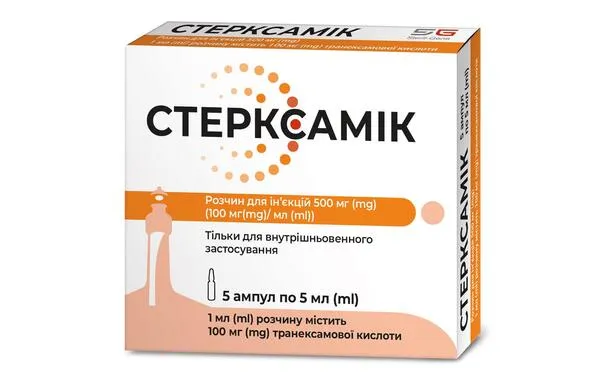
Table of Contents
INSTRUCTIONS FOR MEDICAL USE OF THE MEDICINAL PRODUCT STERKSAMIK
Composition:
Active substance: tranexamic acid;
1 ml of solution contains 100 mg of tranexamic acid;
Excipients: water for injections.
Pharmaceutical form. Solution for injection.
Main physicochemical properties: clear, colorless solution.
Pharmacotherapeutic group. Haemostatic agents, antifibrinolytic amino acids. Fibrinolysis inhibitors.
ATC Code B02A A02.
Pharmacological Properties
Pharmacodynamics
Tranexamic acid exerts an antihemorrhagic effect by inhibiting the fibrinolytic activity of plasmin. A complex is formed involving tranexamic acid and plasminogen; tranexamic acid binds to plasminogen during its conversion involving plasmin. The activity of the tranexamic acid–plasmin complex on fibrin is lower than that of plasmin alone. In vitro studies have shown that high doses of tranexamic acid reduce the activity of this complex.
Pediatric population
Children from 1 year of age. Twelve studies on efficacy in pediatric cardiac surgery, involving 1073 children, have been described in the scientific literature; of these, 631 patients received tranexamic acid. Most were evaluated in comparison with a placebo control group. The study population was heterogeneous with respect to age, type of surgical procedure, and dosing. Study results indicate that tranexamic acid reduces blood loss and the need for blood product transfusions in pediatric cardiac surgery involving cardiopulmonary bypass (CPB), particularly in high-risk bleeding procedures, especially in cyanotic patients (with significant circulatory impairment) or patients undergoing reoperation. The most appropriate dosing regimen identified may be as follows:
- Initial dose (loading dose) — bolus infusion of 10 mg/kg administered after induction of anesthesia and before skin incision;
- continuous infusion at 10 mg/kg/h or intermittent injection into the CPB pump adapter at a dose adjusted for the specific surgical procedure, or at a body weight–based dose of 10 mg/kg, or injection into the CPB pump adapter and a final dose of 10 mg/kg at the end of the surgical procedure involving CPB.
Some data suggest that continuous infusion may be preferable, as it maintains therapeutic plasma concentrations throughout the surgery. No specific dose-response studies have been conducted in children.
Pharmacokinetics
Absorption. Maximum plasma concentration of tranexamic acid is rapidly achieved after short-term intravenous infusion, after which plasma concentrations decline in a multi-exponential manner.
Distribution. At therapeutic plasma levels, the protein binding of tranexamic acid to plasma proteins is approximately 3%; this binding is believed to be entirely attributable to binding with plasminogen. Tranexamic acid does not bind to serum albumin. The initial volume of distribution is approximately 9 to 12 liters.
Tranexamic acid crosses the placental barrier. After intravenous administration of 10 mg/kg in pregnant women, serum concentrations of tranexamic acid range from 10–53 μg/mL, while concentrations in umbilical cord blood range from 4–31 μg/mL. Tranexamic acid rapidly penetrates into joint fluid and synovial membrane tissues. After intravenous administration of 10 mg/kg in 17 patients undergoing knee surgery, concentrations in joint fluid were similar to those in serum. Concentrations in other tissues are proportional to blood levels (in breast milk approximately 1/100, in cerebrospinal fluid 1/10, in intraocular fluid about 1/10). Tranexamic acid has been detected in semen, where it inhibits fibrinolytic activity but has virtually no effect on sperm migration (motility).
Elimination. The drug is primarily excreted unchanged in urine. Renal excretion via glomerular filtration is the main elimination pathway. Renal clearance is practically equivalent to plasma clearance (110–116 mL/min). Approximately 90% of tranexamic acid is excreted within the first 24 hours after intravenous administration of a 10 mg/kg body weight dose. The elimination half-life of tranexamic acid is approximately 3 hours.
Special patient groups. Plasma concentrations increase in patients with renal impairment.
No specific pharmacokinetic studies have been conducted in children.
Clinical Characteristics
Indications
For the prevention and treatment of bleeding caused by generalized or local fibrinolysis in adults and children aged 1 year and older.
Specific indications include:
- Bleeding due to increased systemic or local fibrinolysis, such as:
- Menorrhagia and metrorrhagia;
- Gastrointestinal bleeding;
- Hemorrhagic disorders of the urinary tract occurring after surgical procedures on the prostate or due to surgical interventions or procedures on the urinary tract;
- Use during ENT surgeries (adenoidectomy, tonsillectomy, dental procedures);
- Use during gynecological surgeries or complications in obstetric practice;
- Use during thoracic, abdominal, and other major surgical procedures, e.g., in cardiovascular surgery;
- Use for controlling hemorrhage associated with administration of a fibrinolytic medicinal product.
Contraindications
Hypersensitivity to the active substance or to any excipient.
Acute venous or arterial thrombosis (see section "Special Warnings and Precautions for Use").
Fibrinolytic states due to consumption coagulopathy, except for excessive activation of the fibrinolytic system during acute severe bleeding (see section "Special Warnings and Precautions for Use").
Severe renal insufficiency (risk of accumulation).
History of seizures.
Intrathecal and intraventricular injection, as well as intracerebral administration, are contraindicated (risk of cerebral edema with subsequent development of seizures).
Interaction with Other Medicinal Products and Other Forms of Interactions
Interaction studies have not been conducted.
Concomitant administration with anticoagulants should be performed under strict supervision of a physician experienced in this area.
Patients receiving tranexamic acid should be prescribed with caution other medicinal products affecting hemostasis.
When used concomitantly with estrogens, there is an increased potential for thrombus formation.
The antifibrinolytic effect of tranexamic acid may be inhibited by thrombolytic agents.
Special precautions for use
The specified indications and the following recommendations must be strictly observed:
- Intravenous administration must be very slow (maximum 1 mL per minute);
- Tranexamic acid must not be administered intramuscularly.
Seizures
Cases of seizures associated with tranexamic acid treatment have been reported. Most of these cases occurred after intravenous administration of high doses of tranexamic acid during coronary artery bypass graft (CABG) surgery. When recommended low doses of tranexamic acid are used, the incidence of postoperative seizures is the same as in patients who did not receive tranexamic acid.
Visual disturbances
During treatment with tranexamic acid, possible visual disorders, including decreased visual acuity, blurred vision, and disturbances in color perception, should be monitored. Discontinuation of treatment may be necessary. With continuous long-term use of tranexamic acid, regular ophthalmological examinations (eye examination including assessment of visual acuity, color vision, fundus diagnosis, and visual fields) should be performed. If pathological ophthalmological changes, particularly retinal lesions, are detected, the physician, after consultation with a specialist, should make a decision on a case-by-case basis regarding the necessity of continued long-term use of tranexamic acid.
Hematuria
In cases of bleeding from the upper urinary tract, there is a risk of urethral obstruction.
Thromboembolic complications
Before administering tranexamic acid, risk factors for thromboembolic disorders should be evaluated. Tranexamic acid should be administered to patients with a history of thromboembolic disorders or with increased familial incidence (patients at high risk of thrombophilia) only when there is a clear medical indication, after consultation with a specialist experienced in hemostasis, and under strict medical supervision (see section "Contraindications").
Tranexamic acid should be used with caution in patients taking oral contraceptives due to an increased risk of thrombosis (see section "Interaction with other medicinal products and other forms of interaction").
Disseminated intravascular coagulation (DIC)
Tranexamic acid is generally not recommended for patients with disseminated intravascular coagulation (DIC). The use of tranexamic acid should be restricted to patients with predominant activation of the fibrinolytic system in cases of acute severe bleeding.
The typical hematological profile in these conditions usually includes: shortened fibrinolysis time; prolonged prothrombin time; decreased plasma levels of fibrinogen, factors V and VIII, plasminogen, fibrinolysin, and alpha-2-macroglobulin; normal plasma levels of P and P-complex, i.e., factors II (prothrombin), VIII, and X; elevated plasma levels of fibrinogen degradation products; and normal platelet count. The above assumes that the underlying pathological condition does not alter the various parameters of this profile. In such acute cases, a single dose of 1 g of tranexamic acid is usually sufficient to stop bleeding. The possibility of using tranexamic acid in DIC syndrome should only be considered if appropriate hematological laboratory facilities and clinical experience are available.
Use during pregnancy or breastfeeding
Women of reproductive age should use reliable contraceptive methods during treatment.
Pregnancy
There is insufficient clinical data on the use of tranexamic acid during pregnancy.
Although animal studies do not indicate teratogenic effects, the use of tranexamic acid is not recommended during the first trimester of pregnancy.
Limited clinical data on the use of tranexamic acid in various hemorrhagic conditions during the second and third trimesters of pregnancy do not indicate harmful effects on the fetus.
Tranexamic acid should be used during pregnancy only if the expected benefit to the mother outweighs the potential risks to the mother and fetus.
Lactation
Tranexamic acid passes into breast milk. Breastfeeding is not recommended during treatment with tranexamic acid.
Ability to influence reaction speed when driving vehicles or operating machinery.
Studies evaluating the effect on the ability to drive vehicles or operate machinery have not been conducted.
Method of Administration and Dosage
The use of the medicinal product is strictly limited to slow intravenous administration (injection or infusion).
Adults
Unless otherwise indicated, the following doses are recommended.
Standard treatment of local fibrinolysis:
1 g (2 vials of 5 ml) of tranexamic acid by slow intravenous injection (approximately 1 ml/min) 2–3 times daily.
Standard treatment of systemic fibrinolysis:
1 g (2 vials of 5 ml) of tranexamic acid, equivalent to 15 mg/kg body weight, by slow intravenous injection (approximately 1 ml/min) every 6–8 hours.
Patients with renal impairment
In severe renal insufficiency, which may lead to risk of accumulation, the use of tranexamic acid is contraindicated (see section "Contraindications"). For patients with mild and moderate renal impairment, the dose of tranexamic acid should be reduced according to serum creatinine levels:
| Serum creatinine |
Intravenous dose |
Administration |
|
| μmol/L |
mg/10 mL |
||
| 120–249 |
1.35–2.82 |
10 mg/kg body weight |
Every 12 hours |
| 250–500 |
2.82–5.65 |
10 mg/kg body weight |
Every 24 hours |
| > 500 |
> 5.65 |
5 mg/kg body weight |
Every 24 hours |
Patients with hepatic impairment
Dose adjustment is not required in patients with hepatic impairment.
Elderly patients
If there is no renal impairment, dose adjustment is not required.
Administration method
Administration is strictly limited to slow intravenous injection or infusion at a rate not exceeding 1 mL/min.
The medicinal product may be mixed with electrolyte solutions, amino acids, carbohydrates, and dextran solutions.
Heparin may be added to the medicinal product.
Diluted solutions should be used immediately after dilution.
Tranexamic acid must not be administered intramuscularly.
Intravenous injection. The medicinal product should be administered slowly as a bolus over at least 5 minutes.
Intravenous infusion. The medicinal product should be mixed with the following injection/infusion solutions: sodium chloride 0.9%, Ringer's solution, 5% dextrose solution; dextran-40 in 5% dextrose solution; dextran-40 in 0.9% sodium chloride solution, amino acid solutions.
Children
For children aged 1 year and older, when used according to approved indications, the dose is 20 mg/kg/day. However, data on efficacy, safety, and dosing for these indications are limited.
The efficacy, safety, and dosing of tranexamic acid in children who have undergone cardiac surgery have not been fully established. Limited available data are provided in the "Pharmacodynamics" section.
Overdose
Cases of overdose have not been reported. Signs and symptoms may include dizziness, headache, hypotension, and seizures. Seizures generally occur more frequently with increased doses.
In case of overdose, supportive therapy should be administered.
Side Effects
The table below lists the adverse reactions that occurred during clinical trials and in the post-marketing period.
The frequency of adverse reactions is classified as follows: very common (≥ 1/10); common (≥ 1/100, < 1/10); uncommon (≥ 1/1000, < 1/100); rare (≥ 1/10000, < 1/1000); very rare (≥ 1/100000, < 1/10000), including isolated cases; frequency not known (frequency cannot be estimated from the available data).
| Organ systems |
Frequency |
Adverse reactions |
| Immune system |
Frequency unknown |
Hypersensitivity reactions, including anaphylaxis |
| Nervous system |
Frequency unknown |
Seizures, particularly with incorrect use |
| Eye organs |
Frequency unknown |
Visual disturbances, including color vision disturbances |
| Vascular system |
Frequency unknown |
General malaise with hypotension, with or without loss of consciousness (particularly after rapid intravenous administration, in exceptional cases after oral administration) |
| Gastrointestinal tract |
Common |
Nausea, vomiting, diarrhea |
| Skin and subcutaneous tissue |
Uncommon |
Allergic dermatitis |
Reporting of adverse reactions
Reporting of adverse reactions after registration of the medicinal product is highly important. It enables continuous monitoring of the benefit-risk balance of using this medicinal product. Medical and pharmaceutical professionals, as well as patients or their legal representatives, should report all suspected adverse reactions and lack of efficacy via the Automated Pharmacovigilance Information System at the following link: https://aisf.dec.gov.ua.
Shelf life. 2 years.
Storage conditions. Store in the original packaging at a temperature not exceeding 25 °C. Do not freeze. Keep out of reach and sight of children.
Incompatibility. The medicinal product must not be added to blood for transfusion or to injectable solutions containing penicillin group drugs.
Packaging. 5 ml in an ampoule; 5 ampoules in a blister pack, 1 blister pack in a cardboard box.
Prescription status. Prescription only.
Manufacturer. Steril-Jen Life Sciences (P) Ltd.
Manufacturer's address and location of business activity. No. 45, Mangalam Main Road, Villianur Commune, Puducherry, 605110, India.