Stamaril vaccine for prevention of yellow fever (live attenuated)
Ukraine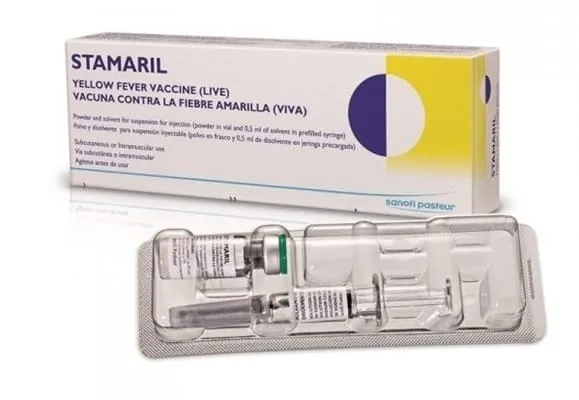
Table of Contents
INSTRUCTIONS FOR MEDICAL USE OF THE MEDICINAL PRODUCT STAMARIL Vaccine for the prevention of yellow fever (live attenuated)
Composition:
Active substance: yellow fever virus, live attenuated;
1 immunizing dose of the vaccine (0.5 ml) contains:
yellow fever virus, strain 17D-204 (live attenuated), cultivated on specific pathogen-free chicken embryos, not less than 1000 CCID50;
Excipients: lactose, sorbitol E420, L-histidine hydrochloride, L-alanine, sodium chloride, potassium chloride, sodium hydrogen phosphate, potassium dihydrogen phosphate, calcium chloride, magnesium sulfate;
Excipient with known properties: each dose of this medicinal product contains approximately 8 mg of sorbitol E420;
Solvent: sodium chloride, water for injections.
Pharmaceutical form. Powder and solvent for suspension for injection.
Main physicochemical properties: the undissolved powder is homogeneous, ranging in color from beige to orange-beige; the solvent is clear and colorless.
Pharmacotherapeutic group. Antimicrobials for systemic use. Vaccines. Viral vaccines. Yellow fever vaccines. Vaccine for prevention of yellow fever (live attenuated). ATC code J07BL01.
Pharmacological Properties
Pharmacodynamics
STAMARIL is a live attenuated vaccine against the yellow fever virus. When live attenuated viral vaccines are administered to healthy individuals, they induce an asymptomatic infection, leading to the development of specific B- and T-cells and the appearance of specific circulating antibodies. A neutralizing antibody titer of 1:10 is considered to confer protection against the yellow fever virus.
Protective immunity develops approximately 10 days after vaccination, lasts for at least 10 years, and may persist for life.
In clinical studies in adults, seroconversion rates ranging between 93% and 100% were observed within 28 days after administration of STAMARIL vaccine.
Pediatric population. In a clinical study involving 337 children aged 12 to 13 months, seropositivity rates for yellow fever 28 days after STAMARIL vaccination were 99.7% (98.5; 100.0), with geometric mean titers of 423 (375; 478). In another clinical study involving 30 children and adolescents aged 2 to 17 years, seroconversion rates ranged from 90% to 100%, confirming results obtained in previous clinical studies.
Pharmacokinetics
Not studied.
Clinical characteristics.
Indications.
STAMARIL is indicated for active immunization against yellow fever in individuals:
- travelling to, transiting through, or residing in areas where there is a constant or periodic risk of yellow fever transmission;
- travelling to any country requiring proof of yellow fever vaccination for entry;
- exposed to potentially infected materials (e.g. laboratory personnel).
Information on the minimum age for vaccination of children under special circumstances and recommendations for vaccination in other specific patient populations are provided in the sections "Instructions for use and dosage", "Contraindications" and "Special precautions".
For up-to-date information on yellow fever vaccination requirements and recommendations, please consult the dedicated website of the World Health Organization (WHO) or official websites of local health authorities.
According to vaccination regulations and requirements for issuing official vaccination certificates, yellow fever vaccines must be administered by qualified and trained healthcare personnel at a WHO-approved vaccination centre, and the data must be recorded in the International Certificate of Vaccination. The validity period of such a certificate is established in accordance with the recommendations of the International Health Regulations (IHR) and begins 10 days after primary vaccination and immediately after booster vaccination (see section "Instructions for use and dosage").
Contraindications.
- Hypersensitivity reaction to components of chicken eggs (chicken protein) or to any component of the STAMARIL vaccine.
- Severe hypersensitivity reactions (e.g. anaphylactic reaction) following previous administration of any yellow fever vaccine.
- Immunosuppression, whether congenital or acquired. This includes individuals receiving immunosuppressive therapy such as treatment with high-dose systemic corticosteroids (e.g. daily dose of 20 mg or 2 mg/kg body weight of prednisone or equivalent for 2 or more weeks, or daily dose of 40 mg or more of prednisone for more than 1 week), or taking any other medicinal products, including biological medicinal products with known immunosuppressive properties, radiotherapy, cytotoxic agents, etc., which may lead to immunosuppression.
- History of thymus dysfunction (including myasthenia gravis, thymoma).
- Thymectomy (regardless of the reason for its occurrence).
- Symptomatic HIV infection.
- Asymptomatic HIV infection if associated with signs of immune system dysfunction (see section "Special precautions").
- Not recommended for children under 6 months of age (see sections "Instructions for use and dosage" and "Special precautions").
- Moderate or severe fever or acute illness.
Interaction with other medicinal products and other forms of interaction.
STAMARIL must not be mixed in the same syringe with any other vaccines or medicinal products.
If another vaccine (vaccines) needs to be administered simultaneously with STAMARIL injection, each vaccine should be administered at different injection sites (and preferably in different limbs).
STAMARIL may be administered simultaneously with measles vaccine, provided this is in accordance with official recommendations.
STAMARIL may be administered simultaneously with typhoid fever vaccines containing Vi-polysaccharide capsule and/or with inactivated hepatitis A virus vaccines.
STAMARIL should not be administered to individuals receiving immunosuppressive therapy such as treatment with high-dose systemic corticosteroids (e.g. daily dose of 20 mg or 2 mg/kg body weight of prednisone or equivalent for 2 or more weeks, or daily dose of 40 mg or more of prednisone for more than 1 week), or taking any other medicinal products, including biological medicinal products with known immunosuppressive properties, radiotherapy, cytotoxic agents, etc., which may lead to immunosuppression (see section "Contraindications"). In cases of uncertainty regarding the level of immunosuppression, vaccination should be postponed and expert advice sought.
Administration of the medicinal product STAMARIL may cause false-positive results in laboratory and/or diagnostic tests for other diseases associated with flaviviruses, such as dengue fever or Japanese encephalitis.
Special precautions for use.
When carrying out immunization in Ukraine, current orders of the Ministry of Health of Ukraine should be followed.
Traceability
To improve traceability of biological medicinal products, the name and batch number of the administered product should be clearly documented in the patient's medical records.
Patients should remain under medical supervision for 30 minutes after vaccination.
Syncope (fainting) may occur following any vaccination or even prior to injection as a psychogenic response to the needle injection. Measures should be taken to prevent injury due to fainting and to manage syncopal reactions.
As with all injectable vaccines, appropriate medical treatment and supervision must be readily available in case of anaphylactic or other severe hypersensitivity reactions following vaccine administration.
STAMARIL should only be administered to individuals who currently have or will have in the future a risk of exposure to yellow fever virus or who require vaccination according to the International Health Regulations. Before considering the use of yellow fever vaccine, the presence of an increased risk of adverse reactions after vaccination should be assessed (see section "Contraindications" and information below).
Yellow fever vaccine-associated neurotropic disease (YEL-AND)
Very rare cases of yellow fever vaccine-associated neurotropic disease (YEL-AND), sometimes complicated and occasionally fatal, have been reported (see section "Adverse reactions"). To date, most cases occurred in individuals receiving the vaccine for the first time, with onset within 30 days after vaccination. The risk is higher in individuals aged over 60 years and in infants under 9 months of age (including breastfed infants exposed to the vaccine virus through breastfeeding), although cases have also been reported in other age groups. Congenital or acquired immunodeficiency is also recognized as a predisposing factor (see section "Contraindications"). However, cases of YEL-AND have also been reported in individuals without any identified risk factors.
Vaccinated individuals should be informed of the need to seek medical attention if they develop any symptoms suggestive of YEL-AND after vaccination, such as high fever associated with headache or confusion, personality changes, or symptoms of severe fatigue, neck stiffness, seizures, loss of motor function, or loss of sensation in parts of or the entire body. Vaccinated individuals should also be reminded to inform their physician that they have been vaccinated with yellow fever vaccine (see section "Adverse reactions").
Yellow fever vaccine-associated viscerotropic disease (YEL-AVD)
Very rare cases of yellow fever vaccine-associated viscerotropic disease (YEL-AVD), resembling fulminant infection caused by wild-type virus, have been reported following vaccination (see section "Adverse reactions"). The case fatality rate is approximately 60%. Most reported cases occurred in individuals receiving the vaccine for the first time, with onset within 10 days after vaccination. The risk is likely higher in individuals aged over 60 years, although cases have also been reported in younger individuals. Thymectomy and thymus disorders have also been identified as predisposing conditions (see sections "Contraindications" and "Adverse reactions"). However, cases of YEL-AVD have also been reported in individuals without any identified risk factors.
Vaccinated individuals should be informed of the need to seek medical attention if they develop any symptoms suggestive of YEL-AVD after vaccination, such as fever, myalgia, fatigue, headache, or arterial hypotension, as these may rapidly progress to liver dysfunction with jaundice, muscle cytolysis, thrombocytopenia, and acute respiratory and renal failure. Vaccinated individuals should also be reminded to inform their physician that they have been vaccinated with yellow fever vaccine (see section "Adverse reactions").
Immunocompromised individuals
STAMARIL should not be administered to immunocompromised individuals (see section "Contraindications").
If immunosuppression is temporary, vaccination should be postponed until immune function is restored. In patients who have received systemic corticosteroids for 14 days or longer, vaccination should preferably be delayed for at least one month after discontinuation of corticosteroid therapy.
HIV infection
STAMARIL should not be administered to individuals with symptomatic HIV infection or asymptomatic HIV infection accompanied by signs of immune system dysfunction (see section "Contraindications"). However, there are currently insufficient data to define immunological markers that could identify individuals who may be safely vaccinated and develop a protective immune response, versus those for whom vaccination may be unsafe and ineffective. Therefore, if a person with asymptomatic HIV infection cannot avoid travel to endemic areas, vaccination may be considered based on an assessment of potential benefits and risks, in accordance with official recommendations.
Children born to HIV-positive mothers
Children aged at least 6 months (see sections "Dosage and administration", "Contraindications", and information below) may be vaccinated if HIV infection has been ruled out.
HIV-infected children aged at least 6 months who may potentially require protection against yellow fever should be referred to a pediatric specialist team for consultation regarding the advisability of vaccination.
Children aged 6 to 9 months
STAMARIL is contraindicated in children under 6 months of age (see section "Contraindications").
Vaccination against yellow fever is not recommended for children aged 6 to 9 months, except under special circumstances (e.g., during major epidemics), in accordance with official recommendations.
Individuals aged 60 years and older
Compared to other age groups, individuals aged over 60 years have an increased risk of serious and life-threatening adverse reactions, including systemic and neurological reactions lasting more than 48 hours, and cases of YEL-AVD and YEL-AND.
The vaccine should only be administered to individuals traveling to regions where there is a risk of yellow fever transmission during travel. Countries designated by WHO where vaccination is not routinely recommended or not recommended should be considered as having no significant or unavoidable risk (see updated list of countries with risk of yellow fever infection, WHO) (see information above and section "Adverse reactions").
Pregnancy and breastfeeding
STAMARIL should not be administered to pregnant women or women who are breastfeeding, except in cases of extreme necessity and only after careful assessment of risks and benefits (see section "Pregnancy and breastfeeding").
Transmission
A very small number of reports suggest the possibility of transmission of the yellow fever virus contained in the vaccine from a mother who received the yellow fever vaccine postpartum and is breastfeeding to her infant. After transmission, the infant may develop yellow fever vaccine-associated neurotropic disease (YEL-AND), from which infants may recover (see section "Pregnancy and breastfeeding").
Like any other vaccine, STAMARIL may not provide 100% protection in vaccinated individuals.
DO NOT ADMINISTER INTRAVENOUSLY.
Since hematoma may occur at the site of intramuscular injection, STAMARIL should not be administered intramuscularly to individuals with any coagulation disorders, such as hemophilia or thrombocytopenia, or to individuals receiving anticoagulant therapy. Instead, the vaccine should be administered subcutaneously.
This vaccine should not be administered to patients with the rare hereditary conditions fructose intolerance.
Latex
Needle caps included with pre-filled syringes contain natural rubber latex, which may cause allergic reactions in latex-sensitive individuals.
One dose of this medicinal product contains:
less than 1 mmol (39 mg)/dose of potassium, i.e., the medicinal product is practically potassium-free;
less than 1 mmol (23 mg)/dose of sodium, i.e., the medicinal product is practically sodium-free.
One dose of this medicinal product contains approximately 8 mg of sorbitol E420.
If an individual has been diagnosed with intolerance to certain sugars, medical advice should be sought before administering this medicinal product.
Pregnancy and breastfeeding.
Pregnancy
Reproductive toxicity studies of the STAMARIL vaccine in animals have not been conducted, and the potential risk to humans is unknown. Data from a limited number of cases of STAMARIL vaccine use during pregnancy suggest no adverse effect on pregnancy or fetal/neonatal health. However, since STAMARIL is a live attenuated vaccine, it should not be used during pregnancy except when absolutely necessary and only after careful evaluation of potential risks and benefits. Pregnancy should be avoided for one month following vaccination.
Lactation
Due to the potential risk of transmission of the vaccine virus strain from a breastfeeding mother to her infant, STAMARIL should not be administered to breastfeeding women except in cases of extreme necessity, such as during an epidemic outbreak, and when the potential benefit to the mother outweighs the potential risks, particularly to the breastfed infant (see section "Special precautions for use"). If vaccination is performed, breastfeeding should be interrupted for at least 2 weeks after vaccination.
Fertility
Fertility studies with STAMARIL in animals have not been conducted, and there are currently no data on the effect of the vaccine on fertility in humans.
Ability to drive and use machines.
No studies on the effect of vaccination on the ability to drive or operate machinery have been conducted.
Administration and Dosage
When conducting immunization in Ukraine, current orders of the Ministry of Health of Ukraine must be followed.
Vaccination is administered by medical personnel in preventive vaccination clinics of healthcare facilities.
Dosage
Primary Vaccination
Adults and children from 9 months of age: a single dose of 0.5 mL of reconstituted vaccine.
Children under 9 months of age: vaccination is contraindicated in children under 6 months of age (see section "Contraindications"). Vaccination against yellow fever is not recommended for children aged 6 to 9 months, except under special circumstances according to official recommendations. In such cases, the dose is the same as that for children from 9 months of age and for adults.
The vaccine should be administered at least 10 days before travel to an endemic area, as protective immunity is achieved only after a minimum of 10 days.
Elderly Patients
The dose is the same as for other adults. However, due to the higher risk of severe and potentially fatal adverse events associated with the yellow fever vaccine, administration to individuals aged 60 years and older should be considered only when there is a significant and unavoidable risk of exposure to yellow fever virus, such as during travel to regions with continuous or periodic risk of yellow fever virus transmission (see sections "Special Warnings and Precautions" and "Adverse Reactions").
Revaccination
Protection following a single 0.5 mL dose of the medicinal product STAMARIL is expected to last for at least 10 years and may persist for life.
According to WHO recommendations and the International Health Regulations, the certificate of yellow fever vaccination is valid for the lifetime of the vaccinated individual. However, revaccination with a single 0.5 mL dose may be required for patients who have an inadequate immune response after primary vaccination and who remain at risk of yellow fever virus infection. Revaccination may also be necessary depending on official recommendations from local health authorities.
Administration Method
The vaccine is preferably administered by subcutaneous injection.
Intramuscular injection may be used if consistent with current official recommendations.
Recommended sites for intramuscular injection are the anterolateral aspect of the thigh in children under 12 months of age, the anterolateral thigh (or deltoid muscle if muscle mass is sufficient) in children aged 12 to 35 months, or the deltoid muscle in children aged 36 months and older and adults.
DO NOT ADMINISTER INTRAVENOUSLY.
For syringe without attached needle only: after removing the syringe cap, firmly press the needle onto the syringe tip and secure it by turning a quarter turn (90°).
The powder is reconstituted by adding the diluent supplied in a pre-filled syringe into the vial. The vial should be shaken and, after complete dissolution of the powder, the resulting suspension should be drawn back into the same syringe for injection.
The reconstituted vaccine should be shaken vigorously immediately before administration.
Use immediately after reconstitution.
After reconstitution, the suspension should be beige to pinkish-beige in color and more or less opalescent.
Contact with disinfectants should be avoided, as they may inactivate the virus.
Any unused medicinal product or waste material must be disposed of in accordance with local requirements.
Children
STAMARIL is contraindicated in children under 6 months of age.
Vaccination against yellow fever is not recommended for children aged 6 to 9 months, except under special circumstances. In such cases, the vaccine should be administered according to official recommendations at the same dose as for children from 9 months of age and adults (see sections "Administration and Dosage", "Contraindications", and "Special Warnings and Precautions").
Overdose
Cases of STAMARIL administration at doses exceeding the recommended dose (overdose) have been reported. The reported adverse reactions were consistent with the known safety profile of STAMARIL (see section "Adverse Reactions").
Adverse reactions
Reports of serious adverse events such as severe hypersensitivity or anaphylactic reactions, neurotropic or viscerotropic disease (NT-VTLD, VT-VTLD), have been recorded during the post-marketing period of the medicinal product's use (see below "List of adverse reactions" and "Description of selected adverse reactions").
A total of 4896 patients of all age groups received STAMARIL in all clinical studies. In the most representative study conducted in the general population, the most frequently reported adverse reactions (in 12–18% of patients) were headache, asthenia, injection site pain, and myalgia.
In the most representative study conducted in young children, the most frequently reported adverse reactions (in 32–35% of patients) were irritability, crying, and loss of appetite.
Adverse reactions usually developed within the first three days after vaccination, except for fever, which occurred between days 4 and 14.
These reactions were generally transient and lasted no more than 3 days.
Both local and systemic reactions were mostly mild in intensity; however, at least one severe local reaction was recorded in 0.8% of patients in the general population and in 0.3% of young children, and at least one severe systemic reaction was recorded in 1.4% of patients in the general population and in 4.9% of young children.
List of adverse reactions
The table below presents data on the frequency of adverse reactions reported after vaccination with STAMARIL in clinical trials and during post-marketing surveillance in various countries worldwide.
Adverse reactions are classified by frequency of occurrence as follows:
- Very common: ≥ 1/10
- Common: ≥ 1/100 to < 1/10
- Uncommon: ≥ 1/1000 to < 1/100
- Rare: ≥ 1/10,000 to < 1/1000
- Very rare: < 1/10,000
- Frequency not known: cannot be estimated from the available data
Within each frequency group, adverse reactions are listed in order of decreasing severity.
| Body systems |
Frequency |
Adverse reactions |
| Infections and infestations |
Uncommon |
Rhinitis |
| Very rare |
VR-URI‡ |
|
| Blood and lymphatic system disorders |
Frequency unknown |
Lymphadenopathy |
| Immune system disorders |
Frequency unknown |
Anaphylactoid reaction, including angioneurotic edema |
| Metabolism and nutrition disorders |
Very common |
Loss of appetite* |
| Nervous system disorders |
Very common |
Somnolence*, headache |
| Uncommon |
Dizziness |
|
| Very rare |
VR-URI‡, convulsions, aseptic meningitis |
|
| Frequency unknown |
Paraesthesia |
|
| Gastrointestinal disorders |
Very common |
Vomiting† |
| Common |
Nausea |
|
| Uncommon |
Abdominal pain |
|
| Rare |
Diarrhea |
|
| Skin and subcutaneous tissue disorders |
Common |
Rash |
| Uncommon |
Pruritus |
|
| Frequency unknown |
Urticaria |
|
| Musculoskeletal and connective tissue disorders |
Very common |
Myalgia |
| Common |
Arthralgia |
|
| General disorders and administration site conditions |
Very common |
Restlessness*, crying*, pyrexia†, asthenia, pain/tenderness at injection site |
| Common |
Erythema/redness at injection site, bruising at injection site, induration at injection site, swelling at injection site |
|
| Uncommon |
Papule at injection site |
|
| Frequency unknown |
Influenza-like illness |
* Characteristic of the pediatric population (see below "Pediatric population").
‡ See below "Description of individual adverse reactions".
† Very common in young children (see below "Pediatric population"), common in the general population.
Description of individual adverse reactions
Cases of neurotropic disease (so-called YEL-AND, Yellow Fever Vaccine-Associated Neurologic Disease), including fatal cases, have been reported within 30 days after administration of the STAMARIL vaccine and other yellow fever vaccines (see section "Special precautions for use"). Neurotropic disease may present as encephalitis (with or without demyelination) or as a neurologic disease affecting the peripheral nervous system (e.g., Guillain-Barré syndrome). Encephalitis usually begins with symptoms such as high fever and headache, possibly progressing to encephalopathy (e.g., confusion, lethargy, personality changes lasting more than 24 hours, focal neurological signs, cerebellar dysfunction, or seizures). YEL-AND with peripheral nervous system involvement typically presents with bilateral limb weakness or cranial nerve palsy, accompanied by diminished or absent tendon reflexes (see section "Special precautions for use").
Neurological disorders not meeting the criteria for YEL-AND have also been reported. Manifestations may include cases of aseptic meningitis or seizures not associated with focal neurological signs. These manifestations are usually mild to moderate in severity and resolve spontaneously.
Cases of viscerotropic disease (so-called YEL-AVD, previously termed "febrile multi-organ failure") have been reported after administration of the STAMARIL vaccine and other yellow fever vaccines, some of which have been fatal (see section "Special precautions for use"). Symptoms typically appear within 10 days after vaccination. Initial non-specific signs and symptoms such as fever, myalgia, increased fatigue, headache, and arterial hypotension may progress to liver dysfunction with jaundice, rhabdomyolysis, thrombocytopenia, and/or acute renal or respiratory failure (see section "Special precautions for use").
Pediatric population
The safety of the STAMARIL medicinal product in the pediatric population was studied in a clinical trial involving 393 children aged 12–13 months who received STAMARIL and placebo simultaneously.
The safety profile was assessed during the first 4 weeks after vaccination.
The most frequently reported adverse reactions characteristic of the pediatric population, recorded with "very common" frequency, were: irritability (34.7%), loss of appetite (33.7%), crying (32.1%), and somnolence (22%).
Other adverse reactions reported in young children were also observed in studies conducted in the general population:
- Injection site pain (17.6%), elevated body temperature (16.5%), and vomiting (17.1%) were reported as very common adverse reactions in young children. Elevated body temperature and vomiting occurred more frequently than in the general population (see above "List of adverse reactions").
- Erythema at the injection site (9.8%) and swelling at the injection site (4.4%) were reported as common adverse reactions in young children, as in the general population, but with significantly higher frequency compared to the general population.
Other patient populations
Congenital or acquired immunodeficiency has been identified as a risk factor for the development of serious adverse reactions, including neurotropic disease (see sections "Contraindications" and "Special precautions for use").
Age over 60 years has been identified as a risk factor for the development of neurotropic and viscerotropic diseases associated with yellow fever vaccination (see section "Special precautions for use"). Age under 9 months (including infants exposed to the vaccine through breastfeeding) (see section "Special precautions for use") is considered a potential risk factor for YEL-AND. A history of thymus disease or thymectomy has also been identified as a predisposing condition for the development of viscerotropic disease (see sections "Contraindications" and "Special precautions for use").
Reporting suspected adverse reactions
Reporting of suspected adverse reactions after marketing authorization of the medicinal product is important. It allows continuous monitoring of the benefit-risk balance of the medicinal product. Healthcare and pharmacy professionals, as well as patients or their legal representatives, should report all suspected adverse reactions and lack of efficacy through the Automated Information System for Pharmacovigilance at the following link: https://aisf.dec.gov.ua/.
Shelf life.
3 years.
After reconstitution, the vaccine should be used immediately.
Storage conditions.
Store out of sight and reach of children. Store in a refrigerator (2–8 °C). Do not freeze. Keep the vial with powder and the syringe with solvent in the outer cardboard packaging to protect the medicinal product from light. Do not use after the expiry date stated on the packaging. The expiry date refers to the last day of the month indicated on the packaging.
Incompatibilities.
Due to lack of compatibility studies, this vaccine should not be mixed with other medicinal products.
Packaging.
Powder and solvent for suspension for injection:
1 dose in vials (Type I glass) with stopper (chlorobutyl rubber) and aluminum cap with tear-off ring, supplied with 0.5 mL solvent in pre-filled syringes (Type I glass) with piston seal (halobutyl) and attached needle and needle cap (natural rubber or polyisoprene), 1 vial with solvent in pre-filled syringe with attached needle in a cardboard box; 1 vial with solvent in pre-filled syringe with attached needle in standard export packaging contained in a cardboard box with package leaflet;
1 dose in vials (Type I glass) with stopper (chlorobutyl rubber) and aluminum cap with tear-off ring, supplied with 0.5 mL solvent in pre-filled syringes (Type I glass) with piston seal (halobutyl) and syringe cap (styrene-butadiene) with 1 or 2 separate needles, 1 vial with solvent in pre-filled syringes with 1 or 2 separate needles in a blister pack in a cardboard box; 1 vial with solvent in pre-filled syringes with 1 or 2 separate needles in a blister pack in standard export packaging contained in a cardboard box with package leaflet.
Prescription category.
Prescription only.
Manufacturers.
Sanofi Pasteur, France.
Sanofi-Aventis Zrt., Hungary.
Manufacturers' locations and addresses of their business premises.
Parc Industriel D'Incarville, Voie De L'Institut, P.O. Box 101, Val de Reuil, 27100, France.
Parc Industriel D Incarville, Voie De L Institut, P. O. Box 101, Val De Reuil, 27100, France.
1541 avenue Marcel Mérieux, 69280 Marcy l’Etoile, France.
1541 avenue Marcel Merieux, 69280 Marcy l’Etoile, France.
Building 5, Kampona Utca 1, Budapest XXII, 1225, Hungary.
Marketing authorization holder: Sanofi Pasteur / Sanofi Pasteur
Location of marketing authorization holder:
14 Espace Henri Vallée, 69007 Lyon, France.
14 Espace Henry Vallée, 69007 Lyon, France.