Spironolactone-darnitsa
Ukraine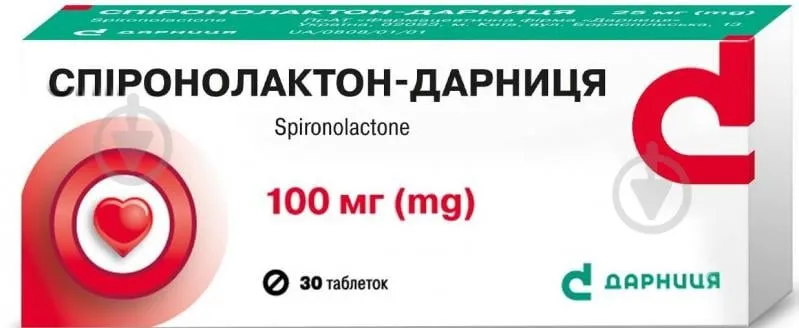
Table of Contents
INSTRUCTION FOR MEDICAL USE OF THE MEDICINAL PRODUCT SПІРОНОЛАКТОН-ДАРНИЦЯ (SPIRONOLACTONE-DARNITSA)
Composition:
Active substance: spironolactone;
1 tablet contains spironolactone 100 mg;
Excipients: potato starch, lactose monohydrate, povidone, calcium stearate.
Pharmaceutical form. Tablets.
Main physico-chemical properties: flat cylindrical tablets with bevelled edges and a score line, white or white with a creamy shade.
Pharmacotherapeutic group. Potassium-sparing diuretics. Aldosterone antagonists. Spironolactone. ATC code C03DA01.
Pharmacological Properties
Pharmacodynamics
The active ingredient of the medicinal product, spironolactone, is a competitive antagonist of aldosterone that acts on the distal renal tubules. By blocking aldosterone, it inhibits the retention of water and Na+ ions and promotes the retention of K+ ions, thereby not only increasing the excretion of Na+ and Cl− ions but also reducing the excretion of K+ ions in urine, as well as decreasing the excretion of H+ ions. As a result, the diuretic effect also has antihypertensive activity.
Pharmacokinetics
Spironolactone is rapidly and completely absorbed from the gastrointestinal tract. It is highly bound to plasma proteins (approximately 90%). Spironolactone undergoes rapid metabolism, with 7α-thiomethylspironolactone and canrenone being its active metabolites. Although the elimination half-life of spironolactone itself is short (1.3 hours), the half-lives of its active metabolites are longer (from 2.8 to 11.2 hours). The metabolites are primarily excreted in urine; a small portion is excreted in feces. Spironolactone and its metabolites cross the placenta and are distributed into breast milk.
After administration of 100 mg of spironolactone daily for 15 days in healthy volunteers, the time to reach peak plasma concentration (tmax), peak plasma concentration (Cmax), and elimination half-life (t1/2) of spironolactone were 2.6 hours, 80 ng/mL, and approximately 1.4 hours, respectively. For 7α-thiomethylspironolactone and canrenone, these values were 3.2 and 4.3 hours; 391 ng/mL and 181 ng/mL; and 13.8 and 16.5 hours, respectively.
The renal effect of a single dose of spironolactone reaches its peak after 7 hours and persists for at least 24 hours.
Clinical characteristics.
Indications.
- Primary hyperaldosteronism.
- Congestive heart failure – when other diuretics are ineffective or not tolerated, or when it is necessary to enhance their efficacy.
- Essential arterial hypertension, particularly in the presence of hypokalemia – usually in combination with other antihypertensive drugs.
- Liver cirrhosis associated with edema and/or ascites.
- Edema due to nephrotic syndrome.
- Hypokalemia – when alternative therapies cannot be used.
- Prevention of hypokalemia in patients receiving cardiac glycosides – when other treatment options are considered inappropriate or unsuitable.
Contraindications.
- Hypersensitivity to the active substance or to any of the excipients.
- Acute renal failure, severe impairment of renal excretory function (glomerular filtration rate < 10 mL/min), anuria.
- Heart failure if glomerular filtration rate is less than 30 mL/min or serum creatinine concentration exceeds 220 µmol/L.
- Hyperkalemia, hyponatremia.
- Addison's disease.
- Concomitant use with potassium-sparing diuretics and potassium supplements – due to the risk of developing hyperkalemia.
- Pregnancy and breastfeeding.
Interaction with other medicinal products and other forms of interaction.
Concomitant use of spironolactone with other medicinal products may cause:
With antihypertensive agents (especially ganglion blockers, nicardipine, nimodipine) – excessive reduction in blood pressure; when used concomitantly, the dose of antihypertensive agents should be reduced, with subsequent adjustment as necessary. Since angiotensin-converting enzyme (ACE) inhibitors reduce aldosterone production, these agents should not be used concomitantly with spironolactone on a long-term basis, especially in patients with established renal impairment;
With ammonium chloride, cholestyramine – development of hyperkalemia and hyperchloremic metabolic acidosis;
With potassium-sparing diuretics, potassium supplements, ACE inhibitors, angiotensin II receptor blockers, aldosterone receptor blockers, anticholinesterase agents, tacrolimus, cyclosporine – development of severe hyperkalemia; concomitant use with potassium-sparing diuretics and potassium supplements is contraindicated due to the risk of hyperkalemia;
With nitroglycerin, other nitrates or vasodilators – enhanced antihypertensive effect of spironolactone;
With trimethoprim/sulfamethoxazole combination (antibiotic, so-called Co-trimoxazole) – clinically significant hyperkalemia;
With other diuretics – enhanced diuretic effect;
With immunosuppressants, cyclosporine, and tacrolimus – development of spironolactone-induced hyperkalemia;
With nonsteroidal anti-inflammatory drugs (NSAIDs) – development of hyperkalemia and renal failure, accompanied by reduced diuretic, natriuretic, and antihypertensive effects of spironolactone; when used concomitantly with acetylsalicylic acid, prostaglandin synthesis is also inhibited, and with antipyrine – its metabolism in the liver is enhanced;
With glucocorticoids, adrenocorticotropic hormone (ACTH) – enhanced diuretic and natriuretic effects of spironolactone, and paradoxical increase in potassium excretion, potentially leading to hypokalemia;
With α- and β-adrenergic agonists, carbenoxolone – reduced efficacy of spironolactone;
With antipsychotics, tricyclic antidepressants – enhanced antihypertensive effect of spironolactone;
With barbiturates, narcotic drugs, ethanol – orthostatic hypotension;
With pressor amines (norepinephrine) – reduced vascular response to norepinephrine. Therefore, caution should be exercised when administering local or general anesthesia in patients receiving spironolactone;
With terfenadine – development of ventricular arrhythmia due to hypokalemia and imbalance of other electrolytes;
With carbamazepine – development of hyponatremia;
With lithium preparations – development of lithium toxicity due to reduced renal clearance of lithium; these drugs should not be used concomitantly;
With antipyrine – accelerated metabolism of antipyrine;
With carbenoxolone – sodium retention and, consequently, reduced efficacy of spironolactone. Concomitant use of carbenoxolone and spironolactone should be avoided;
With indirect anticoagulants (coumarin derivatives), mitotane, pressor amines (epinephrine), cardiac glycosides – reduced efficacy of these medicinal products;
With heparin, low-molecular-weight heparin – severe hyperkalemia;
With triptorelin, buserelin, gonadorelin – enhanced effect of GnRH (gonadotropin-releasing hormone) analogs;
With digoxin – development of glycoside toxicity due to prolonged elimination half-life. When spironolactone is taken, a reduction in digoxin dose may be required. Close monitoring of the patient is necessary to prevent digoxin overdose or inadequate digitalization;
With abiraterone – when used concomitantly, spironolactone binds to the androgen receptor, potentially increasing prostate-specific antigen (PSA) levels in patients with prostate cancer treated with abiraterone. Concomitant use with abiraterone is not recommended;
With aliskiren – reduces plasma concentration of furosemide after oral administration. Reduced furosemide effect may occur in patients receiving both aliskiren and oral furosemide; therefore, monitoring for reduced diuretic effect is recommended, with appropriate dose adjustment.
Effect of the medicinal product on laboratory test results: There have been several reported cases of spironolactone or its metabolites interfering with digoxin concentration measurements by radioimmunoassay. The clinical significance of this interaction is currently undefined.
In fluorometric analysis, spironolactone may interfere with test results for compounds with similar fluorescence parameters (e.g., cortisol, epinephrine).
Special precautions for use.
The use of this medicinal product, especially in patients with impaired renal function, may cause transient increases in blood urea nitrogen levels and hyperkalemia, which may lead to cardiac rhythm disturbances and reversible hyperchloremic metabolic acidosis. The medicinal product should be used with caution in patients with impaired renal or hepatic function and in elderly patients. Plasma electrolyte levels and renal function parameters should be monitored periodically. If hyperkalemia develops, treatment with the drug should be discontinued.
Concomitant use of spironolactone with medicinal products that may cause hyperkalemia (e.g., other potassium-sparing diuretics, ACE inhibitors, angiotensin II receptor antagonists, aldosterone blockers, heparin, low-molecular-weight heparin, potassium supplements, potassium-rich diet, or use of potassium-containing salt substitutes) may result in severe hyperkalemia.
Hyperkalemia can be fatal. Monitoring and correction of potassium levels is critically important in patients with severe heart failure receiving spironolactone. The drug should not be used concomitantly with other potassium-sparing diuretics. Potassium supplements are contraindicated in patients with serum potassium levels above 3.5 mEq/L. Recommended monitoring frequency for potassium and creatinine is one week after initiation of treatment or dose increase of spironolactone, monthly during the first 3 months, then quarterly for one year, and thereafter every 6 months. If serum potassium exceeds 5 mEq/L or creatinine exceeds 4 mg/dL, spironolactone should be temporarily or permanently discontinued.
Spironolactone should be used with particular caution in patients with porphyria, as many medicinal products may provoke porphyria exacerbations.
The medicinal product should be used with caution in patients whose underlying conditions may predispose to acidosis and/or hyperkalemia.
The drug should be used with caution in patients with diabetes mellitus, particularly in the presence of diabetic nephropathy.
Spironolactone therapy may interfere with laboratory determination of cortisol, epinephrine, and digoxin concentrations using radioimmunoassay methods.
Prolonged, unjustified use of the medicinal product should be avoided, as studies in animals have shown that long-term administration of spironolactone at maximum doses may promote the development of carcinomas and myeloid leukemia.
Alcohol consumption is prohibited during treatment with this medicinal product.
Important information about excipients.
The medicinal product contains lactose; therefore, it should not be administered to patients with rare hereditary forms of galactose intolerance, lactase deficiency, or glucose-galactose malabsorption syndrome.
Use during pregnancy or breastfeeding.
The medicinal product is contraindicated during pregnancy and breastfeeding.
Pregnancy.
Spironolactone has antiandrogenic effects in humans and therefore should not be used during pregnancy. Spironolactone or its metabolites cross the placental barrier. In pregnant rats treated with spironolactone, feminization of male fetuses has been observed, and endocrine disturbances were noted in offspring of both sexes after birth.
Breastfeeding.
Spironolactone metabolites have been detected in breast milk.
If spironolactone treatment is necessary, breastfeeding should be discontinued.
Ability to influence the reaction rate when driving or operating machinery.
During the initial period of treatment, the duration of which is individual for each patient, driving vehicles or operating machinery, especially activities associated with a high risk of injury, is prohibited. Subsequently, restrictions should be individually assessed for each patient.
Dosage and Administration.
The medicinal product is taken orally by adults and children.
The daily dose of the medicinal product should be taken in 1 or 2 doses after meals. Administration of the daily dose as a single dose or the first dose in a twice-daily regimen is recommended in the morning.
The duration of treatment is individual and may last several years in some cases. The medicinal product should be administered at the lowest effective daily dose, with regular monitoring of serum electrolyte levels and renal function parameters.
Adults.
Primary hyperaldosteronism.
For preoperative preparation, the medicinal product should be administered at a dose of 100–400 mg per day.
If surgical treatment is not possible, the medicinal product may be used as long-term maintenance therapy at the lowest effective dose, which is determined individually.
In this case, the initial dose may be reduced every 14 days until the minimum effective dose is achieved. If lower doses of the medicinal product are required, Spironolactone-Darnitsya tablets of the appropriate strength should be used. During prolonged treatment, it is recommended to administer the medicinal product in combination with other diuretics to reduce adverse effects.
Congestive heart failure, edema associated with nephrotic syndrome.
The medicinal product should be administered at an initial dose of 100 mg per day in 1 or 2 doses. The daily dose may also range from 25 to 200 mg.
When higher doses are prescribed, the medicinal product may be administered in combination with other diuretics acting in more proximal segments of the renal tubules. In such cases, the dose of spironolactone should be adjusted accordingly.
Essential arterial hypertension.
The medicinal product should be administered at an initial dose of 50–100 mg per day in 1 or 2 doses in combination with other antihypertensive agents. Treatment should be continued for at least 2 weeks, as maximum antihypertensive effect is achieved by the end of this period. Further dose adjustment is individual, depending on the therapeutic response.
Cirrhosis of the liver accompanied by ascites or edema.
If the urinary Na+/K+ ratio is greater than 1, the medicinal product should be administered at an initial dose of 100 mg per day. The maximum daily dose is 100 mg/day. If this ratio is less than 1, the medicinal product should be administered at a dose of 200 mg per day, with a maximum daily dose of 400 mg/day.
Hypokalemia.
The medicinal product should be administered at a dose of 25–100 mg per day to patients who do not respond adequately to dietary potassium supplements or other potassium-replacement therapies.
Children.
The medicinal product should be administered at a dose of 1–3 mg/kg body weight per day in 1 or 2 doses. For maintenance therapy in combination with other diuretics, the daily dose is 1–2 mg/kg body weight.
Elderly patients.
The medicinal product is recommended to be administered at lower doses, with gradual dose escalation until the maximum effect is achieved. It should be noted that this patient group may have hepatic and renal impairments that can affect drug metabolism and excretion.
Children.
The medicinal product is used in pediatric practice as prescribed by a physician.
Overdose.
Symptoms: drowsiness/lethargy, confusion, maculopapular or erythematous rashes, nausea, vomiting, dizziness, diarrhea, arrhythmia, cardiac conduction disturbances, and electrolyte imbalances such as hyponatremia, hypokalemia, or hyperkalemia, particularly in patients with impaired renal function. In patients with severe liver disease, hepatic coma may occur, although it is unlikely to be related to acute spironolactone overdose.
Hyperkalemia may manifest as paresthesia, weakness, flaccid paralysis, or muscle cramps, and it may be clinically difficult to differentiate from hypokalemia. ECG changes are the first specific signs of potassium imbalance.
Treatment of hyperkalemia: symptomatic; there is no specific antidote.
Maintenance of water-electrolyte and acid-base balance should be achieved using potassium-wasting diuretics, intravenous administration of glucose with insulin, and, in severe cases, hemodialysis.
Treatment of hyponatremia: 1M sodium chloride solution or, in the presence of concomitant acidosis, 1M sodium bicarbonate solution should be administered as an additive to the carrier solution.
Adverse Reactions
Adverse reactions are due to the competitive antagonism of aldosterone, which increases potassium excretion, and the antiandrogenic effect of spironolactone.
All adverse reactions are listed by organ systems and frequency: very common (≥ 1/10), common (≥ 1/100 – < 1/10), uncommon (≥ 1/1,000 – < 1/100), rare (≥ 1/10,000 – < 1/1,000), very rare (< 1/10,000), frequency not known (cannot be estimated from available data).
Eye disorders: uncommon – visual disturbances.
Respiratory, thoracic and mediastinal disorders: very rare – voice alteration7.
Gastrointestinal disorders: common – nausea, vomiting; uncommon – dry mouth; rare – abdominal and stomach pain, diarrhea, gastritis, gastric and duodenal ulcer, gastrointestinal hemorrhage; frequency not known – decreased appetite, constipation, intestinal colic.
Hepatobiliary disorders: very rare – hepatitis; frequency not known – liver function abnormalities.
Renal and urinary disorders: very rare – acute renal failure.
Endocrine disorders: uncommon – menstrual disorders; very rare – hirsutism.
Metabolism and nutrition disorders: very common – hyperkalemia1; common – hyperkalemia2; rare – hyponatremia, dehydration, porphyria; frequency not known – hypercreatinemia, increased plasma urea levels, hyperuricemia, metabolic hyperchloremic acidosis or alkalosis.
Nervous system and psychiatric disorders: uncommon – headache, drowsiness3, confusion; very rare – paralysis, paraplegia; frequency not known – dizziness, ataxia, lethargy, sluggishness.
Cardiac disorders: very common – arrhythmia4; very rare – vasculitis; frequency not known – arterial hypotension, orthostatic regulation disorders.
Blood and lymphatic system disorders: very rare – leukopenia (including agranulocytosis), thrombocytopenia, eosinophilia; frequency not known – megaloblastic or aplastic anemia.
Immune system disorders: rare – hypersensitivity reactions.
Skin and subcutaneous tissue disorders: rare – rash, urticaria; very rare – alopecia, annular erythema and skin changes resembling systemic lupus erythematosus and lichen planus, eczema; frequency not known – bullous pemphigoid6, hypertrichosis, Stevens-Johnson syndrome, hyperemia, pruritus, toxic epidermal necrolysis, drug fever, drug reaction with eosinophilia and systemic symptoms (DRESS syndrome).
Musculoskeletal and connective tissue disorders: very rare – osteomalacia; frequency not known – muscle spasms, leg muscle cramps.
Reproductive system and breast disorders: very common – decreased libido, erectile dysfunction, gynecomastia (in men), menstrual cycle disturbances, dysmenorrhea, amenorrhea8, postmenopausal metrorrhagia, nipple tenderness, breast swelling and tenderness in women, breast pain (in men), breast enlargement; common – infertility5; uncommon – sexual potency disturbances; frequency not known – benign breast tumors.
General disorders: uncommon – asthenia, increased fatigue.
Laboratory findings: very rare – increased serum urea levels, increased serum creatinine levels; frequency not known – increased glycated hemoglobin (HbA1c)6.
Usually, adverse effects resolve after discontinuation of spironolactone.
1 In patients with renal impairment and in patients receiving potassium supplements concurrently.
2 In elderly patients, patients with diabetes mellitus, and patients receiving ACE inhibitors concurrently.
3 In patients with hepatic cirrhosis.
4 In patients with renal impairment and in patients receiving potassium supplements concurrently with spironolactone.
5 When the drug is used at high doses (450 mg/day).
6 Usually with long-term use.
7 Voice alteration (particularly hoarseness) in some patients does not resolve even after discontinuation of spironolactone.
8 Dose-dependent.
Metabolism and Digestive Disorders
During spironolactone use, life-threatening hyperkalemia may occur, primarily in patients with impaired renal function, and may manifest as muscle paralysis (hyperkalemic paralysis) and arrhythmia. Therefore, additional intake of potassium supplements, other potassium-sparing diuretics, or a potassium-rich diet should be avoided.
In case of impaired renal function, disturbances in water-electrolyte balance (hyponatremia, hypomagnesemia, hyperchloremia, hypercalcemia) may occur due to increased excretion of water and electrolytes.
Due to excessive diuresis, hypovolemia and hyponatremia may develop in patients. Hyponatremia may occur primarily after excessive water intake during spironolactone therapy. Electrolyte imbalances in blood may lead to loss of appetite, dry mouth, thirst, vomiting, headache or flushing, asthenia, vertigo, drowsiness, fatigue, visual disturbances, apathy, confusion, generalized myasthenia, muscle spasms (cramps in the calves), as well as arrhythmia and circulatory disorders (see adverse reactions under "Cardiac disorders"). Therefore, replacement of unwanted fluid loss (e.g., due to vomiting, diarrhea, hyperhidrosis) is necessary.
In case of irregular pulse, fatigue, or myasthenia (e.g., in the legs), hyperkalemia should be considered. Lethargy and confusion have been observed after high-dose administration.
Serum electrolyte balance (particularly potassium, sodium, and calcium) should be monitored regularly.
At the beginning of therapy and during prolonged use of spironolactone, serum potassium levels should be monitored at regular intervals to prevent excessive potassium accumulation in blood.
Acid-base balance disturbances are possible. Spironolactone may induce or exacerbate hyperchloremic metabolic acidosis.
Cases of reversible increases in serum concentrations of nitrogenous compounds normally excreted in urine (urea, creatinine) have been reported uncommonly.
Hyperuricemia occurs frequently during spironolactone therapy. This may lead to acute gout attacks in predisposed patients.
Serum concentrations of urea, creatinine, and uric acid, as well as acid-base balance and water-electrolyte equilibrium, should be monitored regularly during spironolactone therapy.
Cardiac Disorders
Excessive diuresis leading to hypovolemia may result in headache, vertigo, visual disturbances, dry mouth, thirst, orthostatic regulation disorders, or sudden drop in blood pressure progressing to circulatory failure.
With excessive diuresis, dehydration, and consequent hypovolemia, plasma volume reduction may occur, potentially leading to thrombosis and embolism in elderly patients.
During spironolactone use, serum creatinine and urea concentrations may increase. Increased urine production may worsen the condition or exacerbate existing disorders in patients with urinary tract obstruction.
Reporting of suspected adverse reactions
Reporting suspected adverse reactions after drug authorization is an important procedure. It allows continuous monitoring of the benefit-risk balance of the medicinal product. Healthcare professionals are required to report any suspected adverse reactions via the national reporting system.
Shelf life. 2 years.
Storage conditions.
Store in the original packaging at a temperature not exceeding 25 °C.
Keep out of reach of children.
Packaging.
10 tablets in a blister pack; 3 blisters per carton.
Prescription status. Prescription only.
Manufacturer. JSC "Pharmaceutical Company "Darnytsia".
Manufacturer's address and location of business activity.
13 Borispilska Street, Kyiv, 02093, Ukraine.