Solex
Ukraine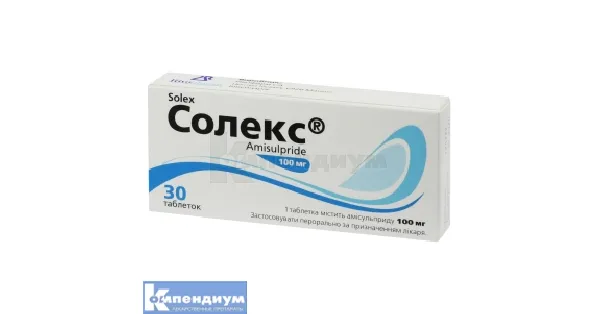
Table of Contents
INSTRUCTIONS FOR MEDICAL USE OF THE MEDICINAL PRODUCT SOLEX® (SOLEX)
Composition:
Active substance: amisulpride;
1 tablet contains 100 mg or 200 mg of amisulpride;
Excipients: lactose monohydrate; microcrystalline cellulose; methylcellulose; sodium starch glycolate (type A); magnesium stearate.
Pharmaceutical form. Tablets.
Main physicochemical properties:
-
100 mg tablets: white or almost white, round, flat tablets, approximately 8.0 mm in diameter, with a score line on one side and imprint A100 on the other side;
-
200 mg tablets: white or almost white, round, flat tablets, approximately 11.0 mm in diameter, with a score line on one side and imprint A200 on the other side.
Pharmacotherapeutic group.
Antipsychotics. ATC code N05A L05.
Pharmacological Properties.
Pharmacodynamics.
Its pharmacodynamic properties are characterized by selective and predominant affinity for D2 and D3 receptors of the limbic system, while lacking affinity for D1, D4, and D5 subtypes. Amisulpride has no affinity for serotonin receptors or other neuroreceptors such as histamine H1, cholinergic, and adrenergic receptors. In addition, amisulpride does not bind to sigma sites. In animal studies at high doses, amisulpride predominantly blocks mesolimbic dopaminergic neurons compared to those in the striatal system. At low doses, amisulpride primarily blocks presynaptic dopaminergic D2 and D3 receptors, which explains its effect on negative symptoms. This pharmacological profile accounts for the clinical efficacy of Solian® in both negative and positive symptoms of schizophrenia.
Pharmacokinetics.
In humans, amisulpride shows two absorption peaks: the first occurs rapidly, within 1 hour after dose administration, and the second occurs 3–4 hours later.
Corresponding plasma concentration levels after a 50 mg dose are 39 ± 3 and 54 ± 4 ng/mL.
The volume of distribution is 5.8 L/kg. Plasma protein binding is low (16%), making interactions with other drugs related to protein binding unlikely. Absolute bioavailability is 48%.
Amisulpride is weakly metabolized: two inactive metabolites have been identified, accounting for approximately 4% of the administered dose.
Amisulpride does not accumulate in the body; its pharmacokinetics remain unchanged after repeated dosing.
The elimination half-life after oral administration is approximately 12 hours.
Amisulpride is excreted unchanged in the urine.
Renal clearance is approximately 20 L/h or 330 mL/min.
A carbohydrate-rich meal (containing 68% liquid) significantly reduces AUC, Tmax, and Cmax of amisulpride, whereas no changes are observed after a fatty meal. The clinical impact of these changes during amisulpride treatment is unknown.
Hepatic impairment.
Since amisulpride is weakly metabolized, dose adjustment is not required in patients with hepatic impairment.
Renal impairment.
In patients with renal impairment, the elimination half-life remains unchanged, while systemic clearance is reduced by 2.5–3 times.
AUC of amisulpride increases twofold in mild renal impairment and nearly tenfold in moderate renal impairment.
However, practical experience is limited, and data on doses exceeding 50 mg are lacking.
Amisulpride is poorly dialyzable.
Geriatric patients.
Available pharmacokinetic data in patients aged 65 years and older indicate that after a single 50 mg dose, Cmax, T1/2, and AUC increase by 10–30%. Data on repeated dosing are lacking.
Clinical characteristics.
Indications.
Treatment of schizophrenia.
Contraindications.
- Hypersensitivity to the active substance or to any of the excipients.
- Serious episodes of arterial hypertension have been reported in patients with pheochromocytoma who were treated with antidopaminergic agents, including certain benzamides. It is advisable to avoid administration of this medicinal product in patients with diagnosed or suspected pheochromocytoma who are receiving antidopaminergic agents, including certain benzamides.
- Known or suspected prolactin-dependent tumours, such as prolactin-secreting pituitary adenoma or breast cancer.
- In combination with methicetin, citalopram, escitalopram, domperidone, hydroxyzine, non-anti-Parkinsonian dopaminergic agents (cabergoline, quinagolide). Use in combination with levodopa (see section "Interaction with other medicinal products and other forms of interaction").
- Paediatric population under 15 years of age (due to lack of clinical data).
- Combination with medicinal products that may induce torsades de pointes (see section "Interaction with other medicinal products and other forms of interaction").
Interaction with other medicinal products and other forms of interaction.
Sedatives. It should be taken into account that many medicinal products or substances may cause additive central nervous system (CNS) depressant effects and contribute to reduced attention. These include morphine derivatives (analgesics, antitussives and opioid substitution therapy), neuroleptics, barbiturates, benzodiazepines, non-benzodiazepine anxiolytics (such as meprobamate), hypnotics, sedative antidepressants (amitriptyline, doxepin, mianserin, mirtazapine, trimipramine), sedative H1-antihistamines, centrally acting antihypertensives, baclofen and thalidomide.
Medicinal products capable of inducing torsades de pointes. This serious arrhythmia may be triggered by a variety of medicinal products, including antiarrhythmics and others. Contributing factors include hypokalaemia (see subsection "Medicinal products that decrease potassium levels"), bradycardia (see subsection "Medicinal products that slow heart rate") or pre-existing congenital or acquired QT interval prolongation.
This is particularly true for Class IA and Class III antiarrhythmic agents, as well as certain neuroleptics. This effect may also be induced by other compounds not belonging to these classes.
For dolasetron, erythromycin, spiramycin and vinpocetine, this interaction applies only to intravenous formulations.
In general, concomitant use of a medicinal product that induces torsades de pointes with another agent having the same effect is contraindicated.
However, some of these agents are exceptions because their use cannot be avoided, and therefore they are simply not recommended for concomitant use with medicinal products that may induce torsades de pointes. This applies to methadone, antiparasitic agents (halofantrine, lumefantrine, pentamidine) and neuroleptics.
However, citalopram, escitalopram, domperidone and hydroxyzine are not among these exceptions, and therefore their concomitant use with any agent capable of inducing torsades de pointes is contraindicated.
Contraindicated combinations (see section "Contraindications").
Dopamine agonists, except anti-Parkinsonian agonists (cabergoline, quinagolide, rotigotine). Mutual antagonism of effects between dopamine agonists and neuroleptics.
Citalopram, escitalopram, domperidone, hydroxyzine. Increased risk of ventricular arrhythmias, particularly torsades de pointes.
Methicetin. Increased risk of ventricular arrhythmias, particularly torsades de pointes.
Not recommended combinations (see section "Special precautions for use").
Antiparasitic agents capable of inducing torsades de pointes (chloroquine, halofantrine, lumefantrine, pentamidine). Increased risk of ventricular arrhythmias, including torsades de pointes. If possible, one of the two treatments should be discontinued. If this combination cannot be avoided, QT monitoring prior to treatment and ECG monitoring are recommended.
Dopaminergic anti-Parkinson agents (amantadine, apomorphine, bromocriptine, entacapone, lisuride, pergolide, piribedil, pramipexole, rasagiline, ropinirole, rotigotine, selegiline, tolcapone). Mutual antagonism between dopamine agonists and neuroleptics. Dopamine agonists may provoke or exacerbate psychotic disorders. When neuroleptic treatment is necessary in a patient with Parkinson's disease who is receiving dopamine agonists, the dose of dopamine agonists should be gradually reduced and then discontinued (abrupt withdrawal of dopaminergic agents may precipitate neuroleptic malignant syndrome).
Other medicinal products that may induce torsades de pointes: Class IA antiarrhythmics (quinidine, hydroquinidine, disopyramide) and Class III antiarrhythmics (amiodarone, dronedarone, sotalol, dofetilide, ibutilide), as well as other agents such as arsenic compounds, bepridil, cisapride, difemethil, intravenous dolasetron, domperidone, intravenous erythromycin, levofloxacin, methicetin, mizolastine, prucalopride, intravenous vinpocetine, moxifloxacin, sparfloxacin, intravenous spiramycin, thioridazine, vandetanib, toremifene. Increased risk of ventricular arrhythmias, particularly torsades de pointes.
Other neuroleptics capable of inducing torsades de pointes (chlorpromazine, zuclopenthixol, droperidol, flupentixol, fluphenazine, haloperidol, levomepromazine, pimozide, pipamperone, pipotiazine, sertindole, sulpiride, sultopride, tiapride, zuclopentixol). Increased risk of ventricular arrhythmias, particularly torsades de pointes.
Alcohol consumption. Alcohol enhances the sedative effect of neuroleptics. Amisulpride may potentiate the CNS effects of alcohol. Reduced alertness may make driving and operating machinery hazardous. Alcohol consumption and use of medicinal products containing alcohol should be avoided.
Levodopa. Mutual antagonism between levodopa and neuroleptics. Patients with Parkinson's disease should receive the minimum effective doses of each agent.
Methadone. Increased risk of ventricular arrhythmias, particularly torsades de pointes.
Sodium oxybate. Enhanced CNS depression. Reduced alertness may pose a danger when driving or operating machinery.
Combinations requiring precautions.
Anagrelide. Increased risk of ventricular arrhythmia, particularly torsades de pointes. Clinical and electrocardiographic monitoring is required during concomitant use.
Azithromycin, clarithromycin, ciprofloxacin, levofloxacin, norfloxacin, roxithromycin. Increased risk of ventricular arrhythmias, particularly torsades de pointes. Clinical and ECG monitoring is required during concomitant use.
Beta-blockers in patients with heart failure (bisoprolol, carvedilol, metoprolol, nebivolol). Increased risk of ventricular arrhythmias, particularly torsades de pointes. In addition, there is a vasodilatory effect and risk of arterial hypotension, especially orthostatic (additive effect). Clinical and ECG monitoring is required.
Medicinal products that slow heart rate (particularly Class IA antiarrhythmics, beta-blockers, certain Class III antiarrhythmics, certain calcium channel blockers, digitalis glycosides, pilocarpine, anticholinesterase agents). Increased risk of ventricular arrhythmias, particularly torsades de pointes. Clinical and ECG monitoring is required.
Medicinal products that reduce potassium concentrations (potassium-losing diuretics, alone or in combination, stimulant laxatives, glucocorticoids, tetracosactide, intravenous amphotericin B). Increased risk of ventricular arrhythmias, particularly torsades de pointes. Any hypokalaemia should be corrected before initiating amisulpride treatment, and clinical status, electrolyte balance and ECG should be monitored.
Lithium. Risk of neuropsychiatric signs suggestive of neuroleptic malignant syndrome or lithium toxicity. Regular clinical monitoring and laboratory testing are indicated, especially at the beginning of concomitant therapy.
Ondansetron. Increased risk of ventricular arrhythmia, particularly torsades de pointes. Clinical and electrocardiographic monitoring is required during concomitant use.
Roxithromycin. Increased risk of ventricular arrhythmias, particularly torsades de pointes. Clinical and ECG monitoring is required during concomitant use.
Combinations to be considered.
Other sedative agents. Enhanced central nervous system depression. Impaired concentration may make driving and operating machinery hazardous.
Antihypertensive agents. Increased risk of arterial hypotension, particularly postural hypotension.
Nitrates and related substances. Increased risk of arterial hypotension, particularly postural hypotension.
Orlistat. Risk of reduced therapeutic effect when used concomitantly with orlistat.
Special precautions.
Special warnings.
Malignant neuroleptic syndrome.
As with other neuroleptics, malignant neuroleptic syndrome, which may be fatal, may develop. It is characterized by hyperthermia, muscle rigidity, dysfunction of the peripheral nervous system, altered consciousness, and elevated creatine kinase (CK) levels. If hyperthermia develops, particularly when high doses are used, all antipsychotic drugs should be discontinued.
QT interval prolongation.
Solex® may cause dose-dependent QT interval prolongation on the electrocardiogram, increasing the risk of serious ventricular arrhythmias such as torsades de pointes.
The risk of serious ventricular arrhythmias is increased in the presence of bradycardia, hypokalemia, congenital or acquired prolonged QT interval (e.g., when combined with drugs that prolong the QT interval) (see section "Adverse reactions").
If the clinical situation allows, it is recommended to assess the absence of risk factors predisposing to this rhythm disturbance before initiating treatment, such as:
- bradycardia (heart rate less than 55 beats/min);
- electrolyte imbalances, particularly hypokalemia;
- congenital prolonged QT interval;
- concomitant use of drugs that may cause marked bradycardia (heart rate < 55 beats/min), hypokalemia, reduced cardiac conduction, or QT interval prolongation (see section "Contraindications").
Electrocardiography (ECG) should be performed prior to initiating treatment in patients requiring long-term neuroleptic therapy.
Stroke.
In randomized, placebo-controlled clinical trials involving elderly patients with dementia treated with certain atypical antipsychotics, an increased risk of stroke was observed compared to placebo.
The mechanism underlying this increased risk is unknown. An increased risk associated with other antipsychotics cannot be ruled out, nor can the risk in other patient populations. This medicinal product should be used with caution in patients with risk factors for stroke.
Elderly patients with dementia.
The risk of fatal outcome is increased in elderly patients with psychosis associated with dementia who are treated with antipsychotic agents.
An analysis of 17 placebo-controlled clinical trials (mean duration: 10 weeks), conducted in patients primarily receiving atypical antipsychotics, showed that the risk of fatal outcome was 1.6–1.7 times higher in patients treated with these drugs compared to placebo.
After an average treatment duration of 10 weeks, the risk of fatal outcome was 4.5% in patients receiving treatment compared to 2.6% in the placebo group.
Although the causes of death during clinical trials with atypical antipsychotics were varied, most fatalities were due to either cardiovascular (e.g., heart failure, sudden death) or infectious (e.g., pneumonia) causes.
Epidemiological studies suggest that traditional antipsychotics may also increase mortality, similar to atypical antipsychotics.
The relative contribution of antipsychotic drugs and individual patient characteristics to increased mortality in epidemiological studies remains unclear. Solex® is not licensed for the treatment of behavioral disorders associated with dementia.
Thromboembolic events.
Venous thromboembolic events (VTE), sometimes fatal, have been reported during treatment with antipsychotic agents. Since patients treated with antipsychotics often have acquired risk factors for VTE, potential VTE risk factors should be identified and preventive measures taken before initiating treatment with Solex® or during ongoing therapy (see section "Adverse reactions").
Hyperglycemia/metabolic syndrome.
Cases of hyperglycemia have been reported in patients treated with certain antipsychotic agents, including amisulpride (see section "Adverse reactions").
Clinical and laboratory monitoring should be performed in accordance with current guidelines in patients receiving Solex®. Particular attention should be paid to patients with diabetes mellitus or risk factors for diabetes.
Seizures.
Amisulpride may lower the seizure threshold. Therefore, patients with a history of seizures require careful monitoring during treatment with amisulpride.
Special patient groups.
Since amisulpride is eliminated via the kidneys, the dose should be reduced or alternative treatment considered in patients with renal impairment (see section "Dosage and administration"). Data are lacking in patients with severe renal impairment (see section "Dosage and administration").
As with other antipsychotics, amisulpride should be used with particular caution in elderly patients due to the potential risk of sedation and arterial hypotension. Dose reduction may also be necessary due to renal impairment.
As with other antidopaminergic agents, caution is required when prescribing amisulpride to patients with Parkinson's disease, as it may worsen the condition. Amisulpride should be used only if treatment with neuroleptics cannot be avoided.
Withdrawal syndrome.
Withdrawal symptoms have been reported after abrupt discontinuation of high doses of antipsychotics, including nausea, vomiting, and insomnia, very rarely following sudden cessation of high-dose antipsychotic therapy. Psychotic symptoms may also recur. Involuntary movement disorders (such as akathisia, dystonia, and dyskinesia) have been reported during amisulpride treatment. Therefore, gradual discontinuation of amisulpride is recommended.
This medicinal product should not be used in combination with alcohol, dopaminergic antiparkinsonian agents, antiparasitic agents capable of provoking torsades de pointes, methadone, levodopa, other neuroleptics, or drugs that may provoke torsades de pointes (see section "Interaction with other medicinal products and other forms of interaction").
Hyperprolactinemia.
Amisulpride may increase prolactin levels (see section "Adverse reactions"). Patients with hyperprolactinemia and/or with potentially prolactin-dependent tumors should be closely monitored during treatment with amisulpride (see section "Contraindications").
Warnings related to excipients.
This medicinal product contains lactose. Patients with rare hereditary conditions such as galactose intolerance (galactosemia), lactase deficiency, or glucose-galactose malabsorption should not take this medicinal product.
Breast cancer.
Solex® may increase prolactin levels. Therefore, amisulpride should be used with caution in patients with a personal or family history of breast cancer, and careful monitoring is required during therapy.
Benign pituitary tumor.
Amisulpride may increase prolactin levels. Cases of benign pituitary tumors, such as prolactinoma, have been observed during treatment with amisulpride (see section "Adverse reactions"). In cases of very high prolactin levels or clinical signs suggestive of pituitary tumor (such as visual field defects and headache), pituitary imaging should be performed. If a pituitary tumor is confirmed, treatment with amisulpride should be discontinued (see section "Contraindications").
Others.
Leukopenia, neutropenia, and agranulocytosis have been reported during treatment with antipsychotics, including Solex®. Fever or infections of unknown origin may indicate leukopenia (see section "Adverse reactions") and require immediate hematological evaluation.
Patients with rare hereditary conditions such as galactose intolerance, Lapp lactase deficiency, or glucose-galactose malabsorption should not take this medicinal product.
Severe hepatic toxicity has been reported with amisulpride. Patients should be advised to immediately inform their physician if they experience symptoms such as asthenia, anorexia, nausea, vomiting, abdominal pain, or jaundice. Investigations, including clinical examination and biochemical assessment of liver function, should be performed immediately (see section "Adverse reactions").
Use during pregnancy or breastfeeding.
Pregnancy.
Animal studies have shown reproductive toxicity of Amisulpride. Amisulpride crosses the placenta.
Clinical data on use during pregnancy are limited. Therefore, the safety of amisulpride during pregnancy has not been established. Amisulpride is not recommended during pregnancy except when the benefits outweigh the potential risks.
If the drug is used during pregnancy, newborns may experience adverse effects of amisulpride. During the third trimester, there is a risk of adverse reactions such as extrapyramidal symptoms and/or withdrawal syndrome, which may vary in severity and duration after delivery. Reported adverse reactions include agitation, hypertonia, hypotonia, tremor, somnolence, respiratory distress syndrome, or feeding difficulties. Therefore, careful monitoring of newborns is required.
Fertility.
Reduced fertility has been observed, related to the pharmacological effects of the drug (prolactin-mediated effect).
Breastfeeding.
Due to lack of information on the passage of amisulpride into breast milk, breastfeeding is contraindicated.
Ability to affect reaction speed when driving or operating machinery.
Patients, especially those who drive or operate machinery, should be warned about the risk of somnolence and blurred vision associated with the use of this medicinal product (see section "Adverse reactions").
Dosage and Administration
If the daily dose does not exceed 400 mg, the drug should be taken once daily.
A dose exceeding 400 mg should be divided into two daily doses.
Acute psychotic episodes.
Treatment may be initiated with intramuscular administration for several days, with a maximum dose of 400 mg/day, followed by a transition to oral administration.
Oral doses ranging from 400 mg/day to 800 mg/day are recommended. The maximum oral dose should not exceed 1200 mg/day. The safety of doses above 1200 mg/day has not been widely studied; therefore, such doses should not be used.
Maintenance or dose adjustments should be individually determined according to the patient's response.
In all cases, maintenance therapy should be individually prescribed at the lowest effective dose.
Primarily negative episodes.
Recommended doses range from 50 mg/day to 300 mg/day. Doses should be individually adjusted. The optimal dose is approximately 100 mg/day.
Elderly patients.
Amisulpride should be used with particular caution in this population due to the risk of arterial hypotension and sedation (see section "Contraindications"). Dose reduction may also be required in patients with renal impairment.
Renal impairment.
Since amisulpride is eliminated via the kidneys, in patients with renal impairment and a creatinine clearance of 30–60 mL/min, the daily dose should be halved; in patients with creatinine clearance of 10–30 mL/min, the dose should be reduced to one-third. Due to insufficient data in patients with severe renal impairment (CrCl < 10 mL/min), strict monitoring of such patients is recommended (see section "Contraindications").
Hepatic impairment.
Since the drug is weakly metabolized, dose reduction is not required.
Children.
The efficacy and safety of amisulpride in adolescents from puberty up to 18 years of age have not been established; data on the use of amisulpride in children with schizophrenia are limited. Therefore, the use of amisulpride in adolescents from puberty up to 18 years of age is not recommended. Amisulpride is contraindicated in children under 15 years of age due to the lack of clinical data.
Overdose.
Currently, data regarding acute amisulpride overdose are limited. Reported symptoms are mainly due to enhanced pharmacological activity, clinically manifesting as dizziness, sedation, coma, arterial hypotension, and extrapyramidal symptoms.
There have been reports of fatal outcomes associated with concomitant use of other psychotropic agents.
There is no specific antidote for amisulpride. In cases of acute overdose, it is essential to determine whether other medicinal products have been co-ingested and to take appropriate measures:
- Close monitoring of vital functions;
- Cardiac monitoring (risk of QT interval prolongation) until full recovery;
- In cases of severe extrapyramidal symptoms, anticholinergic agents should be administered;
- Since amisulpride is poorly dialyzable, hemodialysis has limited efficacy in removing this medicinal compound.
Adverse Reactions
Undesirable effects are classified by frequency according to the following scale: very common (≥ 1/10), common (≥ 1/100, <1/10), uncommon (≥ 1/1000, <1/100), rare (≥ 1/10000, <1/1000), very rare (<1/10000), frequency not known (cannot be estimated from the available data).
Nervous system disorders
Very common: extrapyramidal symptoms possible (tremor, rigidity, hypertonia, increased salivation, akathisia, hypokinesia, dyskinesia). In most cases, these are mild in severity at maintenance doses and are partially reversible without discontinuation of amisulpride upon administration of anticholinergic anti-Parkinson agents.
The incidence of extrapyramidal symptoms, which is dose-dependent, is very low in patients treated for predominantly negative symptoms at doses of 50–300 mg/day.
Common: somnolence; acute dystonia possible (spasmodic torticollis, oculogyric crisis, trismus). This is reversible without discontinuation of amisulpride upon administration of an anticholinergic anti-Parkinson agent.
Uncommon: tardive dyskinesia characterized by involuntary movements of the tongue and/or facial muscles has been reported, usually after long-term treatment.
Anticholinergic anti-Parkinson agents are ineffective or may exacerbate symptoms.
Seizures.
Rare: neuroleptic malignant syndrome, a potentially fatal complication.
Frequency not known: restless legs syndrome.
Psychiatric disorders
Common: insomnia, anxiety, agitation, frigidity.
Uncommon: confusion.
Gastrointestinal disorders
Common: constipation, nausea, vomiting, dry mouth.
Endocrine disorders
Common: increased plasma prolactin levels, reversible upon discontinuation of the drug. This may lead to the following clinical symptoms: galactorrhea, amenorrhea, gynecomastia, breast pain, erectile dysfunction.
Rare: benign pituitary tumors such as prolactinoma (see sections "Contraindications" and "Special Warnings and Precautions for Use").
Metabolism and nutrition disorders
Common: hyperglycemia (see section "Special Warnings and Precautions for Use"), hypertriglyceridemia, and hypercholesterolemia.
Uncommon: hyponatremia, syndrome of inappropriate secretion of antidiuretic hormone (SIADH).
Laboratory investigations
Common: weight gain.
Uncommon: elevated liver enzymes, mainly transaminases, have been reported.
Immune system disorders
Uncommon: allergic reactions.
Cardiac disorders
Common: bradycardia.
Rare:
- QT interval prolongation;
- ventricular arrhythmias such as torsades de pointes and ventricular tachycardia, which may lead to ventricular fibrillation and cardiac arrest;
- sudden death (see section "Special Warnings and Precautions for Use").
Vascular disorders
Common: hypotension.
Uncommon: increased blood pressure.
Rare: cases of venous thromboembolism, including pulmonary embolism, sometimes fatal, and deep vein thrombosis have been reported with antipsychotic drugs (see section "Special Warnings and Precautions for Use").
Blood and lymphatic system disorders
Uncommon: leukopenia, neutropenia.
Rare: agranulocytosis (see section "Special Warnings and Precautions for Use").
Skin and subcutaneous tissue disorders
Rare: angioedema, urticaria.
Frequency not known: photosensitivity reaction.
Pregnancy, puerperium and perinatal conditions
Frequency not known: withdrawal syndrome in newborns (see section "Use in Pregnancy and Lactation").
Musculoskeletal and connective tissue disorders
Uncommon: osteopenia, osteoporosis.
Renal and urinary disorders
Uncommon: urinary retention.
Hepatobiliary disorders
Uncommon: hepatocellular injury.
Respiratory, thoracic and mediastinal disorders
Uncommon: nasal congestion, aspiration pneumonia (mainly in combination with other neuroleptics and CNS depressants).
Eye disorders
Common: blurred vision.
Reporting of adverse reactions
Reporting of adverse reactions after marketing authorization is important. It allows continuous monitoring of the benefit-risk balance of the medicinal product. Healthcare professionals are required to report any adverse reactions via the adverse reaction reporting system in Ukraine.
Shelf life: 36 months.
Storage conditions
Store in a dry, light-protected place in the original packaging at 15–25 ºC. Keep out of reach of children.
Packaging
No. 30 (10x3): 10 tablets in a blister; 3 blisters in a cardboard box.
Prescription status
Prescription only.
Manufacturer
Rivopharm SA
Manufacturer's address
Centro Insema, 6928 Manno, Switzerland