Solacutan
Ukraine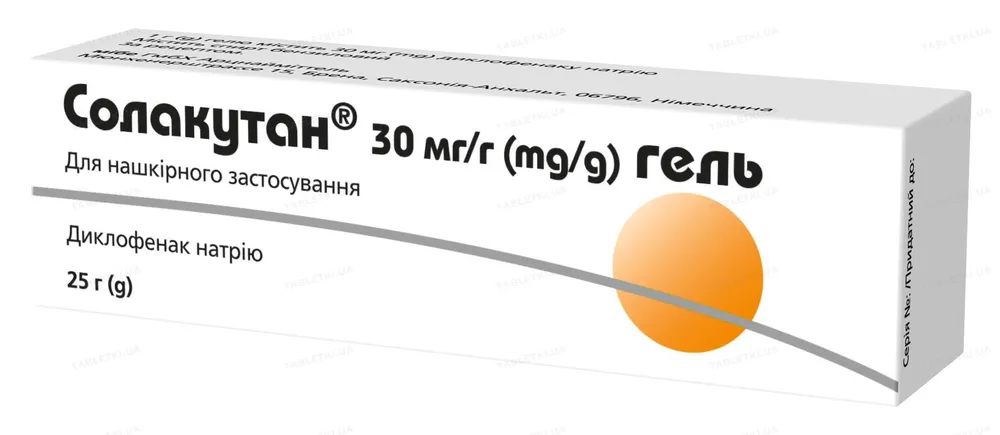
Table of Contents
INSTRUCTIONS FOR MEDICAL USE OF THE MEDICINAL PRODUCT SOLACUTAN® (SOLACUTAN)
Composition:
Active ingredient: diclofenac sodium;
1 g of gel contains 30 mg of diclofenac sodium;
Excipients: sodium hyaluronate, macrogol 400, benzyl alcohol, purified water.
Pharmaceutical form. Gel.
Main physicochemical characteristics: clear transparent gel, colorless to slightly yellow.
Pharmacotherapeutic group.
Dermatologicals. Other dermatologicals. Diclofenac.
ATC code D11A X18.
Pharmacological Properties
Pharmacodynamics
Mechanism of action
Diclofenac is a nonsteroidal anti-inflammatory drug (NSAID).
The mechanism of action of diclofenac in actinic keratosis (AK) is not known, but it may be related to inhibition of the cyclooxygenase pathway of arachidonic acid metabolism, resulting in reduced synthesis of prostaglandin E2 (PGE2). In addition, immunohistochemical analysis of skin biopsies has shown that the clinical effects of diclofenac in AK are primarily due to anti-inflammatory, anti-angiogenic, and likely anti-proliferative effects, as well as induction of apoptosis.
Pharmacodynamic effect
It has been demonstrated that the gel containing diclofenac eliminates AK lesions, with maximum therapeutic effect observed 30 days after discontinuation of this medicinal product.
Pharmacokinetics
Absorption
The mean absorption of diclofenac through the skin ranges from <1% to 12%, with considerable inter-individual variability. Absorption depends on the applied dose and the site of application.
Distribution
Diclofenac is highly bound to serum albumin.
Biotransformation
Biotransformation of diclofenac partially involves conjugation of the intact molecule, but mainly consists of single and multiple hydroxylations, resulting in several phenolic metabolites, most of which are converted into glucuronide conjugates. Two of these phenolic metabolites are biologically active, although significantly less so than diclofenac. The metabolism of diclofenac following transdermal and oral administration is similar.
Elimination
Diclofenac and its metabolites are primarily excreted in urine. After oral administration, the systemic clearance of diclofenac from plasma is 263 ± 56 mL/min (mean ± standard deviation). The terminal half-life in plasma is short (1–2 hours). The metabolites also have short terminal half-lives (1–3 hours).
Pharmacokinetics in special patient populations
With topical application, the extent of diclofenac absorption is similar through normal and affected epidermis, although there is considerable inter-individual variation. Systemic absorption of diclofenac is approximately 12% when applied to affected skin and 9% when applied to intact skin.
Clinical characteristics.
Indications.
The medicinal product is intended for the treatment of actinic keratoses (AK).
Contraindications.
Hypersensitivity to the active substance or to any of the excipients of the product.
Due to the potential for cross-reactivity, the gel should not be used in patients exhibiting hypersensitivity reactions such as asthma symptoms, allergic rhinitis, or urticaria in response to 2-acetoxybenzoic acid (acetylsalicylic acid) or other NSAIDs.
The use of Solakutan® is contraindicated during the third trimester of pregnancy (see section "Use during pregnancy or breastfeeding").
Interaction with other medicinal products and other types of interactions.
Since systemic absorption of diclofenac in topical medicinal products is very low, such interactions are highly unlikely.
Special precautions for use.
Due to the low systemic absorption of Solacutan®, the likelihood of systemic adverse reactions with topical application of this medicinal product is small compared to the frequency of adverse reactions associated with oral diclofenac. However, the possibility of systemic adverse reactions cannot be excluded when diclofenac is used in topical medicinal products applied over large areas of skin for prolonged periods (see the instructions for medical use of medicinal products containing diclofenac for systemic administration). This medicinal product should be used with caution in patients with a history of acute gastrointestinal ulcers and/or bleeding or with impaired cardiac, hepatic, or renal function, as there have been isolated reports of systemic adverse reactions (such as renal disorders) associated with topical use of anti-inflammatory medicinal products.
It is known that NSAIDs have antiplatelet activity. Therefore, although the likelihood of systemic adverse reactions is low, caution should be exercised when using the product in patients with intracranial hemorrhage or hemorrhagic diathesis.
During treatment, exposure to direct sunlight and solarium use should be avoided. If skin hypersensitivity reactions occur, treatment should be discontinued.
Diclofenac for topical use should be applied only to intact skin and should not be applied to skin lesions, open wounds, infected skin areas, or areas affected by exfoliative dermatitis. The gel must not come into contact with the eyes or mucous membranes, and the gel must not be swallowed.
If generalized skin rashes occur after application of this medicinal product, treatment should be discontinued.
Diclofenac for topical use may be used under non-occlusive dressings, but it should not be applied under impermeable occlusive dressings.
1 g of gel contains 15 mg of benzyl alcohol. Benzyl alcohol may cause allergic reactions and mild local irritation.
Use during pregnancy or breastfeeding.
Pregnancy
There are no clinical data on the use of Solacutan® during pregnancy. Even though systemic concentrations are lower compared to the oral formulation, it is unknown whether the systemic concentration of Solacutan® achieved after topical application could be harmful to the embryo/fetus.
Based on experience with NSAIDs that have systemic absorption, the following is recommended:
- Inhibition of prostaglandin synthesis may negatively affect pregnancy and/or embryofetal development. Epidemiological data indicate an increased risk of miscarriage and of congenital heart defects and gastroschisis following use of prostaglandin synthesis inhibitors during early pregnancy. The absolute risk of cardiovascular malformations increases from less than 1% to approximately 1.5%. This risk is considered to increase with increasing dose and duration of treatment.
- Animal studies have shown reproductive toxicity. In animals, administration of prostaglandin synthesis inhibitors leads to increased pre- and post-implantation loss and embryofetal mortality. In addition, increased incidence of various developmental abnormalities, including cardiovascular defects, has been observed in animals treated with prostaglandin synthesis inhibitors during the period of organogenesis.
Diclofenac should be used during the first and second trimesters of pregnancy only if clearly necessary. When diclofenac is used by women attempting to conceive or during the first or second trimester of pregnancy, the lowest possible dose (<30% of body surface area) should be applied for the shortest possible duration of treatment (no longer than 3 weeks).
When used during the second and third trimesters of pregnancy, all prostaglandin synthesis inhibitors, including diclofenac, carry the following risks for the fetus:
- Renal dysfunction in the fetus. After week 12: oligohydramnios (usually reversible after discontinuation of treatment) or anhydramnios (especially with prolonged exposure). After birth: renal failure may persist (particularly with exposure late in pregnancy or prolonged exposure).
- Fetal cardiopulmonary toxicity (pulmonary hypertension with premature closure of the ductus arteriosus). This risk exists from the beginning of the sixth month of pregnancy and increases as term approaches.
During late pregnancy (third trimester), all prostaglandin synthesis inhibitors may pose the following risks to the mother and the newborn:
- Possible prolongation of bleeding time, antiplatelet effect, which may occur even at very low doses.
- Inhibition of uterine contractions, leading to delayed or prolonged labor.
- Increased risk of edema in the mother.
In view of the above, Solacutan® is contraindicated during the third trimester of pregnancy (see section "Contraindications").
Breastfeeding period
Like other NSAIDs, diclofenac passes into breast milk in small amounts. However, with the recommended therapeutic dose of Solacutan®, no effect on the breastfed infant is expected. Due to the lack of controlled studies in breastfeeding women, this medicinal product should be used during lactation only on medical advice. Under these conditions, Solacutan® should not be applied to the breasts of a nursing mother or to any large skin areas or for prolonged periods (see section "Contraindications").
Ability to affect reaction speed when driving vehicles or operating machinery.
Topical application of diclofenac for local use does not affect the ability to drive vehicles or operate machinery.
Administration and Dosage
Administration
For topical use.
Dosage
Adults:
Solacuten® should be applied to affected skin areas twice daily and gently rubbed in. The amount applied depends on the extent of the affected area.
Typically, 0.5 g of gel (approximately the size of a pea) is applied to an affected area measuring 5 x 5 cm. The maximum daily dose of 8 g allows simultaneous treatment of up to 200 cm² of skin surface. The usual duration of treatment is 60 to 90 days. Maximum efficacy is achieved when treatment duration approaches the maximum recommended period.
Complete healing of the lesion(s) or optimal therapeutic effect may not occur until up to 30 days after completion of therapy.
After applying the gel, hands should be wiped with a paper towel and then washed, unless the hands themselves are the treatment area.
If too much gel is accidentally applied, excess gel should be wiped off with a paper towel.
The paper towel should be disposed of with household waste to prevent unused medication from entering the aquatic environment.
Before applying a dressing, allow the gel to dry on the skin for several minutes.
Elderly patients:
The standard dosage may be used.
Children:
AK is a condition not commonly seen in pediatric patients; therefore, the medicinal product has not been studied in the pediatric population, and dosage recommendations and indications for use of Solacuten® have not been established in children and adolescents.
Overdose
Overdose with topically applied diclofenac is highly unlikely due to low systemic absorption; however, the skin should be washed with water. There have been no reports of clinical cases of overdose following ingestion of diclofenac-containing gel.
However, accidental ingestion of topical diclofenac (one 100 g tube contains the equivalent of 3000 mg sodium diclofenac) may result in adverse reactions similar to those observed after overdose with oral diclofenac tablets. In cases of accidental ingestion leading to significant systemic adverse reactions, general therapeutic measures used in the treatment of NSAID poisoning should be applied.
Supportive and symptomatic treatment should be administered for complications such as renal failure, seizures, gastrointestinal irritation, and respiratory depression. Gastric decontamination with activated charcoal should be considered, especially if ingestion occurred recently. Due to the high degree of protein binding of NSAIDs, specific treatments such as forced diuresis or dialysis are likely to be of limited effectiveness in removing the NSAID from the body.
Adverse reactions.
Common adverse reactions:
The most frequently reported adverse reactions were skin-related local reactions such as contact dermatitis, erythema or rash, or application site reactions such as inflammation, skin irritation, pain, and vesicles. Clinical studies to date have not shown an increase in the frequency of adverse reactions with age or any adverse reactions specific to elderly individuals.
Adverse reactions are listed in the table below according to MedDRA (Medical Dictionary for Regulatory Activities) system organ class in decreasing order of frequency as follows:
very common (>1/10);
common (≥1/100 to <1/10);
uncommon (≥1/1000 to <1/100);
rare (≥1/10000 to <1/1000);
very rare (<1/10000);
frequency not known (cannot be estimated from the available data).
| System Organ Class |
Common (≥1/100 - < 1/10) |
Uncommon (≥1/1000 -<1/100) |
Rare (≥1/10000 - < 1/1000) |
Very rare (<1/10000) |
| Infections and infestations |
Pustular rash |
|||
| Immune system disorders |
All types of hypersensitivity reactions (including urticaria, angioneurotic edema) |
|||
| Nervous system disorders |
Hyperesthesia, hypertension, localized paresthesia |
|||
| Eye disorders |
Conjunctivitis |
Eye pain, abnormal lacrimation |
||
| Vascular disorders |
Hemorrhage (skin bleeding) |
|||
| Respiratory, thoracic and mediastinal disorders |
Asthma |
|||
| Gastrointestinal disorders |
Abdominal pain, diarrhea, nausea |
Gastrointestinal hemorrhage |
||
| Skin and subcutaneous tissue disorders |
Dermatitis (including contact dermatitis), eczema, dry skin, erythema, swelling, pruritus, rash, papular rash, skin hypertrophy, skin ulcers, vesiculobullous rash |
Alopecia, facial swelling, maculopapular rash, seborrhea |
Bullous dermatitis |
Photosensitivity reactions |
| Renal and urinary disorders |
Renal failure |
|||
| General disorders and administration site conditions |
Application site reactions (including inflammation, skin irritation, pain and stinging or vesicles at the treatment site) |
Temporary discoloration of hair in the area of application has been observed. This phenomenon is usually reversible after discontinuation of treatment.
Skin tests in previously treated patient groups indicated a possibility (2.18%) of sensitization to diclofenac, causing allergic contact dermatitis (Type IV). The clinical significance of this phenomenon is currently unknown. Cross-reactions with other NSAIDs are unlikely.
Serum testing in over 100 patients showed absence of antibodies against diclofenac (Type I).
Reporting of suspected adverse reactions
Reporting of suspected adverse reactions is very important. Healthcare professionals and patients should report any suspected adverse reactions through the national reporting system.
Shelf life. 3 years. After first opening – 6 months.
Storage conditions.
Store at temperatures not exceeding 25°C. Keep out of reach of children.
Packaging.
25 g in a tube, 1 tube in a carton.
Prescription category. Prescription only.
Manufacturer. mibe GmbH Arzneimittel.
Manufacturer's address and location of operations.
Muenchenstrasse 15, Brehna, Saxony-Anhalt, 06796, Germany.