Soderm
Ukraine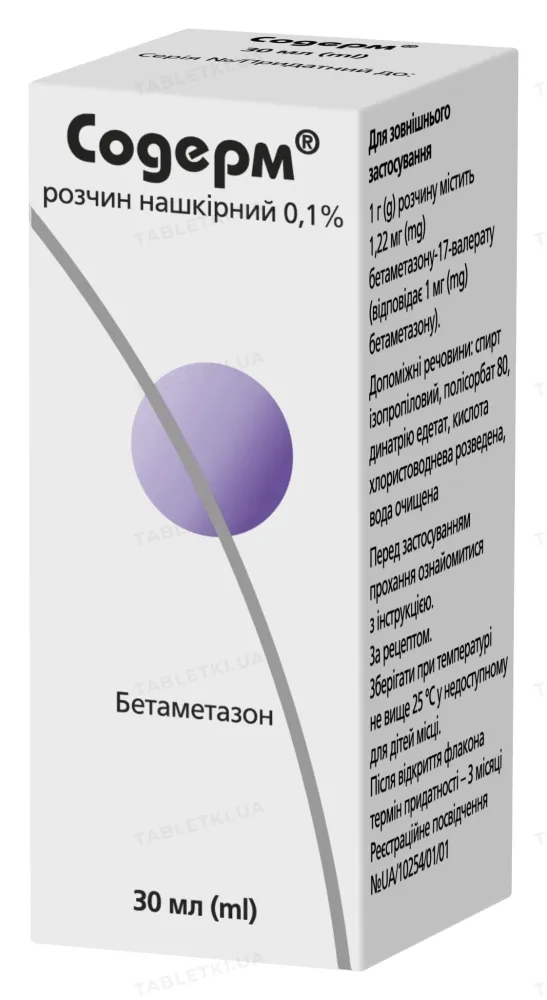
Table of Contents
INSTRUCTIONS FOR MEDICAL USE OF THE MEDICINAL PRODUCT SODERM®
Composition:
Active substance: betamethasone;
1 g of solution contains 1.22 mg of betamethasone-17-valerate (equivalent to 1 mg of betamethasone);
Excipients: isopropyl alcohol, polysorbate 80, disodium edetate, diluted hydrochloric acid, purified water.
Pharmaceutical form. Topical solution.
Main physicochemical characteristics: clear, colorless solution.
Pharmacotherapeutic group. Corticosteroids for dermatological use. Potent corticosteroids (group III). Strong-acting corticosteroids.
ATC code D07AC01.
Pharmacological Properties
Pharmacodynamics
Efficacy
In experimental and clinical settings, betamethasone valerate exerts anti-inflammatory, antiallergic, and antiproliferative effects.
When applied topically, it demonstrates anti-inflammatory activity, effects on the epidermis and stratum corneum, antiallergic activity, and reduction of contact hypersensitivity.
In the McKenzie-Stoughton vasoconstriction test—a method correlated with the therapeutic efficacy of topical corticosteroids—23 esters of betamethasone were evaluated. In relation to fluocinolone acetonide = 100, the vasoconstrictive activity of betamethasone valerate was found to be 360.
Vasoconstrictive values of 5 topical corticosteroids in clinical comparison:
Fluocinolone acetonide 100,
Hydrocortisone < 1,
Triamcinolone acetonide 75,
Betamethasone < 1,
Betamethasone valerate 360.
Mechanism of Action
Qualitatively, the mechanism of anti-inflammatory, antiproliferative, and immunomodulatory action of all glucocorticoids—according to the generally accepted, partially incomplete, and hypothetical understanding—can be schematically and in simplified form represented as follows:
Glucocorticoid molecules form complexes with corticoid receptors in the plasma, which are then transported into the cell nucleus, where they bind to specific genes known as GREs (glucocorticoid response elements).
This induces transcription of specific mRNA molecules, leading to the synthesis of lipocortin proteins on ribosomes. Lipocortins inhibit reactions triggered by physical, chemical, toxic, or immunogenic stimuli, or by microbiological pathogenic agents, acting at the interface between phospholipase A2 and membrane phospholipids, thereby preventing the release of arachidonic acid.
By delaying or slowing the release of arachidonic acid, lipocortins normalize, reduce, or block the synthesis of inflammatory mediators—such as prostaglandins, prostacyclin, leukotrienes, platelet-activating factor (PAF), and thromboxane—regulated by the metabolism of arachidonic acid via cyclooxygenase and lipoxygenase pathways. These mediators influence, for example, blood vessels, cell membranes, leukocytes, and macrophages—including their chemotaxis and migration—and regulate cell proliferation.
In addition, glucocorticoids exert antimitotic effects and slow down the synthesis of nucleic acids and proteins. Key aspects of their immunomodulatory and antiallergic effects include interactions of glucocorticoids with B-cells, T-cells, and Langerhans cells, which inhibit antigen presentation and antagonize the synthesis and function of interleukin-1, interleukin-2, and other cytokines.
Pharmacokinetics
With limited duration and localized application of a preparation containing betamethasone, systemically significant absorption of the substance does not occur.
However, with prolonged use and/or application over large skin areas, depending on the integrity of the stratum corneum barrier, site of application (e.g., intertriginous areas), or use of occlusive dressings, systemically significant absorption of the substance may occur.
In vivo, betamethasone valerate is rapidly hydrolyzed by esterases into betamethasone alcohol.
The metabolism of [3H]-betamethasone was studied in healthy volunteers and patients receiving high therapeutic doses of the steroid. Approximately 70% of the administered dose was excreted in the urine within 48 hours, with 15–30% identified as conjugated metabolites. Six metabolites were isolated, along with unchanged betamethasone. The metabolic transformations involved: oxidation of the 11ß-hydroxyl group, 6ß-hydroxylation, reduction of the carboxyl group at C-20, and cleavage of the side chain.
Clinical characteristics.
Indications.
Treatment of scalp psoriasis and other non-infectious inflammatory, allergic or pruritic skin disorders of the scalp where symptomatic treatment with potent topical corticosteroids is indicated.
Contraindications.
The use of Soderm®, solution, as well as other topical corticosteroids, is contraindicated in:
- specific skin conditions (cutaneous tuberculosis, cutaneous manifestations of syphilis);
- rosacea;
- acne;
- varicella (chickenpox);
- vaccination reactions;
- Pruritus anogenitalis;
- perioral dermatitis;
- infectious skin diseases caused by viruses, bacteria, or fungi;
- hypersensitivity to betamethasone valerate or to any other component of the medicinal product.
Soderm®, solution, must not be used in skin diseases and dermatitis in children under 1 year of age.
The drug should not be used in generalized psoriasis in chronic or stationary stages.
Do not apply the solution to infected, eroded, weeping areas, or to skin fissures and ulcers.
Facial skin is particularly sensitive. Therefore, to prevent skin changes, therapy with topical corticosteroids should be avoided whenever possible.
Soderm®, solution, is not intended for use on the face. Application of the drug to eyelids and the eye area should be avoided, as under certain circumstances this may cause glaucoma and cataract.
Prolonged use of the drug (more than 3–4 weeks), high dosages (application over large areas), and use of occlusive dressings should be avoided.
In such cases, the possibility of percutaneous penetration of betamethasone valerate into the body (transdermal absorption) and disruption of hormonal balance should not be ruled out.
Do not apply to the chest or breast area in women who are breastfeeding.
Interaction with other medicinal products and other forms of interaction.
When used concomitantly with medicinal products that inhibit the CYP3A4 enzyme system (e.g., ritonavir, itraconazole), inhibition of corticosteroid metabolism has been observed, leading to increased systemic availability. The clinical significance of this interaction depends on the dosage and route of administration of the corticosteroid, as well as the potency of the CYP3A4 inhibitor.
Special precautions for use.
Due to the flammability of Soderm® solution, patients should avoid open flames or sources of heat (including the use of a hair dryer) and smoking during or immediately after application of the medication.
Increased systemic absorption of topical corticosteroids in some individuals may lead to signs of hypercorticism (Cushing's syndrome) and reversible suppression of the hypothalamic–pituitary–adrenal (HPA) axis, and consequently, to adrenal insufficiency. If any of the above conditions occur, the frequency of application should be gradually reduced or the medication should be replaced with a weaker corticosteroid. Abrupt discontinuation of treatment may result in adrenal insufficiency (see section "Adverse reactions").
Risk factors for enhanced systemic effects include:
- Potency and composition of the topical corticosteroid;
- Duration of treatment;
- Application over a large skin area;
- Use under occlusive conditions, e.g., in skin folds or under occlusive dressings;
- Increased hydration of the stratum corneum;
- Application to thin skin, such as facial skin;
- Application to damaged skin or skin with impaired barrier function;
- In infants and children compared to adults, due to an incompletely developed skin barrier and a larger body surface area relative to body weight, greater absorption of corticosteroids occurs. Therefore, systemic adverse effects are more likely in infants and older children.
Bacterial infections may result from excessive heat and moisture in skin folds or under occlusive dressings. When using occlusive dressings, the skin should be cleaned during dressing changes.
Topical corticosteroids should be used with caution in psoriasis, as cases of rebound flares ("rebound phenomenon"), development of tolerance, risk of generalized pustular psoriasis, and local or systemic toxicity due to impaired skin barrier function have been reported. Careful patient monitoring is required when using the medication in psoriasis.
Treatment of skin disorders involving infection with corticosteroids requires appropriate antimicrobial therapy. However, if the infection spreads, topical corticosteroids should be discontinued and the patient should consult a physician for specific further management.
Avoid contact of Soderm® solution with the eyes.
Visual disturbances.
Visual disturbances may occur with systemic or topical use of corticosteroids. If a patient presents symptoms such as blurred vision or other visual disturbances, they should be referred to an ophthalmologist to evaluate possible causes, including cataract, glaucoma, or rare conditions such as central serous choroidopathy, which has been reported following systemic or topical corticosteroid use.
Close the bottle tightly after use.
Contains flammable substances (2-propanol/water solution).
Protect from fire, flame, sources of heat, and direct sunlight.
Use during pregnancy or breastfeeding.
During pregnancy, especially during the first three months, prolonged topical treatment should only be performed after careful assessment of benefit versus risk.
There are currently no data on the teratogenic effects of the drug. However, prolonged oral use of glucocorticoids cannot exclude the possibility of intrauterine growth retardation of the fetus.
During pregnancy, topical corticosteroids should not be used in high doses over large areas or for prolonged periods due to the potential for systemic effects, which may disrupt the hypothalamic–pituitary–adrenal axis regulation. In addition, disturbances in fetal development and growth should not be excluded.
Animal studies have shown that glucocorticoid use may lead to cleft palate. A possible increased risk of cleft palate in human fetuses due to glucocorticoid use during the first trimester of pregnancy is therefore suspected. Furthermore, based on epidemiological studies combined with animal data, intrauterine exposure to glucocorticoids may predispose to metabolic and cardiovascular diseases in adulthood. Synthetic glucocorticoids such as betamethasone are generally less effectively inactivated than endogenous cortisol (hydrocortisone), thus posing a risk to the fetus.
When the drug is used late in pregnancy, there is a risk of adrenal cortical atrophy in the fetus, which may require gradual replacement therapy in newborns.
Betamethasone passes into breast milk. No adverse effects in newborns have been reported so far. However, indications for use during breastfeeding should be clearly defined. Betamethasone valerate should be used during breastfeeding only if the expected benefit to the mother outweighs the potential risk to the infant.
If higher doses or application over large skin areas (more than 20% of body surface) are required due to illness, breastfeeding should be discontinued.
Contact between the infant and treated skin areas should be avoided. During breastfeeding, betamethasone valerate should not be applied to the area of the mammary glands to prevent accidental ingestion by the infant.
Ability to affect reaction speed when driving or operating machinery.
There is no experience regarding negative effects of the drug on the ability to drive or operate machinery.
Administration and Dosage
Dosage
At the beginning of treatment, affected skin areas should be moistened with the solution twice daily, in the morning and evening. As soon as therapeutic effects become evident, the frequency of daily applications may be reduced to once daily (either in the morning or evening), and later to 3–4 times per week.
The duration of treatment is 2–4 weeks.
Administration
Soderm®, solution, is particularly suitable for application to the hairy parts of the scalp. The product is supplied in containers equipped with a dosing nozzle, allowing direct application to the affected area without wetting the entire hair.
Children
Do not use the drug in children under 1 year of age. Do not use when occlusive dressings are applied.
Soderm®, solution, may be used in children only for a short period (less than 1 week) and over a small area (less than 10% of body surface area).
In general, corticosteroid treatment in children must be carried out with special caution, as absorption of corticosteroids through children's skin may be higher compared to adults.
Prolonged treatment should be avoided in infants and children under 12 years of age, since increased transdermal absorption may occur even without occlusive dressings, potentially leading to suppression of adrenal gland function.
Overdose
Acute overdose symptoms are unlikely. Prolonged or excessive use of the drug may lead to hypercorticism. In such cases, treatment should be discontinued, or the dosage should be gradually reduced under medical supervision by decreasing the frequency of application or switching to a less potent corticosteroid, due to the possible risk of adrenal insufficiency.
Adverse Reactions
Adverse effects are classified according to frequency of occurrence as follows: very common (≥1/10); common (≥1/100, <1/10); uncommon (≥1/1000, <1/100); rare (≥1/10,000, <1/1000); very rare (<1/10,000); frequency not known (cannot be estimated from the available data).
| System organ class |
Adverse reactions |
Frequency of occurrence |
| Infections and infestations |
Opportunistic infections |
very rare |
| Immune system disorders |
Local hypersensitivity reactions* |
very rare |
| Endocrine system disorders |
Suppression of the hypothalamic-pituitary-adrenal (HPA) axis**: Cushingoid features (e.g., moon face, central obesity), impaired weight gain/growth in children, osteoporosis, glaucoma, hyperglycemia/glycosuria, cataract, arterial hypertension, weight gain/obesity, decreased endogenous cortisol levels, alopecia, brittle hair |
very rare |
| Eye disorders |
Blurred vision (see also section "Special precautions") |
frequency not known |
| Skin and subcutaneous tissue disorders |
Itching, sensation of local burning/pain of the skin. |
common |
| Allergic contact dermatitis/dermatitis (including rosacea-like [perioral] dermatitis), erythema, rash, urticaria, pustular psoriasis, skin thinning***/skin atrophy***, skin wrinkling***, skin dryness***, striae***, telangiectasia***, pigment changes***, hypertrichosis, exacerbation of underlying symptoms |
very rare |
|
| Steroid acne |
frequency not known |
|
| General disorders and administration site conditions |
Irritation/pain at the application site |
very rare |
* If signs of hypersensitivity reactions occur, the drug should be discontinued.
Local hypersensitivity reactions similar to symptoms caused by the disease may occur during use.
** Skin disorders secondary to local and/or systemic suppression of the hypothalamus–anterior pituitary–adrenal cortex axis.
*** Prolonged use of corticosteroids or their application over large skin areas may lead to systemic absorption of the active substance. Systemic effects are more likely in infants and older children, as well as when used under occlusive conditions. Children may be more sensitive to systemic absorption of the active substance than adults when glucocorticoids are used.
With prolonged (more than 3 weeks) use of the drug or application over large skin areas, especially under occlusive dressings or in skin folds, local skin changes such as skin atrophy, striae, steroid acne, telangiectasia, changes in skin pigmentation, and hypertrichosis may occur.
Application of topical preparations containing glucocorticoids to wounds may impair wound healing.
Reporting of suspected adverse reactions
Reporting of suspected adverse reactions is important. Healthcare professionals and patients should report any suspected adverse reactions through the national reporting system.
Shelf life. 3 years.
After opening the bottle – 3 months.
Storage conditions. Store at temperatures not exceeding 25 °C, in a place inaccessible to children.
Packaging. Solution 15 ml, 30 ml, 50 ml, or 100 ml in plastic bottles with dropper and cap, in a cardboard box.
Prescription status. Prescription only.
Manufacturer.
mibe GmbH & Co. KG
Manufacturer's address and place of business.
Muenchener Strasse 15, Brehna, Saxony-Anhalt, 06796, Germany