Soderm®
Ukraine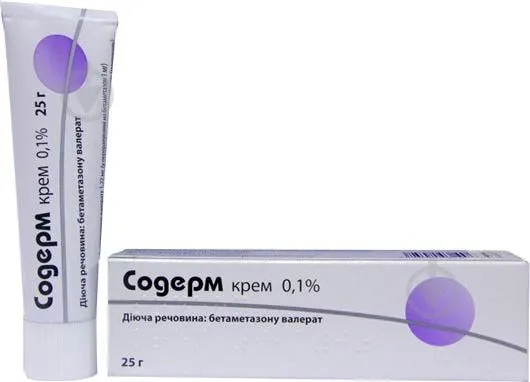
Table of Contents
INSTRUCTIONS FOR MEDICAL USE OF THE MEDICINAL PRODUCT SODERM®
Composition:
Active substance: betamethasone valerate;
1 g of ointment contains betamethasone valerate 1.22 mg (equivalent to betamethasone 1 mg);
Excipients: mineral oil; lanolin; white soft paraffin.
Pharmaceutical form. Ointment.
Main physicochemical properties: shiny, homogeneous ointment of whitish-yellow color.
Pharmacotherapeutic group. Corticosteroids for dermatological use. Potent corticosteroids (Group III). Betamethasone. ATC code D07AC01.
Pharmacological properties.
Pharmacodynamics.
Efficacy
In experimental and therapeutic conditions, betamethasone valerate has anti-inflammatory, antiallergic, and antiproliferative effects.
When applied topically, anti-inflammatory, epidermostatic and dermostatic, as well as antiallergic effects and effects manifesting as contact hypoaesthesia are observed.
The vasoconstrictive assay according to McKenzie and Stoughton, the results of which correlate with the therapeutic efficacy of topical corticosteroids, was used to investigate 23 esters of betamethasone. It was established that betamethasone valerate, with fluocinolone acetonide = 100, has the following vasoconstrictive activity index: 360.
Vasoconstrictive activity indices of 5 corticosteroids for topical use in clinical comparison:
fluocinolone acetonide: 100
hydrocortisone: < 1
triamcinolone acetonide: 75
betamethasone: < 1
betamethasone valerate: 360
Mechanism of action
The mechanisms of anti-inflammatory, antiproliferative, and immunomodulatory actions, which qualitatively are common to all glucocorticosteroids, can be schematically and simplistically represented according to current, and partially still incomplete and hypothetical, knowledge as follows:
glucocorticosteroid molecules form a complex with receptor proteins in the cytoplasm and are transported into the cell nucleus, where, as a corticosteroid-receptor complex, they bind to HRE (hormone-responsive elements) of specific genes.
This induces transcription of specific mRNA molecules, which bind to ribosomes for the synthesis of lipocortin proteins. Lipocortins inhibit the reactions between phospholipase A2 and membrane phospholipids that occur when cells are damaged by physical, chemical, toxic, immunogenic, or bacterial pathogenic factors, and thereby suppress the release of arachidonic acid.
Inhibition or reduction of arachidonic acid release normalizes, weakens, or blocks the synthesis of prostaglandins, prostacyclin, leukotrienes, platelet-activating factor, and thromboxane—mediators of inflammation that affect, for example, blood vessels, cell membranes, leukocytes, macrophages, and their chemotaxis and migration, as well as regulate cell growth—through the metabolism of arachidonic acid via cyclooxygenase and lipoxygenase pathways.
In addition, glucocorticosteroids have antimytotic effects and inhibit the synthesis of nucleic acids and proteins. Important factors in the immunomodulatory and antiallergic effects of glucocorticosteroids include their interaction with B-cells, T-cells, and Langerhans cells, inhibition of antigen processing, and antagonistic effects on the synthesis and function of interleukin-1, interleukin-2, and other cytokines.
Pharmacokinetics.
With limited duration and topical application of a preparation containing betamethasone, no significant systemic absorption of the substance occurs. In clinical studies with this preparation, no systemic adverse effects were observed.
With prolonged use and/or application to large areas of skin, depending on the degree of impairment of the stratum corneum barrier, depending on the site of application (e.g., intertriginous areas) or under occlusive dressings, significant amounts of the drug may be absorbed into the systemic circulation. Betamethasone valerate is rapidly hydrolyzed by esterases in vivo to betamethasone alcohol.
The metabolism of [3H]betamethasone was studied in healthy subjects and patients receiving high therapeutic doses of the steroid. Approximately 70% of the dose was excreted in urine within 48 hours, with 15–30% reappearing in the unconjugated fraction. Six metabolites were identified, along with unchanged betamethasone. The transformations occurred as follows: oxidation of the 11β-hydroxyl group, 6β-hydroxylation, reduction of the carboxyl group at C-20, and removal of the side chain.
Clinical characteristics.
Indications.
For the treatment of inflammatory and allergic skin diseases or skin conditions associated with pruritus, in which symptomatic treatment with potent corticosteroids is indicated.
Contraindications.
- Hypersensitivity to any component of the drug;
- viral infections, including post-vaccination reactions and varicella;
- viral skin infections (e.g., herpes simplex, herpes zoster, varicella);
- untreated skin infections;
- acne;
- pruritus without inflammation;
- anogenital pruritus;
- rosacea;
- rosacea-like dermatitis;
- perioral dermatitis;
- bacterial dermatoses, including tuberculosis and syphilis of the skin;
- skin infections caused by viruses, bacteria, or fungi.
Soderm**®** ointment must not be used to treat skin disorders, including dermatitis and diaper dermatitis, in infants under 1 year of age.
The ointment must also not be used under occlusive conditions, such as under diapers.
Soderm**®** ointment must not be applied in chronic persistent forms of psoriasis with extensive skin involvement.
The skin on the facial area is particularly sensitive. Therefore, to avoid skin changes, prolonged topical corticosteroid therapy should be avoided on this area whenever possible. Application to the eyelids must be avoided entirely, as under certain conditions such use may lead to glaucoma and cataracts. Medicinal products containing glucocorticosteroids are not intended for use in the periorbital area.
Interaction with other medicinal products and other forms of interaction.
When used concomitantly with medicinal products that inhibit the activity of the CYP3A4 enzyme system (e.g., ritonavir, itraconazole), metabolism of corticosteroids may be inhibited, leading to increased systemic availability. The clinical significance of this interaction depends on the dosage and route of administration of the corticosteroid, as well as the potency of the CYP3A4 inhibitors.
Special precautions for use
Enhanced systemic absorption of topical corticosteroids in some individuals may lead to manifestations of hypercortisolism (Cushing's syndrome) and reversible suppression of the hypothalamic-pituitary-adrenal (HPA) axis, followed by adrenal insufficiency.
If suppression occurs, the medicinal product should be discontinued, the frequency of application reduced, or the patient should be switched to a corticosteroid with weaker activity.
Abrupt discontinuation of treatment may lead to adrenal insufficiency (see section "Adverse reactions").
Factors associated with increased risk of systemic effects include:
- Potency and formulation of the topical corticosteroid;
- Duration of treatment;
- Application over large skin areas;
- Use of occlusive dressings, for example, in intertriginous areas, or application under occlusive dressings (in children, diapers may act as occlusive dressings);
- Enhanced hydration of the stratum corneum;
- Application to thin skin, such as facial skin;
- Application to damaged skin or compromised skin barrier;
- In infants and young children, compared to adults, due to an incompletely developed skin barrier and a higher body surface area to body weight ratio, a greater amount of topical corticosteroids may be absorbed systemically. Therefore, systemic adverse effects are more likely in infants and young children.
Soderm**®** ointment should be used in children only for short-term treatment (less than 1 week) and on small areas (less than 10% of body surface area). When treating children with corticosteroids, increased caution is required, as corticosteroids may be absorbed through the skin in higher amounts compared to adults.
Long-term treatment in infants and children under 12 years of age should be avoided, as enhanced transdermal absorption—and consequently adrenal suppression—may occur even without the use of occlusive dressings.
Warm, moist conditions in skin folds may promote bacterial infections, or bacterial infections may be induced by the use of occlusive dressings. If occlusive dressings are used, the skin should be cleaned during dressing changes. Topical corticosteroids should be used with caution in psoriasis, as there have been reports of rebound flares (withdrawal syndrome), development of tachyphylaxis, risk of generalized pustular psoriasis, and local or systemic toxicity due to impaired skin barrier. When treating psoriasis, the patient's condition should be closely monitored.
Treatment of skin disorders with corticosteroids may be complicated by the development of infection, requiring appropriate antibacterial therapy. If such an infection spreads, treatment with topical corticosteroids should be discontinued and the patient should consult a physician for further management. This medicinal product must not come into contact with the eyes or mucous membranes when applied to the facial area.
Facial skin is particularly sensitive. To avoid atrophic skin changes, long-term therapy with topical corticosteroids should not be used on the face.
Topical corticosteroids are sometimes used to treat dermatitis around chronic leg ulcers. However, such use may be associated with a higher incidence of local hypersensitivity reactions and an increased risk of local infections.
Visual disturbances
Visual disturbances may occur with both systemic and topical use of corticosteroids. If a patient presents with symptoms such as blurred vision or other visual disturbances, referral to an ophthalmologist should be considered to identify possible causes, including cataract, glaucoma, or rare conditions such as central serous chorioretinopathy (CSCR), which has been reported after systemic or topical corticosteroid use.
During treatment of genital or anal areas, due to the presence of excipients such as vaseline and paraffin in the formulation, simultaneous use of latex condoms may result in reduced resistance to rupture, potentially compromising condom reliability.
Lanolin may cause localized skin irritation (e.g., contact dermatitis).
Use during pregnancy or breastfeeding
Previously accumulated experience with glucocorticosteroids in humans has not provided evidence suggesting an increased risk of congenital malformations. However, during pregnancy, topical corticosteroids should not be used in high doses, over large skin areas, or for prolonged periods due to their potential systemic effects, which may lead to disturbances in the hypothalamic-pituitary-adrenal (HPA) axis and possibly impaired fetal growth.
Animal studies have shown that glucocorticosteroids may cause cleft palate. There is ongoing debate regarding a potential increased risk of cleft palate in human embryos following glucocorticosteroid use during the first trimester of pregnancy. Furthermore, based on epidemiological data combined with animal studies, there is discussion about the possibility that in utero exposure to glucocorticosteroids may predispose individuals to metabolic and cardiovascular diseases in adulthood. Synthetic glucocorticosteroids such as betamethasone are generally less effectively inactivated in the placenta than endogenous cortisol (= hydrocortisone), thus posing a risk to the fetus.
During pregnancy, especially during the first three months, prolonged topical treatment should only be considered after careful assessment of benefit versus risk. To date, no teratogenic effects have been observed in humans, but disturbances in fetal development due to glucocorticosteroid exposure during long-term oral therapy cannot be ruled out. Treatment during late pregnancy poses a risk of adrenal cortical atrophy in the fetus, which may necessitate replacement therapy in the newborn with gradual dose reduction.
Betamethasone passes into breast milk. Harm to infants has not yet been established. However, there should be a clear medical indication for using this medicinal product during breastfeeding. Betamethasone valerate should be used during breastfeeding only when the expected benefit to the mother outweighs the potential risk to the infant. If higher doses are required due to the disease condition, or if the drug is applied to areas exceeding 20% of body surface area, breastfeeding should be discontinued. Contact between the infant and treated skin areas should be avoided. When using betamethasone valerate during breastfeeding, the drug should not be applied to the breasts to prevent inadvertent ingestion by the infant.
Ability to influence reaction speed when driving vehicles or operating machinery
There is no experience indicating a negative effect on the ability to concentrate while driving vehicles or operating machinery.
Dosage and Administration.
At the beginning of treatment, Soderm**®** ointment should be applied as a thin layer to affected skin areas and gently rubbed in 1–2 times daily. Once improvement occurs, usually one application per day is sufficient.
For children under the age of 12, in most cases one application per day is sufficient.
Adults should avoid prolonged use of Soderm**®** (more than 3 weeks) or application over large areas (over 20% of body surface). Longer-term treatment should be prescribed only exceptionally and when clinically justified.
Children.
Do not use the drug in children under 1 year of age.
In children aged 1 year and older, one application per day is usually sufficient in most cases.
The ointment should be applied as a thin layer to affected skin areas and, if possible, gently rubbed in.
The duration of treatment with Soderm**®** ointment in children should be as short as possible, using the lowest effective dose. Treatment in children should not exceed 1 week. Close monitoring of children for the development of symptoms and systemic effects is recommended.
Long-term treatment should be avoided in infants and children under 12 years of age, as enhanced transdermal absorption may occur even without the use of occlusive dressings, potentially leading to adrenal suppression.
Overdose.
Acute symptoms of overdose are unlikely. Following overdose or incorrect use, clinical manifestations of hypercortisolism may develop. In such cases, the drug should be discontinued, or—due to the risk of developing adrenal insufficiency—the dosage should be gradually reduced under medical supervision by decreasing the frequency of application or switching to a corticosteroid with weaker potency.
Adverse reactions.
The assessment of adverse effects is based on the following data regarding their frequency of occurrence:
Very common (>1/10)
Common (>1/100 to <1/10)
Uncommon (>1/1000 to <1/100)
Rare (>1/10000 to <1/1000)
Very rare (<1/10000)
Not known (frequency cannot be estimated from the available data).
Topical medicinal products containing glucocorticosteroids are generally well tolerated. However, if signs of hypersensitivity occur, the use of these products should be discontinued.
| System organ class |
Adverse reaction |
Frequency |
| Infections and infestations |
Opportunistic infection |
Very rare |
| Immune system disorders |
Local hypersensitivity reactions |
Very rare |
| Endocrine disorders |
Suppression of hypothalamic-pituitary-adrenal (HPA) axis activity §: Cushingoid features (e.g., moon face, central obesity), slowed weight gain/growth retardation in children, osteoporosis, glaucoma, hyperglycemia/glucosuria, cataract, hypertension, increased body weight/obesity, decreased endogenous cortisol levels, alopecia, trichorrhexis |
Very rare |
| Eye disorders |
Blurred vision |
Frequency unknown |
| Skin and subcutaneous tissue disorders |
Itching, local burning sensation/skin pain |
Common |
| Allergic contact dermatitis/dermatitis (including rosacea-like [perioral] dermatitis), erythema, rash, urticaria, pustular psoriasis, skin thinning*/atrophy of the skin*, development of skin folds*, dry skin*, striae*, telangiectasia*, change in skin pigmentation*, hypertrichosis, exacerbation of underlying symptoms |
Very rare |
|
| Steroid acne |
Frequency unknown |
|
| General disorders and administration site conditions |
Irritation/pain at application site |
Very rare |
If signs of hypersensitivity do occur, treatment should be discontinued.
Local hypersensitivity reactions may resemble symptoms caused by the underlying disease.
*Skin manifestations associated with local and/or systemic effects due to suppression of the hypothalamic-pituitary-adrenal (HPA) axis activity.
§Prolonged use of corticosteroids or their application over large areas may result in systemic absorption of the active substance. Systemic effects are more likely in infants and young children, as well as with use under occlusive dressings. In infants, diapers may act as occlusive dressings. When topical glucocorticosteroids are used, children may be more susceptible than adults to systemic absorption of the active substance.
With prolonged use (more than 3 weeks) or application over large areas, especially under occlusive dressings or in skin folds, changes at the treated skin site may occur, such as skin atrophy, striae, steroid acne, telangiectasia, skin pigmentation changes, and hypertrichosis.
Application of topical corticosteroid-containing preparations to wounds may impair wound healing.
Reporting of suspected adverse reactions
Reporting suspected adverse reactions during the post-marketing period is very important. It enables ongoing monitoring of the benefit-risk balance of the medicinal product. Healthcare professionals should report any suspected adverse reactions.
Shelf life. 3 years.
After first opening of the tube, shelf life is 6 months.
Storage conditions.
Store out of reach of children, at temperatures not exceeding 30 °C.
Packaging.
25 g, 50 g in a tube; 1 tube per cardboard box.
Prescription category. Prescription only.
Manufacturer. mibe GmbH & Co. KG.
Manufacturer's address and location of operations.
Muenchener Strasse 15, 06796 Brehna, Saxony-Anhalt, Germany.