Smoflipid 20 %
Ukraine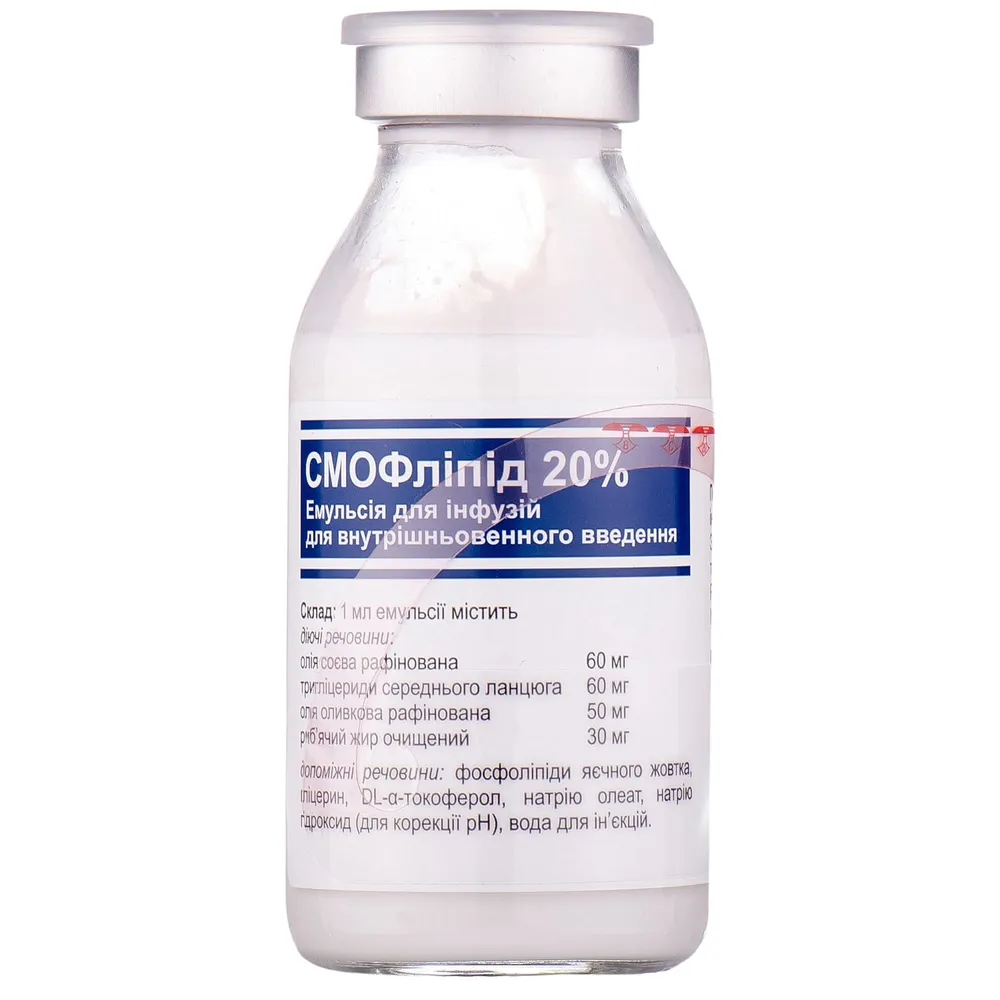
Table of Contents
INSTRUCTIONS FOR MEDICAL USE OF THE MEDICINAL PRODUCT SMOFlipid 20 % (SMOFlipid 20 %)
Composition:
Active substances:
1000 ml of solution contain 60 g of refined soybean oil, 60 g of medium-chain triglycerides, 50 g of refined olive oil, 30 g of purified fish oil;
Excipients: egg yolk phospholipids, glycerol, DL-α-tocopherol, sodium oleate, sodium hydroxide (for pH adjustment), water for injections.
Pharmaceutical form. Emulsion for infusion.
Main physicochemical properties: homogeneous white emulsion.
Pharmacotherapeutic group. Solutions for parenteral nutrition. Fat emulsions.
ATC code B05BA02.
Pharmacological properties.
Pharmacodynamics. The lipid emulsion particles have a size and biological properties similar to endogenous chylomicrons. The components of SMOFlipid 20%: soybean oil, medium-chain triglycerides, olive oil, and fish oil – apart from differences in energy content, each possess their own pharmacodynamic properties. SMOFlipid 20% is an energy source. Soybean oil has a high content of essential fatty acids. The most abundant (55–60%) is the omega-6 fatty acid, linoleic acid. The content of omega-3 fatty acid (alpha-linolenic acid) is approximately 8%. This component of SMOFlipid 20% provides the necessary amount of essential fatty acids. Medium-chain fatty acids are rapidly oxidized and provide readily available energy to the body. Olive oil primarily supplies energy in the form of monounsaturated fatty acids, which are less susceptible to lipid peroxidation than an equivalent amount of polyunsaturated fatty acids. Fish oil is characterized by a high content of eicosapentaenoic acid (EPA) and docosahexaenoic acid (DHA). DHA is an important structural component of cell membranes, while EPA serves as a precursor for eicosanoids: prostaglandins, thromboxanes, and leukotrienes.
Vitamin E protects unsaturated fatty acids from lipid peroxidation.
Two studies on home parenteral nutrition involving patients requiring long-term nutritional support have been conducted.
The primary objective in both studies was to demonstrate safety.
Assessment of efficacy was a secondary objective in one of the studies, which included pediatric patients. Study participants were divided into age groups (1 month – < 2 years, 2–11 years, respectively). Both studies showed that SMOFlipid 20% has the same safety profile as the comparator product (Intralipid 20%).
Efficacy in the pediatric study was assessed by weight gain, growth, body mass index, prealbumin, retinol-binding protein, and fatty acid profile. No differences between groups were observed for any parameter except the fatty acid profile after 4 weeks of treatment. The fatty acid profile in patients receiving SMOFlipid 20% showed an increase in omega-3 fatty acids in plasma lipoproteins and in red blood cell phospholipids, thus reflecting the composition of the lipid emulsion.
Pharmacokinetics. Individual triglycerides have different elimination rates, but SMOFlipid 20%, as a mixture, is eliminated faster than long-chain triglycerides (LCT) during infusion. Olive oil has the slowest elimination rate among the other components (slightly slower than LCT), while medium-chain triglycerides (MCT) have the highest rate. Fish oil in combination with LCT has the same elimination rate as LCT administered alone.
Clinical characteristics.
Indications.
SMOFlipid 20% is a source of energy, essential fatty acids and omega-3 fatty acids for patients as part of parenteral nutrition when oral or enteral nutrition is impossible, inadequate or contraindicated.
Contraindications.
Hypersensitivity to fish, egg, soy proteins, peanuts or to any of the active or excipient ingredients; severe hyperlipidemia; severe hepatic insufficiency; severe coagulation disorders; severe renal insufficiency without possibility of hemofiltration or dialysis; acute shock; general contraindications to infusion therapy: acute pulmonary edema, hyperhydration, decompensated heart failure; unstable condition (e.g., following severe trauma, decompensated diabetes mellitus, acute myocardial infarction, stroke, embolism, metabolic acidosis, severe sepsis and hypotonic dehydration).
Interaction with other medicinal products and other forms of interaction.
Administration of heparin at clinical doses causes a temporary increase in the release of lipoprotein lipase into the circulation. Initially, this may lead to enhanced lipolysis in plasma, followed by a temporary reduction in triglyceride clearance.
Soybean oil contains natural vitamin K1. However, its content in the product is very low, so it does not significantly affect coagulation in patients receiving coumarin derivatives.
SMOFlipid 20% may be mixed with amino acid solutions, glucose and electrolytes under aseptic conditions to prepare a "All-in-one" total parenteral nutrition solution.
Special precautions.
The potential for fat elimination is individual, and therefore the physician should monitor triglyceride levels. Particular caution is required in patients at high risk of hyperlipidemia (e.g., patients receiving high lipid doses, patients with severe sepsis, and extremely low birth weight neonates). Serum triglyceride concentration during fat emulsion infusion should generally not exceed 3 mmol/L. Consideration should be given to reducing the dose or discontinuing fat emulsion administration if serum or plasma triglyceride concentration exceeds 3 mmol/L during or after infusion. Overdose may lead to fat overload syndrome.
This medicinal product contains soybean oil, fish oil, and egg yolk phospholipids, which may rarely cause allergic reactions. Cross-allergic reactions between soybeans and peanuts may occur.
SMOFlipid 20% should be used with caution in conditions of impaired lipid metabolism, which may occur in patients with renal insufficiency, diabetes mellitus, pancreatitis, liver dysfunction, hypothyroidism, and sepsis.
Clinical data in patients with diabetes mellitus or renal insufficiency are limited.
Administration of medium-chain fatty acids as the sole energy source may lead to metabolic acidosis. This risk is largely mitigated by simultaneous administration of long-chain fatty acids present in SMOFlipid 20%. Concurrent administration of carbohydrates further reduces this risk. Therefore, simultaneous administration of carbohydrates or amino acid solutions containing carbohydrates is recommended. For monitoring patients receiving parenteral nutrition, regular laboratory tests are recommended, including blood glucose, liver function, acid-base status, fluid balance, complete blood count, and electrolytes. Infusion must be stopped immediately in case of any sign of anaphylactic reaction (e.g., high fever, chills, rash, dyspnea).
SMOFlipid 20% should be used cautiously in neonates and preterm infants with hyperbilirubinemia or pulmonary hypertension. In neonates, especially preterm infants receiving long-term parenteral nutrition, platelet count, liver function tests, and serum triglyceride levels should be monitored.
Exposure of intravenous parenteral nutrition solutions to light, particularly in the presence of trace elements and/or vitamins, may adversely affect clinical outcomes in neonates due to the formation of peroxides and other degradation products. When administered to neonates and children under 2 years of age, SMOFlipid 20% should be protected from ambient light until the end of administration (see sections "Method of administration and dosage" and "Shelf life" in the instructions).
Use only a homogeneous emulsion.
High lipid levels in plasma may affect certain blood laboratory parameters, such as hemoglobin levels.
Concomitant use of other medicinal products with SMOFlipid 20% should generally be avoided, except when compatibility is known.
SMOFlipid 20% contains up to 5 mmol of sodium per 1000 ml. This should be taken into account for patients on a sodium-restricted diet.
Use during pregnancy or breastfeeding.
There are no data on the effects of SMOFlipid 20% during pregnancy and lactation. No reproductive toxicity studies have been conducted in animals. Parenteral nutrition may be necessary during pregnancy and lactation.
SMOFlipid 20% should be administered only when the expected benefit to the mother outweighs the potential risk to the fetus.
Ability to affect reaction speed when driving or operating machinery.
Data are lacking.
Administration and Dosage
Intravenous infusion into central or peripheral veins.
When administered to newborns and children under 2 years of age, the solution (in vials and infusion sets) must be protected from light until administration is complete (see sections "Special Warnings", "Shelf Life").
Adults
The standard dose is 1–2 g of fat/kg body weight per day, corresponding to 5–10 mL/kg body weight per day. The recommended infusion rate is 0.125 g of fat/kg body weight/hour, corresponding to 0.63 mL of SMOFlipid 20%/kg body weight/hour, and must not exceed 0.15 g of fat/kg body weight/hour, corresponding to 0.75 mL of SMOFlipid 20%/kg body weight/hour.
Newborns and Infants
The initial dose should be 0.5–1 g of fat/kg body weight per day, with subsequent gradual increases of 0.5–1 g of fat/kg body weight per day. A daily dose exceeding 3 g of fat/kg body weight per day (corresponding to 15 mL of SMOFlipid 20%/kg body weight per day) is not recommended. The infusion rate must not exceed 0.125 g of fat/kg body weight/hour.
SMOFlipid 20% should be administered continuously over 24 hours to preterm newborns and infants with low birth weight.
Children
A daily dose exceeding 3 g of fat/kg body weight/day (corresponding to 15 mL of SMOFlipid 20%/kg body weight per day) is not recommended. The daily dose should be gradually increased during the first week. The infusion rate must not exceed 0.15 g of fat/kg body weight/hour.
Children
Used in pediatric practice (see section "Administration and Dosage").
Overdose
Overdose may lead to fat overload syndrome if the infusion is too rapid or prolonged at the recommended rate, particularly in association with changes in the patient's clinical condition, such as the development of renal failure or infection.
Overdose may result in adverse effects. In such cases, lipid infusion should be discontinued or, if necessary, continued at a reduced dose.
Adverse reactions.
Adverse reactions observed after administration of lipid emulsions occurred with the following frequencies: very common (> 1/10); common (≥ 1/100, < 1/10); uncommon (≥ 1/1000, < 1/100); rare (≥ 1/10,000, < 1/1000); very rare (< 1/10,000).
From the respiratory system
Rare: dyspnea.
From the gastrointestinal system
Uncommon: loss of appetite, nausea, vomiting.
From the vascular system
Rare: arterial hypotension, hypertension.
General adverse reactions and reactions at the site of administration
Common: slight increase in body temperature.
Uncommon: chills.
Rare: hypersensitivity reactions (anaphylactic or anaphylactoid reactions, skin rashes, urticaria, flushing, headache), sensation of heat or cold, pallor, cyanosis, pain in the neck, back, bones, chest, and lumbar region.
From the reproductive system
Very rare: priapism.
If adverse reactions occur, infusion of SMOFlipid 20% should be discontinued or continued with a reduced dose.
If triglyceride levels rise above 3 mmol/L during infusion, administration of SMOFlipid 20% should be discontinued or, if necessary, continued with a reduced dose.
SMOFlipid 20% must always be part of complete parenteral nutrition containing amino acids and glucose. Nausea, vomiting, and hyperglycemia may be symptoms of the underlying disease for which parenteral nutrition is indicated, and sometimes may be directly related to parenteral nutrition administration.
Monitoring of blood triglyceride and glucose levels is recommended to avoid potentially dangerous elevated levels.
Fat overload syndrome: impaired ability to eliminate triglycerides may lead to fat overload syndrome. This condition should be monitored, as it may result from overdosage. It may also be caused by genetically determined individual metabolic characteristics, diseases associated with impaired fat metabolism, or previous illnesses. The syndrome may also occur during severe hypertriglyceridemia, even at the recommended infusion rate, and in association with a sudden deterioration in the patient's clinical condition such as renal failure or infection.
Fat overload syndrome is characterized by hyperlipidemia, fever, fatty infiltration, hepatomegaly (including jaundice), splenomegaly, anemia, leukopenia, thrombocytopenia, coagulation disorders, hemolysis, reticulocytosis, liver function impairment, and coma. Symptoms are usually reversible if lipid emulsion infusion is discontinued.
Infusion must be discontinued if signs of fat overload syndrome occur.
Reporting of suspected adverse reactions
Reporting suspected adverse reactions after marketing authorization of the medicinal product is important. It allows continued monitoring of the benefit-risk balance of the medicinal product. Medical and pharmaceutical personnel, as well as patients or their legal representatives, should report all suspected adverse reactions and lack of efficacy via the Automated Information System for Pharmacovigilance at the following link: https://aisf.dec.gov.ua.
Shelf life.
2 years.
When administered to newborns and children under 2 years of age, the solution (in bottles and administration sets) should be protected from light until the end of administration (see sections of the instructions "Method of administration and dosage", "Special precautions").
Storage conditions. Store out of reach of children at a temperature not exceeding 25 °C. Do not freeze.
Storage period after first opening of the vial: not more than 24 hours at 2–8 °C.
Incompatibilities.
The product should not be mixed with other medicinal products except as specified in the section "Interaction with other medicinal products and other forms of interaction".
Packaging.
100 ml, 250 ml, or 500 ml in a vial.
Prescription status.
Prescription only.
Manufacturer.
Fresenius Kabi Austria GmbH.
Manufacturer's address.
Hafnerstraße 36, 8055 Graz, Austria.
Marketing authorization holder.
Fresenius Kabi Deutschland GmbH.
Address of the marketing authorization holder and/or its representative.
Else-Kröner-Straße 1, 61352 Bad Homburg, Germany.