Smofkabiven peripheral
Ukraine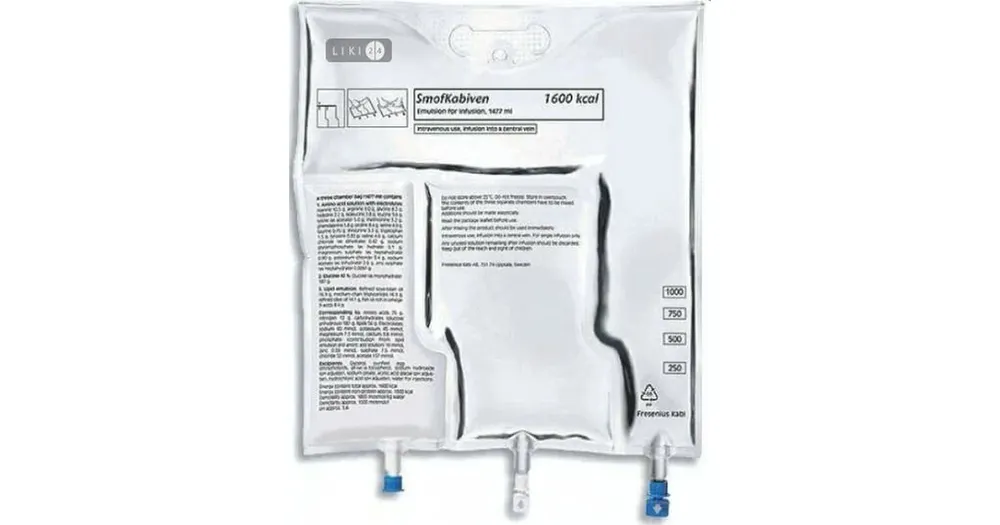
Table of Contents
INSTRUCTIONS FOR MEDICAL USE OF THE MEDICINAL PRODUCT SMOFKABIVEN PERIPHERAL
Composition:
"SmofKabiven Peripheral" is supplied in a three-chamber container. Each chamber contains different volumes of solutions depending on the container size.
| Container volume |
1206 ml |
1448 ml |
1904 ml |
| Chamber No. 1 Glucose 13% |
656 ml |
788 ml |
1036 ml |
| Chamber No. 2 Amino acid solution with electrolytes (Aminoven 10% with electrolytes) |
380 ml |
456 ml |
600 ml |
| Chamber No. 3 Lipid emulsion (Smoflipid 20%) |
170 ml |
204 ml |
268 ml |
Composition of the drug after mixing the contents of the three chambers:
| Active substances |
1206 ml |
1448 ml |
1904 ml |
| Glucose (as glucose monohydrate) |
85 g |
103 g |
135 g |
| Alanine |
5.3 g |
6.4 g |
8.4 g |
| Arginine |
4.6 g |
5.5 g |
7.2 g |
| Glycine |
4.2 g |
5.1 g |
6.6 g |
| Histidine |
1.1 g |
1.3 g |
1.8 g |
| Isoleucine |
1.9 g |
2.3 g |
3.0 g |
| Leucine |
2.8 g |
3.3 g |
4.4 g |
| Lysine (as lysine acetate) |
2.5 g |
3.0 g |
4.0 g |
| Methionine |
1.6 g |
1.9 g |
2.6 g |
| Phenylalanine |
1.9 g |
2.3 g |
3.1 g |
| Proline |
4.2 g |
5.1 g |
6.7 g |
| Serine |
2.5 g |
3.0 g |
3.9 g |
| Taurine |
0.38 g |
0.46 g |
0.60 g |
| Threonine |
1.7 g |
2.0 g |
2.6 g |
| Tryptophan |
0.76 g |
0.91 g |
1.2 g |
| Tyrosine |
0.15 g |
0.17 g |
0.24 g |
| Valine |
2.4 g |
2.9 g |
3.7 g |
| Calcium chloride (as calcium chloride dihydrate) |
0.21 g |
0.26 g |
0.34 g |
| Sodium glycerophosphate (as sodium glycerophosphate hydrate) |
1.6 g |
1.9 g |
2.5 g |
| Magnesium sulfate (as magnesium sulfate heptahydrate) |
0.46 g |
0.55 g |
0.72 g |
| Potassium chloride |
1.7 g |
2.0 g |
2.7 g |
| Sodium acetate (as sodium acetate trihydrate) |
1.3 g |
1.6 g |
2.0 g |
| Zinc sulfate (as zinc sulfate heptahydrate) |
0.005 g |
0.006 g |
0.008 g |
| Refined soybean oil |
10.2 g |
12.3 g |
16.1 g |
| Medium-chain triglycerides |
10.2 g |
12.3 g |
16.1 g |
| Refined olive oil |
8.5 g |
10.1 g |
13.4 g |
| Fish oil enriched with omega-3 fatty acids |
5.1 g |
6.1 g |
8.0 g |
What corresponds to:
| Carbohydrates
|
85 g |
103 g |
135 g |
| Amino acids |
38 g |
46 g |
60 g |
| Nitrogen |
6.2 g |
7.4 g |
9.8 g |
| Fats |
34 g |
41 g |
54 g |
| Electrolytes: |
|||
| Sodium |
30 mmol |
36 mmol |
48 mmol |
| Potassium |
23 mmol |
28 mmol |
36 mmol |
| Magnesium |
3.8 mmol |
4.6 mmol |
6.0 mmol |
| Calcium |
1.9 mmol |
2.3 mmol |
3.0 mmol |
| Phosphate |
9.9 mmol |
11.9 mmol |
15.6 mmol |
| Zinc |
0.03 mmol |
0.03 mmol |
0.05 mmol |
| Sulfate |
3.8 mmol |
4.6 mmol |
6.1 mmol |
| Chloride |
27 mmol |
32 mmol |
42 mmol |
| Acetate |
79 mmol |
96 mmol |
125 mmol |
| Energy value: |
|||
|
800 kcal 3.3 MJ |
1000 kcal 4.0 MJ |
1300 kcal 5.4 MJ |
|
700 kcal 2.9 MJ |
800 kcal 3.5 MJ |
1100 kcal 4.6 MJ |
Osmolality – approximately 950 mOsmol/kg water.
Osmolarity – approximately 850 mOsmol/L.
pH after mixing – approximately 5.6.
Excipients: glycerol, purified egg phospholipids, racemic mixture of α-tocopherols, sodium hydroxide, sodium oleate, glacial acetic acid, water for injections.
Pharmaceutical form. Emulsion for infusion.
Main physicochemical characteristics. 13 % glucose – clear, colorless solution, free from particles. Amino acid solution with electrolytes (Aminoven 10 % with electrolytes) – clear, colorless or slightly yellow solution, free from particles. Lipid emulsion (Smoflipid 20 %) – homogeneous white solution. After mixing the contents of the three chambers, the preparation appears as a white emulsion.
Pharmacotherapeutic group. Solutions for parenteral nutrition. Combinations.
ATC code B05B A10.
Pharmacological Properties.
Pharmacodynamics.
The lipid emulsion of "SmofKabiven Peripheral" consists of 20% Smoflipid, which is similar in particle size and biological properties to endogenous chylomicrons. The components of the lipid emulsion include soybean oil, medium-chain triglycerides, olive oil, and fish oil, which, in addition to their energy value, possess their own pharmacodynamic properties.
Soybean oil has a high content of essential fatty acids. The most prevalent is linoleic acid, belonging to the omega-6 fatty acid class, present in an amount of approximately 55–60%. The content of α-linolenic acid, belonging to the omega-3 fatty acid class, is approximately 8%. This component of "SmofKabiven Peripheral" provides the necessary amount of essential fatty acids. Medium-chain fatty acids are rapidly oxidized and provide the body with readily available energy. Olive oil primarily provides energy through monounsaturated fatty acids, which are considerably less susceptible to peroxidation than an equivalent amount of polyunsaturated fatty acids. Fish oil is characterized by a high content of eicosapentaenoic acid (EPA) and docosahexaenoic acid (DHA). DHA is an important structural component of cell membranes, while EPA serves as a precursor for eicosanoids such as prostaglandins, thromboxanes, and leukotrienes.
Amino acids present in regular food are used for tissue protein synthesis, and any excess is directed toward various metabolic processes. Studies have demonstrated a thermogenic effect of amino acid infusions.
Glucose contained in the preparation participates in maintaining or restoring normal nutritional status and has no other pharmacodynamic effects.
Pharmacokinetics.
Individual triglycerides in 20% Smoflipid have different clearance rates, but Smoflipid 20% as a mixture is eliminated more rapidly than long-chain triglycerides (LCT). Olive oil has a slower component clearance (slightly lower than LCT), while medium-chain triglycerides are cleared more rapidly. Fish oil in a mixture with LCT has the same clearance as LCT alone.
The main pharmacokinetic properties of amino acids and electrolytes administered intravenously are essentially the same as those of amino acids and electrolytes derived from regular food. However, dietary proteins initially enter the portal vein and then the systemic circulation, whereas administered amino acids and electrolytes reach the systemic circulation directly.
The pharmacokinetic properties of administered glucose are essentially the same as when supplied through regular food.
Clinical characteristics.
Indications.
Parenteral nutrition when oral and enteral nutrition are impossible, insufficient, or contraindicated.
Contraindications.
- Hypersensitivity to fish, egg, soy, or peanut proteins or to any component of the medicinal product.
- Severe hyperlipidemia.
- Severe hepatic insufficiency.
- Severe coagulation disorders.
- Inherited disorders of amino acid metabolism.
- Severe renal insufficiency in the absence of access to hemofiltration or dialysis.
- Acute phase of shock.
- Uncontrolled hyperglycemia.
- Pathologically elevated plasma levels of any electrolyte contained in the product.
- General contraindications to infusion therapy: acute pulmonary edema, hyperhydration, decompensated heart failure.
- Hemophagocytic syndrome.
- Unstable condition (e.g., severe post-traumatic state, uncompensated diabetes mellitus, acute stage of myocardial infarction, stroke, embolism, metabolic acidosis, severe sepsis, hypotonic dehydration, and hyperosmolar coma).
- Pediatric use under 2 years of age.
Special precautions.
For single use only.
Do not use if the packaging is damaged. Use only if the amino acid solution and glucose solution are clear, colorless or light yellow, and the lipid emulsion is white and homogeneous. The contents of the three separate chambers must be mixed before use or before adding supplements through the appropriate port. After opening the seals, the container should be rotated several times to homogenize the mixture, which must not show phase separation.
Additives should be introduced under aseptic conditions.
Any unused solution must be discarded.
Interaction with other medicinal products and other forms of interaction.
Some medicinal products, such as insulin, may affect the body's lipase system.
However, this type of interaction has limited clinical significance.
Heparin, at clinical doses, causes a transient release of lipoprotein lipase into the circulation. This may lead to increased lipolysis in plasma and a temporary reduction in triglyceride clearance.
Soybean oil contains natural vitamin K1. However, its concentration in "SmofKabiven Peripheral" is so low that its effect on blood coagulation in patients taking coumarin derivatives is negligible.
Special precautions for use.
The level of triglycerides should be monitored, and their concentration in blood plasma during infusion should not exceed 4 mmol/L. Overdosage may lead to the development of fat overload syndrome. "SmofKabiven peripheral" should be administered with caution in patients with lipid metabolism disorders, which may occur in patients with renal insufficiency, diabetes mellitus, pancreatitis, hepatic dysfunction, hypothyroidism, and sepsis.
The medicinal product contains soybean oil, fish oil, and egg phospholipids, which in rare cases may cause allergic reactions. Allergy to soy and peanuts may be cross-reactive.
To avoid risks associated with very rapid infusion, continuous and well-controlled infusions are recommended, preferably using a volumetric infusion pump.
Electrolyte and fluid imbalances (e.g., abnormally high or low serum electrolyte levels) should be corrected prior to the start of infusion.
"SmofKabiven peripheral" should be administered with caution to patients prone to electrolyte retention. Clinical parameters should be monitored before initiating any intravenous infusions. Infusion should be discontinued immediately if any abnormal symptoms occur.
Since any infusion into a peripheral vein is associated with an increased risk of infection, strict adherence to aseptic techniques is essential during catheter insertion and handling to prevent infection.
Glucose levels, electrolytes, osmolality, fluid balance, acid-base balance, and liver enzyme levels in blood plasma should be monitored.
During prolonged lipid administration, blood cell counts and coagulation parameters should be monitored.
In patients with renal insufficiency, phosphate and potassium intake should be carefully monitored to prevent hyperphosphatemia and hyperkalemia.
The amount of additional electrolytes should be determined by regular monitoring of their plasma concentrations, taking into account the patient's clinical condition.
Parenteral nutrition should be administered with caution in patients with lactic acidosis, inadequate cellular oxygen supply, and increased plasma osmolality.
If any symptoms of an anaphylactic reaction occur (e.g., fever, chills, rash, or dyspnea), the infusion must be stopped immediately.
The presence of lipids in the preparation may affect the results of certain laboratory tests (e.g., bilirubin concentration, lactate dehydrogenase activity, blood oxygen saturation, hemoglobin levels) if blood samples are taken before lipids have been sufficiently cleared from the bloodstream. In most patients, lipids are cleared within 5–6 hours.
Intravenous administration of amino acids is associated with increased urinary excretion of trace elements, especially copper and zinc. This should be considered when adding trace elements, particularly during prolonged parenteral nutrition. The amount of zinc administered with "SmofKabiven peripheral" should be taken into account.
In malnourished patients, initiation of parenteral nutrition may cause fluid redistribution in the body, potentially leading to pulmonary edema and congestive heart failure, as well as decreased plasma concentrations of potassium, phosphorus, magnesium, and water-soluble vitamins. These effects may manifest within 24–48 hours; therefore, parenteral nutrition should be initiated cautiously and slowly in such patients, with careful monitoring and appropriate correction of fluid, electrolyte, trace element, and vitamin levels.
"SmofKabiven peripheral" should not be administered simultaneously with blood through the same infusion system due to the risk of pseudoagglutination.
Patients with hyperglycemia may require insulin administration.
If administered into peripheral veins, thrombophlebitis may develop. The catheter insertion site should be inspected daily for signs of thrombophlebitis.
Only medical and nutritional additives with documented compatibility should be added to "SmofKabiven peripheral."
Use during pregnancy or breastfeeding.
There are no available data on the effects of "SmofKabiven peripheral" in pregnant or breastfeeding women; therefore, the benefit-risk ratio should be carefully evaluated before prescribing the drug.
Ability to affect reaction speed when driving or operating machinery.
Not studied. The drug is intended for use only in a hospital setting.
Administration and Dosage
Intravenous administration via peripheral or central vein.
When determining dosage and infusion rate, the patient's ability to metabolize fats, nitrogen, and glucose must be taken into account. The dose should be individually adjusted based on the patient's condition, body weight, nutritional and energy requirements, and any additional oral/enteral nutrition.
Nitrogen requirements for maintaining body protein mass depend on the patient's condition (nutritional status, level of catabolic stress, and anabolic state).
Adults
In patients with normal nutritional status or mild catabolic stress, nitrogen requirement is 0.10–0.15 g nitrogen/kg body weight/day (0.6–0.9 g amino acids/kg body weight/day). In patients with moderate to high metabolic stress, including malnutrition, the requirement increases to 0.15–0.25 g nitrogen/kg body weight/day (0.9–1.6 g amino acids/kg body weight/day). In certain special conditions (e.g., burns or pronounced anabolism), nitrogen requirements may be even higher.
Dosing
A dosage of 20–40 mL/kg body weight/day of "SmofKabiven peripheral" corresponds to 0.10–0.20 g nitrogen/kg body weight/day (0.6–1.3 g amino acids/kg body weight/day) and provides 14–28 kcal/kg body weight/day of total energy (11–22 kcal/kg body weight/day of non-protein energy). This range meets the needs of most patients. For patients with excessive body weight, dosing should be based on ideal body weight.
Infusion Rate
Maximum infusion rate: glucose – 0.25 g/kg body weight/hour, amino acids – 0.1 g/kg body weight/hour, lipids – 0.15 g/kg body weight/hour.
The infusion rate should not exceed 3 mL/kg body weight/hour (corresponding to 0.21 g glucose, 0.10 g amino acids, and 0.08 g lipids/kg body weight/hour). The recommended duration of infusion is 14–24 hours.
Maximum Daily Dose
The maximum daily dose depends on the patient's clinical condition and may vary. The recommended maximum daily dose is 40 mL/kg body weight/day, which provides 0.20 g nitrogen/kg body weight/day (equivalent to 1.3 g amino acids/kg body weight/day), 2.8 g glucose/kg body weight/day, 1.1 g lipids/kg body weight/day, and a total energy intake of 28 kcal/kg body weight/day (corresponding to 22 kcal/kg body weight/day of non-protein energy).
Children aged 2 to 11 years
Dosing
A dose up to 40 mL/kg body weight/day should be regularly adjusted according to the changing needs of pediatric patients, which may vary more significantly than in adults.
Infusion Rate
Recommended maximum infusion rate: 3.0 mL/kg body weight/hour (corresponding to 0.10 g amino acids/kg/hour, 0.21 g glucose/kg/hour, and 0.08 g lipids/kg/hour).
Recommended infusion period: 12–24 hours.
When administering the recommended maximum dose, the infusion period should be no less than 13 hours to avoid exceeding the recommended maximum infusion rate, except in exceptional cases.
Maximum Daily Dose
The maximum daily dose depends on the patient's clinical condition and may vary from day to day. The recommended maximum daily dose is 40 mL/kg body weight/day, providing 0.2 g nitrogen/kg body weight/day (equivalent to 1.3 g amino acids/kg body weight/day), 2.8 g glucose/kg body weight/day, 1.1 g lipids/kg body weight/day, and total energy of 28 kcal/kg body weight/day (corresponding to 22 kcal/kg body weight/day of non-protein energy).
Adolescents (12–16/18 years)
SmofKabiven peripheral should be administered to adolescents as in adults.
Three different package sizes of SmofKabiven peripheral are available, intended for patients with normal or moderately increased nutritional requirements. To ensure adequate parenteral nutrition according to individual needs, trace elements, vitamins, and electrolytes may be added to SmofKabiven peripheral (taking into account electrolytes already present in SmofKabiven peripheral).
Instructions for Use of the Three-Chamber "Biofin" Container
- Perforation on the outer plastic bag
- Handle
- Hanging hole
- Partition
- Blind port (not used)
- Inlet port (for additives)
- Outlet port (for infusion set)
- Antioxidant (in the outer plastic bag)
- Removal of the outer plastic bag
Holding the container horizontally, remove the outer plastic bag by tearing it at the perforation and pulling along the edge. Discard together with the antioxidant.
- Mixing
Place the three-chamber container on a flat surface. Firmly twist the container starting from the corner near the handle diagonally toward the blind port.
Then, holding the twisted portion with the right hand while maintaining constant internal pressure, press on the container with the left hand until the vertical partitions open.
Open the vertical partitions using the pressure built up inside the container. The horizontal partition does not need to be opened; the contents of the chambers mix easily after opening only the vertical partitions.
Mix the contents by turning the container 2–3 times.
Note: The vertical partitions can be opened without removing the outer bag, after which the outer bag can be removed.
- Connecting the Infusion Set
If additives are required, break off the cap with the arrow from the white port immediately before administration. While holding the inlet port, insert the needle through the center of the membrane and administer the additive (with known compatibility). The port membrane is sterile. After adding, thoroughly mix the solution by turning the container several times.
Immediately before administration, break off the cap from the blue port with the arrow. Holding the bag with the inlet port facing upward, insert the needle through the center of the membrane, rotating and pushing it through if necessary. Use an air-free infusion set or ensure air access is blocked in sets that allow air entry.
- Hanging the Container
Hang the container on the infusion stand using the hanging hole.
Children
Due to the composition of the amino acid solution, SmofKabiven peripheral is not suitable for use in neonates and children under 2 years of age.
Overdose
Fat Overload Syndrome
Impaired ability to eliminate triglycerides may lead to fat overload syndrome. Causes include fat overdose, genetic factors (individual metabolic peculiarities), pre-existing or concurrent diseases, or sudden changes in the patient's clinical condition (e.g., renal failure or infection). This syndrome may also occur during severe hypertriglyceridemia, even at the recommended infusion rate. Fat overload syndrome, resulting from the above causes, is characterized by hyperlipidemia, fever, fat infiltration, hepatomegaly (with or without jaundice), splenomegaly, anemia, leukopenia, thrombocytopenia, coagulation disorders, hemolysis, reticulocytosis, impaired liver function, and coma. Symptoms are usually reversible upon discontinuation of the lipid emulsion.
Excessive Amino Acid Administration
If the infusion rate exceeds recommended levels, as with other amino acid solutions, administration of SmofKabiven peripheral may cause nausea, vomiting, chills, sweating, and elevated body temperature. In patients with impaired renal function, increased levels of nitrogen-containing metabolites (e.g., creatinine, urea) may occur.
Excessive Glucose Administration
If the glucose infusion rate exceeds its clearance, hyperglycemia may develop in patients.
If symptoms of fat or amino acid overdose occur, the infusion rate should be reduced or administration stopped. There are no specific antidotes for overdose. Supportive care should be provided, with special attention to respiratory and cardiovascular function. Biochemical monitoring is essential, and specific abnormalities should be treated accordingly.
In case of hyperglycemia, treatment should be based on the clinical situation: either insulin administration or adjustment of the infusion rate. Additionally, overdose may lead to hypervolemia, electrolyte imbalance, and hyperosmolarity. In severe cases, hemodialysis, hemofiltration, or hemodiafiltration may be indicated.
Adverse Reactions
The following classification is used to assess the frequency of adverse effects: very common: ≥ 1/10; common: ≥ 1/100 and < 1/10; uncommon: ≥ 1/1,000 and < 1/100; rare: ≥ 1/10,000 and < 1/1,000; very rare: < 1/10,000; frequency not known (cannot be estimated from the available data).
Cardiac disorders.
Rare: tachycardia.
Respiratory, thoracic and mediastinal disorders.
Rare: dyspnea.
Gastrointestinal disorders.
Uncommon: loss of appetite, nausea, vomiting.
Metabolism and nutrition disorders.
Uncommon: increased levels of liver enzymes in blood plasma.
Vascular disorders.
Common: thrombophlebitis.
Rare: hypotension, hypertension.
General disorders and administration site conditions.
Common: slight increase in body temperature.
Uncommon: chills, dizziness, headache.
Rare: hypersensitivity reactions (e.g. anaphylactic or anaphylactoid reactions, skin rash, urticaria, facial flushing, headache), sensation of cold or warmth, pallor, cyanosis, pain in the neck, back, bones, chest, or lumbar region.
If any of these adverse reactions occur, administration of "SmofKabiven Peripherally" should be stopped or, if necessary, the dose reduced and administration continued.
Reporting of suspected adverse reactions
Reporting suspected adverse reactions after medicine authorization is important. It allows ongoing monitoring of the benefit-risk balance of the medicine. Healthcare professionals and patients, as well as their legal representatives, are encouraged to report all suspected adverse reactions and lack of efficacy via the Automated Pharmacovigilance Information System at the following link: https://aisf.dec.gov.ua.
Shelf life
Shelf life of the medicinal product in the outer plastic bag: 2 years.
Shelf life after mixing.
Chemical and physical stability after opening and mixing of the three chambers is maintained for 36 hours at 25 °C. From a microbiological standpoint, the product should be used immediately. If immediate use is not possible, storage is the responsibility of the user. Generally, storage time should not exceed 24 hours at 2–8 °C.
Shelf life after mixing with additives.
From a microbiological standpoint, the product should be used immediately. If immediate use is not possible, storage is the responsibility of the user. Generally, storage time should not exceed 24 hours at 2–8 °C.
Storage conditions.
Store in a light-protected place, out of reach of children, at a temperature not exceeding 25 °C. Do not freeze.
Incompatibilities.
Only medical and nutritional additives whose compatibility with the product has been documented may be added to "SmofKabiven Peripherally".
Packaging.
1206 ml, 1448 ml, 1904 ml in a three-compartment plastic container "Biofin", together with an antioxidant, placed in an outer plastic bag.
1206 ml, 1448 ml, 1904 ml in a three-compartment plastic container "Biofin", together with an antioxidant, placed in an outer plastic bag, pack of 4 in a cardboard box.
Supply classification.
For hospital use only.
Manufacturer.
Fresenius Kabi AB.
Manufacturer's address and place of business.
Rapsvägen 7, Uppsala, 754 50, Sweden.
Marketing Authorization Holder.
Fresenius Kabi Deutschland GmbH.
Address of Marketing Authorization Holder.
Else-Kröner-Straße 1, 61352 Bad Homburg, Germany.
Date of latest review.