Sleepezon
Ukraine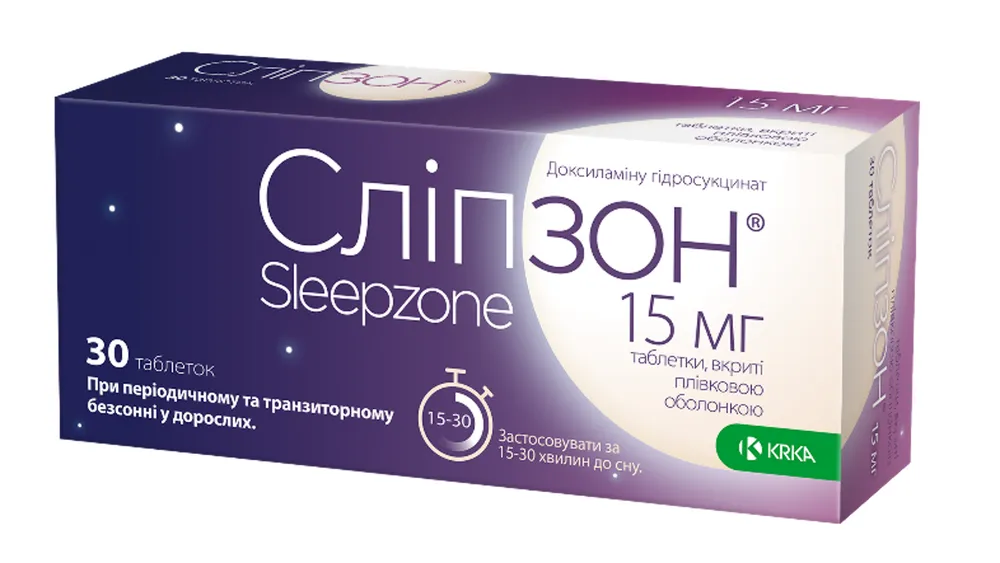
Table of Contents
INSTRUCTIONS FOR MEDICAL USE OF THE MEDICINAL PRODUCT Slipzon® (Sleepzone)
Composition:
Active substance: doxylamine succinate;
One film-coated tablet contains 15 mg of doxylamine succinate;
Excipients: lactose monohydrate, microcrystalline cellulose, sodium croscarmellose, magnesium stearate;
film coating: hypromellose, titanium dioxide, polyethylene glycol 400, iron oxide black, iron oxide red.
Pharmaceutical form. Film-coated tablets.
Main physicochemical properties: pale purplish-grey to purplish-grey, oval, biconvex, film-coated tablets with a score line on one side.
The tablet can be divided into equal halves.
Pharmacotherapeutic group. Antihistamines for systemic use. ATC code R06AA09. Hypnotics and sedatives. ATC code N05CM.
Pharmacological properties.
Pharmacodynamics.
Mechanism of action and pharmacodynamic effects.
Doxylamine succinate is an H1-histamine receptor antagonist of the ethanolamine class, exhibiting sedative and anticholinergic (atropine-like) effects. It has been shown to reduce the time required to fall asleep, as well as improve sleep duration and quality.
Pharmacokinetics.
Absorption
Maximum plasma concentration (Cmax) is reached on average within 2 hours (Tmax) after administration of doxylamine succinate.
Biotransformation and elimination
The mean elimination half-life from plasma (T½) is 10 hours.
Doxylamine succinate is partially metabolized in the liver via demethylation and N-acetylation. The elimination half-life may be significantly prolonged in elderly individuals or in patients with renal or hepatic impairment. Various metabolites formed during breakdown are not quantitatively significant, as 60% of the administered dose is excreted in urine in unchanged form as doxylamine.
Clinical characteristics.
Indications.
Transient insomnia in adults.
Contraindications.
Hypersensitivity to the active substance or to other antihistamines, or to any of the excipients.
Acute angle-closure glaucoma in the patient's medical history or family history. Urethral-prostatic disorders with risk of urinary retention.
Interaction with other medicinal products and other forms of interaction.
Combinations not recommended
Alcohol (beverage and excipient)
Alcohol enhances the sedative effect of most H1-antihistamines. Reduced alertness may make driving and operating machinery hazardous. Consumption of alcoholic beverages and use of medicinal products containing ethanol should be avoided.
Sodium oxybate causes central nervous system (CNS) depression. Reduced alertness may make driving and operating machinery hazardous.
Combinations to be taken into consideration
Acetylcholinesterase inhibitors
Risk of reduced efficacy of acetylcholinesterase inhibitors due to antagonism at muscarinic acetylcholine receptors.
Other antimuscarinic medicinal products (tricyclic antidepressants, most antimuscarinic H1-antihistamines, anticholinergic antiparkinson agents, antimuscarinic spasmolytics, disopyramide, phenothiazine neuroleptics, and clozapine) due to additive antimuscarinic side effects such as urinary retention, constipation, dry mouth.
Other CNS-active antidepressants
Opioid derivatives (analgesics used for cough treatment and substitution therapy), neuroleptics; barbiturates; benzodiazepines; anxiolytics other than benzodiazepines (e.g. meprobamate); hypnotics, sedative antidepressants (amitriptyline, doxepin, mianserin, mirtazapine, trimipramine); sedative H1-antihistamines; centrally-acting antihypertensives; baclofen, thalidomide) enhance CNS depression. Reduced alertness may make driving and operating machinery hazardous.
Other hypnotic agents cause CNS depression.
Opioid-like substances/opioids
Significant risk of intestinal immobility (akinesia) with severe constipation.
Special precautions for use.
Special warnings
Insomnia may have various causes that do not necessarily require drug treatment.
Like all hypnotics or sedatives, doxylamine succinate may exacerbate sleep apnea syndrome (increasing the number and duration of breathing pauses).
The risk of abuse and drug dependence is low; however, cases of abuse and drug dependence have been reported. It is necessary to carefully monitor for signs indicating abuse or dependence. The duration of treatment should not exceed 5 days. Use of the drug Sleepzon in patients with disorders related to psychoactive substance use is not recommended.
Accumulation risk
Like all drugs, doxylamine succinate is retained in the body for approximately 5 half-lives (see section "Pharmacokinetics").
In elderly patients or in individuals with impaired renal or hepatic function, the elimination half-life may be significantly prolonged. With repeated administration, the drug or its metabolites reach a steady-state concentration much later and at a much higher level. Only after achieving steady-state conditions can the efficacy and safety of the drug be adequately assessed.
Dosage adjustment may be required (see section "Dosage and administration").
Elderly patients
H1-antihistamines should be used with caution in elderly patients due to the risk of cognitive disturbances, lethargy, delayed reaction time, and/or dizziness, which may increase the risk of falls (e.g., when getting up at night), with consequences often being serious in this patient group.
Special safety measures
Elderly patients, patients with impaired renal or hepatic function
Increased plasma concentrations and reduced plasma clearance have been observed. Dose reduction is recommended.
To prevent daytime drowsiness, it should be remembered that the duration of sleep after taking the drug should be at least 7 hours.
Sleepzon® contains lactose. This medication should not be used in patients with congenital galactosemia, glucose-galactose malabsorption syndrome, or lactase deficiency.
Use during pregnancy or breastfeeding.
Pregnancy
Based on available data, doxylamine may be used during pregnancy after consultation with a physician. If the drug is administered towards the end of pregnancy, anticholinergic and sedative effects of this molecule should be taken into account when monitoring the newborn.
Period of breastfeeding
It is unknown whether doxylamine passes into breast milk. Considering the potential for causing lethargy or paradoxical excitation in the infant, use of the drug during breastfeeding is not recommended.
Ability to influence reaction speed when driving or operating machinery.
Patients who drive or operate machinery should be informed about the risk of daytime drowsiness. They should be advised not to use sedatives, sodium oxybate, alcoholic beverages, or medicinal products containing alcohol as concomitant therapy, or, if such combinations are used, to consider the sedative effect of antihistamines. The risk of reduced attention concentration increases with insufficient sleep duration.
Dosage and Administration
Dosage
The recommended dose is 7.5–15 mg per day (½–1 tablet per day). If necessary, the dose may be increased up to 30 mg per day (2 tablets per day).
Elderly patients, patients with renal or hepatic impairment
A reduced dose is recommended.
Administration
For oral use. Administer once daily, 15–30 minutes before bedtime. The tablet should be swallowed whole with sufficient amount of water.
Duration of treatment
The treatment course lasts 2–5 days. If insomnia persists for longer than 5 days, the continued use of the medicinal product should be re-evaluated.
Children
The medicinal product must not be used in children under 18 years of age.
Overdose
Symptoms
The initial symptoms of acute poisoning include drowsiness and signs of anticholinergic effects: excitation, mydriasis, cycloplegia, dry mouth, facial and neck flushing, hyperthermia, and sinus tachycardia. Delirium, hallucinations, and athetoid movements are more commonly observed in children and may sometimes precede seizures—rare complications of severe poisoning—or even coma. Even in the absence of seizures, acute poisoning with doxylamine may occasionally cause rhabdomyolysis, which can lead to acute renal failure. This muscular disorder is relatively common and requires systematic screening by measuring creatine phosphokinase (CPK) activity.
Treatment
Treatment is symptomatic. In early stages of poisoning, activated charcoal is recommended (50 g for adults, 1 g/kg for children).
Adverse reactions.
Anticholinergic effects: constipation, urinary retention, dry mouth, visual disturbances (accommodation disorder, blurred vision, hallucinations, impaired visual acuity), tachycardia, confusion.
Rhabdomyolysis, increased blood CK levels.
Daytime drowsiness, requiring dose reduction.
Cases of abuse and dependence have been reported.
Possible allergic reactions, including skin rash, itching.
In addition, first-generation H1-antihistamines are known to cause drowsiness, cognitive disorders, and psychomotor impairment.
Reporting of suspected adverse reactions
Reporting suspected adverse reactions after marketing authorization of the medicinal product is of great importance. It allows continuous monitoring of the benefit-risk balance of the medicinal product. Medical and pharmaceutical professionals, as well as patients or their legal representatives, should report all suspected adverse reactions and lack of efficacy via the Automated Pharmacovigilance Information System at the following link: https://aisf.dec.gov.ua.
Shelf life.
3 years.
Storage conditions.
No special storage conditions required for this medicinal product. Keep out of reach of children.
Packaging.
10 tablets per blister, 1, 2, or 3 blisters per cardboard box.
Classification by availability.
№ 10 – Over-the-counter;
№ 20 – Prescription only;
№ 30 – Prescription only.
Manufacturer.
KRKA, d.d., Novo mesto / KRKA, d.d., Novo mesto.
Manufacturer's address and location of operations.
Smarjeska cesta 6, 8501 Novo mesto, Slovenia / Smarjeska cesta 6, 8501 Novo mesto, Slovenia.