Skinoren
Ukraine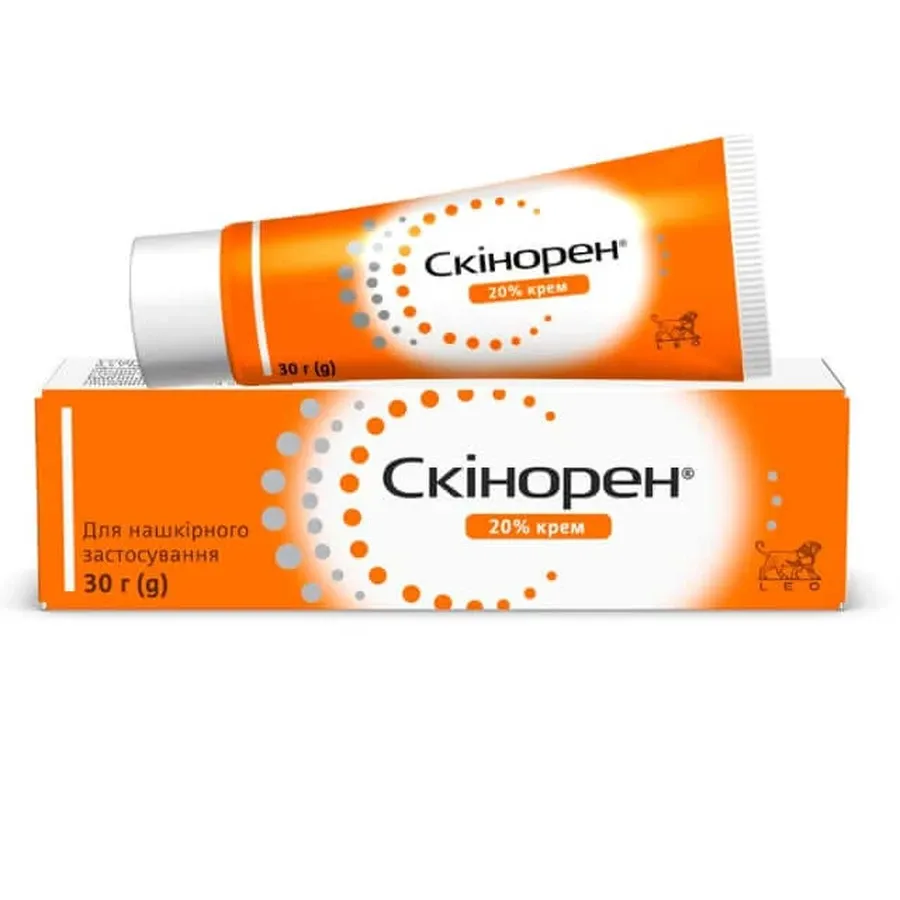
Table of Contents
INSTRUCTIONS FOR MEDICAL USE OF THE MEDICINAL PRODUCT SKINOREN® (SKINOREN®)
Composition:
Active substance: micronized azelaic acid;
1 g of cream contains 0.2 g of micronized azelaic acid;
Excipients: benzoic acid (E 210), stearyl macrogol glycerides, PCL Liquid® (a mixture of excipients: cetearil octanoate and isopropyl myristate), glyceryl monostearate 40–55, cetostearyl alcohol, propylene glycol, glycerin 85%, purified water.
Pharmaceutical form. Cream.
Main physicochemical characteristics: white opaque cream.
Pharmacotherapeutic group. Topical agents for acne treatment.
ATC code D10A X03.
Pharmacological Properties
Pharmacodynamics
Azelaic acid, the active ingredient in Skinoren® cream, is a straight-chain dicarboxylic acid which, being naturally occurring, has no toxicity, teratogenicity, or mutagenicity.
The therapeutic efficacy of Skinoren® cream in the treatment of acne is believed to result from its antimicrobial activity and direct effect on follicular hyperkeratosis. Clinically, a significant reduction in the colonization density of Propionibacterium acnes and a marked decrease in the fraction of free fatty acids in skin surface lipids are observed.
Azelaic acid inhibits keratinocyte proliferation in vitro and in vivo and normalizes impaired terminal differentiation processes of the epidermis in acne. In a rabbit ear model, azelaic acid accelerates comedolysis of tetradecane-induced comedones.
At concentrations of 0.31–2.5%, after prolonged contact for 30–120 minutes, azelaic acid exhibits biocidal activity against gram-positive and gram-negative aerobic bacteria, anaerobic bacteria, and fungi.
In vitro studies have shown no evidence of mutant forms resistant to azelaic acid, either in Staphylococcus epidermidis or in Propionibacterium acnes.
Pharmacokinetics
After topical application, azelaic acid penetrates all layers of human skin. Penetration occurs more rapidly through diseased skin than through intact skin. After a single application of azelaic acid to the skin surface (as 5 g of Skinoren® cream), 3.6% of the applied dose is absorbed into the subcutaneous tissue.
Metabolism of azelaic acid has been studied following oral administration at doses up to 5 g.
Part of the azelaic acid absorbed through the skin is excreted unchanged in urine. The remainder undergoes degradation via β-oxidation into dicarboxylic acids with shorter chain lengths (C7, C5), which have also been detected in urine.
Systemic tolerance studies following repeated oral and topical administration of azelaic acid have revealed no signs indicating that adverse effects could be expected, even under extreme conditions such as application over large skin areas and/or under occlusive dressings.
Clinical characteristics.
Indications.
Treatment of acne (common acne) characterized by the presence of comedones, papules, pustules, and small nodules.
Contraindications.
Hypersensitivity to the active substance or to any of the excipients of the medicinal product.
Interaction with other medicinal products and other forms of interaction.
Interaction studies have not been conducted.
Special precautions for use
For topical use only.
Avoid contact of Skinoren® cream with eyes, mouth, or mucous membranes. If the cream accidentally comes into contact with eyes, mouth, and/or mucous membranes, immediately rinse thoroughly with plenty of water. If eye irritation persists, medical advice should be sought. Hands should be washed after each application of Skinoren® cream.
The concomitant use of cosmetics, alcohol-based or aggressive skin cleansers, tinctures, astringents, abrasive substances, or exfoliating agents should be limited as much as possible during treatment.
Benzoic acid may cause moderate irritation of the skin, eyes, and mucous membranes. Propylene glycol may also cause skin irritation.
In rare cases during post-marketing surveillance, exacerbation of bronchial asthma has been reported in patients receiving azelaic acid (see section "Adverse reactions").
Use during pregnancy or breastfeeding
Pregnancy
There have been no adequate and well-controlled studies of topically applied azelaic acid preparations in pregnant women.
Animal studies indicate a potential effect on pregnancy, embryonic/fetal development, delivery, or postnatal development. However, in animal studies using doses 3–32 times higher than the maximum recommended human dose (based on body surface area), no adverse effects were observed.
Skinoren® cream should be used with caution in pregnant women.
Breastfeeding
It is not known whether azelaic acid is excreted into human breast milk in vivo. However, an in vitro experiment using equilibrium dialysis demonstrated that the active substance may pass into breast milk. Distribution of azelaic acid into breast milk is not expected to cause significant changes relative to its baseline level already present in milk, as it does not concentrate in breast milk and less than 4% of topically applied azelaic acid is systemically absorbed, without increasing endogenous exposure to the substance above physiological levels. Nevertheless, Skinoren® cream should be used with caution in breastfeeding women.
Contact between the infant and treated skin/breast should be avoided.
Fertility
There are no available data on the effect of Skinoren® cream on human fertility. Results from animal studies revealed no effect on fertility in male or female rats.
Effects on ability to drive and use machines
Azelaic acid has no influence on the ability to drive or operate machinery.
Dosage and Administration.
For topical use.
Apply Skinoren® cream twice daily (in the morning and evening) to affected skin areas and gently massage in with circular motions. Approximately 2.5 cm of cream is sufficient for the entire facial surface. Before applying Skinoren® cream, the skin should be thoroughly washed with water and dried. A mild skin cleansing product may also be used.
Regular application of Skinoren® cream throughout the entire treatment course is essential.
The duration of treatment may vary depending on the individual course of the disease and is determined by the degree of its severity.
To achieve optimal results, Skinoren® should be used continuously for several months. There is clinical experience of continuous use of the medicinal product for up to 1 year. In acne patients, noticeable improvement is usually observed after approximately 4 weeks.
In case of excessive skin irritation (see section "Adverse Reactions"), the amount of cream applied or the frequency of Skinoren® application should be reduced to once daily until irritation subsides. If necessary, treatment may be temporarily interrupted for several days. If no noticeable improvement occurs after a short treatment period, a medical reassessment is required.
Elderly patients.
Specific studies on the use of the medicinal product in patients aged 65 years and older have not been conducted.
Patients with hepatic impairment.
Specific studies on the use of the medicinal product in patients with hepatic impairment have not been conducted.
Patients with renal impairment.
Specific studies on the use of the medicinal product in patients with renal impairment have not been conducted.
Children.
The medicinal product can be used in adolescents aged 12 years and older. Dose adjustment is not required when prescribing Skinoren® cream to adolescents aged 12 years and older. Safety and efficacy of Skinoren® cream in children under 12 years of age have not been established.
Overdose.
Due to the very low local and systemic toxicity of azelaic acid, intoxication with this substance is unlikely.
Adverse reactions.
In clinical studies and during post-marketing surveillance, the most frequently observed adverse reactions included burning, itching, and erythema at the application site.
Adverse reactions observed during clinical studies are listed in the table below by frequency of occurrence according to the MedDRA classification:
very common (≥1/10);
common (from ≥1/100 to <1/10);
uncommon (from ≥1/1000 to <1/100);
rare (from ≥1/10000 to <1/1000);
very rare (<1/10000), frequency not known (cannot be estimated based on available data).
| System organ/class |
Very common |
Common |
Uncommon |
Rare |
| Skin and subcutaneous tissue disorders |
Seborrhea, acne, skin depigmentation |
Cheilitis (inflammation of the lips), urticaria1, rash1 |
||
| General disorders and administration site reactions |
Burning sensation, itching and erythema at application site |
Scaling, pain, dryness, skin discoloration and irritation at application site |
Paraesthesia, dermatitis, discomfort and swelling at application site |
Blisters, eczema, sensation of warmth, and ulceration at application site |
| Immune system disorders |
Hypersensitivity (including angioneurotic edema1, contact dermatitis1, eye swelling1, facial swelling1) and exacerbation of bronchial asthma (see section "Special precautions for use") |
1These additional adverse reactions were identified during post-marketing use of Skinoren® cream.
Local skin irritations usually resolve during the course of treatment.
Children
In clinical trials involving children and adolescents aged 12 to 18 years (454/1336; 34%), local tolerability was similar to that in adult patients.
Shelf life. 3 years.
After first opening, the storage period is 6 months.
Storage conditions. Store at a temperature not exceeding 30 °C, in a place inaccessible to children.
Packaging. 30 g in a tube, 1 tube in a cardboard box.
Supply category. Over-the-counter.
Manufacturer.
LEO Pharma Manufacturing Italy SRL.
Manufacturer's address and location of business operations.
Via E. Schering, 21, 20054 Segrate (MI), Italy.