Sevelamer-vista
Ukraine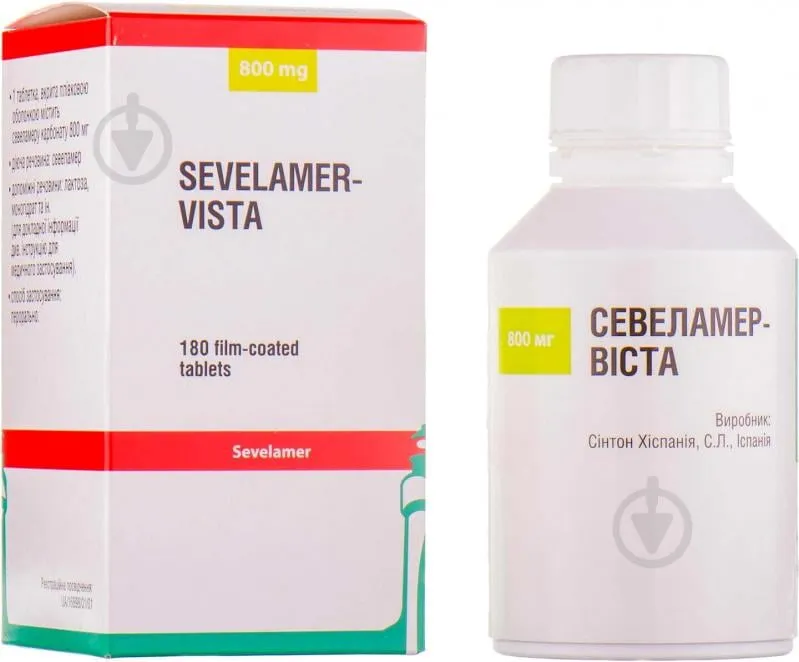
Table of Contents
INSTRUCTIONS FOR MEDICAL USE OF THE MEDICINAL PRODUCT SEVELAMER-VISTA (SEVELAMER-VISTA)
Composition:
Active substance: sevelamer;
One film-coated tablet contains 800 mg of sevelamer carbonate;
Excipients: lactose monohydrate; colloidal anhydrous silicon dioxide; zinc stearate;
Coating components: hypromellose (15 mPa·s), hypromellose (5 mPa·s), diacetylated monoglycerides, purified water.
Pharmaceutical form. Film-coated tablets.
Main physicochemical properties: oval, white to almost white film-coated tablets without a score line. Tablets are engraved with "SVL" on one side.
Pharmacotherapeutic group. Medicinal products for the treatment of hyperkalemia and hyperphosphatemia. ATC code V03A E02.
Pharmacological properties.
Pharmacodynamics.
Mechanism of action.
The medicinal product Sevelamer-Vista contains sevelamer – a non-absorbed, metal- and calcium-free phosphate-binding polymer. Sevelamer contains numerous amines separated by one carbon atom from the main polymer chain, which bind protons in the stomach. These protonated amines bind negatively charged ions, such as dietary phosphate, in the intestine. By binding phosphate in the gastrointestinal tract and reducing its absorption, sevelamer decreases serum phosphate concentration. Regular monitoring of serum phosphorus levels is required during treatment with phosphate-binding medicinal products.
Clinical efficacy and safety.
In two randomized, crossover clinical studies, sevelamer carbonate (both in tablet and powder form), administered three times daily, was found to be therapeutically equivalent to sevelamer hydrochloride, and thus effective in controlling serum phosphorus levels in patients with chronic kidney disease (CKD) undergoing hemodialysis.
Results from the first study demonstrated that sevelamer carbonate in tablets, administered three times daily, was equivalent to sevelamer hydrochloride in tablets, administered three times daily, in 79 hemodialysis patients who received randomized treatment for 8 weeks (mean time-averaged serum phosphorus level was 1.5 ± 0.3 mmol/L for both sevelamer carbonate and sevelamer hydrochloride). Results from the second study demonstrated that sevelamer carbonate in powder form, administered three times daily, was equivalent to sevelamer hydrochloride in tablet form, administered three times daily, in 31 hemodialysis patients with hyperphosphatemia (defined as serum phosphorus level ≥ 1.78 mmol/L) who received randomized treatment for 4 weeks (mean time-averaged serum phosphorus level was 1.6 ± 0.5 mmol/L for sevelamer carbonate powder and 1.7 ± 0.4 mmol/L for sevelamer hydrochloride tablets).
In clinical studies involving hemodialysis patients, sevelamer alone did not have a consistent or clinically significant effect on intact parathyroid hormone (iPTH). However, in a 12-week study involving patients undergoing peritoneal dialysis, a similar reduction in iPTH levels was observed compared to patients receiving calcium acetate. Patients with secondary hyperparathyroidism should take the medicinal product Sevelamer-Vista as part of a comprehensive treatment regimen, which may include additional calcium, 1,25-dihydroxyvitamin D3, or one of its analogs to reduce iPTH levels.
Sevelamer has been shown to bind bile acids in experimental animal models in vitro and in vivo. Binding of bile acids by ion-exchange resins is a well-established method for lowering blood cholesterol. In clinical studies with sevelamer, mean levels of both total cholesterol and low-density lipoprotein cholesterol (LDL-C) decreased by 15–39%. Reduction in cholesterol was observed within 2 weeks of treatment and was maintained during long-term therapy. Levels of triglycerides, high-density lipoprotein cholesterol (HDL-C), and albumin did not change after sevelamer treatment.
Because sevelamer binds bile acids, it may interfere with the absorption of fat-soluble vitamins such as A, D, E, and K.
Sevelamer is calcium-free and reduces the incidence of hypercalcemia compared to patients receiving only calcium-based phosphate binders. The effect of sevelamer on phosphorus and calcium has been shown to be sustained throughout the study period, including one year of follow-up. This information was obtained from studies using sevelamer hydrochloride.
Children.
The safety and efficacy of sevelamer carbonate in pediatric patients with hyperphosphatemia due to CKD were evaluated in a multicenter study with a 2-week randomized, placebo-controlled, fixed-dose period. A total of 101 patients (aged 6 to 18 years, with a BSA range of 0.8 to 2.4 m²) were randomized in the study. Forty-nine patients received sevelamer carbonate and 51 received placebo for 2 weeks. After this period, all patients received sevelamer carbonate during a 26-week dose-titration period. In the study, sevelamer carbonate reduced serum phosphorus levels by a least-squares (LS) mean difference of 0.90 mg/dL compared to placebo, meeting primary and secondary efficacy endpoints. In pediatric patients with hyperphosphatemia secondary to CKD, sevelamer carbonate significantly reduced serum phosphorus levels compared to placebo during the 2-week fixed-dose period. The treatment response was maintained in pediatric patients who continued sevelamer carbonate during the 6-month open-label dose-titration period. Twenty-seven percent of pediatric patients achieved a target serum phosphorus level at the end of treatment. These rates were 23% and 15% in subgroups of patients undergoing hemodialysis and peritoneal dialysis, respectively. BSA did not influence the treatment response during the 2-week fixed-dose period. In contrast, no treatment response was observed in children with baseline phosphorus levels < 7.0 mg/dL. Most adverse reactions reported as related or possibly related to sevelamer carbonate occurred in the gastrointestinal tract. No new risks or safety signals were identified during the use of sevelamer carbonate in the study.
Pharmacokinetics.
Pharmacokinetic studies of sevelamer carbonate have not been conducted. Sevelamer hydrochloride, which contains the same active moiety as sevelamer carbonate, is not absorbed from the gastrointestinal tract, as confirmed in an absorption study involving healthy volunteers.
In a one-year clinical study, no evidence of sevelamer accumulation was observed. However, potential absorption and accumulation of sevelamer during long-term treatment (> 1 year) cannot be completely ruled out.
Clinical characteristics.
Indications.
The medicinal product Sevelamer-Vista is indicated for the control of hyperphosphatemia in adult patients undergoing hemodialysis or peritoneal dialysis.
The medicinal product Sevelamer-Vista is also indicated for the control of hyperphosphatemia in adult patients with chronic kidney disease not on dialysis, with serum phosphorus levels ≥ 1.78 mmol/L.
Sevelamer-Vista should be used as part of a comprehensive treatment regimen including calcium supplementation, 1.25-dihydroxyvitamin D3, or one of its analogs to control the development of renal osteodystrophy.
Contraindications.
- Hypersensitivity to the active substance or to any of the excipients of the medicinal product.
- Hypophosphatemia.
- Bowel obstruction (intestinal obstruction).
Interaction with other medicinal products and other forms of interaction.
Dialysis.
Studies on interaction of the medicinal product with other medicinal products in patients undergoing dialysis have not been conducted.
Ciprofloxacin.
In interaction studies involving healthy volunteers, sevelamer hydrochloride, containing the same active component as the medicinal product Sevelamer-Vista, reduced the bioavailability of ciprofloxacin by approximately 50% when ciprofloxacin was administered concomitantly with sevelamer hydrochloride. Therefore, the medicinal product Sevelamer-Vista should not be taken simultaneously with ciprofloxacin.
Cyclosporine, mycophenolate mofetil, and tacrolimus in transplant patients.
In patients who have undergone organ transplantation, reduced blood levels of cyclosporine, mycophenolate mofetil, and tacrolimus have been reported when administered concomitantly with sevelamer hydrochloride, although without any clinical consequences (e.g., transplant rejection). Interaction cannot be ruled out; therefore, blood concentrations of mycophenolate mofetil, cyclosporine, and tacrolimus should be closely monitored during and after their combined use.
Levothyroxine.
Very rare cases of hypothyroidism have been reported in patients taking sevelamer hydrochloride, containing the same active component as sevelamer carbonate, and levothyroxine simultaneously. Therefore, careful monitoring of thyroid-stimulating hormone (TSH) levels is recommended in patients taking sevelamer carbonate and levothyroxine.
Antiarrhythmic and anticonvulsant medicinal products.
Patients taking antiarrhythmic drugs to control arrhythmias and anticonvulsant drugs to prevent seizures were not included in clinical trials. Therefore, a possible reduction in absorption cannot be excluded. Antiarrhythmic drugs should be administered at least one hour before or three hours after sevelamer, and monitoring of blood levels should also be considered.
Digoxin, warfarin, enalapril, and metoprolol.
In drug interaction studies involving healthy volunteers, sevelamer hydrochloride, containing the same active component as sevelamer carbonate, did not affect the bioavailability of digoxin, warfarin, enalapril, and metoprolol.
Proton pump inhibitors (PPIs).
During post-marketing use, very rare cases of increased phosphate levels have been reported in patients taking PPIs concomitantly with sevelamer carbonate. Caution is advised when prescribing PPIs to patients who are also taking the medicinal product Sevelamer-Vista. Serum phosphate levels should be monitored and the dose of this medicinal product adjusted accordingly.
Biological availability.
The medicinal product Sevelamer-Vista is not absorbed and may affect the bioavailability of other medicinal products. When administering any medicinal product for which reduced bioavailability could have a clinically significant impact on safety and efficacy, this medicinal product should be taken at least 1 hour before or 3 hours after administration of Sevelamer-Vista. Otherwise, the physician should consider the need for monitoring blood levels of these medicinal products.
Special precautions for use.
The efficacy and safety of sevelamer carbonate have not been established in adult patients with chronic kidney disease not on dialysis who have serum phosphorus levels < 1.78 mmol/L. Therefore, the medicinal product is not recommended for use in such patients.
The efficacy and safety of sevelamer carbonate have not been studied in patients with the following conditions:
- Dysphagia;
- Swallowing disorders;
- Severe gastrointestinal motility disorders, including untreated or severe gastric paresis, gastric content retention, and difficult or irregular defecation;
- Active inflammatory bowel disease;
- Patients with a history of major gastrointestinal surgery.
Initiation of treatment with Sevelamer-Vista in patients in these categories should only occur after careful assessment of the benefit-risk ratio. If treatment is initiated, patients suffering from these disorders should be closely monitored. In patients who develop severe constipation or other severe gastrointestinal symptoms, the continuation of Sevelamer-Vista therapy should be re-evaluated.
Intestinal obstruction and complete or partial bowel obstruction.
Intestinal obstruction and complete or partial bowel obstruction have been reported very rarely in patients during treatment with sevelamer hydrochloride (capsules/tablets), which contains the same active ingredient as sevelamer carbonate. Constipation may be a precursor symptom. Patients with constipation should be closely monitored during treatment with this medicinal product. The appropriateness of continuing Sevelamer-Vista therapy should be reconsidered in patients who develop severe constipation or symptoms of other severe gastrointestinal disorders.
Fat-soluble vitamins.
Patients with CKD may have low levels of vitamins A, D, E, and K, depending on dietary intake and disease severity. Sevelamer carbonate may bind fat-soluble vitamins present in ingested food. Therefore, in patients not receiving these vitamins as supplements, levels of vitamins A, D, E, and K should be monitored, and supplementation should be considered as needed according to recommendations.
Patients with CKD not on dialysis are recommended to take vitamin D (approximately 400 IU of native vitamin D daily), for example, as part of a multivitamin preparation administered separately from Sevelamer-Vista. Additional monitoring of fat-soluble vitamin and folic acid levels is recommended in patients undergoing peritoneal dialysis, as levels of vitamins A, D, E, and K were not measured in such patients during clinical trials.
Folic acid salt deficiency.
There are insufficient data to exclude the possibility of folic acid salt deficiency during long-term treatment with this medicinal product. In patients not taking additional folic acid but receiving sevelamer, serum levels of folic acid salts should be regularly assessed.
Hypocalcemia/hypercalcemia.
Hypocalcemia or hypercalcemia may develop in patients with CKD. Sevelamer-Vista does not contain calcium. Serum calcium levels should be monitored at regular intervals, and elemental calcium should be administered if hypocalcemia develops.
Metabolic acidosis.
Patients with chronic kidney failure are prone to developing metabolic acidosis; therefore, careful monitoring of serum bicarbonate levels is recommended.
Peritonitis.
Patients undergoing dialysis are at risk of infection related to the dialysis modality. Peritonitis is a known complication in patients undergoing peritoneal dialysis (PD). In a clinical study using sevelamer hydrochloride, a higher incidence of peritonitis was observed compared to the control group. Therefore, careful monitoring of patients on PD is necessary to ensure proper use of aseptic techniques and prompt recognition and treatment of any signs or symptoms associated with peritonitis.
Dysphagia and choking.
Rare reports of difficulty swallowing Sevelamer-Vista tablets have been received. Most of these cases occurred in patients with concomitant conditions such as swallowing disorders or esophageal pathology. Sevelamer-Vista should be used with caution in patients with dysphagia. For patients with a history of dysphagia, consideration should be given to using Sevelamer-Vista in the form of a powder for oral suspension.
Hypothyroidism.
Careful monitoring is recommended for patients with hypothyroidism who are concurrently taking sevelamer carbonate and levothyroxine.
Long-term treatment.
In a 1-year clinical trial, no signs of sevelamer accumulation were observed. However, the possibility of absorption and accumulation of sevelamer during long-term treatment (more than 1 year) cannot be completely ruled out.
\u>Hyperparathyroidism.\u>
Sevelamer-Vista is not indicated for the control of hyperparathyroidism. In patients with secondary hyperparathyroidism, the medicinal product should be used as part of a multifaceted therapeutic approach, which may include calcium supplements, 1,25-dihydroxyvitamin D3, or one of its analogs to reduce PTH levels.
\u>Inflammatory gastrointestinal disorders.\u>
Literature reports describe cases of serious inflammatory disorders affecting various parts of the gastrointestinal tract (including serious complications such as bleeding, perforation, ulcers, necrosis, colitis, and fecal impaction in the colon and cecum) associated with the presence of sevelamer crystals. Inflammatory disorders may resolve after discontinuation of sevelamer. Sevelamer carbonate therapy should be re-evaluated in patients who develop serious gastrointestinal symptoms.
Important information about excipients.
The medicinal product contains lactose. Patients with rare hereditary problems of galactose intolerance, lactase deficiency, or glucose-galactose malabsorption should not take this medicinal product.
Use during pregnancy or breastfeeding.
\u>Pregnancy.\u>
There is no information or limited data on the use of sevelamer in pregnant women. Animal studies have shown some reproductive toxicity when sevelamer was administered to rats at high doses. It has also been shown that sevelamer reduces the absorption of certain vitamins, including folic acid. The potential risk to humans is unknown. Sevelamer-Vista may be prescribed to pregnant women only under strict medical necessity and after careful benefit-risk assessment for both mother and fetus.
\u> Breastfeeding period. \u>
It is unknown whether sevelamer or its metabolites are excreted in breast milk. The lack of systemic absorption of sevelamer suggests that excretion into breast milk is unlikely. The decision to continue or discontinue breastfeeding or to continue or discontinue Sevelamer-Vista therapy should be made considering the benefits of breastfeeding for the child and the benefits of therapy for the mother.
\u> Fertility. \u>
There are no data on the effect of sevelamer on human fertility. Animal studies have shown that sevelamer does not reduce fertility in male or female rats at drug exposures equivalent to twice the maximum clinical dose (13 g/day) when adjusted for relative body surface area.
Ability to affect reaction speed when driving or operating machinery.
Sevelamer has no effect or has a negligible effect on the ability to drive or operate machinery.
Dosage and Administration.
Route of administration.
For oral use. Tablets should be swallowed whole, without crushing, dividing, or chewing. The tablets should be taken with food, not on an empty stomach.
Doses.
Starting dose.
The recommended starting dose of sevelamer carbonate is 2.4 g or 4.8 g per day, depending on clinical requirements and serum phosphorus levels. The medicinal product Sevelamer-Vista should be taken 3 times daily with meals.
Table 1
| Plasma phosphate level in patients |
Total daily dose of sevelamer carbonate taken during 3 meals |
| 1.78–2.42 mmol/L (5.5–7.5 mg/dL) |
2.4 g* |
| > 2.42 mmol/L (> 7.5 mg/dL) |
4.8 g* |
*With subsequent titration according to the instructions.
For patients previously treated with phosphate-binding medicinal products (based on sevelamer hydrochloride or calcium), the medicinal product Sevelamer-Vista should be administered by gradually increasing the dose by 1 g, with monitoring of serum phosphorus levels to ensure the use of the optimal daily dose.
Titration and maintenance dose.
Serum phosphorus levels should be carefully monitored, and the dose of sevelamer carbonate should be titrated in increments of 0.8 g three times daily (2.4 g per day) every 2–4 weeks until an acceptable serum phosphorus level is achieved, followed by regular ongoing monitoring. Patients receiving Sevelamer-Vista should adhere to the prescribed diet. In clinical practice, treatment should be continuous due to the necessity of controlling serum phosphorus levels, and the daily dose is expected to average approximately 6 g.
Special patient groups.
Elderly patients.
Dose adjustment in elderly patients is not required.
Hepatic impairment.
No studies have been conducted in patients with hepatic impairment.
Children.
The medicinal product Sevelamer-Vista is not intended for use in children.
The safety and efficacy of sevelamer in children under 6 years of age or in children with BSA below 0.75 m² have not been established.
The safety and efficacy of sevelamer in children aged 6 years and older with BSA > 0.75 m² have been established. Current available data are described in the section "Pharmacological properties."
Overdose.
Sevelamer hydrochloride, containing the same active component as sevelamer carbonate, was administered to healthy volunteers at doses up to 14 g per day for 8 days; no adverse reactions occurred. In patients with CKD, the highest studied average daily dose was 14.4 g of sevelamer carbonate as a single daily dose. Symptoms. Symptoms observed in case of overdose are similar to the adverse reactions described in the section "Adverse reactions," primarily constipation and other known gastrointestinal disorders.
Treatment. If necessary, appropriate symptomatic treatment should be administered.
Adverse reactions.
Summary of safety profile.
All adverse reactions most commonly observed (≥ 5% of patients) were classified as gastrointestinal disorders. Most of these adverse reactions were of mild or moderate severity.
List of adverse reactions (see Table 2).
The safety of sevelamer (in the form of carbonate and hydrochloride salts) was evaluated in multiple clinical studies involving 969 patients undergoing hemodialysis with treatment duration ranging from 4 to 50 weeks (724 patients received sevelamer hydrochloride and 245 patients received sevelamer carbonate), 97 patients undergoing peritoneal dialysis with treatment duration of 12 weeks (all received sevelamer hydrochloride), and 128 non-dialysis patients with CKD with treatment duration of 8 to 12 weeks (79 patients received sevelamer hydrochloride and 49 patients received sevelamer carbonate).
Data on adverse reactions occurring during clinical studies or spontaneously reported during post-marketing use of the medicinal product are presented in Table 2 according to their frequency of occurrence. The data are categorized as follows: very common (≥ 1/10), common (≥ 1/100 to < 1/10), uncommon (≥ 1/1000 to < 1/100), rare (≥ 1/10000 to < 1/1000), very rare (< 1/10000), frequency not known (cannot be estimated from the available data).
Table 2
| MedDRA System Organ Classes |
Very common |
Common |
Very rare |
Frequency unknown |
| Immune system disorders |
hypersensitivity* |
|||
| Gastrointestinal disorders |
nausea, vomiting, upper abdominal pain, constipation |
diarrhea, dyspepsia, flatulence, abdominal pain |
intestinal obstruction, partial intestinal obstruction, volvulus, intestinal perforation1, gastrointestinal hemorrhage*1, intestinal ulcer*1, gastrointestinal tract necrosis*1, colitis*1, fecal impaction*1. |
|
| Skin and subcutaneous tissue disorders |
pruritus, rash |
|||
| Investigations (Laboratory findings) |
crystalline deposition in the intestine*1 |
* post-marketing use.
1 See warning regarding inflammatory gastrointestinal disorders in section "Special precautions".
Children.
The overall safety profile in children and adolescents (6 to 18 years of age) is similar to that in adults.
Reporting of suspected adverse reactions.
Reporting of adverse reactions following marketing authorization of the medicinal product is of great importance. It allows continuous monitoring of the benefit-risk balance of the medicinal product. Healthcare professionals and patients, or their legal representatives, should report all suspected adverse reactions and lack of efficacy via the Automated Pharmacovigilance Information System at the following link: https://aisf.dec.gov.ua
Shelf life. 3 years.
Storage conditions.
Store in the original packaging at a temperature not exceeding 25 °C.
Keep out of reach of children.
Packaging.
180 film-coated tablets in containers (bottles) with child-resistant cap and first-opening control, or without child-resistant cap and first-opening control; 1 container (bottle) per cardboard box.
Prescription status. Prescription only.
Manufacturer.
Sicor España, S.L.
Manufacturer's address and location of operations.
C/Castello, no1, Sant Boi de Llobregat, Barcelona, 08830, Spain.