Sermin
Ukraine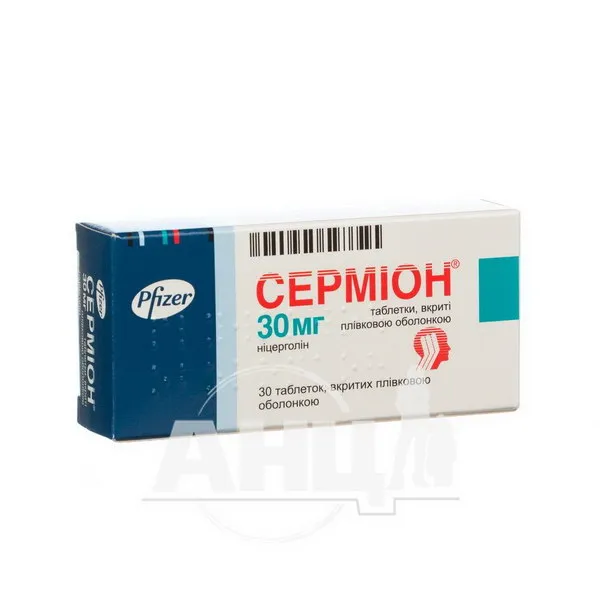
Table of Contents
INSTRUCTIONS FOR MEDICAL USE OF THE MEDICINAL PRODUCT SERMION®
Composition:
Active substance: nicergoline;
1 tablet contains 30 mg of nicergoline;
Excipients: calcium hydrogen phosphate dihydrate, microcrystalline cellulose, magnesium stearate, sodium carboxymethylcellulose, hydroxypropylmethylcellulose, titanium dioxide (E 171), polyethylene glycol 6000, iron oxide yellow (E 172), silicon.
Pharmaceutical form. Film-coated tablets.
Main physicochemical properties: round, biconvex, film-coated tablets with an opaque yellow coating.
Pharmacotherapeutic group. Agents acting on the cardiovascular system. Peripheral vasodilators. Ergot alkaloids. Nicergoline. ATC code C04AE02.
Pharmacological Properties
Pharmacodynamics
Nicergoline is an ergoline derivative with alpha-1-adrenergic blocking activity when administered parenterally. Following oral administration, nicergoline undergoes rapid and extensive metabolism, generating several metabolites that contribute to its activity at various levels of the central nervous system.
Oral administration of Serminon® exerts multiple neuropharmacological effects: it not only enhances glucose uptake and utilization in the brain and stimulates biosynthesis of proteins and nucleic acids, but also affects various neurotransmitter systems.
Serminon® improves cerebral cholinergic functions in aged animals. Prolonged administration of nicergoline in aged rats prevented age-related decline in acetylcholine levels (in the cerebral cortex and striatum), and also reduced acetylcholine release (in the hippocampus) under in vivo conditions. After prolonged oral administration of Serminon®, increased activity of choline acetyltransferase and higher density of muscarinic receptors were observed. Moreover, both in vitro and in vivo studies demonstrated that nicergoline significantly reduces acetylcholinesterase activity. In these experimental studies, neurochemical effects were observed concurrently with sustained improvement in behavioral responses. For example, in maze tests, mature animals treated long-term with Serminon® exhibited behavioral responses resembling those of young animals.
Administration of Serminon® in animals also reduced cognitive deficits induced by various agents (hypoxia, electroconvulsive therapy (ECT), scopolamine). Oral administration of Serminon® at low doses increased dopamine metabolism in mature animals, particularly in the mesolimbic region, likely via modulation of dopaminergic receptors. Serminon® enhances signal transduction mechanisms in cells of mature animals. Both single and repeated oral administration resulted in increased metabolism of basal and agonist-sensitive phosphoinositides. Serminon® also increases the activity and translocation to the membrane region of calcium-dependent isoforms of protein kinase C. These enzymes are involved in the secretion mechanism of the soluble amyloid precursor protein, leading to enhanced release and reduced production of pathological beta-amyloid, as demonstrated in human neuroblastoma cell cultures.
Due to its antioxidant effects and ability to activate detoxifying enzymes, Serminon® prevents neuronal cell death caused by oxidative stress and apoptosis. Serminon® attenuates age-related decline in mRNA expression of neuronal nitric oxide synthase, which may also contribute to improved cognitive function.
Pharmacodynamic studies in humans were conducted using computerized EEG techniques involving young and elderly volunteers, as well as elderly patients with cognitive disorders. Serminon® normalized EEG results in elderly patients and younger adult patients under hypoxic conditions, increasing α- and β-activity and decreasing δ- and θ-activity. In patients with mild to moderate dementia of various etiologies (Alzheimer-type senile dementia and multi-infarct dementia), prolonged treatment with Serminon® (for 2–6 months) resulted in positive changes in evoked potentials and stimulus response, which correlated with clinical symptom improvement. Given the above, it is evident that nicergoline acts through broad-spectrum modulation of cellular and molecular mechanisms involved in the pathogenesis of dementia. More than 1,500 patients with dementia (of Alzheimer's type, vascular, or mixed type) participated in double-blind, placebo-controlled clinical trials, receiving either nicergoline 60 mg daily or placebo. Long-term treatment with nicergoline resulted in sustained reduction of cognitive and behavioral symptoms associated with dementia. Clinical improvement became evident after 2 months of treatment and was maintained throughout one year of therapy.
The drug positively affects attention, concentration, and emotional state. It beneficially influences not only cognitive function but also mood and behavioral disturbances.
Pharmacokinetics
Absorption. After oral administration, nicergoline is rapidly and almost completely absorbed. The peak level of radioactivity following administration of low doses (4–5 mg) of H3-labeled nicergoline in healthy volunteers was observed at 1.5 hours. However, after oral administration of therapeutic doses (30 mg) of C14-labeled nicergoline in healthy volunteers, peak serum radioactivity occurred 3 hours after dosing. After oral administration of nicergoline (15 mg) in healthy volunteers, the area under the serum radioactivity curve was 81% and 6% of the value calculated for the two main metabolites of nicergoline—MDL and MMDL, respectively. Peak plasma concentrations of MDL were reached approximately 3–5 hours after single or multiple doses of the 30 mg tablet. Peak plasma concentration of MMDL was achieved approximately 0.5–1 hour after a single 30 mg tablet dose.
Absolute bioavailability of nicergoline after oral administration is approximately 5%, due to first-pass effect. Based on measurements of the main metabolite MDL, pharmacokinetics of nicergoline after oral administration of 30–60 mg doses in healthy volunteers were found to be linear. After single oral administration of 30 mg nicergoline, food had no significant effect on the pharmacokinetics of MDL and MMDL.
Distribution. Drug distribution in tissues is rapid and extensive, reflected by the short distribution phase of serum radioactivity. The volume of distribution of nicergoline in the central compartment (approximately calculated by dividing dose by plasma concentration of nicergoline at the first sampling time after intravenous administration of a nominal 2 mg dose) is relatively high (224 L), potentially reflecting distribution into blood cells and/or tissues. Nicergoline binds with high affinity to human plasma proteins, with affinity for α-acid glycoprotein being four times higher than for serum albumin. The percentage of binding remains relatively constant as nicergoline concentration increases from 1 µg/mL to 500 µg/mL. Both metabolites of nicergoline, MDL and MMDL, exhibit low binding levels, approximately 14.7% and 34.7%, respectively, within the concentration range of 50–200 ng/mL.
Metabolism and Excretion. The drug is primarily excreted via urine. Within 120 hours after administration, approximately 82% of the total administered radiolabeled nicergoline is eliminated by the kidneys, and 10% via feces. Nicergoline undergoes extensive metabolism, primarily through hydrolysis of ester bonds, forming MMDL, which is then converted to MDL via demethylation (catalyzed by the CYP2D6 isoenzyme). Therefore, the pharmacokinetics of nicergoline and its metabolites are influenced in patients with genetic deficiency of CYP2D6. The active metabolites formed (MMDL and MDL) undergo conjugation with glucuronic acid. The main metabolite MDL accounts for 51% of the total dose and 76% of the radioactivity detected in urine after oral administration of a 15 mg dose. The mean terminal half-life of MDL ranges from approximately 11 to 20 hours.
Special Patient Populations. The effect of renal impairment on the pharmacokinetics of nicergoline was evaluated in patients with mild (creatinine clearance (Clcr) 60–80 mL/min), moderate (Clcr 30–50 mL/min), and severe (Clcr 10–25 mL/min) renal impairment. In patients with mild (n=5), moderate (n=5), and severe (n=4) renal impairment, significant differences were observed in the amount of MDL excreted in urine within 120 hours after oral administration of a 30 mg dose of nicergoline (38.1%, 42.6%, and 25.7% of the administered dose, respectively); corresponding values for MMDL were 1.7%, 0.6%, and 0.2%. In patients with severe renal impairment, urinary excretion of MDL was significantly reduced compared to the other two groups. Additionally, patients with mild, moderate, or severe renal impairment showed mean reductions in urinary excretion of MDL (0–72 hours) by 32%, 32%, and 59%, respectively, compared to patients with normal renal function in another study using 30 mg tablets.
The pharmacokinetics of nicergoline in patients with hepatic impairment have not been studied.
The pharmacokinetics of nicergoline have not been studied in children.
The effect of age (in elderly patients) on the pharmacokinetics of nicergoline has not been fully investigated.
Clinical characteristics.
Indications.
Post-stroke conditions, vascular dementia (multi-infarct dementia), degenerative conditions associated with dementia (senile and presenile dementia of Alzheimer's type, dementia in Parkinson's disease).
Contraindications.
Hypersensitivity to nicergoline, to ergot alkaloids, or to any other component of the drug. Recent myocardial infarction, acute bleeding, orthostatic hypotension, severe bradycardia.
Interaction with other medicinal products and other forms of interaction.
The drug should be used with caution in combination with:
antihypertensive agents: nicergoline may enhance their effects. Nicergoline may enhance the cardiac effects of beta-blockers;
sympathomimetic agents (alpha- and beta-): nicergoline may exert antagonistic action against the vasoconstrictive effect of sympathomimetic agents due to blockade of alpha-adrenergic receptors (see section "Special precautions for use");
medicinal products metabolized by the isoenzyme CYP2D6: since nicergoline is metabolized by the CYP2D6 isoenzyme, possible interactions with other medicinal products metabolized via the same pathway cannot be excluded;
antiplatelet agents and anticoagulants (e.g., with acetylsalicylic acid): enhances the effect on hemostasis, thereby potentially increasing bleeding time;
medicinal products affecting uric acid metabolism: nicergoline may cause asymptomatic elevation of plasma uric acid concentrations.
Special precautions for use
Studies with single or repeated administration of nicergoline have shown that nicergoline may reduce systolic arterial pressure and, to a much lesser extent, diastolic arterial pressure in patients with normal or elevated blood pressure. These effects may vary, as other studies have not observed changes in systolic or diastolic blood pressure.
Patients taking nicergoline should use sympathomimetics (alpha- and beta-receptor agonists) with caution (see section "Interaction with other medicinal products and other forms of interaction").
The medicinal product should be used with caution in patients with a history of hyperuricemia or gout and/or during concomitant treatment with drugs that may affect uric acid metabolism and excretion (see section "Undesirable effects").
Fibrosis (e.g., pulmonary, cardiac, valvular, and retroperitoneal fibrosis) has been associated with the use of certain ergot alkaloids possessing agonistic activity at serotonin 5-HT2β receptors.
Cases of ergotism (including nausea, vomiting, diarrhea, abdominal pain, and peripheral vasoconstriction) have been reported with the use of certain ergot alkaloids and their derivatives.
Before prescribing this class of medicinal products, physicians should be familiar with the signs of ergot overdose.
The medicinal product Sermin®, 30 mg tablets, contains less than 1 mmol of sodium (23 mg) per tablet. Patients on a sodium-restricted diet may be informed that this medicinal product is practically sodium-free.
Use during pregnancy or breastfeeding
Pregnancy
Nicergoline has no toxic effect on reproductive function in pregnant rats and rabbits. Clinical studies in pregnant women have not been conducted. Given the approved indications, the use of nicergoline in pregnant women and women who are breastfeeding is unlikely. Nicergoline should be used during pregnancy only if the potential benefit to the patient outweighs the potential risk to the fetus.
Breastfeeding
It is unknown whether nicergoline passes into breast milk; therefore, Sermin® should not be used in women who are breastfeeding.
Fertility
In a rat study, nicergoline had no effect on fertility.
Effects on ability to drive and use machines
Although the clinical effects of Sermin® are utilized to improve attention and concentration, its influence on the ability to drive vehicles or operate machinery has never been studied. Therefore, treatment should be administered with caution, taking into account the underlying condition of the patient. When driving vehicles or operating machinery, it should be borne in mind that dizziness or somnolence may occasionally occur (see section "Undesirable effects").
Method of Administration and Dosage.
The recommended daily dose is 1 tablet once or twice daily (30–60 mg). The usual daily dose for adults is 30 mg. This dose may be temporarily increased up to 60 mg.
Based on pharmacokinetic and tolerability studies, dosage adjustment in elderly patients is not required.
Patients with Renal Impairment.
Since renal excretion is the main route of elimination (80%) of nicergoline and its metabolites, a reduced dose is recommended for patients with impaired renal function (serum creatinine level ≥ 2 mg/mL) (see section "Pharmacokinetics"). Therapeutic effect develops gradually. As treatment is usually long-term, the physician should evaluate the necessity of continuing therapy at least every 6 months.
Children. Safety and efficacy of nicergoline in children have not been established. No data are available.
Overdose.
When high doses of nicergoline are administered, a temporary decrease in arterial blood pressure may occur. Such condition usually does not require specific treatment and is resolved by lying down for several minutes. In exceptional cases of pronounced cerebral or cardiac circulatory insufficiency, administration of sympathomimetic agents and continuous monitoring of arterial blood pressure are advisable.
Side effects.
Frequency categories are defined as follows: very common (≥ 1/10); common (≥ 1/100 to < 1/10); uncommon (≥ 1/1,000 to < 1/100); rare (≥ 1/10,000 to < 1/1,000); very rare (< 1/10,000); frequency not known (cannot be estimated from the available data).
Within each frequency category, adverse reactions are listed in order of decreasing severity.
Psychiatric disorders. Uncommon: anxiety, confusion, insomnia.
Nervous system disorders. Uncommon: somnolence, dizziness, headache; frequency not known: sensation of warmth*.
Vascular disorders. Uncommon: hypotension, hyperemia.
Gastrointestinal disorders. Common: abdominal discomfort; uncommon: diarrhea, nausea, constipation.
Skin and subcutaneous tissue disorders. Uncommon: pruritus; frequency not known: rash*.
General disorders and administration site conditions. Frequency not known: fibrosis*.
Investigations. Uncommon: increased blood uric acid concentration.
*Frequency assessment of adverse reactions was based on studies in the Integrated Summary of Safety (reactions occurring after initiation of treatment for any reason). This combined safety analysis includes data from eight (8) double-blind controlled studies involving patients with mild to moderate dementia, of whom 1246 received nicergoline. The "rule of three" was not applied, as the Integrated Summary of Safety database for nicergoline included fewer than 3000 patients.
Reporting suspected adverse reactions.
Reporting suspected adverse reactions after marketing authorization is important. It allows continued monitoring of the benefit/risk balance of the medicinal product. Healthcare professionals are encouraged to report any suspected adverse reactions.
Shelf life.
3 years.
Storage conditions.
Store at temperatures not exceeding 25 °C.
Packaging.
15 tablets in a blister; 2 blisters in a cardboard box.
Prescription category.
Prescription only.
Manufacturer.
Pfizer Italia S.r.l./Pfizer Italia S.r.l.
Manufacturer's name and address.
Localita Marino del Tronto ‒ 63100 Ascoli Piceno (AP), Italy/Localita Marino del Tronto ‒ 63100 Ascoli Piceno (AP), Italy.