Sermon
Ukraine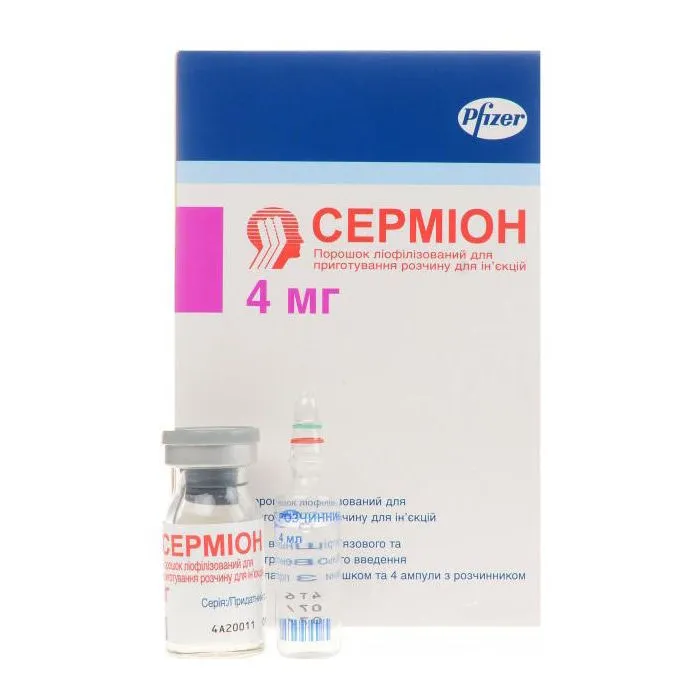
Table of Contents
INSTRUCTIONS FOR MEDICAL USE OF THE MEDICINAL PRODUCT SERMION® (SERMION®)
Composition:
Active substance: nicergoline;
1 vial contains 4 mg of nicergoline;
Excipients: lactose monohydrate; tartaric acid;
Solvent: sodium chloride, benzalkonium chloride, water for injections.
Pharmaceutical form. Lyophilisate for solution for injection.
Main physicochemical properties: porous white lyophilisate.
Pharmacotherapeutic group. Agents acting on the cardiovascular system. Peripheral vasodilators. Ergot alkaloids. Nicergoline. ATC code C04AE02.
Pharmacological Properties.
Pharmacodynamics.
Nicergoline is an ergoline derivative with alpha-1-adrenergic blocking activity when administered parenterally. Following oral administration, nicergoline undergoes rapid and extensive metabolism, producing several metabolites that contribute to its activity at various levels of the central nervous system.
Oral administration of Sermin®** exhibits numerous neuropharmacological effects: it not only enhances glucose uptake and utilization in the brain and stimulates the biosynthesis of proteins and nucleic acids, but also affects various neurotransmitter systems.
Sermin® improves cerebral cholinergic functions in aged animals. Long-term administration of nicergoline in aged rats prevented age-related declines in acetylcholine levels (in the cerebral cortex and striatum), as well as reduced acetylcholine release (in the hippocampus) under in vivo conditions. After prolonged oral administration of Sermin®**, increased activity of choline acetyltransferase and higher density of muscarinic receptors were also observed. Moreover, in both in vitro and in vivo studies, nicergoline significantly reduced acetylcholinesterase activity. In these experimental studies, neurochemical effects were observed concurrently with sustained improvements in behavioral responses. For example, in a maze test, mature animals treated long-term with Sermin® exhibited behavioral responses resembling those of young animals.
Administration of Sermin® in animals also reduced cognitive deficits induced by various agents (hypoxia, electroconvulsive therapy (ECT), scopolamine). Oral administration of Sermin® at low doses increased dopamine turnover in mature animals, particularly in the mesolimbic region, likely through modulation of dopaminergic receptors. Sermin® enhances intercellular signal transduction mechanisms in mature animals. Both single-dose and repeated oral administration resulted in increased turnover of basal and agonist-sensitive phosphoinositides. Sermin® also increases the activity and membrane translocation of calcium-dependent isoforms of protein kinase C. These enzymes are involved in the mechanism of soluble amyloid precursor protein secretion, leading to enhanced release and reduced production of pathological beta-amyloid, as demonstrated in human neuroblastoma cell cultures.
Due to its antioxidant effects and ability to activate detoxifying enzymes, Sermin® prevents neuronal cell death caused by oxidative stress and inhibits apoptosis in both in vivo and in vitro experimental models. Sermin® attenuates age-related decline in mRNA expression of neuronal nitric oxide synthase, which may also contribute to improved cognitive function.
Pharmacodynamic studies in humans using computerized electroencephalography (EEG) techniques were conducted in young volunteers, elderly volunteers, and elderly patients with cognitive disorders. Nicergoline exerted a normalizing effect on EEG results in elderly and young adult patients under hypoxic conditions, increasing α- and β-activity while decreasing δ- and θ-activity. Positive changes in evoked potentials and stimulus response were recorded in patients with mild to moderate dementia of various etiologies (senile Alzheimer-type dementia and multi-infarct dementia); after prolonged treatment with nicergoline (2–6 months), these changes correlated with clinical symptom improvement.
Given the above, it is evident that nicergoline acts by modulating a broad spectrum of cellular and molecular mechanisms involved in the pathophysiology of dementia.
In double-blind, placebo-controlled clinical trials involving over 1500 patients with dementia (Alzheimer’s type, vascular, and mixed types) receiving nicergoline at a dose of 60 mg per day or placebo, long-term treatment with nicergoline resulted in continuous reduction of cognitive and behavioral impairments associated with dementia. Changes were observable after 2 months of treatment and were maintained throughout one year of therapy.
Pharmacokinetics.
Following intravenous infusion of 2 mg H3-nicergoline over approximately 10 minutes in three healthy volunteers, nicergoline underwent rapid hydrolysis of its ester bond, forming the metabolite 1-methyl-10-methoxydihydrolysergol (MMDL). Subsequent demethylation at position 1 of the ergoline structure produces the main metabolite, 10-methoxydihydrolysergol (MDL). Unchanged nicergoline was detected in all three subjects within 90 minutes post-infusion, with mean plasma levels of approximately 4.5 ng/mL at 20 minutes, followed by a rapid decline associated with an elimination half-life of less than 30 minutes. Peak MMDL concentration occurred within 20 minutes after administration and declined rapidly over the next 8 hours. Peak MDL concentration reached approximately 2.2 ng/mL at 4 hours after infusion completion, followed by a slower elimination phase compared to MMDL. Approximately 50% and 10% of the administered radioactive dose were excreted in urine over 4 days and in feces over 7 days, respectively.
Special Patient Populations.
The effect of renal impairment on nicergoline pharmacokinetics was evaluated in patients with mild (creatinine clearance (CLcr) 60–80 mL/min), moderate (CLcr 30–50 mL/min), and severe (CLcr 10–25 mL/min) renal dysfunction. In patients with mild (n = 5), moderate (n = 5), and severe (n = 4) renal impairment, significant differences were observed in the amount of MDL excreted in urine over 120 hours after a single 30 mg oral dose of nicergoline (38.1%, 42.6%, and 25.7% of the dose, respectively); corresponding values for MMDL were 1.7%, 0.6%, and 0.2%. Patients with severe renal impairment showed a marked reduction in urinary MDL excretion compared to the other two groups. Additionally, in patients with mild, moderate, and severe renal impairment, mean reduction in urinary MDL excretion (0–72 hours) was 32%, 32%, and 59%, respectively, compared to patients with normal renal function in another study receiving 30 mg tablets.
Pharmacokinetics of nicergoline has not been studied in patients with hepatic impairment.
Pharmacokinetics of nicergoline has not been studied in children.
Pharmacokinetics of nicergoline has not been fully studied in elderly patients.
Clinical characteristics.
Indications.
Acute and chronic cerebrovascular metabolic disorders due to atherosclerosis, thrombosis, and embolism of cerebral vessels, transient disturbances of cerebral circulation (transient ischemic attacks).
Headache.
Adjunctive therapy in the treatment of arterial hypertension.
Contraindications.
Hypersensitivity to the active substance, ergot alkaloids, or to any component of the medicinal product. Recent myocardial infarction, acute hemorrhage, orthostatic hypotension, severe bradycardia.
Interaction with other medicinal products and other forms of interaction.
The medicinal product should be used with caution concomitantly with:
- antihypertensive agents (nicergoline may potentiate their effect). Nicergoline may potentiate the cardiac effects of β-blockers;
- sympathomimetic agents (alpha and beta): nicergoline may counteract vasoconstrictor effects of sympathomimetic drugs due to its alpha-adrenergic blocking effect (see section "Special precautions");
- medicinal products metabolized by the CYP2D6 isoenzyme: since nicergoline is metabolized via the CYP2D6 isoenzyme, interactions with other drugs metabolized through the same pathway cannot be excluded;
- antiplatelet agents and anticoagulants (e.g., with acetylsalicylic acid): nicergoline enhances the effect on hemostasis, thereby possibly prolonging bleeding time;
- drugs affecting uric acid metabolism: nicergoline may cause asymptomatic increases in plasma uric acid levels.
Special precautions for use.
Studies with single or multiple doses of nicergoline have shown that nicergoline may reduce systolic arterial pressure and, to a lesser extent, diastolic arterial pressure in normotensive patients and in patients with elevated arterial pressure. This effect of nicergoline on arterial pressure may be variable, as other studies have not demonstrated changes in systolic or diastolic arterial pressure.
Sympathomimetic agents (alpha and beta agonists) should be used with caution in patients receiving nicergoline (see section "Interaction with other medicinal products and other forms of interaction").
Nicergoline should be administered with caution to patients with hyperuricemia or a history of gout and/or during concomitant treatment with drugs that may affect the metabolism and excretion of uric acid (see section "Side effects").
Fibrosis (e.g., pulmonary, cardiac, valvular, and retroperitoneal fibrosis) has been associated with the use of certain ergot alkaloids that possess agonistic activity at serotonin 5-HT2β receptors.
Cases of ergotism (including nausea, vomiting, diarrhea, abdominal pain, and peripheral vasoconstriction) have been reported with the use of certain ergot alkaloids and their derivatives.
Before prescribing this class of medicinal products, physicians should be familiar with the signs and symptoms of ergot overdose.
This medicinal product contains 13.3 mg of sodium per 4 ml solvent ampoule, which is equivalent to 0.7% of the WHO recommended maximum daily intake of 2 g sodium for an adult. Sodium is present only in the solvent ampoule.
Use during pregnancy or breastfeeding.
Pregnancy
Nicergoline showed no toxic effects on reproductive function in pregnant female rats and rabbits. Studies in pregnant women have not been conducted. Given the approved indications, use of the drug in pregnant women and women who are breastfeeding is unlikely. Nicergoline may be used during pregnancy only if the potential benefit to the woman outweighs the potential risk to the fetus.
Breastfeeding
It is unknown whether nicergoline passes into breast milk; therefore, Serminon® should not be used in women who are breastfeeding.
Fertility
In a rat study, nicergoline had no effect on fertility.
Ability to affect reaction speed when driving or operating machinery.
Although the clinical action of Serminon® is directed toward improving alertness and concentration, its effect on reaction speed during driving or operating machinery has not been studied. In any case, caution should be exercised, taking into account the patient's underlying condition.
When driving vehicles or operating machinery, it should be noted that dizziness or somnolence may occasionally occur (see section "Side effects").
Method of Administration and Dosage
Intramuscular injections: 2–4 mg (2–4 ml) twice daily (the solvent provided should be used).
Slow intravenous infusion: 4–8 mg dissolved in 100 ml of physiological saline or glucose solution. At the physician's discretion, this dose may be repeated several times daily.
There is experience with intra-arterial administration of Sermin®: 4 mg dissolved in 10 ml of physiological saline administered over 2 minutes.
The dosage regimen, duration of treatment, and route of administration depend on the individual clinical situation. In some cases, it may be appropriate to initiate treatment with parenteral administration of the drug, followed by long-term oral therapy.
Therapeutic effect develops gradually. Since therapy is generally long-term, the physician should periodically evaluate the continued need for treatment at regular intervals, but no less frequently than every 6 months.
Elderly patients. According to pharmacokinetic and tolerability study results, dosage adjustment is not required for elderly patients.
Patients with renal impairment. Since renal excretion is the main elimination pathway (80%) of nicergoline and its metabolites, dosage reduction is recommended for patients with impaired renal function (serum creatinine level ≥ 2 mg/ml) (see section "Pharmacokinetics").
Children.
The safety and efficacy of nicergoline in children have not been established. No data are available.
Overdose. When nicergoline is administered in high doses, transient hypotension may occur. Specific treatment is usually not required; lying down for several minutes is sufficient. In exceptional cases, if pronounced cerebral or cardiac hypoperfusion develops, administration of sympathomimetic agents and continuous monitoring of arterial pressure are recommended.
Adverse Reactions
The adverse reactions listed below are classified by system organ classes and in order of decreasing severity. Frequency is defined as follows: very common (≥ 1/10); common (≥ 1/100 to < 1/10); uncommon (≥ 1/1000 to < 1/100); rare (≥ 1/10,000 to < 1/1000); very rare (< 1/10,000); frequency not known (cannot be estimated based on available data).
Psychiatric disorders:
Uncommon: agitation, confusion, insomnia.
Nervous system disorders:
Uncommon: somnolence, dizziness, headache; frequency not known: sensation of warmth.
Vascular disorders:
Uncommon: arterial hypotension, flushing.
Gastrointestinal disorders:
Common: abdominal discomfort; uncommon: diarrhoea, nausea, constipation.
Skin and subcutaneous tissue disorders:
Uncommon: pruritus; frequency not known: rash.
General disorders and administration site conditions:
Frequency not known: fibrosis.
Investigations:
Uncommon: increased blood uric acid levels.
a Assessment of the frequency of adverse reactions was based on results from studies included in the integrated safety summary of the medicinal product (reactions occurring after treatment initiation for any reason). This integrated safety analysis includes data from 8 double-blind controlled studies involving patients with mild to moderate dementia, of whom 1246 received nicergoline. The "rule of three" was not applied, as the integrated safety database for nicergoline included fewer than 3000 patients.
Reporting of suspected adverse reactions
Reporting suspected adverse reactions after marketing authorization is important. It allows continued monitoring of the benefit-risk balance of the medicinal product. Healthcare professionals are requested to report any suspected adverse reactions in accordance with national legislative requirements.
Shelf life. 4 years.
Storage conditions. Store out of reach of children at a temperature not exceeding 25 °C.
After reconstitution, store in the cardboard packaging to protect from light at a temperature not exceeding 25 °C. The solution should be used within 48 hours.
Incompatibilities. For intramuscular injections, use the solvent provided. For intravenous injections/infusions, use physiological saline or glucose solution.
Packaging. 4 mg of lyophilisate in a vial; 4 mL of solvent in an ampoule. Two vials and two ampoules in a blister pack; two blisters in a cardboard box; or one vial of powder and one ampoule of solvent placed in a cardboard box together with the instructions for medical use. Four cardboard boxes, packaged together in a cardboard box.
Prescription category. Prescription only.
Manufacturer.
Pfizer Manufacturing Belgium/Pfizer Manufacturing Belgium.
Manufacturer's address and location of the site of manufacture.
Rijksweg 12, Puurs-Sint-Amands, 2870, Belgium/Rijksweg 12, Puurs-Sint-Amands, 2870, Belgium.