Septolète® total eucalypt
Ukraine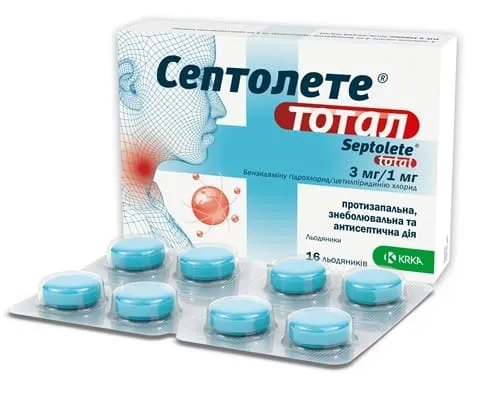
Table of Contents
INSTRUCTIONS FOR MEDICAL USE OF THE MEDICINAL PRODUCT SEPTOLETE® TOTAL EUCALYPTUS (SEPTOLETE® TOTAL EUCALYPTUS)
Composition:
Active substances: benzidamine hydrochloride, cetylpyridinium chloride;
1 lozenge contains 3 mg of benzidamine hydrochloride and 1 mg of cetylpyridinium chloride;
Excipients: eucalyptus oil, levomenthol, sucralose, citric acid, isomalt (type M), brilliant blue FCF (E 133).
Pharmaceutical form. Lozenges.
Main physicochemical characteristics:
Round lozenges with bevelled edges and uneven surface ranging in color from blue to dark blue, with possible white spots, uneven coloring, air bubbles, and slightly jagged edges.
Pharmacotherapeutic group. Preparations for the throat. Antiseptics. Other preparations for the throat. ATC code R02AX03.
Pharmacological properties.
Pharmacodynamics.
Mechanism of action
Benzidamine hydrochloride is a non-steroidal anti-inflammatory and analgesic agent. Its mechanism of action is believed to be related to inhibition of prostaglandin synthesis, thereby reducing signs of inflammation (such as pain, redness, swelling, and heat). Benzidamine hydrochloride also exerts a moderate local anesthetic effect.
Cetylpyridinium chloride is an antiseptic agent belonging to the quaternary ammonium compounds group. It acts as a cationic detergent. Quaternary ammonium compounds bind to the surface of bacterial cells, penetrate through it, and bind to the microorganism's cytoplasmic membrane. As a result of this binding, the cytoplasmic membrane of microbes increases permeability to low-molecular-weight components, primarily potassium ions. Subsequently, quaternary ammonium compounds penetrate into the cell, disrupting cellular functions and thus destroying it.
Cetylpyridinium chloride has a broad spectrum of antimicrobial activity, as well as antifungal activity (e.g., against Candida and Saccharomyces) and antiviral activity against certain enveloped viruses. The most pronounced bactericidal effect is observed against gram-positive bacteria (particularly Staphylococcus). In vivo studies with cetylpyridinium chloride have demonstrated antiviral activity; however, clinical relevance has not been established. Gram-negative bacteria are moderately sensitive to cetylpyridinium chloride, whereas some strains of Pseudomonas are relatively insensitive.
Pharmacokinetics.
Absorption
Of the two active substances, only benzidamine is absorbed; therefore, systemic pharmacokinetic interactions do not occur.
Evidence of benzidamine absorption through the oral and pharyngeal mucosa comes from serum blood concentrations detected, which are insufficient to produce a systemic effect.
Elimination
Elimination occurs primarily via urine, mostly in the form of inactive metabolites. The elimination half-life and systemic clearance are similar across all dosage forms of the drug.
Clinical characteristics.
Indications.
Symptomatic treatment of infections of the throat and oral cavity (pharyngitis, laryngitis, gingivitis).
Contraindications.
Hypersensitivity to the active substances or to any of the excipients.
Children under 6 years of age.
Interaction with other medicinal products and other forms of interaction.
Septolete® Total Eucalypt should not be used simultaneously with other antiseptics.
Lozenges should not be sucked together with milk due to its ability to reduce the antiseptic activity of cetylpyridinium chloride.
Special precautions for use
Do not use Septolète® Total Eucalypt for more than 7 days. If there is no improvement within 3 days, consult a physician.
The use of topical agents, especially over prolonged periods, may lead to sensitization; in such cases, treatment should be discontinued and appropriate therapy initiated.
Do not use Septolète® Total Eucalypt in combination with anionic compounds present in toothpastes (as they reduce the effectiveness of cetylpyridinium); therefore, it is not recommended to suck the lozenge immediately before or after tooth brushing.
The use of medicinal products containing benzidamine is not advisable in patients with increased sensitivity to salicylates (e.g., acetylsalicylic acid and salicylic acid) or to other non-steroidal anti-inflammatory drugs.
Its use is not recommended in the presence of oral wounds due to delayed healing caused by cetylpyridinium chloride.
In cases of severe infections accompanied by high fever, headache, or vomiting, patients should consult a physician, especially if there is no improvement within 3 days.
Bronchospasm may occur in patients with a history of bronchial asthma. Use with caution in such patients.
If a patient suffers from chronic cough or hoarseness, medical advice should be sought.
Septolète® Total Eucalypt contains isomalt (E 953). Patients with rare hereditary fructose intolerance should not take this medicinal product.
Septolète® Total Eucalypt is sugar-free and therefore suitable for patients with diabetes.
Use during pregnancy or breastfeeding
Pregnancy
Due to insufficient data on the use of benzidamine hydrochloride and cetylpyridinium chloride in pregnant women, Septolète® Total Eucalypt is not recommended during pregnancy.
Breastfeeding period
It is unknown whether the medicinal product passes into breast milk, but a risk to newborns and infants cannot be excluded. The decision on whether to discontinue breastfeeding or to discontinue use of Septolète® Total Eucalypt should be made taking into account the benefits of breastfeeding for the child and the benefits of treatment for the mother.
Ability to influence reaction speed while driving or operating machinery
Septolète® Total Eucalypt has no effect or has a negligible effect on reaction speed while driving or operating machinery.
Method of Administration and Dosage
Adults and children aged 12 years and older are recommended to take 3–4 lozenges daily by slowly dissolving them in the mouth every 3–6 hours.
For elderly patients, the recommended dosage is the same as for adults.
Children aged 6 to 12 years are recommended to take 3 lozenges daily by slowly dissolving them in the mouth every 3–6 hours.
Recommended doses should not be exceeded.
Septolete® Total Eucalypt can be used for up to 7 days.
Method of Administration
Slowly dissolve the lozenge in the mouth.
To achieve the optimal effect, the lozenge should not be taken immediately before or after tooth brushing.
Children
Use in children under 6 years of age is contraindicated due to the pharmaceutical form.
Children aged 6–11 years should use this medicinal product under adult supervision.
Overdose
Due to the low concentrations of both active substances in Septolete® Total Eucalypt, overdose is not expected when used at recommended doses.
Symptoms
Toxic manifestations of benzidamine overdose: excitation, seizures, sweating, ataxia, tremor, and vomiting.
Signs and symptoms of intoxication following ingestion of large amounts of cetylpyridinium chloride: nausea, vomiting, dyspnea, cyanosis, asphyxia due to paralysis of respiratory muscles, central nervous system depression, arterial hypotension, and coma. The lethal dose in humans is approximately 1–3 g (which exceeds the maximum daily dose of Septolete® Total Eucalypt lozenges by 250–750 times).
Treatment
As there is no specific antidote, treatment of acute overdose is symptomatic.
Adverse reactions.
| System organ |
Rare (≥ 1/10000 — < 1/100) |
Very rare (< 1/10000) |
Not known (cannot be estimated from available data) |
| Immune system disorders |
anaphylactic shock, hypersensitivity reactions |
||
| Nervous system disorders |
burning sensation of oral mucosa |
||
| Respiratory system disorders |
bronchospasm |
laryngospasm |
|
| Gastrointestinal disorders |
dry mouth |
burning sensation in the mouth, irritation in the mouth |
loss of oral mucosa sensation |
| Skin and subcutaneous tissue disorders |
urticaria, photosensitivity |
If any adverse reactions occur, treatment should be discontinued and a doctor should be consulted.
Reporting of suspected adverse reactions
Reporting of suspected adverse reactions after authorization of the medicinal product is important. It allows continuous monitoring of the benefit-risk balance of the medicinal product. Healthcare professionals, as well as patients or their legal representatives, should report all suspected adverse reactions and lack of effectiveness of the medicinal product via the Automated Pharmacovigilance System at the following link: https://aisf.dec.gov.ua/.
Shelf life.
4 years.
Storage conditions.
No special storage conditions are required for this medicinal product. Store in the original packaging to protect from light. Keep out of reach and sight of children.
Packaging.
8 lozenges per blister; 1, 2, 3, 4 or 5 blisters per cardboard box.
Supply classification. Over-the-counter.
Manufacturer.
KRKA, d.d., Novo mesto, Slovenia / KRKA, d.d., Novo mesto, Slovenia.
Manufacturer's address and location of operations.
Smarjeska cesta 6, 8501 Novo mesto, Slovenia / Smarjeska cesta 6, 8501 Novo mesto, Slovenia.