Septefril verde for sore throat
Ukraine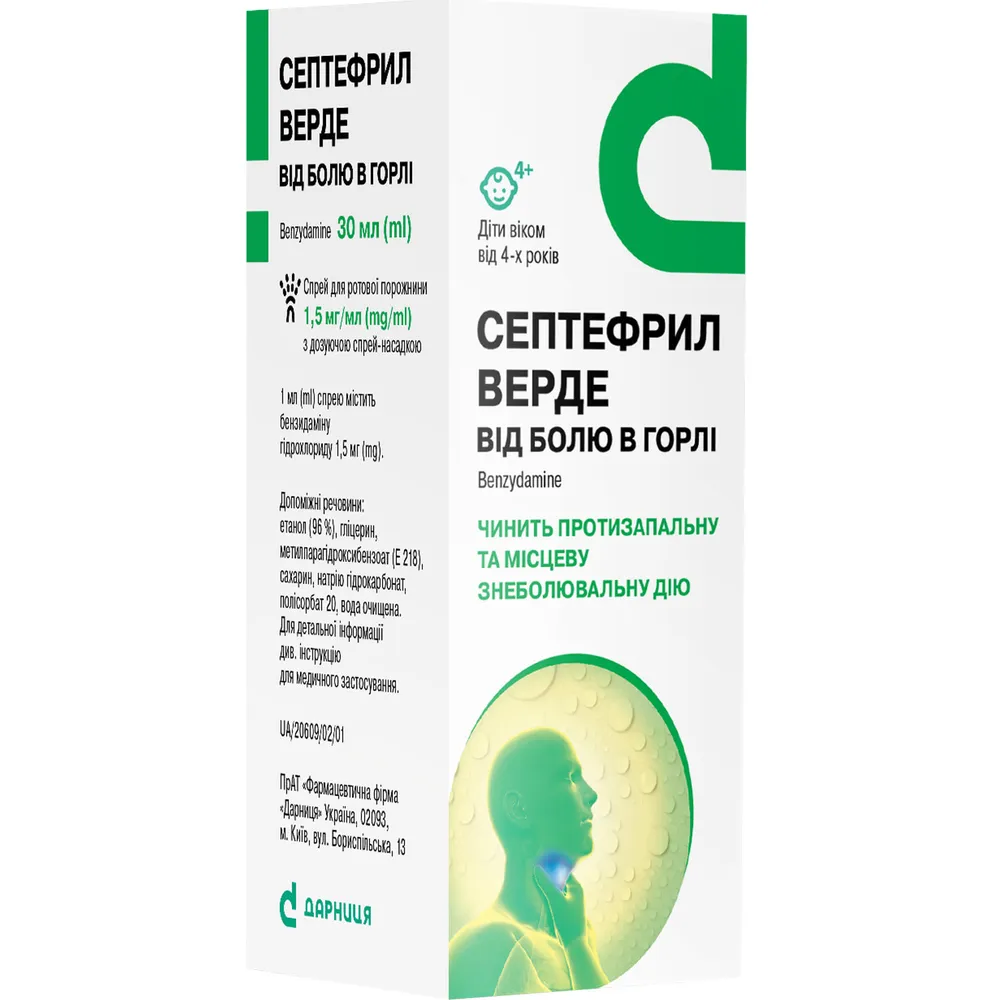
Instructions for Use
INSTRUCTIONS FOR MEDICAL USE OF THE MEDICINAL PRODUCT Septefril Verde from a sore throat (Septefril Verde from a sore throat)
Composition:
Active substance: benzidamine hydrochloride;
1 ml of spray contains 3 mg of benzidamine hydrochloride;
Excipients: ethanol (96%), glycerol, methylparahydroxybenzoate (E 218), sodium saccharin, macrogol glycerol hydroxystearate, purified water.
Pharmaceutical form. Oral spray.
Main physicochemical properties: clear, colorless liquid with a characteristic odor.
Pharmacotherapeutic group. Other agents for local treatment of diseases of the oral cavity; benzidamine. ATC code A01A D02.
Pharmacological properties.
Pharmacodynamics.
Benzydamine is a non-steroidal anti-inflammatory drug (NSAID) with analgesic and anti-exudative properties. It exerts anti-inflammatory and antiseptic actions and produces a local analgesic effect on the oral mucosa.
In clinical studies, the first relief of acute pain was observed as early as 1 minute after application of the spray (in 78% of patients), increasing at 2 minutes (in 91% of patients). After 15 minutes, significant pain relief persisted in 75% of patients. The duration of relief after administration lasted up to 4 hours. In addition, improvement in the sensation of throat swelling and easier swallowing were observed.
The study confirmed the efficacy of benzydamine in providing rapid pain relief and a favorable safety profile.
Pharmacokinetics.
Absorption
When applied locally, benzydamine readily penetrates through the skin and mucous membranes and accumulates in inflamed tissues.
Distribution
The fraction of the dose absorbed systemically is low, with a delayed peak plasma concentration. The amount of benzydamine in blood serum after absorption through the oropharyngeal mucosa is insufficient to produce systemic pharmacological effects.
Elimination
The drug is excreted in the urine, primarily as inactive metabolites and conjugation products.
Clinical characteristics.
Indications.
An anti-inflammatory and analgesic medicinal product for inflammatory conditions of the throat, oral cavity, and gums.
In dentistry, following tooth extraction.
For inflammatory processes and complications in the larynx following radiation therapy.
Contraindications.
Hypersensitivity to the active substance or to any of the excipients of the medicinal product.
Interaction with other medicinal products and other forms of interaction.
No interactions with other medicinal products have been established.
Special precautions for use.
If sensitivity occurs during prolonged use, treatment should be discontinued and medical advice should be sought in order to prescribe appropriate therapy.
The patient should consult a physician if there is no improvement after seven days of treatment with benzidamine.
The medicinal product is specifically designed for patients who have difficulty gargling.
Important information about excipients.
This medicinal product contains a small amount of ethanol (alcohol), less than 100 mg per dose.
The medicinal product contains methyl parahydroxybenzoate (E 218), which may cause allergic reactions (possibly delayed).
Use during pregnancy or breastfeeding.
Currently, there are no adequate data available on the use of benzidamine in pregnant or breastfeeding women. The ability of this medicinal product to pass into breast milk has not been studied. Animal data are insufficient to draw any conclusions regarding the effects of this product during pregnancy or breastfeeding. The potential risk to humans is unknown.
Septefril Verde should not be used for sore throat during pregnancy or breastfeeding.
Ability to affect reaction speed when driving or operating machinery.
The medicinal product does not affect the ability to drive or operate machinery.
Method of Administration and Dosage
For adults: 2–4 sprays 2–6 times daily (1 spray dose contains 0.17 ml, corresponding to 0.51 mg of benzidamine hydrochloride).
Do not exceed the recommended doses.
Children
The drug must not be used in children (under 18 years of age).
Overdose
Accidental ingestion of a large amount of benzidamine (> 300 mg) may lead to poisoning. Intoxication is possible only in case of accidental oral intake of a large amount of benzidamine (> 300 mg).
Symptoms
Characteristic signs of overdose following oral ingestion are gastrointestinal symptoms (most commonly nausea, vomiting, abdominal pain, esophageal irritation) and symptoms affecting the central nervous system (dizziness, hallucinations, excitement, restlessness, anxiety, and irritability may occur).
Treatment
In case of acute overdose, only symptomatic treatment is possible. Patients should be under close medical supervision and receive supportive therapy and adequate hydration.
Side effects
All adverse reactions are listed by system organ class and frequency: very common (≥ 1/10), common (≥ 1/100 to < 1/10), uncommon (≥ 1/1,000 to < 1/100), rare (≥ 1/10,000 to < 1/1,000), very rare (< 1/10,000), frequency not known (cannot be estimated from the available data).
Gastrointestinal disorders:
Rare – burning sensation in the mouth, dry mouth;
Frequency not known – oral hypoaesthesia, nausea, vomiting, swelling and discoloration of the tongue, taste alteration.
Immune system disorders:
Rare – hypersensitivity reaction;
Frequency not known – anaphylactic reaction.
Respiratory, thoracic and mediastinal disorders:
Very rare – laryngospasm;
Frequency not known – bronchospasm.
Skin and subcutaneous tissue disorders:
Uncommon – photosensitivity;
Very rare – angioneurotic oedema;
Frequency not known – rash, pruritus, urticaria.
Nervous system disorders:
Frequency not known – dizziness, headache.
Local adverse reactions are related to the anaesthetic effect of benzidamine.
These are usually transient, resolve spontaneously, and rarely require further treatment.
Benzidamine administered topically is absorbed into the bloodstream in small amounts; therefore, systemic adverse effects occur infrequently. Reducing the dose of the drug usually eliminates these symptoms.
Reporting of suspected adverse reactions.
Reporting suspected adverse reactions after marketing authorization is important. It allows continued monitoring of the benefit-risk balance of the medicinal product. Healthcare professionals and patients, as well as their legal representatives, are encouraged to report any suspected adverse reactions and/or lack of efficacy of the medicinal product via the Automated Pharmacovigilance Information System at the following link: https://aisf.dec.gov.ua.
Shelf life. 1.5 years.
Shelf life after first opening of the container: 30 days.
Storage conditions. Store in the original packaging at a temperature not exceeding 25°C. Do not freeze. Keep out of reach of children.
Packaging. 30 ml in a bottle, 1 bottle with a metered spray nozzle in a carton.
Supply category. Over-the-counter.
Manufacturer. JSC "Pharmaceutical company "Darnytsia".
Manufacturer's address and location of business activity.
13, Boryspylska Street, Kyiv, 02093, Ukraine.
Frequently Asked Questions
What is Septefril verde for sore throat prescribed for?
The drug is used as an analgesic and anti-inflammatory agent for inflammation of the throat, gums, and oral cavity. It is also used in dentistry after tooth extraction and for complications in the larynx following radiation therapy.
How should Septefril verde for sore throat be taken correctly?
Adults should administer 2–4 sprays from 2 to 6 times daily. It is not recommended to exceed the established dose.
Who should not use this drug?
The product must not be used by individuals with hypersensitivity to the active substance or excipients. The drug is contraindicated for children under 18 years of age, as well as for women during pregnancy and breastfeeding.
What are the possible side effects?
Possible reactions include dryness or burning in the mouth, taste changes, nausea, vomiting, headache, or dizziness. Allergic reactions (rash, itching) or swelling may also occur. Most local reactions usually resolve on their own.
Can I drive a car during treatment?
The drug does not affect the ability to drive vehicles or operate machinery.
What should I do if there is no improvement after treatment?
If no positive result is observed within seven days of use, it is necessary to consult a physician.
Does the drug interact with other medicines?
At this time, no interactions with other medicinal products have been established.
Similar Medications
-
Angi.net® spray
Form: spray, oral cavity
Active substance Dosage benzydamine 1.5 mg/ml Manufacturer: Laboratorium Sanitatis S.L. (manufacturing, primary and secondary packaging, quality control, batch release)
-
Benziverde
Form: spray, oral cavity
Active substance Dosage benzydamine 1.5 mg/ml Manufacturer: PJSC "HIMFARMZAVOD "CHERVONA ZIRKA"
-
Decatilen oris
Form: spray, oral cavity
Active substance Dosage benzydamine 1.5 mg/ml -
Deftoxil
Form: spray, oral cavity
Active substance Dosage benzydamine 1.5 mg/ml Manufacturer: Joint Ukrainian-Spanish Enterprise "Sperko Ukraine" (full production cycle, batch release; quality control)
-
Fari verde
Form: spray, oral cavity
Active substance Dosage benzydamine 1.5 mg/ml Manufacturer: Joint Ukrainian-Spanish Enterprise "SPERKO UKRAINE"
-
Faridamin
Form: spray, oral cavity
Active substance Dosage benzydamine 1.5 mg/ml Manufacturer: Joint Ukrainian-Spanish Enterprise "Sperko Ukraine"
-
Faridamin
Form: spray, oral cavity
Active substance Dosage benzydamine 1.5 mg/ml Manufacturer: Joint Ukrainian-Spanish Enterprise "Sperko Ukraine"
-
Fortalor
Form: spray, oral cavity
Active substance Dosage benzydamine 1.5 mg/ml Manufacturer: Joint Ukrainian-Spanish Enterprise "Sperko Ukraine"
-
Glandum
Form: spray, oral cavity
Active substance Dosage benzydamine 1.5 mg/ml Manufacturer: PJSC "HIMFARMZAVOD "CHERVONA ZIRKA"
-
Lordiphens
Form: spray, oral cavity
Active substance Dosage benzydamine 1.5 mg/ml Manufacturer: Sperko Ukraine LLC (full production cycle, batch release, quality control)
-
Lortum
Form: spray, oral cavity
Active substance Dosage benzydamine 1.5 mg/ml Manufacturer: Joint Ukrainian-Spanish Enterprise "Sperko Ukraine"
-
Milistan faringo forte
Form: spray, oral cavity
Active substance Dosage benzydamine 3 mg/ml Manufacturer: ICPE Health Products Limited
This page has been machine-translated and may contain inaccuracies. The original data is available in the manufacturing country's language.
Last data check: July 21, 2026 · Data source: Державний реєстр лікарських засобів України