Senadexin
Ukraine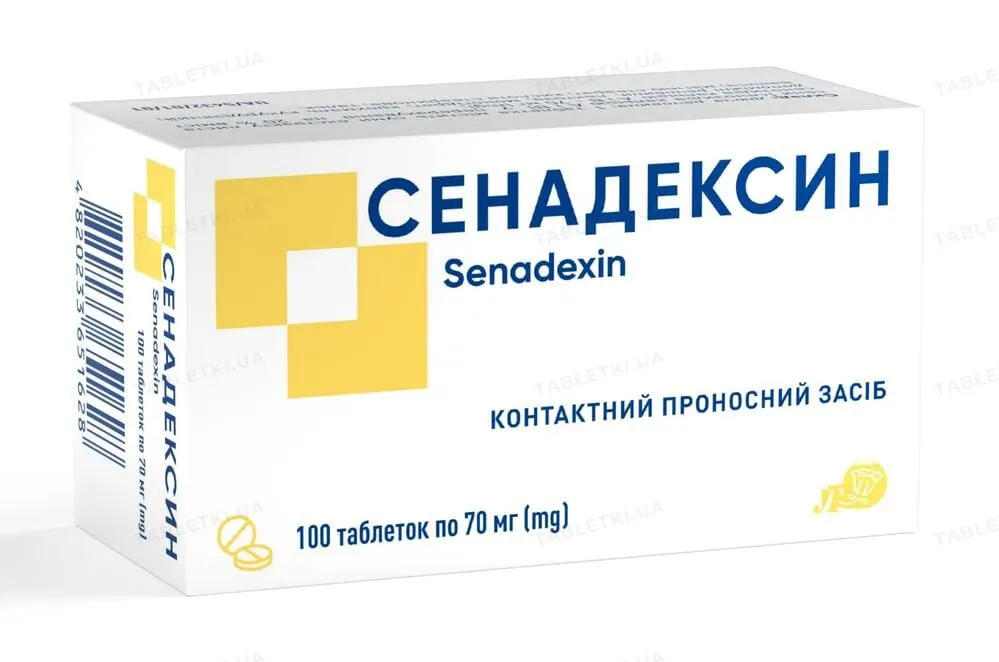
Table of Contents
INSTRUCTIONS FOR MEDICAL USE OF THE MEDICINAL PRODUCT SENADEXIN
Composition:
Active substance: 1 tablet contains a sum of leaf extract of senna (calcium sennosides A and B), calculated as 20% content of calcium sennosides A and B – 70 mg;
Excipients: lactose monohydrate; corn starch; vanillin; magnesium stearate; stearic acid; talc.
Pharmaceutical form. Tablets.
Main physicochemical properties: intact, regular cylindrical tablets with flat upper and lower surfaces, bevelled edges, a dividing line, light brown to dark brown in colour with speckles, with the odour of vanillin.
Pharmacotherapeutic group.
Stimulant laxatives. Senna glycosides. ATC code A06AB06.
Pharmacological properties.
Pharmacodynamics.
A prodrug of plant origin (senna leaf or Alexandrian leaf, or Cassia acutifolia leaf) that acts on the motility of the large intestine.
The pharmacological effect is due to anthra glycosides (mainly sennosides A and B), as well as other glycosides. When administered orally, senna glycosides pass through the stomach and small intestine unchanged, without being absorbed. In the large intestine, anthra glycosides are hydrolyzed by intestinal bacteria into pharmacologically active anthrones and anthranols, which stimulate intestinal intrareceptors of the colon, enhance peristalsis, and accelerate intestinal evacuation. Anthrones and anthranols inhibit absorption of water and electrolytes and promote diffusion of water into the intestinal lumen. As a result of the osmotic effect, the volume of fecal mass increases and intraluminal pressure rises, thereby promoting stimulation of peristalsis.
The laxative effect occurs within 6–12 hours. With prolonged use of the drug, the intensity of its action may decrease due to reduced potassium levels in the body.
Pharmacokinetics.
The active substances—metabolites of senna anthra glycosides—are practically not absorbed, are mainly excreted in feces, and also in urine. They are also excreted in sweat, and a small amount passes into breast milk.
Clinical characteristics.
Indications.
Constipation due to intestinal atony of various etiologies.
Preparation for radiological examinations.
Contraindications.
Hypersensitivity to the components of the drug. Nausea, vomiting, acute inflammatory diseases of the gastrointestinal tract (Crohn's disease, colitis), undiagnosed gastrointestinal disorders which may result from acute intestinal diseases or surgical interventions (diverticulitis, appendicitis, peritonitis, frequent diarrhea), intestinal obstruction, spastic constipation, incarcerated hernia, gastrointestinal or uterine bleeding, cystitis, epigastric pain of unknown origin, spastic pain, organic liver lesions, severe disturbances of water-electrolyte balance (hypokalemia), rectal hemorrhages.
Special safety precautions.
The drug is recommended for use only if normalization of bowel movements cannot be achieved by dietary changes; the minimum effective dose required to restore normal intestinal function should be used.
Patients taking cardiac glycosides, antiarrhythmic agents, drugs that prolong the QT interval, diuretics, corticosteroids, or licorice root-based preparations should consult a physician prior to starting this drug.
If the cause of constipation is unknown or if there are gastrointestinal complaints (abdominal pain, nausea, vomiting), a physician must determine the cause of constipation before initiating laxative therapy, as these symptoms may indicate developing or existing intestinal obstruction.
The drug is intended for episodic use; therefore, caution and prior consultation with a physician are required if treatment lasts longer than 1 week, since prolonged use of stimulant laxatives may lead to worsening of intestinal atony.
The drug should not be administered within 2 hours after other medicinal products or in doses exceeding the recommended ones.
Adults suffering from fecal incontinence should avoid prolonged skin contact with feces by changing pads (liners) regularly during treatment with this drug.
The drug should be used with caution in patients with liver or kidney diseases, and in those with chronic inflammatory bowel diseases.
The drug contains lactose, which should be taken into account in patients with rare hereditary forms of lactose intolerance, lactase deficiency, or glucose-galactose malabsorption syndrome.
Interaction with other medicinal products and other types of interactions.
No cases of clinically significant drug interactions have been reported to date.
A possible reduction in serum levels of active substances may occur when concomitantly administered with quinine sulfate (an antiarrhythmic agent), due to competitive properties with anthraquinone-containing laxatives. Concomitant use with cardiac glycosides may lead to cardiac arrhythmia due to hypokalemia. Muscle weakness may develop when used concomitantly with antiarrhythmic agents, diuretics, and corticosteroids. Prolonged use or use in high doses may impair absorption of tetracyclines. The drug may reduce the efficacy of medicinal products that are slowly absorbed in the gastrointestinal tract.
Special precautions for use.
Use during pregnancy or breastfeeding.
Although the use of the drug is not contraindicated in pregnant women, it is recommended to use it only under medical supervision. The use of the drug in pregnant women is associated with a higher likelihood of adverse effects (abdominal pain, diarrhea).
Breastfeeding should be discontinued during treatment with this drug, as its components may pass into breast milk and cause frequent loose stools in the infant. However, with appropriate dosing, the occurrence of adverse effects in the infant is unlikely.
Ability to affect reaction speed when driving or operating machinery.
The drug generally does not affect the ability to drive or operate machinery, or to perform tasks requiring increased attention and rapid mental or motor reactions. Nevertheless, individual response to the drug should be assessed.
Dosage and Administration.
The drug should be taken orally, swallowed with a small amount of liquid, usually before bedtime or in the morning.
For adults and children aged 12 years and older: the recommended dose is 2 tablets 1–2 times daily. Maximum daily dose – 4 tablets.
For elderly patients, treatment should be initiated at a dose of 1 tablet.
Children.
Not recommended for children under 12 years of age.
Overdose.
In case of overdose, diarrhea may develop, leading to disturbances in water-electrolyte balance, intestinal colic, irritation of the gastrointestinal organs causing nausea, epigastric pain, cramps, worsening intestinal function, vascular collapse, and metabolic acidosis.
Treatment: symptomatic, including gastric lavage. If there is a risk of severe diarrhea, rehydration is recommended (ingestion of large amounts of water).
Adverse reactions.
The drug is usually well tolerated, but rare adverse effects may occur, which are generally reversible and quickly resolve after discontinuation of the drug or dose reduction.
Gastrointestinal tract: in isolated cases, anorexia, abdominal pain, diarrhea may occur; with prolonged use/abuse – nausea, vomiting, flatulence, colonic pseudomelanosis, colonic atony, digestive disturbances, colic, weight loss.
Urinary system: change in urine color (red or brown depending on pH, which has no clinical significance); with prolonged use/abuse – proteinuria, hematuria.
Metabolism and endocrine system: prolonged use/abuse of laxatives may lead to electrolyte loss, primarily potassium, which may cause cardiac disturbances, fatigue, muscle weakness, cramps, collapse.
Immune system: allergic reactions may occur (skin rashes, pruritus, urticaria, localized or generalized exanthema).
Shelf life. 3 years.
Storage conditions.
Store in the original packaging at a temperature not exceeding 25 °C.
Keep out of reach of children.
Packaging.
10 tablets per blister;
10 tablets per blister, 5 or 10 blisters per pack.
Release classification.
Over-the-counter: tablets № 10.
By prescription only: tablets № 50 (5×10), № 100 (10×10).
Manufacturer.
JSC "Lubnipharm".
Manufacturer's address and place of business.
16 Barvinkova Street, Lubny, Poltava Oblast, 37500, Ukraine.