Selofen
Ukraine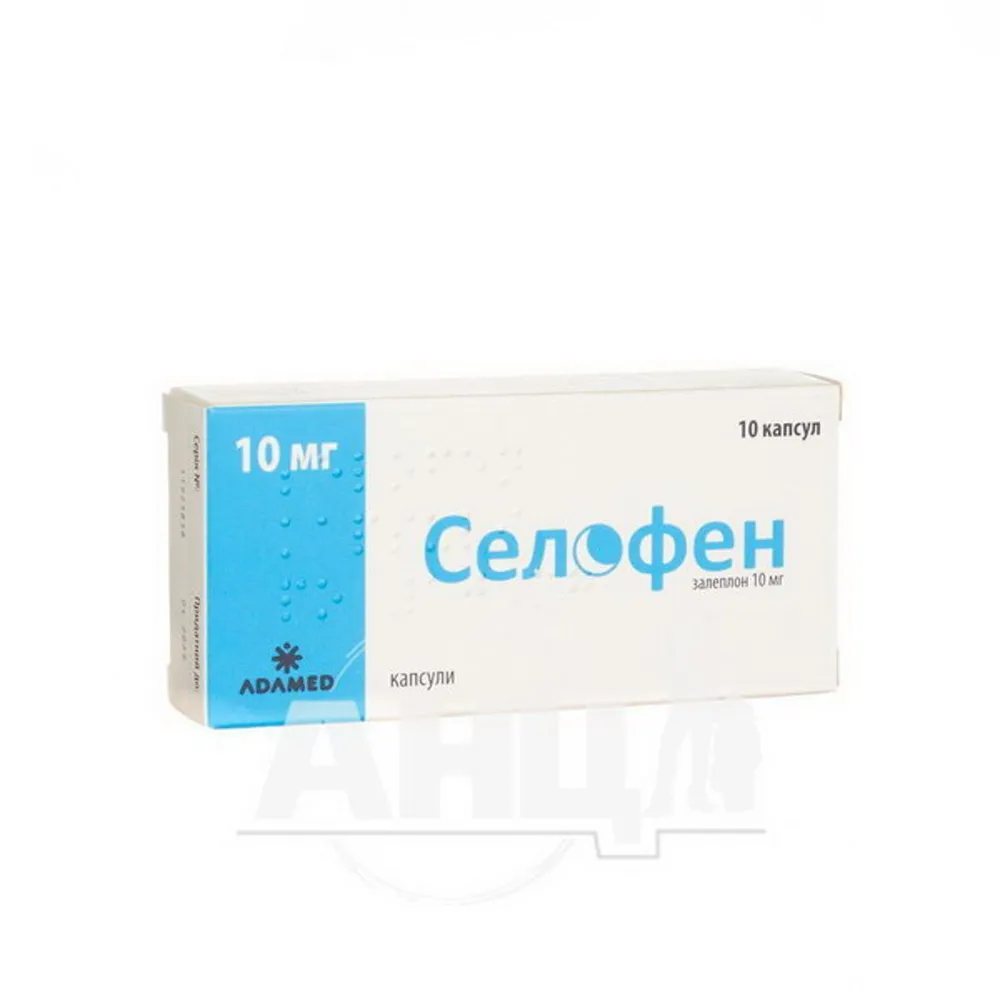
Table of Contents
I N S T R U C T I O N for medical use of the medicinal product C E L O F E N (SELOFEN)
Composition:
active substance: zaleplon;
1 capsule contains zaleplon 10 mg;
excipients: lactose monohydrate, microcrystalline cellulose, colloidal anhydrous silicon dioxide, sodium lauryl sulfate, sodium starch glycolate (type A), magnesium stearate; capsule composition: gelatin, titanium dioxide (E 171), red iron oxide (E 172), black iron oxide (E 172), erythrosine (E 127), indigo carmine (E 132).
Medicinal form. Capsules.
Main physicochemical properties: hard gelatin capsules with pink body and blue cap, size "3", containing white powder.
Pharmacotherapeutic group. Hypnotics and sedatives. ATC code N05CF03.
Pharmacological properties.
Pharmacodynamics.
Zaleplon is a medicinal product belonging to the pyrazolopyrimidine class, differing from benzodiazepines and other hypnotic agents. Zaleplon interacts with the GABAA benzodiazepine receptor located in neuronal structures of the central nervous system (CNS).
The pharmacokinetic profile of zaleplon demonstrates rapid absorption and elimination. It selectively binds to type I benzodiazepine receptors.
Pharmacokinetics.
Absorption
After oral administration, zaleplon is rapidly and almost completely absorbed from the gastrointestinal tract (at least 71%). Maximum plasma concentration (Cmax) is reached within approximately 1 hour. Zaleplon undergoes hepatic biotransformation, and its bioavailability is approximately 30%.
Distribution
Zaleplon is lipophilic, and its volume of distribution after intravenous administration is about 1.4 ± 0.3 L/kg. In vitro, it is approximately 60% bound to plasma proteins, indicating a low risk of interaction due to displacement from plasma protein binding.
Biotransformation
Zaleplon is primarily metabolized in the liver to 5-oxo-zaleplon by the enzyme aldehyde oxidase. To a lesser extent, it is metabolized by the CYP3A4 isoenzyme to desethylzaleplon and then to 5-oxo-desethylzaleplon. Both metabolites, 5-oxo-zaleplon and 5-oxo-desethylzaleplon, are subsequently glucuronidated and excreted in urine. In vitro animal studies have shown that zaleplon metabolites are pharmacologically inactive. Zaleplon plasma concentrations increase linearly, and no accumulation of zaleplon has been observed following doses up to 30 mg/day. The elimination half-life of zaleplon is approximately 1 hour.
Excretion
Zaleplon is excreted in the form of inactive metabolites, primarily in urine (71%) and feces (17%). The majority (57%) of the administered dose is excreted in urine as 5-oxo-zaleplon and its glucuronide derivatives, and an additional 9% as 5-oxo-desethylzaleplon and its glucuronide derivatives. The remainder consists of minor metabolites excreted in urine. Most of the metabolites detected in feces are 5-oxo-zaleplon.
Clinical characteristics.
Indications. Indicated for the treatment of insomnia characterized by difficulty in falling asleep. It is recommended only when the disorder is severe or causes significant distress to the patient.
Contraindications. Hypersensitivity to the components of the medicinal product. Breastfeeding period. Severe hepatic insufficiency. Severe respiratory insufficiency. Severe renal function impairment. Sleep apnea syndrome. Severe myasthenia gravis. Pediatric age.
Interaction with other medicinal products and other types of interactions.
Alcohol – concomitant use with zaleplon is not recommended due to enhanced sedative effects. This impairs mental and physical responses and reduces the ability to drive or operate machinery the following day (see section "Ability to affect reaction speed when driving or operating machinery").
Caution should be exercised when using concurrently with agents affecting the central nervous system (CNS). Central nervous system depressant effects may be enhanced when combined with the following agents: drugs used in psychiatric disorders (antipsychotics, hypnotics, anxiolytics, sedatives, antidepressants), drugs used in the treatment of severe pain (opioid analgesics), drugs used to treat seizures (antiepileptic drugs), anesthetics, and drugs used in allergy treatment (antihistamines with sedative effects). Concomitant use of zaleplon with these drugs increases the risk of somnolence, including reduced ability to drive the following day.
Venlafaxine (75 mg or 150 mg daily, in extended-release formulation), when used in combination with 10 mg of zaleplon, does not cause memory impairments (immediate and delayed word recall) or psychomotor reactions (digit-symbol substitution test). Furthermore, no pharmacokinetic interaction between zaleplon and venlafaxine (in extended-release formulation) was observed.
When used with opioid analgesics, euphoric effects may be enhanced, leading to increased physical dependence.
Cimetidine (a non-specific, moderately potent inhibitor of hepatic enzymes, such as oxidase and CYP3A4) increases plasma concentrations of zaleplon by 85% by inhibiting aldehyde oxidase and CYP3A4 (enzymes responsible for zaleplon metabolism). Therefore, concomitant use of these drugs should be cautious.
Concomitant administration of the drug Selofen with 800 mg of erythromycin (a strong selective inhibitor of CYP3A4) results in a 34% increase in zaleplon plasma concentration.
No dose adjustment of Selofen is necessary, but patients should be informed that potentiation of its sedative effect may occur.
Rifampicin, as a strong inducer of hepatic enzymes such as CYP3A4, may reduce zaleplon plasma concentrations by up to fourfold. CYP3A4-inducing agents such as rifampicin, carbamazepine, and phenobarbital may reduce the efficacy of Selofen when used concomitantly.
Zaleplon does not affect the pharmacokinetics and pharmacodynamics of digoxin and warfarin, both of which have a narrow therapeutic index.
Ibuprofen, when used concomitantly with zaleplon, does not cause additional interactions.
Dimenhydrinate acted as a weak inhibitor of hepatic aldehyde oxidase in rats, but its inhibitory effect on human liver is unknown. There was no evidence of pharmacokinetic interaction between zaleplon and dimenhydrinate after single doses (10 mg and 50 mg, respectively). However, since both compounds affect the central nervous system, an additive pharmacodynamic effect is possible.
Risks associated with concomitant use of opioids
Concomitant administration of sedative drugs such as benzodiazepines or similar drugs like Selofen with opioids may result in sedation, respiratory depression, coma, and death due to enhanced CNS depressant effects. The dose and duration of concomitant use should be limited (see section "Special precautions for use").
If a decision is made to prescribe Selofen concomitantly with opioids, the lowest effective dose should be used for the shortest possible duration of concomitant treatment (see also section "Method of administration and dosage").
Special precautions for use
Patients should be informed about the possibility of insomnia recurrence after discontinuation of treatment.
In patients taking hypnotic and sedative drugs, behavioral disturbances in a state of incomplete consciousness, including reversible amnesia, have been observed after administration. These phenomena may occur in patients who have not previously been treated or have been treated with hypnotic and sedative drugs. The phenomenon of "sleep-driving" may occur during the use of hypnotic and sedative drugs at therapeutic doses; however, the risk of such a condition increases with concomitant alcohol intake and other substances that have a CNS depressant effect, as well as in cases of exceeding the maximum recommended dose. Due to the risk to the patient and others, use of zaleplon is not recommended in patients who have previously experienced sleep-driving.
Following administration of hypnotic and sedative drugs, other behavioral disturbances have also been observed (e.g., preparing and eating food, making phone calls, engaging in sexual activity while not fully awake). Patients usually do not recall these events.
Severe anaphylactic and anaphylactoid reactions have been reported during treatment with hypnotic and sedative drugs, including zaleplon. Cases of angioedema involving the tongue, glottis, and larynx have been observed after administration of the first or subsequent doses. Some patients taking hypnotic and sedative drugs developed additional symptoms such as dyspnea, throat spasm, nausea, and vomiting. Some patients required hospitalization and emergency treatment. Angioedema involving the tongue, glottis, and larynx may lead to upper airway obstruction and potentially fatal outcomes. Zaleplon should not be re-administered to patients who have experienced angioedema after its use.
Insomnia may be caused by physical or psychological disorders. Insomnia that persists or worsens after short-term use of zaleplon may indicate the need for re-evaluation of the patient.
The elimination half-life of zaleplon is short, lasting approximately 1 hour. If a patient wakes up early in the morning, consideration should be given to alternative therapies. Patients should be warned that a second dose of Selefin should not be taken during the same night.
Concomitant use of zaleplon with other drugs affecting CYP3A4 may alter zaleplon concentrations.
Concomitant use of zaleplon with alcohol is not recommended due to enhanced sedative effects. This impairs mental and physical reactions and reduces the ability to drive or operate machinery the following day (see section "Ability to affect reaction speed when driving or operating machinery").
Risk associated with concomitant use of opioids
Concomitant administration of the medicinal product Selefin with opioids may cause sedation, respiratory depression, coma, and death.
Due to these risks, concomitant prescribing of sedative drugs such as benzodiazepines or similar agents like Selefin with opioids should be reserved only for patients for whom alternative treatment options are inadequate. If a decision is made to prescribe Selefin concomitantly with opioids, both drugs should be initiated at the lowest effective doses and for the shortest duration possible (see section "Dosage and administration").
Patients should be monitored for signs of respiratory depression and sedation. It is strongly recommended to inform patients and their caregivers about these symptoms so they can recognize them (see section "Interaction with other medicinal products and other forms of interaction").
The medicinal product contains lactose monohydrate. Patients with rare hereditary conditions of galactose intolerance, congenital lactase deficiency, or glucose-galactose malabsorption should not take this product.
The medicinal product Selefin contains less than 1 mmol (23 mg) of sodium per capsule and is therefore considered sodium-free.
Development of tolerance
Administration of short-acting benzodiazepines and benzodiazepine-like drugs over several weeks may be associated with reduced hypnotic effect.
Dependence
Use of benzodiazepines and drugs with similar mechanisms of action may lead to physical and psychological dependence. The risk of dependence increases with higher doses, prolonged treatment duration, and in patients with a history of alcohol or drug dependence.
In cases of established physical dependence, abrupt discontinuation of the drug may lead to withdrawal symptoms such as headache, muscle pain, marked anxiety, increased tension, restlessness, confusion, and irritability. In severe cases, derealization, depersonalization, hyperacusis, limb paresthesia, increased sensitivity to light, sound, and physical stimuli, hallucinations, and epileptic seizures may occur. Post-marketing reports have described dependence associated with zaleplon use, primarily in combination with other psychotropic substances.
Duration of treatment
The treatment course should be as short as possible (see section "Dosage and administration"). The maximum duration of treatment is 2 weeks. Treatment should not be continued without re-evaluation of the patient.
At the beginning of treatment, patients should be informed about the limited duration of therapy. It is also important that patients understand the possibility of insomnia recurrence after treatment ends. As a result, they will be less anxious if such symptoms occur after discontinuation of the drug.
Memory and psychomotor functions
Anterograde amnesia and psychomotor impairment may occur, particularly several hours after drug intake. To prevent these symptoms, the drug should only be taken when the patient has the opportunity for uninterrupted sleep of at least 4 hours after administration.
Discontinuation of the drug
After stopping treatment, transient insomnia symptoms may occur, sometimes in a more pronounced form. Other associated symptoms may also develop, such as mood disturbances, increased anxiety, sleep disturbances, or restlessness.
Psychiatric and paradoxical reactions
Treatment with zaleplon should be discontinued if increased anxiety, excitement, irritability, aggression, loss of control, perceptual disturbances, delirium, rage attacks, nightmares, depersonalization, hallucinations, psychosis, extroversion, or particularly behavior changes not typical of the patient’s character occur. These may be caused by the active substance, occur spontaneously, or result from psychological or physical disorders. Elderly patients are more susceptible to developing such symptoms. Any new symptoms require careful and immediate evaluation.
Special patient populations
Elderly patients
Elderly patients may be more sensitive to hypnotic drugs; therefore, the 10 mg dosage of the drug is not recommended for this patient group.
Use in patients with hepatic impairment
Benzodiazepines and drugs with similar effects are not intended for use in patients with hepatic insufficiency, as they may induce encephalopathy.
Use in patients with renal impairment
Zaleplon is not indicated for treatment of patients with severe renal insufficiency, as it has not been adequately studied in this patient group. Dose adjustment is not required in patients with moderate renal insufficiency, as the pharmacokinetics of zaleplon are not altered in these patients.
Respiratory insufficiency
Particular caution is required when prescribing Selefin to patients with chronic respiratory insufficiency.
Patients should be monitored for signs of respiratory depression and sedation. It is strongly recommended to inform patients and their caregivers about these symptoms so they can recognize them (see section "Interaction with other medicinal products and other forms of interaction").
Psychoses
The drug and benzodiazepine derivatives should not be used for basic treatment of psychosis.
Use in patients with alcohol or drug abuse
Extreme caution is required when administering benzodiazepines and similar-acting drugs to this patient group.
Depression
Zaleplon may unmask or worsen pre-existing depression. Zaleplon should be prescribed with caution to patients with depressive symptoms. Such patients may be prone to suicidal behavior. Zaleplon should not be used alone to treat depression or depression-related anxiety (in such patients, this may lead to suicide). Due to the increased risk of intentional overdose in patients with depression, the dose of zaleplon should be limited to the necessary minimum.
Use during pregnancy or breastfeeding
Pregnancy
Zaleplon should not be used during pregnancy due to the lack of clinical studies in pregnant women.
Women of childbearing potential should be advised to discontinue treatment with Selefin if pregnancy is planned or suspected.
If Selefin is prescribed by a physician during the last months of pregnancy or during labor, effects on the newborn should be anticipated. In such cases, hypothermia, arterial hypotension, or moderate respiratory depression may occur. There is a risk that infants of women who have used the drug long-term during pregnancy (in the last few weeks) may develop physical dependence with a risk of withdrawal syndrome.
Lactation
Due to passage into breast milk, zaleplon is contraindicated in breastfeeding women.
Ability to affect reaction speed when driving or operating machinery
The medicinal product significantly affects the ability to drive vehicles and operate machinery. Drowsiness, amnesia, concentration impairment, and muscle function disturbances may impair the ability to drive or operate machinery the following day. The risk of attention deficits increases if sleep duration is insufficient.
Selefin affects psychomotor reaction speed; therefore, it should not be prescribed to patients whose activities require high attention and significant psychomotor activity.
Additionally, concomitant use of zaleplon with alcohol and other CNS depressants increases this risk (see section "Interaction with other medicinal products and other forms of interaction").
Patients whose activities require high psychophysical performance should be advised to exercise caution. Patients should be advised not to drive or operate machinery until it is established that their psychophysical status is not impaired.
Method of Administration and Dosage
Selofen is intended for use in adults.
The recommended daily dose is 10 mg. A second dose of the medication should not be taken during the same night. The maximum daily dose is 10 mg. The maximum duration of treatment is 2 weeks.
For patients with mild to moderate hepatic impairment or chronic respiratory insufficiency, a daily dose of 5 mg is recommended. If this dosage cannot be achieved, zolpidem should not be used in such patients.
Zolpidem should not be taken during or immediately after a meal, as food delays the absorption of the drug. Alcohol should not be consumed during treatment with zolpidem.
Selofen should be taken immediately before going to bed and at least 4 hours before planned awakening.
Elderly Patients
A daily dose of 5 mg is recommended due to increased sensitivity to hypnotic agents in elderly patients. If this dosage cannot be achieved, zolpidem should not be used in such patients.
Hepatic Impairment
Due to reduced clearance, a dose of 5 mg should be administered to patients with mild or moderate hepatic impairment. If this dosage cannot be achieved, zolpidem should not be used in such patients. Zolpidem is contraindicated in patients with severe hepatic impairment.
Renal Impairment
The pharmacokinetics of the drug are not altered in patients with mild to moderate renal impairment; therefore, dose adjustment is not necessary.
Children
Currently, there is insufficient clinical data on the use of zolpidem in children; therefore, its use in this patient population is contraindicated.
Overdose
At present, insufficient data are available regarding zolpidem overdose.
Symptoms of Overdose
Overdose with benzodiazepines or drugs with similar effects typically manifests as central nervous system (CNS) depression of varying severity, ranging from drowsiness to coma.
In mild cases, symptoms such as somnolence, disorientation, and lethargy may occur. In severe overdose, ataxia, decreased general muscle tone, arterial hypotension, respiratory depression, and rarely coma may occur; very rarely, fatal outcomes have been reported. Chromaturia (blue-green discoloration of urine) has been observed following zolpidem overdose.
Zolpidem overdose poses a life-threatening risk in individuals taking other CNS depressants (including alcohol).
Treatment of Overdose
When treating overdose of any medication, the possibility of concomitant intake of multiple drugs should be considered.
In cases of overdose with the medicinal product Selofen, supportive therapy is generally applied. Maintenance of airway patency, respiratory support, and hemodynamic stability are usually sufficient. In mild cases, the patient should be allowed to sleep while respiratory and circulatory functions are monitored. Induction of vomiting is not recommended. In severe cases, administration of activated charcoal or gastric lavage may be beneficial if the drug was recently ingested. Circulatory stabilization and intensive monitoring of the patient's condition may also be required. The benefit of forced diuresis or hemodialysis in treating overdose has not been proven.
Animal studies have shown that flumazenil is an effective antidote; however, data on its efficacy in humans are lacking.
Adverse Reactions
Below are the adverse effects and their frequency observed during clinical trials of zolpidem.
General disorders
Uncommon (>1/1000, <1/100): asthenia, decreased tactile sensitivity, malaise, feeling unwell.
Nervous system disorders (see also amnesia)
Common (>1/100, <1/10): amnesia, paraesthesia, somnolence, disorientation.
Uncommon (>1/1000, <1/100): ataxia/dyscoordination, poor coordination, decreased concentration, dizziness, auditory hyperesthesia, olfactory hallucinations, visual field defects, diplopia, incoherent speech, speech disorders (dysarthria, slurred speech), hypoesthesia.
Frequency not known: somnambulism.
Eye disorders
Uncommon (>1/1000, <1/100): visual disturbances, diplopia.
Ear and labyrinth disorders
Uncommon (>1/1000, <1/100): hyperacusis.
Gastrointestinal disorders
Uncommon (>1/1000, <1/100): nausea.
Frequency not known: increased liver transaminase levels.
Reproductive system disorders
Common (>1/100, <1/10): dysmenorrhoea.
Immune system disorders
Very rare (<1/10,000): anaphylactic/anaphylactoid and pseudo-anaphylactic reactions.
Frequency unknown: angioedema.
Skin and subcutaneous tissue disorders
Uncommon (>1/1000, <1/100): photosensitivity.
Frequency unknown: angioedema.
Metabolism and nutrition disorders
Uncommon (>1/1000, <1/100): anorexia.
Hepatobiliary disorders
Frequency unknown: hepatotoxicity (mainly as increased aminotransferase activity).
Psychiatric disorders (see also depression and psychiatric and paradoxical reactions)
Uncommon (>1/1000, <1/100): depersonalization, hallucinations, depression, confusion, apathy, disorientation.
Frequency unknown: somnambulism.
Amnesia
Amnesia may occur even at recommended therapeutic doses. The risk of amnesia increases with higher doses of the drug. Amnesia may be associated with unusual behavior (see section "Special precautions").
Depression
Depression may occur or worsen during treatment with zolpidem. Zolpidem should be prescribed with caution to patients with symptoms of depression. Such patients may be prone to suicidal behavior. Zolpidem should not be used alone for the treatment of depression or anxiety associated with depression (in such patients this may lead to suicide).
Psychiatric and paradoxical reactions
Symptoms such as increased anxiety, excitement, irritability, loss of control, aggression, inability to think logically, delirium, anger, nightmares, depersonalization, hallucinations, psychosis, inappropriate behavior, extroversion appearing atypical, and other adverse behavioral effects may occur during treatment with benzodiazepines or agents with similar effects. These symptoms occur more frequently in elderly patients.
Dependence.
Use of the drug (even at therapeutic doses) may lead to the development of physical dependence: discontinuation of treatment may result in withdrawal symptoms or rebound effects (see section "Special precautions"). Psychological dependence may also occur. Abuse of benzodiazepines or agents with similar effects has been reported.
Shelf life. 4 years.
Storage conditions. Store at temperatures not exceeding 25 °C in the original packaging. Keep out of reach of children.
Packaging. 10 capsules in a blister; 1 or 2 blisters per cardboard box.
Prescription status. Prescription only.
Manufacturer.
Adamed Pharma S.A., Poland.
Manufacturer's address and place of business.
ul. Marszałka J. Piłsudskiego 5, 95-200 Pabianice, Poland.