Secnidox
Ukraine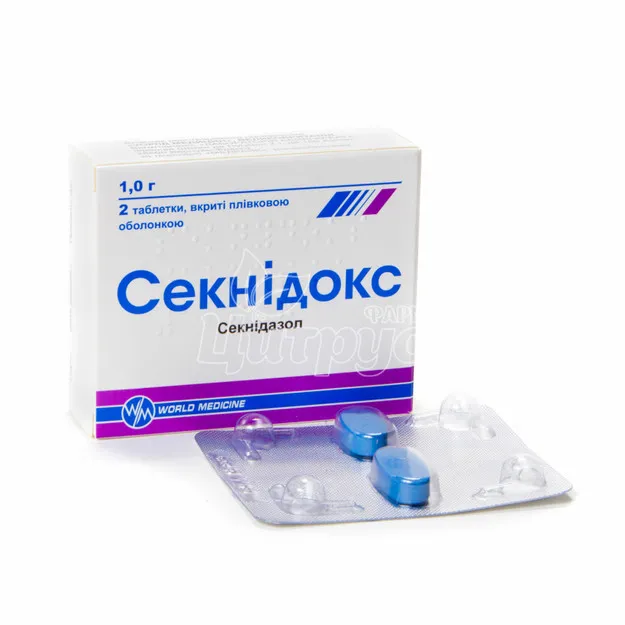
Table of Contents
INSTRUCTIONS FOR MEDICAL USE OF THE MEDICINAL PRODUCT SECNIDOX
Composition:
Active substance: secnidazole;
One film-coated tablet contains secnidazole 1.0 g;
Excipients: maize starch, calcium hydrogen phosphate, microcrystalline cellulose, sodium starch glycolate (type A), povidone (K 30), magnesium stearate, talc;
Coating composition: hypromellose (E 15), titanium dioxide (E 171), indigo carmine lake (E 132), talc, propylene glycol.
Pharmaceutical form. Film-coated tablets.
Main physicochemical properties: capsule-shaped, film-coated tablets, blue in color, with "SECN" embossed on one side and a score line on the other.
Pharmacotherapeutic group.
Antiprotozoal agents. Nitroimidazole derivatives. ATC code P01AB07.
Pharmacological Properties.
Pharmacodynamics.
The active ingredient of the medicinal product, secnidazole, belongs to the group of antiprotozoal agents known as nitroimidazoles with antibacterial activity. It exhibits bactericidal effects (against gram-positive and gram-negative anaerobic bacteria) and amebicidal effects (both intestinal and extraintestinal). Secnidazole is particularly active against Trichomonas vaginalis, Entamoeba histolytica, and Giardia lamblia. After penetrating into the microbial cell, it becomes activated through reduction of the 5-nitro group, thereby interacting with cellular DNA. This leads to disruption of its helical structure, strand breakage, inhibition of nucleotide synthesis, and ultimately cell death.
Pharmacokinetics.
After oral administration, secnidazole is rapidly and completely absorbed from the gastrointestinal tract. Bioavailability is approximately 80%. Maximum plasma concentration is reached within 3 hours.
The elimination half-life of secnidazole is approximately 25 hours, which allows simplification of the dosing regimen, making it more convenient for patients. It is eliminated slowly (16% of the dose is excreted within 72 hours and 50% within 120 hours), primarily via urine.
Secnidazole crosses the blood-brain barrier and placental barrier and penetrates into breast milk.
Clinical characteristics.
Indications.
- Trichomonad urethritis and vaginitis (caused by Trichomonas vaginalis).
- Bacterial vaginosis.
- Intestinal amoebiasis (caused by Entamoeba histolytica).
- Hepatic amoebiasis (caused by Entamoeba histolytica).
- Giardiasis (caused by Giardia lamblia).
Contraindications.
- Hypersensitivity to the active substance, other derivatives of imidazole, and/or to any of the excipients of the medicinal product.
- Organic neurological disorders.
- Pathological blood disorders, including in the medical history.
- First trimester of pregnancy.
Interaction with other medicinal products and other forms of interaction.
Disulfiram.
Concomitant use with disulfiram may lead to development of paranoid reactions and psychosis. Combination with alcohol causes symptoms of a disulfiram-like reaction (abdominal cramps, nausea, vomiting, headache, flushing), and delirious episodes and dizziness are possible. These medicinal products should not be used concomitantly.
Warfarin.
Concomitant use with secnidazole may enhance the anticoagulant effect of warfarin. When these medicinal products are used together, careful monitoring of the patient's condition and prothrombin time is required, and dosage adjustment should be performed if necessary.
Lithium preparations.
Concomitant use with secnidazole may increase plasma lithium concentration.
Cyclosporine.
Concomitant use with secnidazole may increase plasma cyclosporine concentration. When these medicinal products are used together, careful monitoring of cyclosporine and creatinine levels in blood plasma is required.
5-Fluorouracil.
Concomitant use with secnidazole increases the clearance of 5-fluorouracil, leading to increased toxicity.
Alcoholic beverages.
Concomitant use of secnidazole with alcoholic beverages causes symptoms such as painful abdominal cramps, flushing, vomiting, and tachycardia.
Special precautions for use
Alcoholic beverages should not be consumed during treatment with the medicinal product and for 72 hours after discontinuation of therapy in order to prevent adverse reactions similar to those occurring during disulfiram intake (painful abdominal cramps, flushing, vomiting, and tachycardia).
If prolonged use of the medicinal product beyond the recommended duration is required, hematological parameters (particularly leukocyte count) should be monitored, and the patient should be monitored for adverse reactions indicating the development of central and peripheral neuropathies (such as paresthesia, ataxia, dizziness, and seizures).
The medicinal product should be used with caution in patients with hepatic encephalopathy.
If disturbances in motor coordination, dizziness, and/or confusion occur, administration of the medicinal product should be discontinued.
Patients should abstain from sexual intercourse during treatment with this medicinal product.
The medicinal product contains less than 1 mmol (23 mg)/dose of sodium, i.e., it is practically sodium-free.
Use during pregnancy or breastfeeding
Secnidazole crosses the placental barrier and is excreted into breast milk. The medicinal product is not recommended for use during pregnancy or breastfeeding.
Ability to influence reaction speed when driving or operating machinery
When using secnidazole, adverse reactions such as psychosis, confusion, hallucinations, headache, seizures, vertigo, dizziness, encephalopathy (e.g., confusion), and subacute cerebellar syndrome (e.g., ataxia, dysarthria, motor disturbances, nystagmus, and tremor) may occur. The possibility of such effects should be taken into account by patients who drive or operate machinery.
Dosage and Administration
Route of administration
The medicinal product is intended for oral administration. Tablets should be swallowed whole with a small amount of water immediately before meals.
Dosage for adults
Trichomonas urethritis and vaginitis, bacterial vaginosis: a single dose of 2 g (2 tablets).
Intestinal amoebiasis:
- Acute amoebiasis: a single dose of 2 g (2 tablets);
- Asymptomatic amoebiasis, including focal and cyst forms: 2 g (2 tablets) once daily for 3 days.
Hepatic amoebiasis: 1.5 g (1.5 tablets) 1–2 times daily for 5 days.
Giardiasis: 2 g (2 tablets) once daily for 3 days.
Dosage for children
Intestinal amoebiasis:
- Acute amoebiasis: a single dose of 30 mg/kg body weight;
- Asymptomatic amoebiasis, including focal and cyst forms: 30 mg/kg body weight 1–2 times daily for 3 days.
Hepatic amoebiasis: 30 mg/kg body weight 1–2 times daily for 5 days.
Giardiasis: a single dose of 30 mg/kg body weight (1–1.5 g).
Children
The medicinal product can be used in children aged 12 years and older.
Overdose
Symptoms
In case of overdose, adverse reactions of secnidazole are intensified, particularly those affecting the nervous system.
Treatment
In case of overdose, symptomatic therapy should be administered. There is no specific antidote. Patient monitoring in a hospital setting is recommended. If necessary, hemodialysis may be used to eliminate secnidazole from the body.
Side effects.
The adverse reactions listed below are classified by frequency as follows: very common (≥1/10), common (≥1/100 to <1/10), uncommon (≥1/1,000 to <1/100), rare (≥1/10,000 to <1/1,000), very rare (<1/10,000), frequency not known (cannot be estimated from the available data).
Blood and lymphatic system disorders:
rare – moderately expressed leukopenia, which is reversible upon discontinuation of treatment; very rare – agranulocytosis, neutropenia, thrombocytopenia.
Immune system disorders:
rare – hypersensitivity reactions, sometimes severe, such as rash, pruritus, urticaria, angioneurotic edema, bronchospasm, facial swelling, periorbital edema, and laryngeal edema, fever, erythema, and anaphylactic reactions.
Psychiatric disorders:
very rare – psychosis, confusion, hallucinations.
Nervous system disorders:
rare – headache, seizures, vertigo, dizziness, paresthesia, peripheral sensory neuropathy, sensorimotor polyneuritis; very rare – encephalopathy (e.g. confusion) and subacute cerebellar syndrome (e.g. ataxia, dysarthria, motor disturbances, nystagmus, and tremor), which are reversible upon discontinuation of treatment.
Cardiac disorders:
rare – palpitations.
Gastrointestinal disorders:
common – epigastric and/or abdominal pain, nausea, vomiting, diarrhea, constipation; uncommon – glossitis, stomatitis, taste disturbances (metallic taste in mouth), anorexia.
Hepatobiliary disorders:
very rare – hepatitis.
Reporting of suspected adverse reactions.
Reporting of suspected adverse reactions after marketing authorization is highly important. It allows continuous monitoring of the benefit-risk balance of the medicinal product. Healthcare professionals should report any suspected adverse reactions via the national pharmacovigilance system.
Shelf life.
3 years.
Storage conditions.
Store at temperatures not exceeding 25 °C in a dry place and out of reach of children.
Packaging.
2 tablets in a blister; 1 blister in a cardboard box.
Prescription status.
Prescription only.
Manufacturer.
LABORATOIRE BAILLY-CREAT, France /
LABORATOIRE BAILLY-CREAT, France.
Manufacturer's address and site of manufacturing activity.
Chemin de Nuisement, Lieu-dit les 150 Arpents, VERNOUILLET, 28500, France /
Chemin de Nuisement, Lieu-dit les 150 Arpents, VERNOUILLET, 28500, France.
Marketing Authorization Holder.
WORLD MEDICINE, LLC, Ukraine /
WORLD MEDICINE, LLC, Ukraine.