Sangiva
Ukraine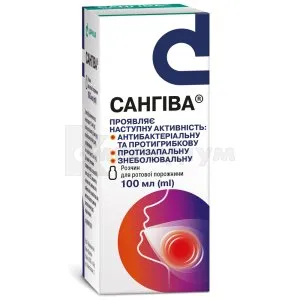
Table of Contents
INSTRUCTIONS for medical use of the medicinal product SANGIVA®
Composition:
Active ingredients: chlorobutanol hemihydrate, choline salicylate, hexetidine;
1 ml of solution contains: hexetidine 1.0 mg; choline salicylate 5.0 mg; chlorobutanol hemihydrate equivalent to chlorobutanol 2.5 mg;
Excipients: sodium saccharin, ethanol 96%, polysorbate 20, levomenthol, anise oil, lemon oil, lime oil, eucalyptus oil, methyl salicylate, citric acid monohydrate, purified water.
Pharmaceutical form. Oral spray.
Main physicochemical properties: clear colorless or slightly yellowish liquid with a characteristic aromatic odor.
Pharmacotherapeutic group. Agents used in throat diseases. Antiseptics. ATC code R02A A20.
Pharmacological properties.
Pharmacodynamics.
The effect of the medicinal product is due to three active components.
Antibacterial and antifungal activity. Hexetidine exerts antibacterial activity against both Gram-positive and Gram-negative microbial strains, as well as against both aerobes and anaerobes.
Against aerobic strains, hexetidine generally produces a bacteriostatic effect, with weak bactericidal activity. Against anaerobic strains, hexetidine exerts a pronounced bactericidal effect. The mechanism of action involves competitive inhibition with thiamine: the structure of hexetidine is similar to that of thiamine, which is essential for microbial growth.
Anti-inflammatory activity. Choline salicylate provides analgesic, antipyretic, and anti-inflammatory effects. It is used for the treatment of oral cavity diseases.
Analgesic activity. Chlorobutanol produces an analgesic effect. It can be used, in particular, in otorhinolaryngology (nasal drops, mouthwashes) and in dental practice (applications and sprays). It can be classically used as a local anesthetic.
Pharmacokinetics.
The active substances bind to the oral mucosa, from where they are gradually released.
Clinical characteristics.
Indications.
Antibacterial and analgesic agent for local treatment of diseases of the mucous membrane of the oral cavity and oropharynx.
Contraindications.
- Hypersensitivity to any component of the medicinal product;
- atrophic pharyngitis;
- bronchial asthma or any other respiratory tract diseases associated with existing respiratory tract hypersensitivity.
Interaction with other medicinal products and other types of interactions.
Do not use together with medicinal products containing antiseptics.
Hexetidine may be inactivated by alkaline solutions.
Special precautions for use.
The medicinal product must not be swallowed, and contact with the eyes should be avoided, as the product contains ethanol.
The medicinal product should be used with caution in patients with epilepsy. The product may lower the epileptic threshold and may provoke seizures in children.
Use with caution in patients with a predisposition to allergic reactions, including bronchial asthma, particularly in patients allergic to acetylsalicylic acid.
If signs of hypersensitivity to the medicinal product occur, its use should be discontinued immediately.
Since the medicinal product contains ethanol, it should be administered with caution to patients with liver disease.
Prolonged use is not recommended, as it may alter the natural microbial balance of the oral cavity and pharynx, with a risk of bacterial and fungal overgrowth. If general clinical signs of bacterial infection appear, systemic antibacterial therapy should be initiated.
If symptoms persist for more than 5 days and/or body temperature remains elevated, the treatment strategy should be reevaluated.
If inflammation worsens, treatment with the medicinal product should be discontinued.
Use during pregnancy or breastfeeding.
There are no human data available on the potential of hexetidine to cross the placenta or be excreted in breast milk. Therefore, the medicinal product should not be used during pregnancy or breastfeeding.
Ability to affect reaction speed when driving or operating machinery.
The medicinal product contains ethanol. Drivers are advised not to operate a vehicle or machinery for 30 minutes after administration of the medicinal product.
Dosage and Administration.
For topical use as an oral and oropharyngeal spray.
Adults and children aged 15 years and older: 1 spray 4–6 times daily.
Children aged 6 to 15 years: 1 spray 2–3 times daily.
Treatment duration – no longer than 5 days.
Children.
Do not use in children under 6 years of age.
Overdose.
There have been no reports of overdose with this medicinal product.
Alcohol intoxication due to the ethanol content may occur if a sufficient amount of the solution is absorbed through the oral mucosa.
The concentration of hexetidine in the medicinal product is not toxic when used as directed.
Acute alcohol intoxication is unlikely. However, if a child swallows a large amount of the medicinal product, alcohol intoxication may occur due to the presence of ethanol.
No cases of excessive hexetidine exposure leading to hypersensitivity reactions have been reported.
Treatment of overdose is symptomatic and rarely required. In the event that a child swallows the contents of the bottle, seek immediate medical attention. Gastric lavage should be considered within 2 hours after ingestion, and measures to counteract signs of alcohol intoxication should be implemented.
Side effects.
Respiratory, thoracic and mediastinal disorders: cough, dyspnea.
Gastrointestinal disorders: dry mouth, dysphagia, salivary gland enlargement, pain on swallowing. Gastrointestinal disturbances, primarily nausea and vomiting, may occur if the medicinal product is accidentally swallowed.
Nervous system disorders: ageusia, dysgeusia, altered taste sensations for up to 48 hours (sweet taste may be perceived as bitter).
Immune system disorders: hypersensitivity reactions, including urticaria, angioedema, laryngospasm, bronchospasm.
Skin and subcutaneous tissue disorders: allergic contact dermatitis, skin reactions (rash).
General disorders and administration site conditions: local reactions: reversible discoloration of teeth and tongue; mucosal sensitivity, namely burning sensation, numbness; irritation (pain, sensation of warmth, itching) of the tongue and/or oral mucosa; decreased sensitivity; mucosal paraesthesia; inflammation; blisters; development of mucosal ulcers, throat irritation, local swelling at site of contact, dryness of nasal/throat mucosa.
Reporting of suspected adverse reactions.
Reporting suspected adverse reactions after the medicinal product has been authorized is of great importance. It allows ongoing monitoring of the benefit-risk balance of the medicinal product. Healthcare professionals and patients, as well as their legal representatives, are encouraged to report any suspected adverse reactions and/or lack of efficacy of the medicinal product via the Automated Pharmacovigilance Information System at the following link: https://aisf.dec.gov.ua.
Shelf life. 3 years.
Storage conditions.
Store in the original packaging at a temperature not exceeding 25 °C. Do not freeze. Keep out of reach and sight of children.
Packaging.
50 ml in a bottle; 1 bottle with spray nozzle in a carton.
Availability. Over-the-counter.
Manufacturer. JSC "Pharmaceutical Company "Darnytsia".
Manufacturer's address and place of business.
13, Boryspylska Street, Kyiv, 02093, Ukraine.