Salbrosol
Ukraine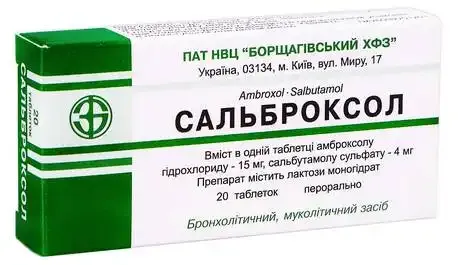
Table of Contents
INSTRUCTIONS FOR MEDICAL USE OF THE MEDICINAL PRODUCT SALBROXOL (SALBROXOL)
Composition:
Active substances: ambroxol hydrochloride, salbutamol sulfate;
1 tablet contains ambroxol hydrochloride (calculated as 100% substance) – 15 mg, salbutamol sulfate (calculated as 100% substance) – 4 mg;
Excipients: lactose monohydrate, crospovidone, calcium stearate, colloidal anhydrous silicon dioxide.
Pharmaceutical form. Tablets.
Main physicochemical properties: round-shaped white tablets with a flat surface, bevelled edges and a score line.
Pharmacotherapeutic group. Medicinal products affecting the respiratory system. Medicinal products used in obstructive airway diseases. Salbutamol, combinations. ATC code R03AK04.
Pharmacological properties.
Pharmacodynamics.
A combined medicinal product, whose therapeutic effect is determined by the pharmacological properties of the active components contained in its composition.
Ambroxol is a secretolytic and secretomotor agent of the benzylamine group.
It normalizes pathologically altered bronchial secretion by stimulating serous cells of the bronchial mucosal glands, thereby increasing the content of mucous secretion and changing the ratio between mucous and serous components of sputum. Ambroxol activates hydrolyzing enzymes and enhances the release of lysosomes from Clara cells, alters the structure of bronchial secretion by reducing and fragmenting mucopolysaccharide fibers, selectively inhibits sodium absorption by the respiratory epithelium, resulting in reduced sputum viscosity. It enhances ciliary movement of the bronchial ciliated epithelium, increasing mucociliary transport of sputum, thus facilitating its expectoration. In addition, ambroxol stimulates surfactant phospholipid synthesis by alveolar pneumocytes and exerts antioxidant effects. Ambroxol readily penetrates the placental barrier and improves surfactant synthesis during fetal intrauterine development.
Salbutamol is a selective β2-adrenergic receptor agonist. It produces a bronchodilating effect, prevents and relieves bronchospasm, reduces airway resistance, and increases lung vital capacity. It increases the stability of mast cells and basophils against degranulation upon allergen contact, thereby preventing the release of histamine, slow-reacting substance of anaphylaxis, and neutrophil chemotactic factor. Compared to other β2-adrenergic agonists, salbutamol has a less pronounced positive chronotropic and inotropic effect on the myocardium and practically does not alter arterial pressure or heart rate.
Pharmacokinetics.
After oral administration, ambroxol is rapidly and completely absorbed from the gastrointestinal tract.
The pharmacological effect begins within 30 minutes after administration; maximum plasma concentration is reached within 1–3 hours and persists for 6–12 hours. The bioavailability of ambroxol is 30%, which is associated with the "first-pass" effect in the liver. Binding to plasma proteins is approximately 85%.
Approximately 90% of ambroxol is excreted from the body as metabolites in urine, less than 10% is excreted unchanged.
Salbutamol is poorly bound to plasma proteins; its bioavailability after oral administration is 40–50%. The elimination half-life of salbutamol and its active metabolite is about 6 hours. Salbutamol metabolites are conjugated sulfates (42%), the main one being salbutamol ether sulfate, which retains β2-adrenergic stimulating activity. Conjugated sulfates are primarily excreted in urine and to a minor extent in bile.
Salbutamol and ambroxol penetrate the placental barrier and are excreted in breast milk.
Clinical characteristics.
Indications.
- Bronchial asthma;
- chronic obstructive bronchitis;
- pulmonary emphysema.
Contraindications.
- Hypersensitivity to the active substances or to any of the other components of the medicinal product;
- marked tachyarrhythmia;
- severe arterial hypertension;
- acute heart failure, heart defects, myocarditis;
- seizure disorders;
- peptic ulcer of the stomach and duodenum;
- glaucoma;
- phaeochromocytoma;
- thyrotoxicosis;
- concomitant use of β-adrenergic blockers, especially non-selective ones;
- threat of abortion.
Interaction with other medicinal products and other forms of interaction.
Interactions related to ambroxol
Antitussives (e.g., codeine): suppression of mucus expectoration and excessive accumulation of mucus due to reduced coughing. Therefore, such combination is possible only after careful evaluation by a physician of the benefit-risk ratio.
Antibiotics (amoxicillin, cefuroxime, erythromycin, doxycycline): improved penetration of antibiotics into lung tissue.
Theophylline: increased plasma concentration of theophylline.
Compatible with agents that inhibit labor activity (hexoprenaline, terbutaline).
Possible concomitant use with cardiac glycosides, diuretics, corticosteroids.
Interactions related to salbutamol
β-blockers (including propranolol): concomitant use with salbutamol is contraindicated, as it leads to mutual attenuation of effects and increases the risk of severe bronchospasm.
MAO inhibitors, ergotamine, tetracyclines, antidepressants, methylxanthines, furazolidone, procarbazine: concomitant use is not recommended due to possible potentiation of adrenergic effects.
Antidiabetic agents: possible reduction of hypoglycemic effect.
Halothane, methoxyflurane or enflurane: salbutamol therapy should be discontinued at least 6 hours before anesthesia with halogenated anesthetics.
Adrenergic drugs, including sympathomimetics: use with caution to avoid cardiac disturbances.
Diuretics, corticosteroids: risk of developing severe hypokalemia.
Cardiac glycosides (e.g., digoxin): increased risk of arrhythmias; possible hypokalemia due to salbutamol use; decreased serum concentration of digoxin.
Special precautions for use.
When using mucolytic agents, including ambroxol hydrochloride, there have been isolated reports of severe skin reactions, such as Stevens-Johnson syndrome and Lyell’s syndrome (toxic epidermal necrolysis). These reactions were mostly attributable to the severity of the underlying disease and/or concomitant therapy. Furthermore, during the initial stages of Stevens-Johnson syndrome or Lyell’s syndrome, patients may present with influenza-like nonspecific prodromal symptoms such as fever, body aches, rhinitis, cough, and sore throat. As a result of misinterpretation of these symptoms, patients might have received medications for symptomatic treatment of cough and cold. Therefore, if skin and/or mucosal lesions occur during treatment with ambroxol hydrochloride, the drug should be discontinued immediately and medical advice should be sought.
Dose escalation or reduction of dosing intervals should be performed under physician supervision. Shortening of the dosing interval is possible only in exceptional cases and must be strictly justified.
The drug should be used with caution in patients with renal and/or hepatic impairment (due to the potential for metabolite accumulation in the liver), risk factors for arterial hypertension, ischemic heart disease or significant risk factors for IHD, arrhythmias, tachycardia, or chronic heart failure.
There have been reports of isolated cases of myocardial ischemia associated with salbutamol use. Attention should be paid to symptoms such as dyspnea and chest pain, which may result from either cardiac or respiratory diseases.
Potentially serious hypokalemia may occur during therapy with β2-adrenoceptor agonists. Particular caution is recommended in patients with severe bronchial asthma, as this effect may be exacerbated by hypoxia and concomitant use of xanthine derivatives (e.g., theophylline), corticosteroids, diuretics, or cardiac glycosides. In such cases, serum potassium levels should be monitored.
Salbrosol should be used with caution in patients with diabetes mellitus, and careful monitoring of blood glucose levels is required. Like other β2-adrenoceptor agonists, salbutamol may increase blood glucose levels. In diabetic patients, this may lead to the development of ketoacidosis. Concomitant use of corticosteroids may exacerbate this condition.
It should be remembered that the drug contains an active substance that may result in a positive doping test.
The drug contains lactose; therefore, it should not be administered to patients with rare hereditary disorders of carbohydrate intolerance (congenital galactosemia, glucose-galactose malabsorption syndrome, lactase deficiency).
Use during pregnancy or breastfeeding.
The drug crosses the placental barrier. Use during the first trimester of pregnancy is contraindicated. Despite the lack of reliable data on negative effects on the fetus and infant, use during the second and third trimesters of pregnancy is possible only if the expected benefit to the mother outweighs the potential risk to the fetus/child.
The drug is excreted in breast milk; therefore, it is not recommended during breastfeeding. If use of the drug is necessary, breastfeeding should be discontinued.
Ability to affect reaction speed when driving or operating machinery.
During treatment, caution should be exercised when driving or operating machinery. Given that adverse reactions (e.g., dizziness, somnolence) may occur in sensitive patients during treatment, patients should refrain from driving vehicles and performing other tasks requiring concentration during treatment.
Dosage and Administration.
For oral use. For adults and children aged 14 years and older, the recommended dose is 1 tablet
3–4 times daily.
The medication should be taken between meals. The intervals between doses should be at least 6 hours.
If necessary, the dose for adults may be increased to 2 tablets 4 times daily. The duration of treatment is determined by the physician depending on the clinical presentation of the disease.
Children.
There is no experience with the use of the drug for treatment of children under 14 years of age.
Overdose.
Symptoms: tachycardia, arrhythmia, sleep disturbances, chest pain, palpitations, tremor of hands and the whole body, excitement, increased fatigue, gastrointestinal reactions including nausea and vomiting, hypersalivation.
Severe complications may occur: arterial hypertension or hypotension, collapse, angioneurotic edema.
Hypokalemia may develop in some cases; therefore, serum potassium levels should be monitored.
Treatment: symptomatic. Perform gastric lavage and administer activated charcoal and laxatives to reduce unwanted absorption of the drug.
If necessary, β1-adrenoblockers may be used, but administration of high doses should be avoided (in patients with increased sensitivity, this may cause bronchospasm). Monitoring of heart rate is required. There is no known antidote.
Adverse Reactions
Adverse reactions that may be associated with ambroxol
Gastrointestinal tract: dyspepsia, heartburn, nausea, vomiting, anorexia, abdominal pain, sensation of stomach fullness, diarrhea/constipation, hypersalivation, dry mouth, hypoaesthesia of the oral and/or pharyngeal mucosa.
Respiratory system: rhinorrhea, dryness of the mucous membranes of the upper respiratory tract, dyspnea (as a symptom of hypersensitivity reaction).
Urinary system: dysuria.
Nervous system: dysgeusia (disturbance of taste sensation).
Immune system, skin and subcutaneous tissue: hypersensitivity reactions, including pruritus, skin rash, urticaria, angioneurotic edema, anaphylactic reactions (including anaphylactic shock), drug fever, chills, and other allergic reactions. Erythema and severe skin reactions such as Stevens-Johnson syndrome and Lyell's syndrome may very rarely occur. In most cases, their occurrence could be explained by the severity of the underlying disease or concomitant use of other medicinal products.
Other: reactions involving mucous membranes.
Adverse reactions that may be associated with salbutamol
Immune system: anaphylactic reactions, including urticaria, angioneurotic edema, bronchospasm, arterial hypotension, collapse.
Skin and subcutaneous tissue: skin rashes, pruritus, sweating.
Gastrointestinal tract: nausea, vomiting.
Metabolic disorders: hypokalemia (the use of β2-adrenergic agonists may potentially lead to marked hypokalemia), increased blood glucose levels.
Nervous system: headache, dizziness, hyperactivity.
Cardiac disorders: tachycardia, palpitations, cardiac arrhythmias, including fibrillation, supraventricular tachycardia, and extrasystoles; myocardial ischemia.
Vascular disorders: peripheral vasodilation.
Musculoskeletal system: tension, skeletal muscle tremor (usually of the hands), muscle cramps.
Urinary system: urinary retention.
Shelf life. 3 years.
Storage conditions. Store in the original packaging at a temperature not exceeding 25 °C. Keep out of reach of children.
Packaging. 10 tablets per blister, 2 or 4 blisters per carton.
Prescription status. Prescription only.
Manufacturer.
Public Joint-Stock Company "Scientific and Production Center "Borshchagovskiy Chemical and Pharmaceutical Plant".
Limited Liability Company "Agrofarm".
Manufacturer's location and address of business activity.
17 Myru Street, Kyiv, 03134, Ukraine.
113-A Tsentralna Street, Irpin, Kyiv Region, 08200, Ukraine.