Sagilia
Ukraine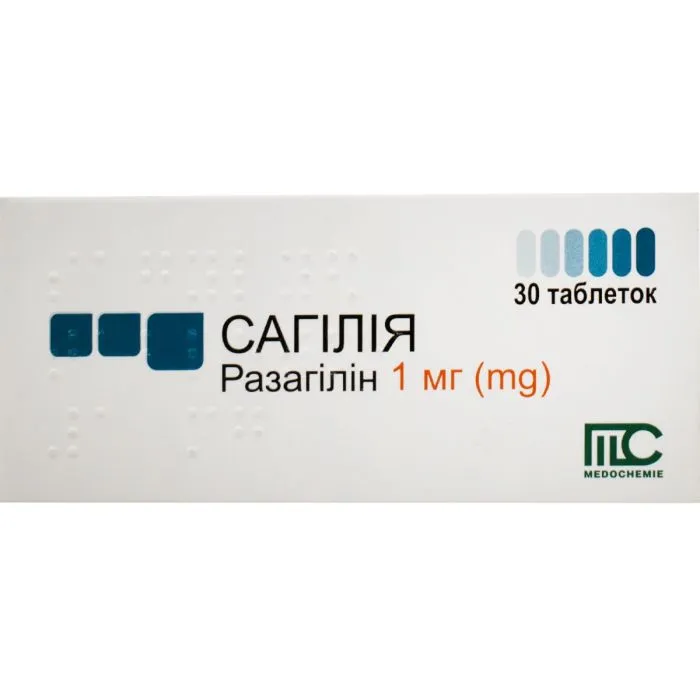
Table of Contents
INSTRUCTIONS FOR MEDICAL USE OF THE MEDICINAL PRODUCT SAGILIA® (SAGILIA)
Composition:
Active substance: rasagiline;
1 tablet contains rasagiline (as rasagiline tartrate) 1 mg;
Excipients: microcrystalline cellulose (PH 200), microcrystalline cellulose (PH 101), corn starch, pregelatinized starch, talc, sodium stearyl fumarate.
Pharmaceutical form. Tablets.
Main physicochemical characteristics: white or almost white, round, flat tablets with bevelled edges.
Pharmacotherapeutic group. Anti-parkinsonian agents. Monoamine oxidase type B inhibitors. ATC code N04BD02.
Pharmacological properties.
Pharmacodynamics. Rasagiline is a potent and irreversible selective inhibitor of monoamine oxidase B (MAO-B), which may lead to increased extracellular levels of dopamine in the brain. In models of dopaminergic motor dysfunction, elevated dopamine levels and enhanced dopaminergic activity have been demonstrated, which likely contribute to the therapeutic effects of rasagiline. 1-aminoindan is an active primary metabolite and is not an inhibitor of MAO-B.
Clinical studies. The efficacy of rasagiline was established in three studies: as monotherapy in Study I and as adjunctive therapy to levodopa in Studies II and III.
Monotherapy. In Study I, 404 patients were randomly assigned to treatment groups: placebo group (138 patients), rasagiline 1 mg once daily (134 patients), or rasagiline 2 mg once daily (132 patients) for 26 weeks without an active comparator. In this study, the primary efficacy endpoint was the change from baseline in the total score of the Unified Parkinson's Disease Rating Scale (UPDRS, parts I–III). The difference between mean changes from baseline to week 26/discontinuation (LOCF – last observation carried forward method) was statistically significant (UPDRS, parts I–III: for 1 mg rasagiline vs. placebo –4.2, 95 % confidence interval (CI) [-5.7; -2.7]; p < 0.0001; for 2 mg rasagiline vs. placebo –3.6, 95 % CI [-5.0; -2.1]; p < 0.0001. UPDRS motor score, part II: for 1 mg rasagiline vs. placebo –2.7, 95 % CI [-3.87; -1.55], p < 0.0001; for 2 mg rasagiline vs. placebo –1.68, 95 % CI [-2.85; -0.51], p = 0.0050). The result was evident, although its magnitude was modest in this group of patients with mild disease. A significant and positive effect on quality of life was observed (as measured by the PD-QUALIF scale).
Adjunctive therapy. In Study II, patients were randomly assigned to receive placebo (229 patients), rasagiline 1 mg once daily (231 patients), or 200 mg entacapone – a catechol-O-methyltransferase (COMT) inhibitor – in combination with standard levodopa (LD)/decarboxylase inhibitor doses (227 patients) for 18 weeks. In Study III, patients were randomly assigned to receive placebo (159 patients), rasagiline 0.5 mg once daily (164 patients), or rasagiline 1 mg once daily (149 patients) for 26 weeks. In both studies, the primary efficacy endpoint was the change from baseline in the average number of hours spent in the "off" state during the day (according to 24-hour home diaries recorded for 3 days prior to each assessment visit) to the end of treatment. In Study II, the mean difference in hours spent in the "off" state compared to placebo was -0.78 h, 95 % CI [-1.18; -0.39], p = 0.0001. The mean overall daily reduction in "off" time was similar in the entacapone group (-0.80 h, 95 % CI [-1.20; -0.41], p < 0.0001) to that observed in the group receiving 1 mg rasagiline. In Study III, the mean difference compared to placebo was -0.94 h, 95 % CI [-1.36; -0.51], p < 0.0001. A statistically significant improvement compared to placebo was also observed in the group receiving 0.5 mg rasagiline, although the magnitude of improvement was lower. The robustness of results for the primary efficacy endpoint was confirmed across multiple additional statistical models and demonstrated in three patient populations (intent-to-treat, per-protocol, and completers). Secondary efficacy endpoints included overall assessment of improvement by the investigator, activities of daily living (ADL) scores during "off" periods, and UPDRS motor scores during "on" periods. Rasagiline demonstrated statistically significant superiority compared to placebo.
Pharmacokinetics.
Absorption. Rasagiline is rapidly absorbed, with peak plasma concentration (Cmax) reached approximately 0.5 hours after administration. Absolute bioavailability after a single oral dose of rasagiline is 36%. Food does not affect the time to reach peak plasma concentration (Tmax), but consumption of a high-fat meal reduces Cmax and area under the concentration-time curve (AUC) by 60% and 20%, respectively. Rasagiline can be taken independently of meals.
Distribution. The mean volume of distribution after a single intravenous dose of rasagiline is 243 L. Plasma protein binding after oral administration of a single dose of 14C-labeled rasagiline ranges from 60 to 70%.
Metabolism. Rasagiline is almost completely metabolized in the liver. Metabolism occurs via two main pathways: N-dealkylation and/or hydroxylation, resulting in the formation of metabolites: 1-aminoindan, 3-hydroxy-N-propargyl-1-aminoindan, and 3-hydroxy-1-aminoindan. In vitro studies have shown that both metabolic pathways of rasagiline are mediated by the CYP1A2 isoenzyme of the cytochrome P450 system. Elimination of rasagiline occurs as glucuronide conjugates of the drug and its metabolites.
Excretion. After oral administration of 14C-labeled rasagiline, excretion occurs primarily via urine (62.6%) and to a lesser extent in feces (21.8%). Complete elimination of 84.4% of the dose takes 38 days. Less than 1% of the drug is excreted unchanged in urine.
Linearity/Non-linearity. Rasagiline exhibits linear pharmacokinetics at doses of 0.5–2 mg. Elimination half-life ranges from 0.6 to 2 hours.
Pharmacokinetics in specific patient populations.
Patients with hepatic impairment. In patients with mild hepatic impairment, Cmax and AUC values increased by 80% and 38%, respectively. In patients with moderate hepatic impairment, Cmax and AUC values increased by 568% and 83%, respectively.
Patients with renal impairment. Pharmacokinetic parameters of rasagiline are practically unchanged in patients with mild to moderate renal impairment.
Clinical characteristics.
Indications.
Monotherapy (without levodopa) in idiopathic Parkinson's disease or as adjunctive therapy (with levodopa) in end-of-dose fluctuations.
Contraindications.
Hypersensitivity to the active substance or to any other component of the medicinal product. Concomitant therapy with other MAO inhibitors (including medicinal products and herbal preparations, e.g. those containing Hypericum perforatum [St. John's wort]) or with pethidine (a washout period of at least 14 days between discontinuation of rasagiline and initiation of therapy with these agents is required). Severe hepatic impairment.
Interaction with other medicinal products and other forms of interaction.
MAO inhibitors. Concomitant use of rasagiline with other MAO inhibitors (including medicinal products and herbal preparations containing Hypericum perforatum) is contraindicated due to the risk of non-selective inhibition, which may lead to hypertensive crisis.
Pethidine. Serious adverse reactions have been reported with concomitant administration of pethidine and MAO inhibitors, including other selective MAO-B inhibitors. Concomitant use of rasagiline and pethidine is contraindicated.
Sympathomimetics. Interactions between MAO inhibitors and sympathomimetics have been reported when administered concomitantly. Due to the MAO-inhibiting activity of rasagiline, its concomitant use with sympathomimetics such as oral or nasal vasoconstrictors, or cold remedies containing ephedrine or pseudoephedrine, is not recommended.
Dextromethorphan. Interactions between dextromethorphan and non-selective MAO inhibitors have been reported upon concomitant use. Therefore, since rasagiline is a potent MAO inhibitor, its concomitant use with dextromethorphan is not recommended.
SSRIs/SNRIs, tricyclic/tetracyclic antidepressants. Concomitant use of rasagiline with fluoxetine and fluvoxamine should be avoided (see section "Special precautions for use"). Serious adverse reactions have been reported with concomitant use of rasagiline with selective serotonin reuptake inhibitors (SSRIs), serotonin-norepinephrine reuptake inhibitors (SNRIs), tricyclic/tetracyclic antidepressants, and MAO inhibitors (see section "Adverse reactions"). Therefore, since rasagiline is a potent MAO inhibitor, caution should be exercised when using rasagiline with antidepressants.
Medicinal products affecting CYP1A2 activity. In vitro metabolism studies have shown that the CYP1A2 isoenzyme of cytochrome P450 is the main enzyme responsible for rasagiline metabolism.
CYP1A2 inhibitors. Concomitant administration of rasagiline and ciprofloxacin (a CYP1A2 isoenzyme inhibitor) increases rasagiline AUC by 83%. Concomitant administration of rasagiline and theophylline (a CYP1A2 substrate) does not affect rasagiline pharmacokinetics. Thus, CYP1A2 isoenzyme inhibitors may alter rasagiline plasma levels and should be used with caution.
CYP1A2 inducers. There is a risk that CYP1A2 induction in smokers may reduce rasagiline plasma concentrations.
Other cytochrome P450 isoenzymes. In vitro studies have shown that rasagiline at a concentration of 1 µg/mL (equivalent to a concentration 160 times higher than the mean Cmax [5.9–8.5 ng/mL] after multiple 1 mg doses of rasagiline in patients with Parkinson's disease) does not inhibit the cytochrome P450 isoenzymes CYP1A2, CYP2A6, CYP2C9, CYP2C19, CYP2D6, CYP2E1, CYP3A4, and CYP4A. This suggests that rasagiline at therapeutic concentrations is unlikely to affect the metabolism of these isoenzymes or produce clinically significant effects.
Levodopa and other antiparkinsonian agents. Levodopa, when co-administered with rasagiline in patients with Parkinson's disease, did not show any clinically significant effect on rasagiline clearance. Concomitant oral administration of rasagiline and entacapone increases rasagiline clearance by 28%.
Tyramine/rasagiline interactions. Five clinical studies involving volunteers and patients with Parkinson's disease, and blood pressure monitoring after meals (464 patients received 0.5–1 mg/day rasagiline or placebo as add-on therapy to levodopa for 6 months without tyramine dietary restrictions), demonstrated no interaction between rasagiline and tyramine; therefore, rasagiline can be used without dietary restrictions on tyramine intake.
Special precautions for use.
Concomitant use of rasagiline with other medicinal products. Concomitant use of rasagiline with fluoxetine or fluvoxamine should be avoided (see section "Interaction with other medicinal products and other forms of interaction"). The interval between discontinuation of fluoxetine and initiation of rasagiline therapy should be at least 5 weeks. The interval between discontinuation of rasagiline and initiation of fluoxetine or fluvoxamine therapy should be at least 14 days. Concomitant use of rasagiline with dextromethorphan or sympathomimetics, such as those contained in nasal or oral decongestants or cold remedies containing ephedrine or pseudoephedrine, is not recommended (see section "Interaction with other medicinal products and other forms of interaction").
Concomitant use of rasagiline and levodopa. Rasagiline may enhance the effects of levodopa, potentially leading to an increased incidence of adverse reactions associated with levodopa and worsening of pre-existing dyskinesia. The intensity of these adverse reactions may be reduced by lowering the dose of levodopa. Cases of orthostatic hypotension have been reported during concomitant use of rasagiline and levodopa. Patients with Parkinson's disease are particularly susceptible to adverse reactions in the form of arterial hypotension due to pre-existing gait disturbances.
Dopaminergic effects.
Excessive daytime sleepiness (EDS) and sudden onset of sleep (SOS) episodes. Rasagiline may cause daytime somnolence and, occasionally, particularly when used concomitantly with other dopaminergic agents, may lead to falling asleep during normal daily activities. Therefore, patients should be advised to exercise caution when driving or operating machinery during treatment with rasagiline. Patients experiencing somnolence and/or sudden onset of sleep episodes should refrain from driving and operating machinery (see section "Ability to affect reaction speed when driving or operating machinery").
Impulse control disorders. Impulse control disorders may occur in patients receiving dopamine agonists and/or undergoing dopaminergic therapy. Post-marketing reports have described cases of impulse control disorders associated with rasagiline. Patients should be regularly monitored for signs of impulse control disorders. Patients and caregivers should be informed about behavioral changes indicating impulse control disorders observed during rasagiline treatment, including compulsions, obsessive thoughts, pathological gambling, increased libido, hypersexuality, impulsive behavior, and pathological spending or shopping behavior.
Melanoma. Data from a retrospective cohort study suggest a possible increased risk of melanoma development with rasagiline use, particularly with long-term treatment and/or high cumulative doses of rasagiline. Any suspicious skin lesions should be evaluated by a specialist. Patients should be advised to consult a dermatologist if they notice any new skin lesions or changes in existing ones.
Hepatic impairment. Rasagiline therapy should be initiated with caution in patients with mild hepatic impairment. Rasagiline should be avoided in patients with moderate hepatic impairment. If hepatic impairment progresses from mild to moderate, rasagiline treatment should be discontinued.
Use during pregnancy or breastfeeding.
Pregnancy. There are no clinical data on the use of rasagiline in pregnant women. Animal studies have not shown direct or indirect harmful effects on reproductive toxicity. As a precautionary measure, it is advisable to avoid using rasagiline during pregnancy.
Breastfeeding period. Preclinical data indicate that rasagiline inhibits prolactin secretion and consequently suppresses lactation. It is unknown whether rasagiline passes into breast milk. Rasagiline should be used with caution during breastfeeding.
Fertility. There are no data on the effect of rasagiline on human fertility. Preclinical data suggest that rasagiline does not affect fertility.
Ability to affect reaction speed when driving or operating machinery.
Rasagiline may impair the ability to drive or operate machinery in patients who experience somnolence or sudden episodes of sleep. Patients should be cautious when driving or operating complex machinery until they are certain that rasagiline does not adversely affect them.
Patients treated with rasagiline who develop somnolence and/or sudden sleep episodes should be advised to refrain from driving or engaging in activities where reduced alertness could place themselves or others at risk of serious injury or death (e.g., operating machinery) until they have gained sufficient experience with rasagiline and other dopaminergic agents to assess whether they adversely affect their mental and/or motor performance. If increased somnolence or new sudden sleep episodes occur during routine activities (e.g., watching television, riding in a car as a passenger) at any time during treatment, patients should not drive or participate in potentially hazardous activities. Patients should not drive, operate machinery, or perform work at heights during treatment if they have previously experienced somnolence and/or sudden sleep attacks without warning prior to starting rasagiline. Patients should be warned about possible additive effects of sedatives, alcohol, or other central nervous system depressants (e.g., benzodiazepines, antipsychotics, antidepressants) when used concomitantly with rasagiline or when taking concomitant medications that increase plasma levels of rasagiline (e.g., ciprofloxacin) (see section "Special precautions for use").
Dosage and Administration.
Dosage regimen. Rasagiline is administered orally at a dose of 1 mg once daily. The drug may be used independently of food intake.
Elderly patients. Dose adjustment is not required for elderly patients.
Patients with hepatic impairment. Rasagiline should be avoided in patients with moderate hepatic impairment, and therapy should be initiated with caution in patients with mild hepatic impairment. If hepatic impairment progresses from mild to moderate severity, rasagiline treatment should be discontinued.
Patients with renal impairment. Dose adjustment is not required for patients with renal impairment.
Children.
Due to insufficient data on the use of the drug in children, Cagilija**®** is not recommended for use in this patient population.
Overdose.
Symptoms. Symptoms of Cagilija**®** overdose at doses ranging from 3 mg to 100 mg include hypomania, hypertensive crisis, and serotonin syndrome. Overdose may be associated with significant inhibition of MAO-A and MAO-B. Studies have been conducted in healthy volunteers receiving single doses up to 20 mg per day, and a 10-day study in healthy volunteers receiving 10 mg once daily. Adverse reactions of mild or moderate severity were reported, including reactions not typically associated with rasagiline treatment. In a high-dose rasagiline study in patients receiving concomitant levodopa therapy and rasagiline 10 mg/day, cardiovascular adverse reactions (including arterial hypertension and postural hypotension) were reported, which resolved after discontinuation of treatment. These symptoms are similar to those observed with overdose of non-selective MAO inhibitors.
Treatment. Specific antidotes are not known. In case of overdose, patients should be closely monitored, and treatment should be symptomatic and supportive.
Adverse Reactions.
Summary of safety profile. It is known that in clinical trials in patients with Parkinson's disease, the following adverse reactions were most frequently reported: headache, depression, dizziness, and influenza-like symptoms (influenza and rhinitis) during monotherapy; dyskinesia, orthostatic hypotension, falls, abdominal pain, nausea, vomiting, and dry mouth when used as an adjunct to levodopa therapy; musculoskeletal pain such as back and neck pain, arthralgia in both treatment regimens. These adverse reactions were not associated with an increased rate of drug discontinuation. The following classification was used to assess the frequency of adverse reactions: very common (≥ 1/10), common (≥ 1/100 to < 1/10), uncommon (≥ 1/1000 to < 1/100), rare (≥ 1/10000 to < 1/1000), very rare (< 1/10000), frequency not known (cannot be estimated from available data).
Monotherapy. The adverse reactions listed below were reported at a higher frequency in placebo-controlled studies in patients receiving rasagiline 1 mg once daily.
Infections and infestations. Common: influenza.
Benign, malignant and unspecified neoplasms (including cysts and polyps). Common: skin carcinoma.
Blood and lymphatic system disorders. Common: leukopenia.
Immune system disorders. Common: allergy.
Metabolism and nutrition disorders. Uncommon: decreased appetite.
Psychiatric disorders. Common: depression, hallucinations*. Frequency not known: impulse control disorders*.
Nervous system disorders. Very common: headache. Uncommon: cerebrovascular disorders. Frequency not known: serotonin syndrome*, excessive daytime sleepiness and sudden onset of sleep episodes*.
Eye disorders. Common: conjunctivitis.
Ear and labyrinth disorders. Common: dizziness.
Cardiac disorders. Common: angina pectoris. Uncommon: myocardial infarction.
Vascular disorders. Frequency not known: arterial hypertension*.
Respiratory, thoracic and mediastinal disorders. Common: rhinitis.
Gastrointestinal disorders. Common: flatulence.
Skin and subcutaneous tissue disorders. Common: dermatitis. Uncommon: vesiculobullous rash.
Musculoskeletal and connective tissue disorders. Common: bone and muscle pain, neck pain, arthritis.
Renal and urinary disorders. Common: urinary urgency.
General disorders and administration site conditions. Common: pyrexia, fatigue.
* See section on description of selected adverse reactions.
Adjunctive therapy.
The adverse reactions listed below were reported at a higher frequency in placebo-controlled studies in patients receiving 1 mg/day rasagiline.
Benign, malignant and unspecified neoplasms (including cysts and polyps). Uncommon: skin melanoma*.
Metabolism and nutrition disorders. Common: decreased appetite.
Psychiatric disorders. Common: hallucinations*, pathological dreams. Uncommon: confusion. Frequency not known: impulse control disorders*.
Nervous system disorders. Very common: dyskinesia. Common: dystonia, carpal tunnel syndrome, impaired balance. Uncommon: acute cerebrovascular accident. Frequency not known: serotonin syndrome, excessive sleepiness and sudden onset of sleep episodes*.
Cardiac disorders. Uncommon: angina pectoris.
Vascular disorders. Common: orthostatic hypotension*. Frequency not known: arterial hypertension*.
Gastrointestinal disorders. Common: abdominal pain, constipation, nausea and vomiting, dry mouth.
Skin and subcutaneous tissue disorders. Common: rash.
Musculoskeletal and connective tissue disorders. Common: arthralgia, neck pain.
Investigations. Common: weight decreased.
Injury, poisoning and procedural complications. Common: falls.
* See section on description of selected adverse reactions.
Description of selected adverse reactions
Orthostatic hypotension. In double-blind placebo-controlled studies, severe orthostatic hypotension was reported in one patient (0.3%) in the rasagiline group (adjunctive studies), and in none in the placebo group. Clinical trial data also indicate that orthostatic hypotension occurs most frequently during the first two months of rasagiline treatment and tends to decrease over time.
Arterial hypertension. Rasagiline is a selective MAO-B inhibitor and is not associated with increased sensitivity to tyramine at the recommended dose (1 mg daily). In double-blind placebo-controlled studies (monotherapy and adjunctive therapy), no cases of severe arterial hypertension were reported in any patient receiving rasagiline. During the post-marketing period, cases of elevated blood pressure, including isolated cases of hypertensive crisis associated with consumption of tyramine-rich foods, have been reported in patients taking rasagiline. During the post-marketing period, one case of elevated blood pressure was reported in a patient taking rasagiline concomitantly with the ophthalmic vasoconstrictor tetrahydrozoline hydrochloride.
Impulse control disorders. One case of hypersexuality was reported in a placebo-controlled monotherapy study. During post-marketing surveillance, at unknown frequency, the following have been reported: compulsions, compulsive urges to shop, dermatillomania, dopamine dysregulation syndrome, impulse control disorders, impulsive behavior, kleptomania, theft, intrusive thoughts, obsessive-compulsive disorder, stereotypy, gambling, pathological gambling, increased libido, hypersexuality, psychosexual disorders, sexually inappropriate behavior. Half of the reported cases of impulse control disorders were considered serious. Only isolated cases reported did not resolve at the time of reporting.
Excessive daytime sleepiness and sudden onset of sleep episodes. Excessive daytime sleepiness (hypersomnia, lethargy, sedation, sleep attacks, somnolence, and sudden sleep episodes) may occur in patients receiving dopamine agonists and/or other dopaminergic therapies. Similar cases of excessive daytime sleepiness have been reported during the post-marketing period with rasagiline. Cases of falling asleep during normal daily activities have been reported in patients receiving rasagiline and other dopaminergic agents. Although many of these patients reported somnolence while taking rasagiline with other dopaminergic agents, some reported no prior warning signs such as excessive drowsiness. Some of these events occurred more than one year after initiation of treatment.
Hallucinations. Parkinson's disease is associated with the occurrence of hallucinations and confusion. These symptoms were observed during post-marketing studies in patients with Parkinson's disease receiving rasagiline.
Serotonin syndrome. Fluoxetine or fluvoxamine were not co-administered with rasagiline in clinical trials; however, other antidepressants were used concomitantly with rasagiline: amitriptyline ≤ 50 mg daily, trazodone ≤ 100 mg daily, citalopram ≤ 20 mg daily, sertraline ≤ 100 mg daily, and paroxetine ≤ 30 mg daily (see section "Interaction with other medicinal products and other forms of interaction"). During post-marketing studies, cases of serotonin syndrome characterized by agitation, confusion, muscle rigidity, hyperthermia, and myoclonic jerks have been reported in patients receiving antidepressants, meperidine, tramadol, methadone, or propoxyphene concomitantly with rasagiline.
Malignant melanoma. The incidence of melanoma in placebo-controlled clinical trials was 2/380 (0.5%) in patients receiving rasagiline 1 mg in combination with levodopa therapy, compared to 1/388 (0.3%) in the placebo group. Additional cases of malignant melanoma have been reported during the post-marketing period. In all reports, these cases were considered serious.
Reporting suspected adverse reactions. Reporting of suspected adverse reactions after authorization of the medicinal product is important. It allows continued monitoring of the benefit-risk balance of the medicinal product. Healthcare professionals, pharmacists, patients, and their legal representatives should report all suspected adverse reactions and lack of efficacy via the Automated Pharmacovigilance Information System at the following link: https://aisf.dec.gov.ua.
Shelf life. 3 years.
Storage conditions. Store in the original packaging, out of the reach of children.
Packaging. 10 tablets in a blister; 3 blisters in a cardboard box.
Prescription status. Prescription only.
Manufacturer. Medocem Limited / Medochemie Limited.
Manufacturer's address and location of business operations.
Agios Athanassios Industrial Area, Michail Irakleous 2, Agios Athanassios, Limassol, 4101, Cyprus / Agios Athanassios Industrial Area, Michail Irakleous 2, Agios Athanassios, Limassol, 4101, Cyprus.