Sabril
Ukraine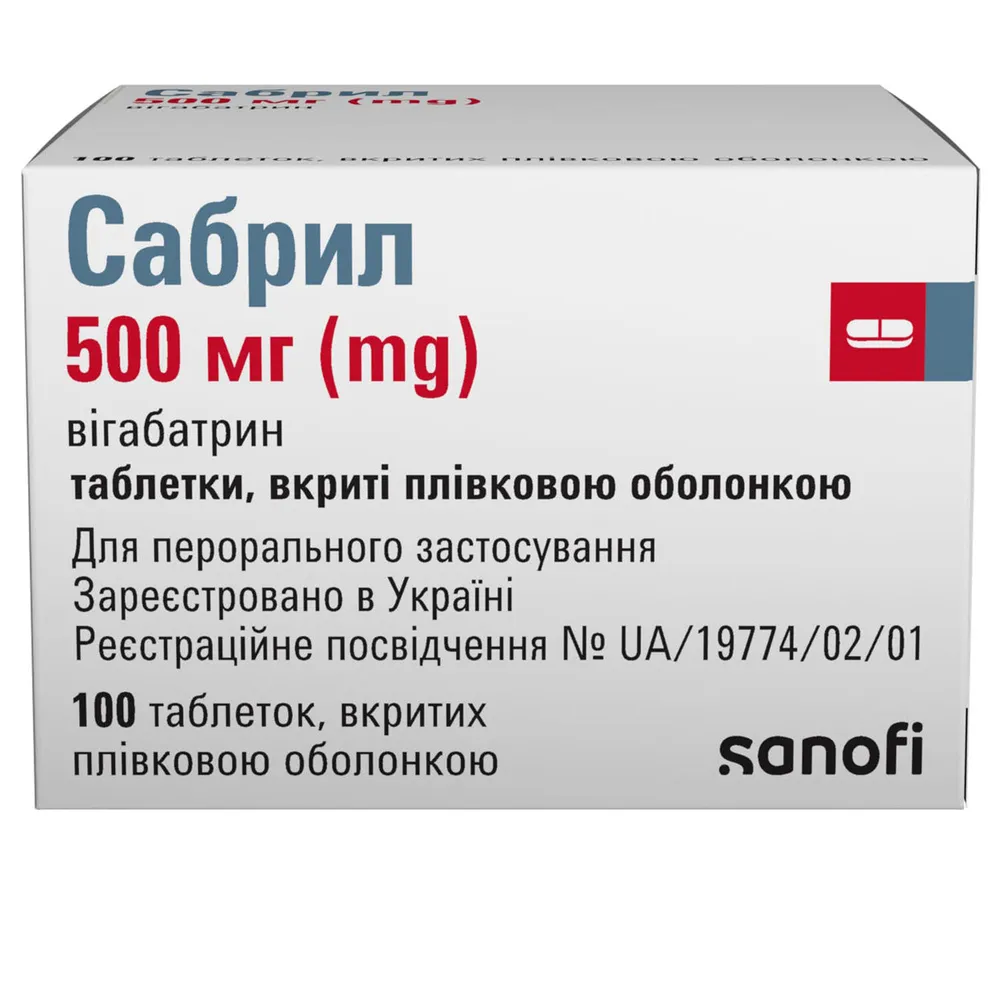
Table of Contents
INSTRUCTIONS FOR MEDICAL USE OF THE MEDICINAL PRODUCT SABRIL SABRIL
Composition:
Active ingredient: vigabatrin;
1 tablet contains vigabatrin 500 mg;
Excipients: tablet core: povidone K30 (E1201), microcrystalline cellulose (E460), sodium carboxymethyl starch (type A), magnesium stearate; film coating: Opadry White OY-S-7298 (hypromellose 15 mPas (E464), titanium dioxide (E171), polyethylene glycol 8000).
Pharmaceutical form. Film-coated tablets.
Main physicochemical properties: white or almost white oval biconvex film-coated tablets with a breakline on one side and engraved “SABRIL” or “SABRILEX” on the other.
The breakline is intended only to facilitate tablet splitting for ease of swallowing, and not for dividing into equal doses.
Pharmacotherapeutic group. Antiepileptic agents.
ATC code N03AG04.
Pharmacological properties.
Pharmacodynamics.
Mechanism of action
Vigabatrin is an antiepileptic medicinal product with a clearly defined mechanism of action. Treatment with vigabatrin leads to an increase in the concentration of GABA (gamma-aminobutyric acid), an important inhibitory neurotransmitter in the brain. This is due to the fact that vigabatrin was specifically designed as a selective irreversible inhibitor of GABA transaminase, the enzyme responsible for the breakdown of GABA.
Clinical efficacy and safety
Controlled and long-term clinical studies have shown that vigabatrin is an effective anticonvulsant agent when used as adjunctive therapy in patients with epilepsy that is not adequately controlled with standard therapy. This efficacy has been particularly noted in patients with partial seizures.
The epidemiology of visual field defects (VFD) in patients with refractory partial epilepsy was studied in a phase IV, multicenter, open-label, parallel-group, observational comparative study involving 734 patients aged at least 8 years, with refractory partial epilepsy for at least one year.
Patients were divided into three treatment groups: patients currently treated with vigabatrin (Group I), patients previously treated with vigabatrin (Group II), and patients who had never received vigabatrin (Group III). The table below presents the main results at baseline, as well as the first and last follow-up assessments in the evaluated population (n = 524):
| Children (8 to 12 years) |
Adults (> 12 years) |
|||||
| Group I1 |
Group II2 |
Group III |
Group I3 |
Group II4 |
Group III |
|
| N = 38 |
N = 47 |
N = 41 |
N = 150 |
N = 151 |
N = 97 |
|
| Visual field defects of unknown etiology: |
||||||
|
1 (4.4 %) |
3 (8.8 %) |
2 (7.1 %) |
31 (34.1 %) |
20 (19.2 %) |
1 (1.4 %) |
|
4 (10.5 %) |
6 (12.8 %) |
2 (4.9 %) |
59 (39.3 %) |
39 (25.8 %) |
4 (4.1 %) |
|
10 (26.3 %) |
7 (14.9 %) |
3 (7.3 %) |
70 (46.7 %) |
47 (31.1 %) |
5 (5.2 %) |
1 Mean duration of treatment: 44.4 months, mean daily dose 1.48 g.
2 Mean duration of treatment: 20.6 months, mean daily dose 1.39 g.
3 Mean duration of treatment: 48.8 months, mean daily dose 2.10 g.
4 Mean duration of treatment: 23.0 months, mean daily dose 2.18 g.
Pharmacokinetics.
Absorption
Vigabatrin is a water-soluble drug that is rapidly and completely absorbed from the gastrointestinal tract. Food intake does not affect the extent of vigabatrin absorption. Time to reach maximum plasma concentration (tmax) is approximately 1 hour.
Distribution
Vigabatrin is widely distributed, with a theoretical volume of distribution slightly greater than the total body water volume. Plasma and cerebrospinal fluid concentrations are linearly related to dose within the recommended dosage range.
Biotransformation
Vigabatrin is not significantly metabolized. No metabolites have been detected in plasma.
Elimination
Vigabatrin is eliminated via renal excretion, with a terminal half-life of 5–8 hours. Oral clearance of vigabatrin (CI/F) is approximately 7 L/h (i.e., 0.1 L/h/kg). Approximately 70% of a single oral dose was recovered unchanged in urine within the first 24 hours after administration.
Pharmacokinetic/pharmacodynamic relationships
There is no direct correlation between plasma concentration and efficacy. Duration of drug action depends on the rate of GABA-transaminase resynthesis.
Children
The pharmacokinetic properties of vigabatrin were studied in groups of six neonates (aged 15–26 days), six infants (aged 5–22 months), and six children (aged 4.6–14.2 years) with refractory epilepsy. After administration of a single oral dose of 37–50 mg/kg of vigabatrin solution, tmax was approximately 2.5 hours in neonates, 5.7 hours in infants, and 5.5 hours in children. The mean Cl/F value of the active S-enantiomer of vigabatrin in infants and children was 0.591 L/h/kg and 0.446 L/h/kg, respectively.
Non-clinical safety data.
Safety studies conducted in rats, mice, dogs, and monkeys showed that vigabatrin has no significant negative impact on the liver, kidneys, lungs, heart, or gastrointestinal tract.
Microvacuolation of white matter in the brain was observed in rats, mice, and dogs at doses ranging from 30 to 50 mg/kg/day. In monkeys, these pathological changes were minimal or questionable. This phenomenon is caused by detachment of the outer lamellar sheath of myelinated fibers, characteristic of intramyelinic edema. In both rats and dogs, intramyelinic edema was reversible after discontinuation of vigabatrin treatment, and histological regression was even observed during continued treatment.
However, minor residual changes such as axonal swelling (eosinophilic spheroids) or peroxisomal mineralization were observed in rodents. Electrophysiological studies in dogs indicate that intramyelinic edema is associated with increased latency of evoked sensory potentials, which is reversible upon discontinuation of treatment.
Vigabatrin-related retinotoxicity was observed only in albino rats, but not in pigmented rats, dogs, or monkeys. Retinal changes in albino rats were characterized by focal or multifocal lesions of the outer nuclear layer with displacement of nuclei in the cone and rod cell zone. Other retinal layers were unaffected. These lesions were observed in 80–100% of animals receiving an oral dose of 300 mg/kg/day.
The histological appearance of these lesions has been shown to be comparable to those observed in albino rats after excessive light exposure. However, retinal changes may also result from the direct effect of the drug.
Animal studies have shown that vigabatrin does not adversely affect fertility or offspring development. In rats receiving doses up to 150 mg/kg (three times the human dose) and in rabbits receiving doses up to 100 mg/kg, no teratogenic effects were observed. However, in rabbits, a slight increase in the incidence of cleft palate was observed at doses of 150–200 mg/kg.
Studies with vigabatrin revealed no evidence of mutagenic or carcinogenic potential.
Clinical characteristics.
Indications.
Use in combination with other antiepileptic medicinal products for the treatment of patients with refractory partial epilepsy, with or without secondary generalization, when other appropriate combinations of medicinal products are ineffective or poorly tolerated.
Use as monotherapy for infantile spasms (West syndrome).
Contraindications.
Hypersensitivity to vigabatrin or to any of the excipients listed in the section "Composition".
Interaction with other medicinal products and other forms of interaction.
Since vigabatrin is not metabolized, does not bind to proteins, and is not a cytochrome P450 inducer, interaction with other medicinal products is unlikely. However, during controlled clinical trials, a gradual reduction in plasma phenytoin concentration by 16–33% was observed. The exact nature of this interaction is currently unclear, but in most cases, its therapeutic significance is unlikely.
Plasma concentrations of carbamazepine, phenobarbital, and sodium valproate were also monitored during controlled clinical trials, and no clinically significant interactions were identified.
Vigabatrin may cause a reduction in measured alanine aminotransferase (ALT) activity in plasma and, to a lesser extent, aspartate aminotransferase (AST). The reported magnitude of ALT suppression ranged from 30% to 100%. Therefore, such liver parameters in patients taking vigabatrin may be falsely low (see section "Side effects").
Vigabatrin may increase the amount of amino acids in urine, which may lead to false-positive results in tests for certain rare genetic metabolic disorders (e.g., alpha-aminoadipic aciduria).
Concomitant use of vigabatrin and clonazepam may enhance the sedative effect (see section "Special precautions").
Special precautions for use.
Except for the treatment of infantile spasms, Sabril should not be used as monotherapy.
| Visual field defects have been reported frequently in patients receiving vigabatrin (approximately 1 in 3 patients). The incidence of visual field defects determined in an open clinical trial is presented in section "Pharmacodynamics". These defects usually develop after several months or even years of treatment with vigabatrin. The degree of visual field constriction may be marked. Most patients with perimetry-confirmed defects have not experienced any symptoms. Therefore, this adverse effect can be reliably detected only by perimetry, which generally can be systematically performed only in patients aged 9 years and older. Electroretinography may also be an effective method but should be used only in adults unable to cooperate during perimetry or in very young children (see "Visual field defects" below). Available data indicate that visual field defects are irreversible even after discontinuation of vigabatrin therapy. Worsening of visual field defects after stopping treatment cannot be excluded. Therefore, vigabatrin should be used only after careful assessment of benefits and risks compared to available alternative treatments. Vigabatrin is not recommended for patients with pre-existing clinically significant visual field defects. Patients should be closely monitored at the beginning of vigabatrin therapy, and visual disturbances and visual acuity should be assessed at regular intervals thereafter. Visual field testing and visual acuity assessment should be performed every 6 months throughout the duration of treatment (see "Visual field defects" and "Visual acuity" below). |
Visual Field Defects (VFD)
Available data indicate that visual field defects are typically manifested as bilateral concentric constriction of the visual field, which is usually more pronounced on the nasal side than on the temporal side. A ring-shaped defect is often observed in the central visual field (within 30 degrees of eccentricity). VFDs in patients receiving vigabatrin have varied in severity — from mild to severe. Severe cases may be characterized by tunnel vision. Cases of blindness have also been reported in severe cases.
Most patients with abnormalities confirmed by perimetry previously had not noticed any symptoms, including cases where significant abnormalities were detected by perimetry. Available data suggest that VFDs are irreversible, including after discontinuation of vigabatrin therapy. Worsening of visual field defects after stopping treatment cannot be ruled out.
Summary data from examinations indicate that one-third of patients receiving vigabatrin suffer from VFDs. Men are more prone to developing VFDs than women. The incidence of VFDs, determined in an open clinical study, is described in the section "Pharmacodynamics". This study demonstrated a possible association between the risk of VFDs and vigabatrin exposure depending on daily dose (from 1 g to over 3 g) and duration of treatment (maximum within the first 3 years).
Before initiating vigabatrin therapy, all patients should consult an ophthalmologist for visual field examination.
Prior to starting treatment, an appropriate visual field test (perimetry) should be performed using a standard method of static (Humphrey or Octopus) or kinetic (Goldmann standard) perimetry, followed by testing every six months throughout the entire treatment period. Static perimetry is the method of choice for detecting visual field abnormalities associated with vigabatrin use.
Electroretinography may be a useful method but should only be performed in adults who are unable to cooperate during perimetry. Available data show that the first oscillatory potential and the 30 Hz flicker response observed on electroretinogram correlate with VFDs caused by vigabatrin. These responses are delayed and have lower amplitude than normal. Such changes have not been observed in patients receiving vigabatrin who do not have VFDs.
The patient and/or caregiver should be fully informed about the frequency and consequences of developing VFDs during vigabatrin therapy. Patients should be instructed to report any new visual problems or symptoms that may be related to visual field constriction. In the event of visual symptoms, the patient should be referred to an ophthalmologist.
If visual field constriction is detected during monitoring, consideration should be given to gradually discontinuing vigabatrin therapy. If continued treatment is necessary, more frequent examinations (perimetry) may be required to detect progression of constriction or development of visual defects.
Vigabatrin should not be used concomitantly with other retinotoxic drugs.
Children
Perimetry is not recommended for children under 9 years of age. The risk of treatment in children should be carefully weighed against the expected benefit. Currently, there is no validated method for diagnosing or excluding visual field defects in children who are unable to undergo standard perimetry.
However, the presence of peripheral vision does not exclude the possibility of developing VFDs.
Electroretinography may be a useful method but should only be performed in children under 3 years of age.
Visual Acuity
The prevalence of reduced visual acuity in patients receiving vigabatrin is unknown.
Retinal disorders, blurred vision, optic nerve atrophy, or optic neuritis may lead to decreased visual acuity (see section "Adverse Reactions").
Visual acuity should be assessed during ophthalmological consultations before starting vigabatrin therapy and then every 6 months during treatment.
Neurological and Psychiatric Disorders
Based on safety studies conducted in animals, possible neurological adverse reactions in patients receiving vigabatrin should be closely monitored.
Rare cases of encephalopathy symptoms, such as marked sedation, stupor, or confusion, associated with non-specific presence of slow waves on electroencephalogram, have been observed shortly after initiation of vigabatrin therapy. Risk factors for these reactions include, in particular, initiation of a dose exceeding the recommended dose, more rapid dose escalation and/or dose increments larger than recommended, or presence of renal impairment. These reactions were reversible after dose reduction or discontinuation of vigabatrin (see section "Adverse Reactions").
Cases of brain abnormalities on MRI have been reported, particularly in infants/young children treated with high doses of vigabatrin for infantile spasms. The clinical significance of these abnormalities is currently unknown. In addition, cases of intramyelinic edema (IME), particularly in infants/young children treated for infantile spasms, have been reported (see sections "Adverse Reactions" and "Preclinical Safety Data"). IME was reversible upon discontinuation of treatment; therefore, gradual discontinuation of vigabatrin is recommended if IME is detected.
Abnormal movements, including dystonia, dyskinesia, and hypertonia, have been reported in patients receiving treatment for infantile spasms. The benefit-risk ratio of vigabatrin use should be evaluated individually for each patient. If new abnormal movements occur during vigabatrin therapy, consideration should be given to dose reduction or gradual discontinuation of treatment.
In some patients receiving vigabatrin, increased seizure frequency or development of new seizure types may occur (see section "Adverse Reactions"). These phenomena may also arise due to overdose, decreased plasma concentration of concomitantly administered antiepileptic drugs, or paradoxical effect.
As with any antiepileptic drug, abrupt discontinuation of vigabatrin may lead to seizure occurrence. If discontinuation of vigabatrin is required, a gradual dose reduction over 2–4 weeks is recommended.
Vigabatrin should be used with caution in patients with a history of psychosis, depression, or behavioral disturbances. Psychiatric adverse events (e.g., agitation, depression, thought disturbances, paranoid reactions) have been reported during vigabatrin therapy. These events occurred both in patients with and without psychiatric history. They were generally reversible with dose reduction of vigabatrin or gradual discontinuation of therapy.
Suicidal Ideation and Behavior
Suicidal ideation and behavior have been reported in patients receiving antiepileptic drugs for various indications. A meta-analysis of randomized placebo-controlled trials of antiepileptic drugs also showed a slightly increased risk of suicidal ideation and behavior. The cause of this risk is unknown, and available data do not exclude an increased risk with vigabatrin use. Therefore, patients should be closely monitored for signs of suicidal ideation and behavior, and appropriate treatment should be initiated. Patients (and their caregivers) should be advised to contact their physician if signs of suicidal ideation or behavior occur.
Elderly Patients and Patients with Renal Impairment
Since vigabatrin is eliminated by the kidneys, special caution is required when treating patients with creatinine clearance below 60 ml/min and elderly patients. These patients should be closely monitored for adverse effects such as sedation or confusion (see section "Dosage and Administration").
Concomitant Use of Vigabatrin and Clonazepam
Concomitant use of vigabatrin and clonazepam may enhance sedative effects (see section "Interaction with Other Medicinal Products and Other Forms of Interaction"). The necessity of such concomitant use should be evaluated considering all risks.
Sabril 500 mg film-coated tablets contain less than 1 mmol (23 mg) of sodium per tablet, i.e., essentially sodium-free.
Use during Pregnancy or Breastfeeding
Pregnancy
Risk Associated with Epilepsy and Antiepileptic Drugs in General
In children born to women treated with antiepileptic drugs, the prevalence of congenital malformations is 2–3 times higher than in the general population. Most frequently reported malformations include cleft lip, cardiovascular defects, and neural tube defects. Polytherapy may be associated with a higher risk of congenital malformations than monotherapy; therefore, monotherapy should be used whenever possible.
All female patients of reproductive potential should be advised to consult a specialist. The need for antiepileptic treatment should be reviewed when a patient plans pregnancy.
In case of pregnancy in women being treated for epilepsy, abrupt discontinuation of antiepileptic therapy should be avoided, as this may lead to increased seizures and may adversely affect both mother and fetus.
Risk Associated with Vigabatrin
From spontaneous reports on vigabatrin use during pregnancy, cases of congenital anomalies in children and spontaneous abortions are known. A definitive conclusion cannot be drawn regarding whether vigabatrin causes an increased risk of developmental abnormalities when used during pregnancy, due to limited data and concomitant use of other antiepileptic drugs during these pregnancies.
Animal studies have shown reproductive toxicity (see section "Preclinical Safety Data").
Sabril should not be used during pregnancy unless the clinical condition of the woman requires treatment with vigabatrin.
The amount of information regarding possible occurrence of visual field defects in children exposed to vigabatrin in utero is limited.
Breastfeeding
Vigabatrin is excreted in human breast milk. Information on the effects of vigabatrin on newborns and infants is insufficient. A decision must be made whether to discontinue breastfeeding or to discontinue therapy with Sabril, taking into account the benefit of breastfeeding for the child and the benefit of therapy for the woman.
Reproductive Function
Studies on reproductive function in rats did not reveal effects on male and female reproductive function (see section "Preclinical Safety Data").
Ability to Affect Reaction Speed When Driving or Operating Machinery
Generally, patients with uncontrolled epilepsy are not permitted to drive or operate potentially dangerous machinery. Given that somnolence has been observed in clinical trials with Sabril, patients should be warned about this possibility at the beginning of treatment.
Visual field defects, which may significantly impair the ability to drive or operate machinery, have frequently been reported in association with Sabril use. Patients should be evaluated for visual field defects, with particular attention to patients who drive, operate machinery, or perform any hazardous tasks (see also section "Special Warnings and Precautions for Use").
Dosage and Administration.
Treatment with the medicinal product Sabril may be initiated only by a specialist in epileptology, neurology, or pediatric neurology. Further treatment must be coordinated and conducted under the supervision of a specialist in epileptology, neurology, or pediatric neurology.
Sabril is intended for oral administration once or twice daily and may be taken with or without food.
If, after a trial period, treatment with vigabatrin does not provide clinically significant improvement in the manifestations of epilepsy, this treatment should not be continued. Vigabatrin therapy should be gradually discontinued under continuous medical supervision.
The tablet form is not recommended for children under 6 years of age due to the risk of aspiration into the respiratory tract.
Adults
Maximum efficacy is usually observed with doses in the range of 2–3 g/day. The initial dose of 1 g per day should be added to the patient's current regimen of antiepileptic medicinal products. The daily dose should then be titrated in increments of 0.5 g at weekly intervals, depending on clinical response and tolerability. The maximum recommended dose is 3 g/day.
There is no direct correlation between plasma concentration and efficacy. The duration of action of the medicinal product depends on the rate of resynthesis of GABA-transaminase, not on the drug concentration in plasma (see also sections "Pharmacodynamics" and "Pharmacokinetics").
Children
Refractory partial epilepsy
The recommended initial dose of vigabatrin for children is 40 mg/kg/day.
Recommended maintenance doses according to body weight:
| Body weight |
Dose |
| 10–15 kg |
0.5–1 g/day |
| 15–30 kg |
1–1.5 g/day |
| 30–50 kg |
1.5–3 g/day |
| > 50 kg |
2–3 g/day |
Do not exceed the maximum recommended dose in each of these categories.
Monotherapy of infantile spasms (West syndrome)
The recommended initial dose is 50 mg/kg/day, i.e., 1 tablet once daily. If necessary, the dose may be titrated over a one-week period. Doses up to 150 mg/kg/day have demonstrated adequate tolerability.
If a child has difficulty swallowing the tablet, Sabril medication in the form of oral granules may be used.
If appropriate doses of Sabril according to body weight cannot be achieved, alternative medications for monotherapy of infantile spasms (West syndrome) should be considered.
Geriatric patients and patients with renal impairment
Since vigabatrin is eliminated by the kidneys, caution should be exercised when prescribing the drug to elderly individuals and, in particular, to patients with creatinine clearance below 60 ml/min. Dose adjustment or dosing frequency may be required. Such patients may respond to lower doses of the drug. Patients should be monitored for adverse effects such as sedation or confusion (see sections "Special precautions" and "Adverse reactions").
Children.
The drug should be administered to children according to indications and based on body weight as described in the section "Dosage and administration."
The tablet form of vigabatrin is not recommended for children under 6 years of age due to the risk of aspiration.
Overdose.
Symptoms
Cases of vigabatrin overdose have been reported. In the reported cases, doses were mostly between 7.5 and 30 g; however, ingestion of up to 90 g has been reported. In approximately half of the cases, multiple drugs were taken. The most common symptoms included somnolence or coma. Other less frequently reported symptoms included dizziness, headache, psychosis, respiratory depression or apnea, bradycardia, hypotension, agitation, irritability, confusion, abnormal behavior, and speech disturbances. No case of overdose resulted in death.
Treatment
There is no specific antidote. Standard supportive measures should be implemented. Measures to remove unabsorbed drug may be applied. Activated charcoal showed minimal ability to adsorb vigabatrin in an in vitro study. The effectiveness of hemodialysis in treating vigabatrin overdose is unknown. In individual cases of patients with renal insufficiency receiving therapeutic doses of vigabatrin, hemodialysis reduced plasma vigabatrin concentrations by 40–60%.
Adverse reactions
Visual field defects, ranging from mild to severe, have been frequently observed in patients receiving vigabatrin. Severe visual disturbances may lead to loss of ability to work. These defects typically develop after several months or even years of vigabatrin treatment. Data summaries indicate that visual field defects occur in approximately one-third of patients treated with vigabatrin (see section "Special precautions for use").
In controlled clinical trials, approximately 50% of patients experienced adverse effects during treatment with vigabatrin. In adults, most adverse effects are related to the central nervous system and include sedation, somnolence, fatigue, and attention disturbances. In children, by contrast, agitation or hyperexcitability are more commonly observed. The frequency of these adverse effects is usually higher at the beginning of treatment and gradually decreases over time.
As with any antiepileptic drug, in some patients receiving vigabatrin, an increased seizure frequency or even epileptic status may occur. Patients experiencing myoclonic seizures are particularly susceptible to such effects. New onset of myoclonus or worsening of pre-existing myoclonus has been observed in rare cases.
The table below lists adverse reactions associated with the use of vigabatrin, classified by frequency: very common (≥ 1/10); common (≥ 1/100 to < 1/10); uncommon (≥ 1/1,000 to < 1/100); rare (≥ 1/10,000 to < 1/1,000); very rare (< 1/10,000); frequency not known (cannot be estimated from available data).
| Very common |
Common |
Uncommon |
Rare |
Very rare |
Frequency not known |
|
| Blood and lymphatic system disorders |
anaemia |
|||||
| Psychiatric disorders* |
excitation, aggression, nervousness, depression, paranoid reaction, insomnia |
hypomania, mania, psychotic disorders |
suicide attempts |
hallucinations |
||
| Nervous system disorders |
drowsiness |
speech disorder, headache, dizziness, paraesthesia, attention and memory impairment, cognitive decline (thought disorder), tremor |
coordination disorder (ataxia) |
encephalopathy** |
optic neuritis |
brain abnormalities on MRI, intramyelinic edema, particularly in infants/young children (see section "Special precautions for use"), abnormal movements including dystonia, dyskinesia and hypertonia, including those associated with MRI abnormalities (see section "Special precautions for use") |
| Eye disorders |
visual field defects |
blurred vision, double vision, nystagmus |
retinal disorders (mainly peripheral) |
optic nerve atrophy |
reduced visual acuity |
|
| Gastrointestinal disorders |
nausea, vomiting, abdominal pain |
|||||
| Hepatobiliary disorders |
hepatitis |
|||||
| Skin and subcutaneous tissue disorders |
alopecia |
rash |
angioedema, urticaria |
|||
| Musculoskeletal and connective tissue disorders |
arthralgia |
|||||
| General disorders and administration site conditions |
fatigue |
oedema, irritability |
||||
| Investigations*** |
weight increased |
*Psychiatric reactions have been reported during vigabatrin treatment. These reactions occurred both in patients with and without a psychiatric history. They were usually reversible upon dose reduction or gradual discontinuation of vigabatrin treatment (see section "Special precautions for use"). Depression is a psychiatric reaction that was frequently observed in clinical trials, but rarely required discontinuation of vigabatrin therapy.
** Rare cases of encephalopathy symptoms such as marked sedation, stupor, or confusion, associated with non-specific presence of slow waves on electroencephalogram, have been observed shortly after initiation of vigabatrin treatment. These reactions are reversible after dose reduction or discontinuation of vigabatrin (see section "Special precautions for use").
*** Laboratory test results indicate that vigabatrin treatment does not cause nephrotoxicity. Decreased levels of ALT and AST have been observed, which are considered to result from inhibition of these aminotransferases by vigabatrin.
Adverse reactions observed in children
In children, psychiatric disorders such as agitation and hyperexcitability were very commonly observed during vigabatrin treatment.
Reporting suspected adverse reactions
Reporting suspected adverse reactions of medicinal products is important. It allows continued monitoring of the benefit-risk balance of the medicinal product. Healthcare professionals and patients, or their legal representatives, should report all suspected adverse reactions and lack of efficacy through the automated pharmacovigilance information system at the following link: https://aisf.dec.gov.ua/.
Shelf life. 3 years.
Storage conditions.
No special storage conditions required. Keep out of reach and sight of children.
Packaging.
No. 100 (10 × 10): 10 film-coated tablets in a blister; 10 blisters in a cardboard box.
No. 100 (10 × 10): 10 film-coated tablets in a blister; 10 blisters in a cardboard box with a Ukrainian-language sticker.
Prescription status. Prescription only.
Manufacturer.
PATEON FRANCE, France / PATHEON FRANCE, France.
Address of manufacturer and location of manufacturing site:
40 boulevard de Champaret, BOURGOIN JALLIEU, 38300, France / 40 boulevard de Champaret, BOURGOIN JALLIEU, 38300, France.