Rupafin
Ukraine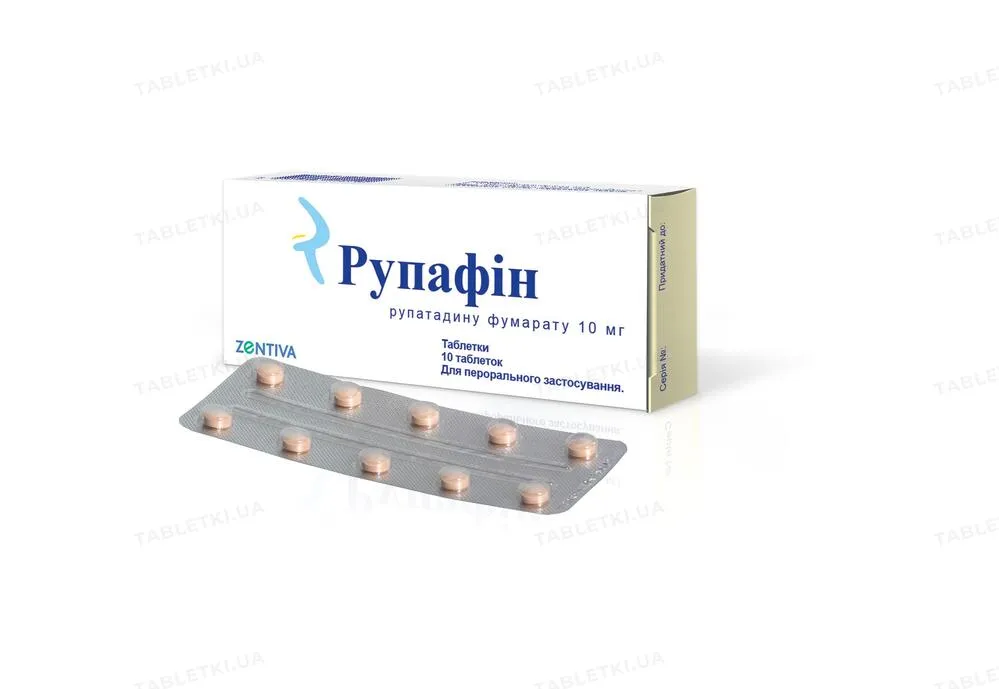
Table of Contents
INSTRUCTIONS FOR MEDICAL USE OF THE MEDICINAL PRODUCT RUPAFIN (RUPAFIN)
Composition:
Active substance: rupatadine fumarate;
One tablet contains rupatadine fumarate 12.8 mg, equivalent to 10 mg of rupatadine;
Excipients: lactose monohydrate; pregelatinized corn starch; microcrystalline cellulose; iron oxide red (E 172); iron oxide yellow (E 172); magnesium stearate.
Pharmaceutical form. Tablets.
Main physicochemical properties: round tablets, light pink-orange in color, unmarked.
Pharmacotherapeutic group. Agents acting on the respiratory system. Other antihistamines for systemic use. Rupatadine. ATC code R06AX28.
Pharmacological Properties
Pharmacodynamics.
Rupatadine belongs to the second generation of antihistamines and is a long-acting histamine antagonist with selective peripheral antagonistic activity at H1-receptors. Some of its metabolites (desloratadine and its hydroxylated metabolites) retain antihistaminic activity and may partially contribute to the overall efficacy of the drug.
In vitro studies of rupatadine at high concentrations have demonstrated inhibition of mast cell degranulation induced by both immunological and non-immunological stimuli, as well as reduced release of cytokines, including TNFα, from human mast cells and monocytes. The clinical significance of these experimental findings remains to be confirmed.
During clinical studies, administration of rupatadine in doses ranging from 2 mg to 100 mg in volunteers (n=375) and patients (n=2650) with allergic rhinitis and chronic idiopathic urticaria did not show any significant effect of the drug on electrocardiographic parameters.
Chronic idiopathic urticaria was studied under clinical disease models because, despite its etiology, the pathophysiology of the disease remains consistent. Additionally, patients with the chronic form are more readily recruited into clinical trials. Since histamine release is a causative factor in all manifestations of urticaria, rupatadine is expected to be effective in symptomatic treatment of chronic idiopathic urticaria and other forms of urticaria, as indicated in clinical guidelines.
In placebo-controlled studies of chronic idiopathic urticaria, rupatadine effectively reduced the mean symptom score (reduction from baseline: rupatadine – 57.5%, placebo – 44.8%) and mean number of wheals (54.3% vs. 39.7%) after four weeks of treatment.
Pharmacokinetics.
Absorption and Bioavailability.
Rupatadine is rapidly absorbed after oral administration, with a tmax of approximately 0.75 hours after tablet intake. The mean Cmax was 2.6 ng/mL after a single 10 mg oral dose and 4.6 ng/mL after a single 20 mg oral dose. The pharmacokinetics of rupatadine were linear over the dose range of 10–40 mg. After administration of a 10 mg dose once daily for 7 days, the mean Cmax was 3.8 ng/mL. Plasma concentration declined in a biexponential manner with a mean elimination half-life of 5.9 hours. The plasma protein binding of rupatadine was 98.5–99%.
As rupatadine has never been administered intravenously to humans, data on its absolute bioavailability are unavailable.
Effect of Food Intake
Food intake increases the overall systemic exposure to rupatadine (AUC, area under the concentration–time curve) by approximately 23%. The effect on one of its active metabolites and on the main inactive metabolite was practically unchanged (decrease by approximately 5% and 3%, respectively). The time required to reach maximum plasma concentration (tmax) of rupatadine was prolonged by 1 hour. The maximum plasma concentration (Cmax) was not altered by food intake. These differences are not clinically significant.
Metabolism and Elimination
In a 7-day excretion study in humans (40 mg of 14C-rupatadine), 34.6% of the administered radioactivity was excreted in urine and 60.9% in feces. Rupatadine undergoes extensive presystemic metabolism following oral administration. The unchanged active substance was detected in urine and feces only in negligible amounts, indicating that rupatadine is almost completely metabolized. The active metabolite desloratadine and other hydroxylated derivatives accounted for approximately 27% and 48% of total systemic exposure to the active substance, respectively. In vitro metabolism studies in human liver microsomes indicate that rupatadine is primarily metabolized by cytochrome P450 (CYP3A4).
Special Patient Populations
In a study comparing results in young adults and elderly subjects, AUC and Cmax values for rupatadine were higher in elderly subjects compared to young adults. This is likely due to reduced hepatic metabolism during first-pass metabolism in the elderly. No differences in AUC and Cmax were observed for metabolites between young and elderly subjects. The mean elimination half-life of rupatadine was 8.7 hours in elderly subjects and 5.9 hours in young volunteers. As the differences observed for rupatadine and its metabolites were not clinically significant, dose adjustment is not required when administering 10 mg of the drug to elderly patients.
Preclinical Safety Data
Preclinical studies do not indicate any special risk to humans based on standard assessments of pharmacological toxicity upon repeated administration, genotoxicity, and carcinogenicity.
Doses of rupatadine 100 times higher than the recommended clinical dose (10 mg) did not affect QTc and QRS intervals nor induce arrhythmia symptoms in various animal species, such as rats, guinea pigs, and dogs. Rupatadine and its main human metabolite, 3-hydroxydesloratadine, did not affect the action potential in canine Purkinje fibers at concentrations at least 2000 times higher than the maximum plasma concentration achieved in humans after administration of 10 mg. In a study assessing the effect of rupatadine on the cloned gene of the specific cardiac potassium channel, it inhibited this channel at a concentration 1685 times higher than the maximum plasma concentration achieved after administration of 10 mg. Desloratadine, the metabolite with the highest activity, showed no effect at a concentration of 10 µmol/L. Tissue distribution studies in rats using radiolabeled rupatadine showed no accumulation in cardiac tissue.
A significant reduction in fertility in both male and female rats was observed at a dose of 120 mg/kg/day, where the maximum concentration was 268 times higher than the Cmax in humans achieved with the therapeutic dose (10 mg/day). Teratogenic effects (developmental delay, incomplete ossification, minor skeletal variations) were reported in rats at maternally toxic doses (25 and 120 mg/kg/day). Developmental toxicity was observed in rabbits at doses up to 100 mg/kg. The no-observed-adverse-effect level (NOAEL) was 5 mg/kg/day in rats and 100 mg/kg/day in rabbits, corresponding to Cmax values 45 and 116 times higher, respectively, than the concentration achieved with the therapeutic dose (10 mg/day) in humans.
Clinical characteristics.
Indications.
Symptomatic treatment of allergic rhinitis and urticaria in adults and adolescents aged 12 years and older.
Contraindications.
Hypersensitivity to the active substance or to any of the other components of the medicinal product.
Interaction with other medicinal products and other forms of interaction.
The interaction of rupatadine 10 mg tablets with other medicinal products has been studied in adults and children aged 12 years and older.
Effect of other medicinal products on rupatadine
Concomitant use of potent CYP3A4 inhibitors (e.g., itraconazole, ketoconazole, voriconazole, posaconazole, HIV protease inhibitors, clarithromycin, nefazodone) should be avoided, and moderate CYP3A4 inhibitors (erythromycin, fluconazole, diltiazem) should be used with particular caution.
Concomitant administration of rupatadine 20 mg with ketoconazole or erythromycin increases systemic exposure to rupatadine by 10-fold and 2–3-fold, respectively. These changes are not associated with alterations in QT interval or increased incidence of adverse reactions compared to administration of the respective drugs alone.
Interaction with grapefruit
Concomitant intake of grapefruit juice increases overall exposure to rupatadine by 3.5-fold. Grapefruit juice should not be consumed at the same time as the medicinal product.
Effect of rupatadine on other medicinal products
Rupatadine should be used with caution in combination with other medicinal products having a narrow therapeutic index, as information regarding its effect on such drugs is limited.
Interaction with alcohol
After alcohol intake, a 10 mg dose of rupatadine showed minimal effect on the results of certain psychomotor performance tests, which did not differ significantly from the effect of alcohol alone. A 20 mg dose enhanced the changes induced by alcohol.
Interaction with CNS depressants
As with other antihistamines, interaction with central nervous system (CNS) depressants cannot be ruled out.
Interaction with statins
Asymptomatic increases in creatine phosphokinase have occasionally been observed during clinical studies with rupatadine. The risk of interaction with statins—some of which are also metabolized by the CYP3A4 isoenzyme of cytochrome P450—is unknown. Therefore, rupatadine should be used with caution when co-administered with statins.
Interaction with midazolam
Following administration of a 10 mg dose of rupatadine in combination with 7.5 mg midazolam, exposure (Cmax and AUC) to midazolam was slightly increased. For this reason, rupatadine acts as a mild inhibitor of CYP3A4.
Special precautions for use.
Concomitant intake of rupatadine with grapefruit juice is not recommended (see section "Interaction with other medicinal products and other forms of interaction").
Concomitant use of rupatadine with strong CYP3A4 inhibitors should be avoided, and with moderate CYP3A4 inhibitors – used with particular caution (see section "Interaction with other medicinal products and other forms of interaction").
Dosage adjustment may be required for sensitive substrates of CYP3A4 (e.g. simvastatin, lovastatin) and substrates of the CYP3A4 enzyme with a narrow therapeutic range (e.g. cyclosporine, tacrolimus, sirolimus, everolimus, cisapride), since rupatadine may increase their plasma concentrations (see section "Interaction with other medicinal products and other forms of interaction").
The cardiac safety of rupatadine was evaluated in a Thorough QT/QTc study. Administration of rupatadine doses 10 times higher than therapeutic ones showed no effect on ECG parameters; therefore, its use raises no concerns regarding cardiac safety. However, rupatadine should be prescribed with caution to patients with prolonged QT interval, uncorrected hypokalemia, and patients with proarrhythmic conditions such as clinically significant bradycardia or acute myocardial ischemia.
Rupatadine 10 mg tablets should be prescribed with caution to elderly patients (aged 65 years and older). Although no overall differences in efficacy or safety were observed in clinical trials, increased sensitivity in some elderly patients cannot be ruled out due to the small number of elderly participants in the trials (see section "Pharmacological properties").
For use in children over 12 years of age and in patients with renal or hepatic impairment, see section "Dosage and administration".
Since rupatadine tablets contain lactose, the drug should not be administered to patients with rare hereditary problems of galactose intolerance, Lapp lactase deficiency, or glucose-galactose malabsorption.
Use during pregnancy or breastfeeding.
Pregnancy
There are limited data on the use of rupatadine in pregnant women. Animal studies do not indicate a direct or indirect harmful effect on embryonal/fetal, peri- and postnatal development (see section "Pharmacological properties"). As a precautionary measure, rupatadine should be avoided during pregnancy.
Breastfeeding
Rupatadine is excreted into animal milk. It is unknown whether rupatadine passes into human breast milk. A decision should be made whether to discontinue breastfeeding or to discontinue/abstain from rupatadine therapy, taking into account the benefit of breastfeeding for the child and the benefit of therapy for the woman.
Fertility
Clinical data on the effect on fertility are lacking. Animal studies indicate a significant reduction in fertility at concentrations higher than the maximum therapeutic concentrations in humans (see section "Pharmacological properties").
Ability to affect reaction speed when driving or operating machinery.
The effect of rupatadine 10 mg on the ability to drive vehicles or operate machinery is negligible. However, caution should be exercised when driving vehicles or operating machinery until the individual's response to rupatadine has been established.
Method of Administration and Dosage
Adults and children aged 12 years and older
The recommended dose is 10 mg (one tablet) once daily, independent of food intake.
Elderly patients
Rupatadine should be used with caution in elderly patients (see section "Special Warnings and Precautions for Use").
Patients with renal or hepatic impairment
Due to lack of clinical experience with the use of the drug, rupatadine is not recommended for patients with impaired kidney or liver function.
The duration of treatment is determined by the physician depending on the severity and course of the disease. Treatment should be discontinued after symptoms resolve and restarted upon their recurrence.
Children
This medicinal product is not recommended for children under 12 years of age due to insufficient data on safety and efficacy.
Overdose
There have been no reported cases of overdose. In clinical safety studies, rupatadine was well tolerated at a daily dose of 100 mg over 6 days. The most common adverse reaction was somnolence. In case of accidental ingestion of very high doses, symptomatic and supportive therapy is recommended.
Side effects.
During clinical trials, rupatadine 10 mg tablets were administered to 2043 adults and adolescents, 120 of whom received the drug for at least one year.
The most commonly reported adverse reactions during controlled clinical trials were somnolence (9.4%), headache (6.9%), fatigue (3.1%), asthenia (1.5%), dry mouth (1.2%), and dizziness (1.03%).
Most of the adverse events observed during controlled clinical trials were mild to moderate in severity and generally did not require discontinuation of treatment.
The frequency of adverse reactions is defined as follows:
- Common (≥ 1/100 to < 1/10);
- Uncommon (≥ 1/1000 to < 1/100);
- Rare (≥ 1/10000 to < 1/1000).
The adverse reactions listed below have been reported in patients during clinical trials and post-marketing use of the drug.
Infections and infestations
Uncommon: pharyngitis, rhinitis.
Immune system disorders
Rare: hypersensitivity reactions (including anaphylactic reactions, angioedema, and urticaria)*.
Metabolism and nutrition disorders
Uncommon: increased appetite.
Nervous system disorders
Common: somnolence, headache, dizziness.
Uncommon: attention disorders.
Cardiac disorders
Rare: tachycardia and palpitations*.
Respiratory system disorders
Uncommon: epistaxis, dryness of nasal mucosa, cough, dry throat, sore throat, and laryngeal pain.
Gastrointestinal disorders
Common: dry mouth.
Uncommon: nausea, upper abdominal pain, diarrhea, dyspepsia, vomiting, abdominal pain, constipation.
Skin and subcutaneous tissue disorders
Uncommon: rash.
Musculoskeletal and connective tissue disorders
Uncommon: back pain, arthralgia, myalgia.
General disorders
Common: fatigue, asthenia.
Uncommon: thirst, malaise, fever, irritation.
Investigations
Uncommon: increased blood creatine phosphokinase, increased alanine aminotransferase, increased aspartate aminotransferase, abnormal liver function tests, weight gain.
*Three rare cases of tachycardia, palpitations, and hypersensitivity reactions (including anaphylactic reactions, angioedema, and urticaria) have been reported during post-marketing use of rupatadine 10 mg tablets.
Reporting suspected adverse reactions
Reporting of suspected adverse reactions after drug authorization is important. It allows continued monitoring of the benefit-risk balance of the medicinal product. Healthcare professionals, pharmacists, as well as patients or their legal representatives are encouraged to report any suspected adverse reactions and lack of efficacy through the Automated Pharmacovigilance Information System at the following link: https://aisf.dec.gov.ua.
Shelf life. 3 years.
Storage conditions.
Store in a cardboard box to protect from light.
Keep out of reach of children.
Packaging.
10 tablets in a blister, 1, 3, or 5 blisters per cardboard box.
15 tablets in a blister, 2 blisters per cardboard box.
Prescription status. Prescription only.
Manufacturer.
NuCorder Health, S.A.
Manufacturer's address and place of business.
Carrer del Camí Real, 51-57, Palau-solità i Plegamans, 08184, Spain.