Rosamet
Ukraine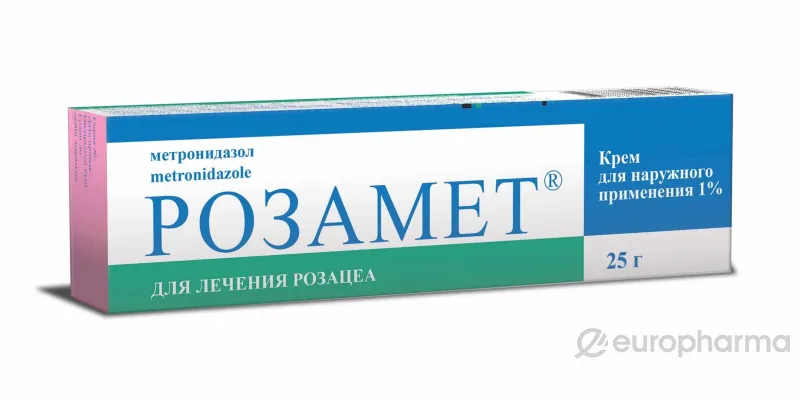
Table of Contents
INSTRUCTIONS FOR MEDICAL USE OF THE MEDICINAL PRODUCT ROZAMET® (ROZAMET®)
Composition:
Active substance: metronidazole;
1 g of cream contains 10 mg of metronidazole;
Excipients: methylparaben (methylparahydroxybenzoate) (E218), propylparaben (propylparahydroxybenzoate) (E216), glycerol, mineral oil, emulsifying anionic wax, propylene glycol, purified water.
Pharmaceutical form. Cream.
Main physicochemical characteristics: homogeneous white-colored cream.
Pharmacotherapeutic group. Chemotherapeutic agents for topical use.
ATC code D06BX01.
Pharmacological properties.
Pharmacodynamics.
The active component of the drug, metronidazole, is a synthetic (a derivative of
5-nitroimidazole) antiprotozoal and antibacterial agent. Its mechanism of action involves the biochemical reduction of the 5-nitro group of metronidazole by intracellular transport proteins of anaerobic microorganisms and protozoa. The reduced 5-nitro group of metronidazole interacts with microbial DNA, inhibiting its synthesis, which leads to the death of microorganisms. It is believed that these reduced metabolites are responsible for the antimicrobial and cytostatic effects of the drug, as they damage DNA and inhibit nucleic acid synthesis. Metronidazole is equally effective in both dividing and non-dividing cells. Anti-inflammatory and immunosuppressive effects of metronidazole have been demonstrated in in vitro and in vivo studies. It is considered that, via the aforementioned mechanism of action, the drug reduces inflammatory lesions (papules and pustules) and erythema in patients with rosacea. The local antibacterial effect of metronidazole is not considered significant in the treatment of rosacea and rosacea-like dermatitis.
Application of 1% metronidazole twice daily for 30 days does not lead to changes in aerobic or anaerobic skin or fecal microflora.
Pharmacokinetics.
Metabolism and elimination of metronidazole after topical application have not been determined. Systemically absorbed metronidazole is metabolized in the liver and excreted by the kidneys.
Clinical Characteristics.
Indications.
Local treatment of inflammatory papules and pustules in rosacea and common acne, as well as rosacea-like steroid dermatitis.
Contraindications.
Metronidazole is contraindicated in patients with hypersensitivity to the drug, to imidazole derivatives, parabens and related compounds, or to any other components of the drug.
Interaction with other medicinal products and other types of interactions.
When applied topically in recommended doses, systemic interaction of the cream with other medicinal products has not been observed; however, caution should be exercised when prescribing Rosamet® cream together with certain medicinal products.
Warfarin and other coumarin anticoagulants. It is known that orally administered metronidazole potentiates anticoagulant effects, leading to prolonged prothrombin formation time.
Phenobarbital. It has been established that concomitant use with orally administered metronidazole reduces the latter's antimicrobial activity. The reason is accelerated metabolism of metronidazole.
Disulfiram. Concurrent oral administration enhances drug toxicity, which may lead to the development of neurological symptoms.
Cimetidine. Inhibits the metabolism of orally administered metronidazole, potentially causing increased serum concentrations of metronidazole.
During systemic therapy with metronidazole, alcohol intake should be avoided, as a disulfiram-like reaction may occur.
Special precautions for use
The medicinal product is intended exclusively for topical use. Contact with mucous membranes and eyes should be avoided, as the product may cause irritation. If the cream gets into the eyes, they should be immediately rinsed thoroughly with plenty of water. The cream should not be applied to areas close to the eyes. The affected area should be cleaned before applying Rozamet® cream. Cosmetic products may be used after application of the product.
When applied over a large skin surface area or used for prolonged periods, there is a possibility of systemic adverse effects.
The product should be prescribed with caution to patients with impaired hematopoietic system function.
Topically applied metronidazole is ineffective in treating telangiectasia associated with rosacea.
Propylparahydroxybenzoate (E 216) and methylparahydroxybenzoate (E 218) contained in the product may cause allergic reactions (possibly delayed); contact dermatitis is very rare. Propylene glycol contained in the product may also cause skin reactions.
During use of the product, exposure to UV radiation (sunbathing, solarium, UV lamps) should be avoided.
Use during pregnancy or breastfeeding
When administered systemically, metronidazole crosses the placental barrier and is excreted in breast milk in significant concentrations. Although blood concentrations of metronidazole are low following topical application, Rozamet® cream is contraindicated during the first trimester of pregnancy and may be used during the second and third trimesters only if absolutely necessary.
Breastfeeding should be discontinued for the duration of treatment with this product.
Ability to influence reaction speed when driving or operating machinery
Use of the product at the recommended dose does not affect reaction speed when driving or operating potentially hazardous machinery.
Method of Administration and Dosage.
The product is intended for external use only!
Apply the cream in a thin layer to the skin previously cleansed with warm water or a mild detergent, and gently rub in. It is recommended to wait 15–20 minutes between cleansing the skin and applying the cream. Use twice daily (in the morning and evening). The average duration of treatment is 3–4 months. Therapeutic effect is observed after 3 weeks of treatment.
Children.
Do not use in children.
Overdose.
Cases of overdose with topical application are unknown. When applied topically, metronidazole is absorbed in negligible amounts, producing no systemic effect.
Adverse reactions.
Adverse reactions related to topical application of metronidazole are usually infrequent and mild in severity. The most common adverse effects are allergic reactions and manifestations of hypersensitivity, including skin rashes, pruritus, urticaria, and local skin irritation characterized by transient erythema, sensations of dryness, burning, stinging, tingling, and signs of irritation, as well as local increase in skin temperature. Application of the cream to the eye area may cause lacrimation.
At the beginning of treatment, a temporary worsening of rosacea symptoms may occur; therefore, evaluation of local reactions caused by metronidazole may be difficult, as many of the aforementioned symptoms are also typical of rosacea itself.
Systemic adverse effects of metronidazole are unlikely due to the very low concentrations achieved with topical application.
Possible nervous system reactions: hypoesthesia, paresthesia, dysgeusia (metallic taste in the mouth).
Other: nausea, disulfiram-like symptoms.
Propylparaben (E 216) and methylparaben (E 218) contained in the formulation may cause allergic reactions (possibly delayed); contact dermatitis is very rare. Propylene glycol contained in the formulation may also cause skin reactions.
Shelf life. 2 years.
Storage conditions.
Store in a place inaccessible to children, at a temperature not exceeding 25 °C.
Packaging. 25 g of cream in a tube; 1 tube per cardboard box.
Prescription status. Prescription only.
Manufacturer. Jadran-Galenski Laboratorij d. d. / Jadran-Galenski Laboratorij d. d.
Manufacturer's address and place of business.
Svilno 20, 51000 Rijeka, Croatia.