Rosalin
Ukraine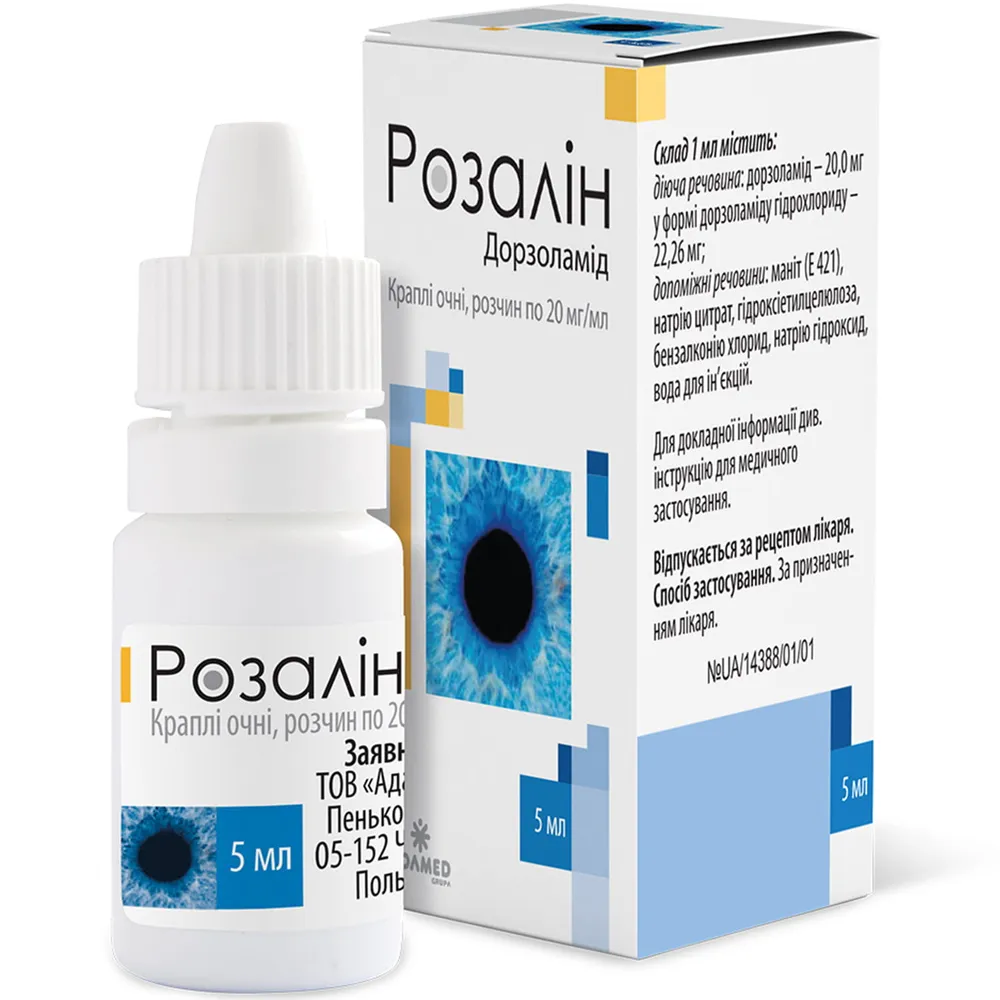
Table of Contents
INSTRUCTIONS FOR MEDICAL USE OF THE MEDICINAL PRODUCT ROZALIN (ROZALIN)
Composition:
Active substance: dorzolamide (in the form of dorzolamide hydrochloride);
1 ml of solution contains dorzolamide 20 mg (in the form of dorzolamide hydrochloride);
Excipients: mannitol (E 421), sodium citrate, hydroxyethylcellulose, benzalkonium chloride, sodium hydroxide, water for injections.
Pharmaceutical form. Eye drops, solution.
Main physicochemical properties: slightly opalescent, almost colorless, slightly viscous solution. Color: must not exceed standard B9. Opalescence: must not exceed reference suspension I.
Pharmacotherapeutic group. Carbonic anhydrase inhibitors. ATC code S01E C03.
Pharmacological Properties
Dorzolamide contains dorzolamide hydrochloride, which actively inhibits human carbonic anhydrase II. After topical ocular administration, dorzolamide reduces elevated intraocular pressure, regardless of whether it is associated with glaucoma. Dorzolamide lowers intraocular pressure without causing side effects such as night blindness and accommodative spasm. Unlike topical beta-adrenergic blocking agents, dorzolamide has little or no effect on heart function and arterial blood pressure.
It has been demonstrated that adding Rozalin to topical beta-adrenergic blocking agents leads to more effective reduction of intraocular pressure. A similar effect has been observed with the use of beta-adrenergic blocking agents and oral carbonic anhydrase inhibitors.
Pharmacodynamics
The efficacy of dorzolamide administered to patients with glaucoma or ocular hypertension either as monotherapy three times daily (baseline intraocular pressure ≥23 mmHg) or twice daily as an adjunct to beta-adrenergic blocker eye drops (baseline intraocular pressure ≥22 mmHg) has been confirmed in clinical studies. When used both as monotherapy and as an adjunct, the drug reduced intraocular pressure throughout the day, and this effect was maintained during long-term use. The efficacy of the drug after long-term monotherapy was similar to that of betaxolol and only slightly less than that of timolol. When dorzolamide was used as an adjunct to beta-adrenergic blocker therapy in the form of eye drops, additional reduction in intraocular pressure was observed, comparable to that achieved with 2% pilocarpine administered four times daily.
Pharmacokinetics
Absorption
Topical administration of dorzolamide hydrochloride allows the drug to act directly on the eye following application of a small dose, resulting in significantly lower systemic exposure. Therefore, the reduction in intraocular pressure is not accompanied by acid-base imbalances or electrolyte disturbances typical of oral carbonic anhydrase inhibitors.
After topical administration, dorzolamide enters the systemic circulation. With long-term use, dorzolamide accumulates in erythrocytes due to selective binding to carbonic anhydrase II isoenzyme, while the concentration of free drug in plasma remains very low. The only metabolite of the drug is N-desethyl-dorzolamide, which inhibits carbonic anhydrase II more slowly than dorzolamide and also inhibits the less active isoenzyme (carbonic anhydrase I). This metabolite also accumulates in erythrocytes, where it binds primarily to carbonic anhydrase I.
Elimination
Dorzolamide binds to plasma proteins (approximately 33%). Dorzolamide and its metabolite are primarily excreted unchanged in urine. After discontinuation of the drug, a nonlinear decline in dorzolamide concentration in erythrocytes occurs. Initially, there is a rapid decrease in drug concentration, followed by a phase of slower elimination with a half-life of approximately 4 months.
After oral administration of dorzolamide to simulate the maximum systemic exposure possible following long-term topical use of dorzolamide, steady state was reached within 13 weeks. At steady state, neither free drug nor its metabolite was detectable in plasma. Similar pharmacokinetic results were observed after long-term topical administration of dorzolamide.
Pharmacokinetics in different patient groups
Higher concentrations of dorzolamide metabolite in erythrocytes were observed in some elderly patients with impaired renal function (estimated creatinine clearance 30–60 mL/min). No significant differences were observed regarding inhibition of carbonic anhydrase activity or clinically significant systemic adverse effects related to this finding.
Clinical characteristics.
Indications.
Treatment of elevated intraocular pressure in patients with:
- ocular hypertension;
- open-angle glaucoma;
- pseudoexfoliative glauopenia;
- as adjunctive therapy to beta-blockers or as monotherapy when treatment with beta-blockers has been unsuccessful or beta-blockers are contraindicated.
Contraindications.
Hypersensitivity to the active substance of the medicinal product or to any of the excipients.
Severe renal function impairment (CrCl <30 mL/min).
Hyperchloremic acidosis.
Interaction with other medicinal products and other forms of interaction.
No extensive studies of interactions between dorzolamide and other drugs have been conducted. Clinical studies have not confirmed interactions during concomitant administration of dorzolamide with timolol and betaxolol in the form of eye drops, or with systemic agents: ACE inhibitors, calcium channel blockers (CCBs), diuretics, and non-steroidal anti-inflammatory drugs (NSAIDs), including acetylsalicylic acid, as well as with hormonal agents (e.g., estrogens, insulin, thyroxine).
The potential interaction between dorzolamide and miotic agents, as well as adrenergic receptor agonists during glaucoma treatment, has not been studied.
Special precautions for use
The use of dorzolamide in patients with hepatic insufficiency has not been studied; therefore, caution is recommended when treating such patients.
When treating patients with acute angle-closure glaucoma, in addition to medications that reduce intraocular pressure, other therapeutic measures are required. The use of dorzolamide in patients with this diagnosis has not been studied.
Dorzolamide is a sulfonamide that, in addition to its local effect, is also subject to systemic absorption into the general circulation. Therefore, adverse reactions associated with systemic administration of sulfonamides may also occur following local application. If severe adverse reactions or symptoms of hypersensitivity are diagnosed, the drug should be discontinued.
Treatment with oral carbonic anhydrase inhibitors has been associated with the development of urinary calculi due to water-electrolyte disturbances, particularly in patients with a history of nephrolithiasis. Although water-electrolyte disturbances have not been observed with dorzolamide use, rare cases of ureterolithiasis have been reported. Since dorzolamide is a locally acting carbonic anhydrase inhibitor that is absorbed into the systemic circulation, patients with a history of nephrolithiasis are considered to be at increased risk of developing ureterolithiasis during treatment with dorzolamide.
In clinical studies, local adverse effects were observed during long-term use of dorzolamide, primarily conjunctivitis and eyelid irritation. Some of these reactions were allergic in nature and resolved after discontinuation of the drug. In such cases, discontinuation of dorzolamide therapy should be considered.
An increased systemic effect may occur when carbonic anhydrase inhibitors are used in patients who are concurrently taking an oral carbonic anhydrase inhibitor and dorzolamide. Concomitant use of dorzolamide and oral carbonic anhydrase inhibitors has not been studied and is not recommended.
Corneal edema and irreversible corneal decompensation have been observed in patients with previously diagnosed chronic corneal defects and/or a history of intraocular surgery during treatment with dorzolamide. Dorzolamide should be used locally with caution in such patients.
Cases of choroidal detachment have been reported during treatment with agents that reduce aqueous humor production following filtration procedures.
Rozalin contains the preservative benzalkonium chloride, which may cause eye irritation. Contact lenses should be removed prior to administration of the medication and not reinserted earlier than 15 minutes after instillation. Benzalkonium chloride may cause discoloration of soft contact lenses.
Use during pregnancy or breastfeeding.
Pregnancy.
Appropriate controlled studies of the use of this drug in pregnant women have not been conducted. Dorzolamide should not be used during pregnancy.
Breastfeeding period.
It is unknown whether dorzolamide is excreted in human breast milk. Dorzolamide should not be used during breastfeeding.
Ability to affect the rate of reactions when driving or operating machinery.
In some patients receiving dorzolamide, adverse effects such as dizziness and visual disturbances may occur, which could affect the ability to drive a vehicle or operate machinery.
Method of Administration and Dosage
If Rosalin is used as monotherapy, instill 1 drop into the affected eye (or both eyes) 3 times daily.
As adjunctive therapy with beta-adrenergic blocking agents for local administration, instill 1 drop of Rosalin into the conjunctival sac of the affected eye (eyes) 2 times daily.
After instilling Rosalin, press a finger against the inner corner of the eye near the nose or close the eye for 2 minutes. This may reduce systemic side effects and enhance local activity.
If switching from another topical anti-glaucoma agent to Rosalin, discontinue the previous medication and initiate treatment with Rosalin the following day.
If the patient is using several topical ophthalmic medications, they should be administered with an interval of at least 10 minutes between applications.
During administration, avoid contact of the dropper tip with the surface of the eye or surrounding skin, as the eye drops may become contaminated with microorganisms, potentially causing ocular infection. Use of a contaminated solution may lead to severe eye injury, possibly resulting in vision loss.
Children. Data on the use of eye drops in children are limited; therefore, the drug should not be used in children.
Overdose.
Data regarding the consequences of overdose in humans are limited. The following symptoms have been observed: after oral administration – drowsiness; after topical application – nausea, dizziness, headache, fatigue, unusual dreams, and dysphagia. In case of overdose, symptomatic and supportive therapy should be administered. Electrolyte imbalances, development of asthenia, and symptoms affecting the central nervous system (CNS) may occur. Serum electrolyte concentrations (particularly potassium) should be monitored, and blood pH levels should be determined.
Adverse Reactions
The most commonly reported adverse effects associated with dorzolamide use are bitter taste, burning and stinging in the eyes, blurred vision, ocular itching, tearing, headache, conjunctivitis, blepharitis, nausea, eyelid irritation, and sensations of weakness and fatigue. The most frequent reason for discontinuation of treatment with Rozalin (in approximately 3% of patients) was ocular adverse effects, primarily diagnosis of conjunctivitis after drug administration and eyelid-related reactions. Rarely, inflammation of the iris and ciliary body and skin rashes were observed. In one case, nephrolithiasis was diagnosed.
When using a medicinal product containing dorzolamide, adverse effects were observed with the following frequency: very common (≥ 1/10), common (≥ 1/100 to < 1/10), uncommon (≥ 1/1,000 to < 1/100), rare (≥ 1/10,000 to < 1/1,000), very rare (< 1/10,000), frequency not known (cannot be estimated from available data).
Nervous system disorders:
Common: headache;
Rare: paraesthesia, dizziness.
Eye disorders:
Very common: burning and stinging;
Common: superficial punctate keratitis, tearing, conjunctivitis, blepharitis, ocular pruritus, eye irritation, blurred vision;
Uncommon: iridocyclitis (inflammation of the iris and ciliary body);
Rare: irritation including redness, pain, eyelid adhesion, transient myopia (resolving after discontinuation of treatment), corneal edema, reduced intraocular pressure, choroidal detachment following filtration procedures;
Frequency not known: foreign body sensation in the eye.
Cardiac disorders:
Frequency not known: palpitations, tachycardia.
Respiratory system disorders:
Rare: epistaxis;
Frequency not known: dyspnea.
Gastrointestinal disorders:
Common: nausea, bitter taste in mouth;
Rare: throat irritation, dry mouth.
Skin and subcutaneous tissue disorders:
Rare: contact dermatitis, Stevens-Johnson syndrome, toxic epidermal necrolysis.
Renal and urinary disorders:
Rare: nephrolithiasis.
Vascular disorders:
Frequency not known:
hypertension
General disorders and administration site conditions:
Common: asthenia/increased fatigue;
Rare: hypersensitivity, local reactions (subjective and objective), including eyelid reactions and manifestations of systemic allergic reactions, such as angioedema, bronchospasm, urticaria, pruritus, rash, dyspnea.
Effect of the medicinal product on laboratory test results.
No significant electrolyte disturbances associated with dorzolamide use have been reported.
Shelf life: 2 years.
Shelf life after opening the bottle: 4 weeks.
Storage conditions.
Store in the original packaging at a temperature below 25°C.
Keep out of reach and sight of children.
Packaging.
5 ml in a bottle with dropper and white cap; 1 bottle per cardboard box.
Prescription status.
Prescription only.
Manufacturer.
Manufacturer responsible for batch release:
Pharmaswiss International Betriebs GmbH.
Manufacturer's address and place of business.
Ernst-Melchior-Gasse 20, 1020 Vienna, Austria.