Rolinos
Ukraine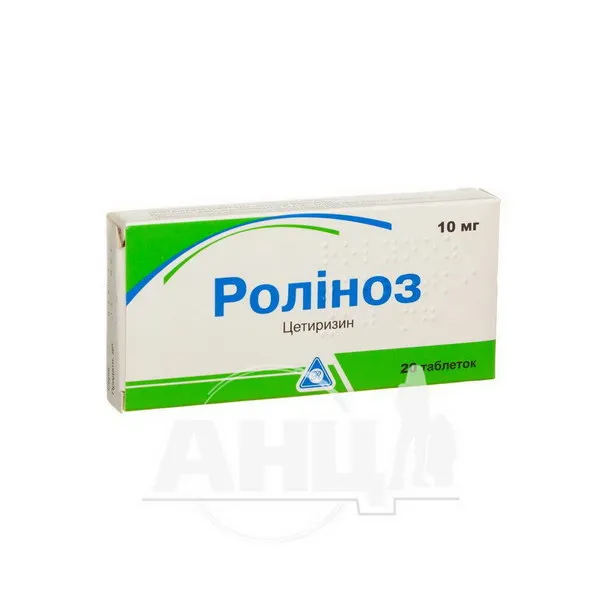
Table of Contents
INSTRUCTIONS FOR MEDICAL USE OF THE MEDICINAL PRODUCT ROLINOZ (ROLINOZ)
Composition:
Active substance: cetirizine;
1 film-coated tablet contains 10 mg of cetirizine dihydrochloride;
Excipients: microcrystalline cellulose; lactose monohydrate; colloidal anhydrous silicon dioxide; sodium starch glycolate (type A); magnesium stearate;
Film coating: Opadry® II White 85F18422 (polyvinyl alcohol, titanium dioxide (E 171), macrogol, talc).
Pharmaceutical form. Film-coated tablets.
Main physicochemical characteristics: elongated, film-coated tablets of white to almost white color, with a score line on both sides.
Pharmacological Properties
Pharmacodynamics
Cetirizine, a metabolite of hydroxyzine, is a potent selective antagonist of peripheral H1-receptors. In vitro receptor binding studies showed no significant affinity for other receptors except H1-receptors.
In addition to its H1-receptor antagonistic effect, cetirizine exerts an anti-allergic action: at a dose of 10 mg once or twice daily, cetirizine inhibited the late-phase migration of cells involved in the inflammatory response (predominantly eosinophils) into the skin and conjunctiva of atopic individuals following antigen challenge.
At doses of 5 mg and 10 mg, cetirizine strongly inhibits histamine-induced wheal and flare reactions in the skin, although the correlation with clinical efficacy has not been established.
Administration of cetirizine to patients with allergic rhinitis and concomitant mild to moderate bronchial asthma at a dose of 10 mg once daily improved rhinitis symptoms and did not affect lung function, confirming the safety of cetirizine use in patients with mild to moderate bronchial asthma.
Administration of cetirizine at a high daily dose of 60 mg for one week did not cause statistically significant QT interval prolongation.
When administered at recommended doses, cetirizine improves symptoms in patients with perennial and seasonal allergic rhinitis.
In children aged 5 to 12 years, no tolerance to the antihistaminic effect of cetirizine (suppression of wheal and flare reactions) was observed. If cetirizine treatment is discontinued after repeated administration, skin reactivity to histamine returns to baseline within 3 days.
Pharmacokinetics
Cetirizine exhibits linear kinetics over the dose range of 5 mg to 60 mg.
Absorption
The steady-state maximum plasma concentration of cetirizine is approximately 300 ng/mL and is reached within 1 ± 0.5 hours. The distribution of pharmacokinetic parameters such as peak plasma concentrations (Cmax) and area under the curve (AUC) is homogeneous. The extent of cetirizine absorption is not reduced when taken with food, although the rate of absorption is decreased. Bioavailability is similar when cetirizine is administered as a solution, capsules, or tablets.
Distribution
The apparent volume of distribution of cetirizine is 0.5 L/kg. Plasma protein binding is 93 ± 0.3%. Cetirizine does not affect the protein binding of warfarin in blood.
Metabolism
Cetirizine does not undergo extensive first-pass metabolism.
Elimination
Approximately two-thirds of the dose is excreted unchanged in urine. The terminal elimination half-life is approximately 10 hours. No accumulation of cetirizine was observed after administration of 10 mg daily for 10 days.
Special Patient Populations
Patients with Hepatic Impairment
In patients with chronic liver diseases (hepatocellular, cholestatic, and biliary cirrhosis), following a single 10 mg or 20 mg dose of cetirizine, the elimination half-life increased by 50% and clearance decreased by 40% compared to healthy volunteers. Dose adjustment in patients with hepatic impairment is required only if renal function is also impaired.
Patients with Renal Impairment
Pharmacokinetics of cetirizine were similar in patients with mild renal impairment (creatinine clearance >40 mL/min) and healthy volunteers. In patients with moderate renal impairment, the elimination half-life increased by threefold and clearance decreased by 70% compared to healthy volunteers. In patients undergoing hemodialysis (creatinine clearance 7 mL/min), following a 10 mg oral dose of cetirizine, the elimination half-life increased threefold and clearance decreased by 70% compared to healthy volunteers. Cetirizine is poorly removed by hemodialysis. Dose adjustment of cetirizine is necessary in patients with moderate renal impairment. Cetirizine is contraindicated in patients with severe renal impairment.
Elderly Patients
After a single 10 mg oral dose of cetirizine, the elimination half-life increased by nearly 50% and clearance decreased by approximately 40% compared to younger individuals. The reduced clearance of cetirizine was associated with decreased renal function.
Children
The elimination half-life of cetirizine is approximately 6 hours in children aged 6–12 years and 5 hours in children aged 2–6 years. In children aged 6 to 24 months, the half-life is shortened to 3.1 hours.
Clinical characteristics
Indications
The medicinal product Rolinos is indicated for adults and children aged 6 years and older:
- for relief of nasal and ocular symptoms of seasonal and perennial allergic rhinitis;
- for relief of symptoms of chronic idiopathic urticaria.
Contraindications
- Hypersensitivity to the active substance, any of the excipients of the medicinal product, to hydroxyzine, or to any piperazine derivatives in medical history.
- End-stage renal disease (glomerular filtration rate (GFR) < 15 ml/min).
Interaction with other medicinal products and other forms of interaction
Based on the pharmacokinetics, pharmacodynamics, and tolerability profile of cetirizine, the occurrence of any type of interaction when taking this antihistamine is unlikely.
In particular, drug interaction studies have shown no pharmacodynamic or clinically significant pharmacokinetic interaction when administered concomitantly with pseudoephedrine or theophylline (400 mg/day).
The absorption level of cetirizine is not reduced when taken with food, although the rate of absorption is decreased.
Concomitant use of cetirizine with alcohol or other central nervous system (CNS) depressants in sensitive patients may cause additional impairment of attention and ability to perform tasks, although cetirizine does not potentiate the effect of alcohol (at blood alcohol levels of 0.5 g/L).
Special precautions for use
Antihistamines, including cetirizine, suppress the response to skin allergy tests; therefore, administration of the medicinal product should be discontinued 3 days before testing (elimination period).
Cases of pruritus and/or urticaria after discontinuation of cetirizine have been reported, even if these symptoms were not previously observed. In some cases, symptoms may be severe and require resumption of cetirizine treatment. Symptoms should resolve upon restarting therapy.
When cetirizine is used at therapeutic doses, no clinically significant interactions with alcohol (at blood alcohol levels of 0.5 g/L) have been observed. However, caution should be exercised if alcohol is consumed during treatment with the medicinal product.
The medicinal product should be used with caution in patients predisposed to urinary retention (e.g., spinal cord injury, prostate hyperplasia), in patients with epilepsy, and in those at risk of seizures.
The medicinal product contains lactose and therefore should not be used in patients with rare hereditary problems of galactose intolerance, lactase deficiency, or glucose-galactose malabsorption.
Use during pregnancy or breastfeeding
Pregnancy
Prospectively collected data on cetirizine regarding pregnancy outcomes do not indicate potential toxicity for the mother or embryo/fetus. Animal studies have not shown any direct or indirect harmful effects on pregnancy, embryonic/fetal development, parturition, or postnatal development. Nevertheless, the medicinal product should be used with caution during pregnancy.
Breastfeeding
Cetirizine passes into breast milk at concentrations ranging from 25–90% of plasma concentrations, depending on the time interval after administration. The medicinal product should be used with caution during breastfeeding.
Fertility
Data on the effect of cetirizine on human fertility are limited; however, no negative effects on fertility have been observed.
Animal studies have not revealed any adverse effects on fertility.
Ability to affect reaction speed when driving or operating machinery
Objective assessments of the ability to drive, sleep latency, and performance on an assembly line have shown no clinically significant effect of cetirizine when used at the recommended dose of 10 mg.
Patients who drive or operate machinery should not exceed the recommended doses and should consider their individual response to the medicinal product. Patients experiencing somnolence should refrain from driving or operating machinery.
Dosage and Administration
Route of administration
The medicinal product is intended for oral use. Tablets should be swallowed with a glass of water.
Dosage
Adults
The medicinal product should be administered at a dose of 10 mg (1 tablet) once daily.
Pediatric population
Children aged 6 to 12 years
The medicinal product should be administered at a dose of 5 mg (½ tablet) twice daily.
Children aged 12 years and older
The medicinal product should be administered at a dose of 10 mg (1 tablet) once daily.
In children with impaired renal function, dosage should be individually adjusted according to creatinine clearance, age, and body weight.
Elderly patients
In elderly patients with normal renal function, no dosage adjustment is required.
Patients with hepatic impairment
Dosage adjustment is not required in these patients. However, in patients with concomitant hepatic and renal impairment, dosage adjustment is recommended (see section below, "Patients with renal impairment").
Patients with renal impairment
There are no documented data on the benefit-risk balance in patients with renal impairment. Since cetirizine is primarily excreted by the kidneys, if no alternative treatment is available, the dosage should be individually adjusted based on renal function. Refer to the table below and adjust the dose accordingly.
| Renal function status |
CrCl (mL/min) |
Dosage and frequency |
| Normal function |
≥ 90 |
10 mg once daily |
| Mild impairment |
60 – < 90 |
10 mg once daily |
| Moderate impairment |
30 – < 60 |
5 mg once daily |
| Severe impairment |
15 – < 30 not requiring dialysis |
5 mg every 2 days |
| End-stage renal disease |
< 15 requiring dialysis |
Contraindicated |
Children
The use of the medicinal product in tablet form is not recommended for children under 6 years of age, as this dosage form does not allow for the necessary dose adjustment.
Overdose
Symptoms
Symptoms observed after significant overdose of cetirizine are mainly related to effects on the central nervous system (CNS) or effects indicating anticholinergic activity. Adverse reactions reported after ingestion of doses at least 5 times higher than the recommended daily dose include: confusion, diarrhea, dizziness, increased fatigue, headache, malaise, mydriasis, itching, restlessness, sedation, somnolence, stupor, tachycardia, tremor, and urinary retention.
Treatment
Symptomatic and supportive therapy should be administered in case of overdose. Gastric lavage may be performed. Dialysis is not an effective method for eliminating cetirizine. There is no known specific antidote for cetirizine.
Adverse Reactions
It is known that cetirizine, when used at recommended doses, has a minimal effect on the central nervous system (CNS), including somnolence, increased fatigue, dizziness, and headache. In some cases, paradoxical CNS stimulation has been reported.
Although cetirizine is a selective antagonist of peripheral H1-receptors and exhibits almost no anticholinergic activity, isolated cases of urinary retention, accommodation disorders of the eye, and dry mouth have been reported.
Cases of impaired liver function characterized by elevated liver enzyme levels accompanied by increased bilirubin levels have been reported. Usually, the condition normalized after discontinuation of the drug.
The following adverse reactions occurred during cetirizine clinical trials in at least 1% of patients:
Psychiatric disorders – somnolence;
Nervous system disorders – dizziness, headache;
Respiratory, thoracic and mediastinal disorders – pharyngitis;
Gastrointestinal disorders – abdominal pain, dry mouth, nausea;
General disorders – increased fatigue.
Although somnolence occurred statistically more frequently than in the placebo group, in most cases it was mild or moderate in severity. As with other studies, objective test results confirmed that the recommended daily dose does not impair daily activities in healthy subjects.
The following adverse reactions occurred during cetirizine clinical trials in at least 1% of children aged 6 months to 12 years:
Psychiatric disorders – somnolence;
Respiratory, thoracic and mediastinal disorders – rhinitis;
Gastrointestinal disorders – diarrhea;
General disorders – increased fatigue.
During post-marketing use of cetirizine, the following adverse reactions have also been reported. Adverse reactions are listed by system organ classes according to MedDRA (Medical Dictionary for Regulatory Activities) and by frequency: very common (≥ 1/10); common (≥ 1/100, < 1/10); uncommon (≥ 1/1000, < 1/100); rare (≥ 1/10,000, < 1/1000); very rare (< 1/10,000); not known (frequency cannot be estimated from available data).
Blood and lymphatic system disorders:
very rare – thrombocytopenia.
Immune system disorders:
rare – hypersensitivity reactions; very rare – anaphylactic shock.
Metabolism and nutrition disorders:
not known – increased appetite.
Psychiatric disorders:
uncommon – agitation; rare – aggression, confusion, depression, hallucinations, insomnia; very rare – tic; not known – suicidal thoughts, night terrors.
Nervous system disorders:
uncommon – paraesthesia; rare – seizures; very rare – dysgeusia, dyskinesia, dystonia, syncope, tremor; not known – amnesia, memory impairment.
Eye disorders:
very rare – accommodation disorder, blurred vision, involuntary eye movements.
Ear and labyrinth disorders:
not known – vertigo.
Cardiac disorders:
rare – tachycardia.
Gastrointestinal disorders:
uncommon – diarrhea.
Hepatobiliary disorders:
rare – liver function abnormalities (elevated levels of transaminases, alkaline phosphatase, γ-glutamyl transferase, and bilirubin); not known – hepatitis.
Skin and subcutaneous tissue disorders:
uncommon – pruritus, rash; rare – urticaria; very rare – angioneurotic edema, localised drug rash; not known – acute generalized exanthematous pustulosis.
Musculoskeletal and connective tissue disorders:
not known – arthralgia, myalgia.
Renal and urinary disorders:
very rare – dysuria, enuresis; not known – urinary retention.
General disorders:
uncommon – asthenia, malaise; rare – swelling.
Investigations:
rare – weight gain.
After discontinuation of cetirizine, cases of intense itching and urticaria have been reported.
Reporting of suspected adverse reactions
Reporting suspected adverse reactions after drug authorization is important. It allows continued monitoring of the benefit-risk balance of the medicinal product. Healthcare professionals and patients, or their legal representatives, should report all suspected adverse reactions and lack of efficacy through the Automated Pharmacovigilance Information System at the following link: https://aisf.dec.gov.ua.
Shelf life
3 years.
Storage conditions
Store at temperatures not exceeding 25 °C, in a place inaccessible to children.
Packaging
10 tablets per blister; 1 or 2 blisters per cardboard box.
Prescription status
Over-the-counter (without prescription).
Manufacturer
UORLД MEDICIN ILAC SAN. VE TIC. A.S. /
WORLD MEDICINE ILAC SAN. VE TIC. A.S.
Manufacturer's address and place of business
15 Temmuz Mahallesi Cami Yolu Caddesi No:50 Gunesli Bagcilar/Istanbul, Turkey.