Rizotan®
Ukraine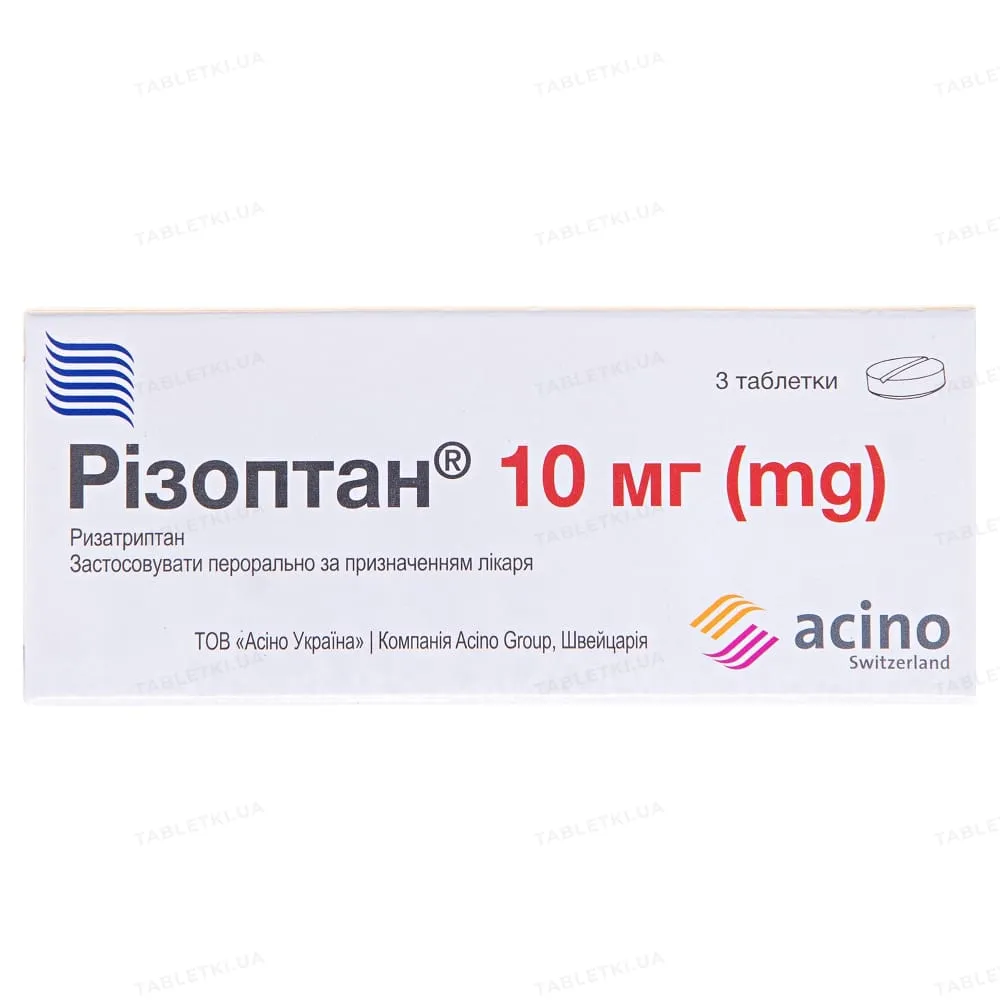
Table of Contents
INSTRUCTION FOR MEDICAL USE OF THE MEDICINAL PRODUCT RIZOPTAN® (RIZOPTAN)
Composition:
Active substance: rizatriptan;
1 tablet contains 14.53 mg of rizatriptan benzoate equivalent to 10 mg of rizatriptan;
Excipients: lactose monohydrate, microcrystalline cellulose, pregelatinized starch, magnesium stearate.
Pharmaceutical form. Tablets.
Main physicochemical properties: white or almost white, round, flat cylindrical tablets, bevelled, with a score on one side.
Pharmacotherapeutic group. Medicinal products used in migraine. Selective serotonin 5-HT1-receptor agonists. Rizatriptan. ATC code N02C C04.
Pharmacological properties.
Pharmacodynamics.
Rizatriptan selectively binds with high affinity to human 5-HT1B and 5-HT1D receptors and has little or no effect or pharmacological activity at 5-HT2, 5-HT3, adrenergic α1-, α2-, or β-receptors, dopaminergic D1 or D2 receptors, histamine H1, muscarinic, or benzodiazepine receptors.
The therapeutic efficacy of rizatriptan in the treatment of migraine headache may be explained by its agonist effect on 5-HT1B and 5-HT1D receptors located on extracerebral intracranial blood vessels, which are believed to dilate during an attack, and on trigeminal sensory nerves innervating these vessels. Activation of 5-HT1B and 5-HT1D receptors may lead to constriction of pain-producing intracranial blood vessels and inhibition of neuropeptide release, resulting in reduced inflammation of sensitive tissues and decreased central trigeminal pain signal transmission.
Pharmacokinetics.
Absorption
After oral administration, rizatriptan is rapidly and completely absorbed. The mean bioavailability of tablets following oral administration is approximately 40–45%, and the mean peak plasma concentration (Cmax) is reached within approximately 1–1.5 hours (Tmax). Administration of rizatriptan with a high-fat breakfast did not affect the extent of absorption, but delayed absorption by approximately one hour.
Effect of food: Tmax is delayed by approximately 1 hour when tablets are taken with food.
Distribution
Rizatriptan is minimally (14%) bound to plasma proteins. The volume of distribution is approximately 140 L in males and 110 L in females.
Biotransformation
The primary metabolic pathway of rizatriptan involves oxidative deamination by monoamine oxidase-A (MAO-A) to form indoleacetic acid metabolite, which is not pharmacologically active. A small amount of N-monodesmethyl-rizatriptan is formed, a metabolite whose activity at 5-HT1B/1D receptors is similar to that of the parent compound, but which does not significantly contribute to the pharmacodynamic activity of rizatriptan. The plasma concentration of N-monodesmethyl-rizatriptan is approximately 14% of the parent compound concentration, and it is eliminated at a similar rate. Other minor metabolites include N-oxide, 6-hydroxy compound, and sulfate conjugate of the 6-hydroxy metabolite. None of these minor metabolites exhibit pharmacological activity.
Elimination
After oral administration of doses above the 2.5–10 mg range, the area under the curve (AUC) increases almost proportionally. In both males and females, the mean plasma half-life of rizatriptan is approximately 2–3 hours. The plasma clearance of rizatriptan averages approximately 1000–1500 mL/min in males and approximately 900–1100 mL/min in females; about 20–30% of this represents renal clearance. Following oral administration of 14C-labeled rizatriptan, approximately 80% of radioactivity is excreted in urine and about 10% of the dose is excreted in feces. This indicates that metabolites are primarily eliminated via the kidneys.
Due to presystemic metabolism, approximately 14% of an oral dose is excreted in urine unchanged, while 51% is excreted as the indoleacetic acid metabolite. No more than 1% is excreted in urine as the active N-monodesmethyl metabolite.
When rizatriptan is administered at maximum recommended doses, no daily accumulation of the drug occurs in plasma.
Characteristics in various patient populations
Patients with migraine attacks. Migraine attacks do not affect the pharmacokinetics of rizatriptan.
Gender. In males, AUC of rizatriptan (10 mg orally) was approximately 25% lower than in females, Cmax was 11% lower, while Tmax was approximately the same. This apparent pharmacokinetic difference is not clinically significant.
Elderly patients. Plasma concentrations of rizatriptan are similar to those in younger patients.
Patients with hepatic impairment (Child-Pugh score 5–6). After oral administration, plasma concentrations of rizatriptan in patients with hepatic impairment were similar to those observed in young male and female subjects in the study. A significant increase in AUC (by 50%) and Cmax (by 25%) was observed in patients with moderate hepatic impairment (Child-Pugh score 7). Pharmacokinetics in patients with severe hepatic impairment (Child-Pugh score >7) have not been studied.
Patients with renal impairment. In patients with renal impairment (creatinine clearance 10–60 mL/min/1.73 m²), AUC of rizatriptan did not differ significantly from AUC in healthy volunteers. In patients undergoing hemodialysis (creatinine clearance <10 mL/min/1.73 m²), AUC of rizatriptan was approximately 44% higher than in patients with normal renal function. Cmax of rizatriptan in plasma in patients with renal impairment of any degree was similar to that in healthy volunteers.
Clinical characteristics.
Indications.
Acute treatment of the headache phase of migraine attacks, with or without aura.
Contraindications.
Hypersensitivity to rizatriptan or to any of the excipients of the medicinal product.
Concomitant use with monoamine oxidase inhibitors (MAO inhibitors) or use within two weeks of discontinuing MAO inhibitor therapy.
Severe hepatic or severe renal insufficiency.
History of cerebrovascular accident or transient ischemic attack.
Moderate or severe arterial hypertension, as well as untreated mild arterial hypertension.
Established coronary artery disease, including ischemic heart disease (angina, history of myocardial infarction, or documented silent ischemia), signs and symptoms of ischemic heart disease, or Prinzmetal's angina.
Peripheral vascular disease.
Concomitant use of rizatriptan with ergotamine, ergot alkaloid derivatives (including methysergide), or other 5-HT1B/1D receptor agonists.
Interaction with other medicinal products and other forms of interaction.
Ergotamine, ergot alkaloid derivatives (including methysergide), other 5-HT1B/1D receptor agonists. Due to additive effects, concomitant use of rizatriptan with ergotamine, ergot alkaloid derivatives (including methysergide), or other 5-HT1B/1D receptor agonists (e.g., sumatriptan, zolmitriptan, naratriptan) increases the risk of coronary artery vasoconstriction and hypertensive effects. Such combinations are contraindicated (see section "Contraindications").
MAO inhibitors. Rizatriptan is primarily metabolized by monoamine oxidase subtype A (MAO-A). Plasma concentrations of rizatriptan and its active N-monodesmethyl metabolite increase when co-administered with a selective, reversible MAO-A inhibitor. A similar or greater effect is expected with non-selective, reversible MAO inhibitors (e.g., linezolid). Due to the risk of coronary spasm and arterial hypertension, rizatriptan is contraindicated in patients taking MAO inhibitors (see section "Contraindications").
Beta-blockers. Plasma concentrations of rizatriptan may increase when co-administered with propranolol. This increase is most likely due to interaction in the primary metabolism of both drugs, as MAO-A plays a role in the metabolism of both rizatriptan and propranolol. This interaction results in an average increase in AUC and Cmax by 70–80%. Patients taking propranolol should receive rizatriptan at a dose of 5 mg (see section "Dosage and administration").
The medicinal products nadolol and metoprolol do not alter rizatriptan plasma concentrations.
Selective serotonin reuptake inhibitors/serotonin-norepinephrine reuptake inhibitors and serotonin syndrome. Cases have been reported in patients with symptoms resembling serotonin syndrome (including altered mental status, autonomic nervous system dysfunction, and neuromuscular disturbances) following concomitant use of serotonin reuptake inhibitors, serotonin-norepinephrine reuptake inhibitors, and triptans (see section "Special precautions for use").
In vitro studies show that rizatriptan inhibits cytochrome P450 2D6 (CYP2D6). Clinical data on such interactions are lacking. Potential interactions should be considered when prescribing rizatriptan to patients taking CYP2D6 substrates.
Special precautions for use.
Rizatriptan should be prescribed only to patients who have a clear diagnosis of migraine. Rizatriptan should not be prescribed to patients with basilar or hemiplegic migraine.
Rizatriptan should not be used to treat atypical headache, i.e., headache that may be associated with potentially serious conditions (e.g., stroke, ruptured aneurysm), in which vasoconstriction of cerebral vessels could be hazardous.
Administration of rizatriptan may be associated with transient symptoms, including chest pain and sensation of chest tightness, which may be intense and involve the throat. If such symptoms raise suspicion of ischemic heart disease, the drug should be discontinued and appropriate evaluation initiated.
Like other 5-HT1B/1D receptor agonists, rizatriptan should not be administered without prior cardiovascular evaluation to patients who may have underlying heart disease or those at risk for coronary artery disease (e.g., patients with hypertension, diabetes mellitus, smokers or those using nicotine replacement therapy; men aged 40 years or older, postmenopausal women, patients with interventricular conduction abnormalities, or those with a family history of serious coronary artery disease). Cardiovascular evaluation may not detect all patients with heart disease, and in very rare cases, serious cardiac complications have occurred in patients without known cardiovascular disorders during administration of 5-HT1 receptor agonists. Rizatriptan is contraindicated in patients with diagnosed coronary atherosclerosis (see section "Contraindications").
5-HT1B/1D receptor agonists have been associated with coronary vasospasm. In some cases, ischemia or myocardial infarction has been reported during use of 5-HT1B/1D receptor agonists.
Other 5-HT1B/1D receptor agonists (e.g., sumatriptan) should not be administered concomitantly with rizatriptan.
It is recommended to wait at least 6 hours after administration of rizatriptan before taking ergotamine-containing medications (e.g., ergotamine, dihydroergotamine, or methysergide). Before administering rizatriptan, ensure that at least 24 hours have passed since the last dose of any ergotamine-containing medication.
Serotonin syndrome (including mental status changes, autonomic instability, and neuromuscular abnormalities) has been reported following concomitant use of triptans and selective serotonin reuptake inhibitors (SSRIs) or serotonin-norepinephrine reuptake inhibitors (SNRIs). These reactions may be serious. If concomitant administration of rizatriptan and SSRIs or SNRIs is clinically indicated, appropriate monitoring of the patient is recommended, especially at the beginning of treatment, during dose escalation, or when adding another serotonergic agent.
Adverse effects occur more frequently during concomitant use of triptans (5-HT1B/1D agonists) and herbal products containing St. John’s wort (Hypericum perforatum).
Angioedema (e.g., facial, tongue, and laryngeal swelling) may occur in patients taking triptans, including rizatriptan. If angioedema of the tongue or pharynx occurs, the patient should remain under medical observation until symptoms resolve. Treatment with triptans should be discontinued immediately and replaced with a medication from another drug class.
The product contains lactose; therefore, patients with rare hereditary problems of galactose intolerance, Lapp lactase deficiency, or glucose-galactose malabsorption should not take this medication.
When prescribing rizatriptan to patients taking CYP2D6 substrates, potential drug interactions should be considered.
Medication-overuse headache
Prolonged use of any analgesic for headache may exacerbate headache. If such a situation occurs (or is suspected), medical advice should be sought and treatment discontinued. Medication-overuse headache should be suspected in patients who experience frequent or daily headaches despite regular use of headache medications.
Use during pregnancy or breastfeeding.
Reproductive function
The effect on human reproductive function has not been studied. Animal studies have shown minimal effects on reproductive function at plasma concentrations substantially exceeding therapeutic concentrations in humans (more than 500-fold higher).
Use during pregnancy
Moderate data from pregnant women (from 300 to 1000 pregnancy cases) indicate no malformative toxicity following rizatriptan use during the first trimester of pregnancy. Animal studies do not indicate reproductive toxicity.
Data on the use of rizatriptan during the second and third trimesters of pregnancy are limited. Rizatriptan may be considered during pregnancy if clinically necessary.
Use during lactation
Rizatriptan is excreted in breast milk in low concentrations, with a mean relative infant dose < 1% (less than 6% in the worst-case scenario based on Cmax in breast milk). Rizatriptan should be used with caution in breastfeeding women. Exposure to the infant should be minimized by avoiding breastfeeding for 12 hours after administration of rizatriptan.
Ability to affect reaction speed when driving or operating machinery.
Migraine itself or administration of rizatriptan may cause somnolence in some patients. Dizziness has also been reported in some patients taking rizatriptan. Therefore, during migraine attacks and after taking rizatriptan, patients should assess their ability to perform complex tasks.
Method of Administration and Dosage.
Administer orally. Do not use RIZOPTAN® for prophylactic purposes.
Tablets should be swallowed whole with liquid.
Food effect: When taken with food, absorption of rizatriptan is delayed by approximately 1 hour. Therefore, the onset of the drug's effect may be delayed if taken in a fed state (see also section "Pharmacological properties").
The recommended dose is 10 mg.
Repeat dosing: the next dose may be taken no sooner than 2 hours after the previous one; no more than two doses should be taken within a 24-hour period.
- For recurrent headache within the following 24 hours: if headache returns after initial relief, another dose may be taken. The above-mentioned dosing guidelines must be followed.
- In the absence of effect: the efficacy of a repeat dose for treating the same attack when the first dose was ineffective has not been studied during rizatriptan trials. Therefore, if no therapeutic effect occurs after the first dose, a second dose should not be taken to treat the same attack.
Clinical studies of rizatriptan have shown that even if no therapeutic effect occurs during one attack, there remains a possibility of achieving a therapeutic effect during subsequent attacks.
Some patients may require a lower dose of RIZOPTAN® (5 mg), particularly the following patient groups:
- patients taking propranolol (rizatriptan should be taken no sooner than 2 hours after propranolol);
- patients with mild to moderate renal impairment;
- patients with mild to moderate hepatic impairment.
The interval between two doses should be at least 2 hours; no more than 2 doses should be taken within a 24-hour period.
Patients aged 65 years and older
The efficacy and safety of rizatriptan in patients aged 65 years and older have not been systematically studied.
Children.
The efficacy and safety of RIZOPTAN® in children (under 18 years of age) have not been established.
Overdose.
Rizatriptan 40 mg (administered as a single dose or two doses with a 2-hour interval between doses) was generally well tolerated; the most common adverse effects were dizziness and somnolence.
In a clinical pharmacology study in which 12 adult subjects received a total cumulative dose of 80 mg rizatriptan (over 4 hours), two subjects experienced loss of consciousness and/or bradycardia. In one subject, a 29-year-old woman, vomiting, bradycardia, and dizziness were observed 3 hours after a total of 80 mg rizatriptan (administered over 2 hours). Following these symptoms, third-degree atrioventricular block occurred, which was responsive to atropine. In the second subject, a 25-year-old man, transient dizziness, loss of consciousness, urinary incontinence, and a 5-second systolic pause (on ECG monitoring) occurred immediately after a painful venipuncture. The venipuncture was performed 2 hours after the subject had received a cumulative dose of 80 mg rizatriptan (administered over 4 hours).
After overdose, hypertension or other more serious cardiovascular symptoms may occur. Patients suspected of rizatriptan overdose should undergo gastrointestinal decontamination (e.g., gastric lavage, followed by activated charcoal). After this, clinical and electrocardiographic monitoring should be conducted for at least 12 hours, even if no clinical symptoms are present.
The effect of hemodialysis and peritoneal dialysis on rizatriptan plasma concentration is unknown.
Side effects.
The most commonly observed side effects are dizziness, somnolence, and weakness/fatigue. The frequency of adverse reactions is defined as follows: very common (≥1/10), common (≥1/100, <1/10), uncommon (≥1/1,000, <1/100), rare (≥1/10,000, <1/1,000), very rare (≤1/10,000), frequency not known (cannot be estimated from the available data).
Immune system disorders: rare – allergic reactions, anaphylaxis/anaphylactoid reaction.
Psychiatric disorders: common – insomnia; uncommon – confusion, irritability.
Nervous system disorders: common – dizziness, somnolence, paresthesia, headache, hypoesthesia, decreased mental alertness; uncommon – ataxia, tremor, vertigo, dysgeusia/unpleasant taste, loss of consciousness; frequency not known – seizures, serotonin syndrome.
Eye disorders: uncommon – blurred vision.
Cardiac and vascular disorders: common – palpitations, flushing; uncommon – arrhythmia, tachycardia, ECG changes, hypertension; rare – cerebrovascular disorders (according to reports, most of these adverse reactions occurred in patients with risk factors for coronary artery disease), bradycardia; frequency not known – myocardial ischemia or infarction (according to reports, most of these adverse reactions occurred in patients with risk factors for coronary artery disease), peripheral vascular ischemia.
Respiratory, thoracic and mediastinal disorders: common – throat discomfort; uncommon – dyspnea; rare – wheezing.
Gastrointestinal disorders: common – nausea, dry mouth, vomiting, diarrhea, dyspepsia; uncommon – thirst; frequency not known – ischemic colitis.
Skin and subcutaneous tissue disorders: common – erythema; uncommon – pruritus, urticaria, angioneurotic edema (e.g., facial, tongue, and pharyngeal edema), rash, increased sweating; frequency not known – toxic epidermal necrolysis.
Musculoskeletal and connective tissue disorders: common – heaviness, stiffness, neck pain; uncommon – rigidity, muscle weakness, facial pain, myalgia.
General disorders: common – asthenia/fatigue, abdominal or chest pain.
Shelf life. 3 years.
Do not use the medicinal product after the expiry date stated on the packaging.
Storage conditions. Store in the original packaging, in a place inaccessible to children, at a temperature not exceeding 25 °C.
Packaging. 3 tablets in a blister; 1, 2, or 3 blisters in a cardboard box; 10 tablets in a blister; 1 blister in a cardboard box.
Prescription status. Prescription only.
Manufacturer. LLC "Pharma Start".
Manufacturer's address and place of business. 8 Vatslava Havela Boulevard, Kyiv, 03124, Ukraine.