Rieko
Ukraine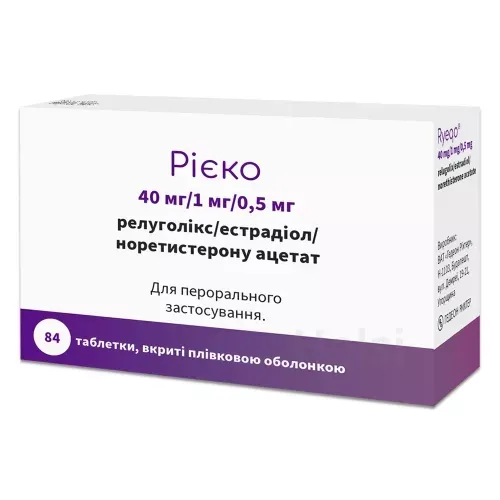
Table of Contents
INSTRUCTIONS FOR MEDICAL USE OF THE MEDICINAL PRODUCT RYEQO (RYEQO®)
Composition:
Active substances: relugolix, estradiol (as estradiol hemihydrate), norethisterone acetate;
1 tablet contains 40 mg of relugolix, 1 mg of estradiol (as estradiol hemihydrate), and 0.5 mg of norethisterone acetate;
Excipients: mannitol (E 421), sodium starch glycolate (type A), hydroxypropylcellulose, lactose monohydrate, magnesium stearate;
Film coating: Opadry II Yellow (hypromellose 2910, titanium dioxide (E 171), lactose monohydrate, triacetin, iron oxide yellow (E 172)).
Pharmaceutical form. Film-coated tablets.
Main physicochemical properties: round, film-coated tablets of light yellow to yellow color, with "415" engraved on one side and a smooth surface on the other.
Pharmacotherapeutic group. Pituitary and hypothalamic hormones and their analogues. Antigonadotropin-releasing hormone agents. ATC code H01CC54.
Pharmacological properties.
Pharmacodynamics.
Mechanism of action
Relugolix is a non-peptide antagonist of gonadotropin-releasing hormone (GnRH) that binds to and blocks GnRH receptors in the anterior pituitary. In humans, blockade of GnRH receptors leads to a dose-dependent reduction in the release of luteinizing hormone (LH) and follicle-stimulating hormone (FSH) from the anterior pituitary, resulting in decreased serum concentrations of LH and FSH. The reduction in FSH levels prevents follicular growth and maturation, thereby reducing estrogen production. Suppression of LH release inhibits ovulation and corpus luteum development, thus preventing progesterone production. Consequently, treatment with Ryeqo provides adequate contraception when taken for at least 1 month (see section "Posology and method of administration").
Estradiol is identical to the endogenous hormone and acts as a potent agonist of nuclear estrogen receptor subtypes. Exogenously administered estradiol alleviates symptoms associated with reduced estrogen levels, such as vasomotor symptoms and loss of bone mineral density.
Norethisterone acetate is a synthetic progestogen. Since estrogens promote endometrial growth, unopposed estrogen therapy increases the risk of endometrial hyperplasia and cancer. The addition of a progestogen reduces the estrogen-induced risk of endometrial hyperplasia in women with an intact uterus.
Effects on pituitary and ovarian hormones
After administration of relugolix, a rapid, dose-dependent decrease in serum concentrations of LH, FSH, and estradiol is observed. Near-maximal suppression of estradiol concentrations is achieved with a 40 mg dose, bringing levels into the postmenopausal range. During clinical trials, mean estradiol concentrations remained consistently at least 10 pg/mL higher with Ryeqo compared to relugolix monotherapy. In Phase 3 clinical trials of Ryeqo in patients with uterine fibroids, mean estradiol concentrations at trough after 24 weeks were approximately 33 pg/mL, and approximately 38 pg/mL in women with endometriosis, corresponding to estradiol levels in the early follicular phase of the menstrual cycle. During treatment with Ryeqo, progesterone levels remained at < 3.0 ng/mL in both populations.
Effect on ovulatory function
In one cohort study in healthy premenopausal women, once-daily administration of Ryeqo for 84 days significantly suppressed follicular growth throughout the entire 84-day treatment period (mean dominant follicle size was approximately 6 mm), and ovulation was inhibited in 100% of women based on the Hoggland-Skubik scale. After discontinuation of treatment, ovulation resumed within 43 days (on average within 23.5 days) in all evaluated women (66 out of 67).
Uterine fibroids
Efficacy and safety over 24 weeks
The efficacy and safety of once-daily Ryeqo in patients with uterine fibroids were evaluated in two replicate, 24-week, multinational, randomized, double-blind, placebo-controlled trials conducted in women aged 18 to 50 years with heavy menstrual bleeding associated with uterine fibroids (Studies L1 and L2). Women had ultrasound-confirmed uterine fibroids and menstrual blood loss (MBL) ≥ 80 mL measured by the alkaline hematin method.
In both studies, there were three treatment groups: women were randomized to receive either relugolix 40 mg plus estradiol 1 mg and norethisterone acetate 0.5 mg (Ryeqo) for 24 weeks, placebo for 24 weeks, or relugolix 40 mg for 12 weeks followed by relugolix 40 mg combined with estradiol and norethisterone acetate for an additional 12 weeks. The mean age of women was 42 years, and the mean body mass index was 31.7 kg/m². Approximately 49.4% of women were of Black race, 44.7% were of White race, and 5.9% were of other races.
Reduction of heavy menstrual bleeding
In both studies, a statistically significant higher proportion of responders—defined as having MBL < 80 mL and a reduction in MBL of at least 50% from baseline—was observed in women receiving Ryeqo compared to those receiving placebo (see Table 1). Reduction in MBL was evident at the first assessment (Week 4). Results for other secondary bleeding-related endpoints are shown in Table 1. All key secondary endpoints were alpha-controlled.
Table 1
Results of primary and selected secondary efficacy assessments in Study L1 and Study L2 (uterine fibroids)
| Parameter |
Study L1 |
Study L2 |
||
| Riyequo (N = 128) |
Placebo (N = 127) |
Riyequo (N = 125) |
Placebo (N = 129) |
|
| Number (%) of respondersb |
94 (73.4%) |
24 (18.9%) |
89 (71.2%) |
19 (14.7%) |
| Number (%) of patients with MB < 80 mL |
97 (75.8%) |
34 (26.8%) |
97 (73.6%) |
25 (19.4%) |
| Number (%) of patients with reduction in MB volume by ≥ 50% |
101 (78.9%) |
28 (22.1%) |
96 (76.8%) |
28 (21.7%) |
| Number (%) of patients with amenorrheab,c |
67 (52.3%) |
7 (5.5%) |
63 (50.4%) |
4 (3.1%) |
| Number (%) of patients with hemoglobin increase > 2 g/dLd |
15 (50.0%) |
5 (21.7%) |
19 (61.3%) |
2 (5.4%) |
| Number (%) of patients achieving HbA1c ≤ 1b,e |
25 (43.1%) |
7 (10.1%) |
32 (47.1%) |
14 (17.1%) |
| Percentage change from baseline in uterine fibroid volume |
-12.4 (5.62) |
-0.3 (5.40) |
-17.4 (5.93) |
-7.4 (5.92) |
| Percentage change in uterine volume |
-12.9 (3.08) |
2.2 (3.01) |
-13.8 (3.39) |
-1.5 (3.37) |
a Respondent is a woman with menstrual blood loss (MBL) < 80 mL and a reduction in MBL volume of at least 50% compared to baseline within the last 35 days of treatment.
b p-value < 0.0001 – comparison of Ryequo versus placebo, stratified by baseline MBL volume (< 225 mL, ≥ 225 mL) and geographic region (North America, rest of the world).
c Amenorrhea is defined as recorded amenorrhea, spotting, or minimal bleeding (MBL < 5 mL) with compliance supported by electronic diary entries during two consecutive visits.
d In patients with baseline hemoglobin ≤ 10.5 g/dL.
e In patients with moderate or severe pain at baseline.
Abbreviations: MBL – menstrual blood loss; NRS – numerical rating scale.
Endometriosis
Efficacy and safety of treatment over 24 weeks
The efficacy and safety of Ryequo administered once daily in female patients with endometriosis were evaluated in two 24-week, international, randomized, double-blind, placebo-controlled, repeat-design studies involving women aged 18–50 years with moderate or severe endometriosis-associated pain (Studies S1 and S2), confirmed by direct visualization during surgical intervention and/or histological examination. Pain (moderate or severe) was assessed using an 11-point numerical rating scale (NRS).
Both studies included three treatment groups. Women were randomized to receive either relugolix 40 mg in combination with estradiol 1 mg and norethisterone acetate 0.5 mg (E2/NETA) (Ryequo) for 24 weeks, placebo for 24 weeks, or relugolix 40 mg for 12 weeks followed by transition to combination therapy with relugolix 40 mg and E2/NETA for 12 weeks. Patients were included in the study if they had moderate or severe pain prior to screening and through the end of the run-in period (i.e., at least two cycles). In Studies S1 and S2, 83.2% of participants had previously undergone surgery/invasive treatment for endometriosis, while 8% had no prior surgical or medical treatment reported before study enrollment. At baseline, the majority of patients (92.6%) were using analgesics to manage pelvic pain, with 29.1% of patients in Study S1 and 48.4% in Study S2 using opioid analgesics. Other medications most commonly used for endometriosis treatment included dienogest (19.4%), combined oral contraceptives containing estrogen and progestin (15.2%), and GnRH agonists (7.6%). Median patient age was 34 years, and mean body mass index was 26 kg/m². Approximately 91% of women were Caucasian, 6% were Black, and 3% had other racial backgrounds.
Reduction in dysmenorrhea and non-menstrual pelvic pain
Studies S1 and S2 included two co-primary composite endpoints, each consisting of two components. In both studies, there was a statistically significant increase in the proportion of patients who responded to treatment. A treatment responder was defined as a patient who achieved a reduction in dysmenorrhea score of at least 2.8 points and a reduction in non-menstrual pelvic pain score of at least 2.1 points during the last 35 days of treatment, without an increase in the use of analgesics (ibuprofen or opioids) (Table 2).
Table 2
Results for the two co-primary composite efficacy endpoints in Studies S1 and S2 (endometriosis)
| Definition of endpoint |
Study S1 |
Study S2 |
||
| Riiekko (N = 212) |
Placebo (N = 212) |
Riiekko (N = 206) |
Placebo (N = 204) |
|
| Number (%) of patients who responded to treatment based on dysmenorrhea assessmenta,c |
158 (74.5%) |
57 (26.9%) |
155 (75.2%) |
62 (30.4%) |
| Number (%) of patients who responded to treatment based on non-menstrual pelvic pain assessment (NMPP)b,c |
124 (58.5%) |
84 (39.6%) |
136 (66.0%) |
87 (42.6%) |
a Patients were considered to have responded to treatment if there was a reduction of at least 2.8 points on the NRS dysmenorrhea score without an increase in the use of analgesics permitted in the study for relief of pelvic pain by Week 24/end of treatment.
b Patients were considered to have responded to treatment if there was a reduction of at least 2.1 points on the non-menstrual pelvic pain (NMPP) NRS score without an increase in the use of analgesics permitted in the study for relief of pelvic pain by Week 24/end of treatment.
c P-value < 0.0001 for comparison of Relugolix versus placebo, adjusted for baseline pain score, time since surgical diagnosis of endometriosis, and geographic region.
Abbreviations: N – number of patients; NMPP – non-menstrual pelvic pain; NRS – numerical rating scale (0 points – no pain; 10 points – pain as intense as can be imagined).
Results of the analysis of key secondary efficacy endpoints are presented in Table 3. All key secondary endpoints were controlled for alpha-level significance.
Table 3
Results of the analysis of selected secondary efficacy endpoints in Studies S1 and S2 (endometriosis)
| Definition of endpoint |
Study S1 |
Study S2 |
||
| Riiekko (N = 212) |
Placebo (N = 212) |
Riiekko (N = 206) |
Placebo (N = 204) |
|
| Change in EHP-30 questionnaire pain score, LS-mean (SE)a,b |
-33.8 (1.83) |
-18.7 (1.83) |
-32.2 (1.68) |
-19.9 (1.69) |
| Change in mean dysmenorrhea rating on NRS, LS-mean (SE)a,b |
-5.1 (0.19) |
-1.8 (0.19) |
-5.1 (0.19) |
-2.0 (0.19) |
| Change in mean non-menstrual pelvic pain rating on NRS, LS-mean (SE)a,b |
-2.9 (0.18) |
-2.0 (0.18) |
-2.7 (0.17) |
-2.0 (0.17) |
| Change in mean dyspareunia rating on NRS, LS-mean (SE)a,b |
-2.4 (0.21) |
-1.7 (0.22) |
-2.4 (0.19) |
-1.9 (0.19) |
| Proportion of patients who did not use protocol-allowed opioid analgesics for endometriosis-related pain, n (%)c |
182 (85.8%) |
162 (76.4%) |
169 (82.0%) |
135 (66.2%) |
a LSM values were calculated using a mixed-effects model with repeated measures, in which treatment, baseline value, visit, geographic region (North America, rest of the world), time since surgical diagnosis of endometriosis (< 5 years, ≥ 5 years), and treatment-by-visit interaction were included as fixed effects; visit was also included in the model as a random effect for each patient. An unstructured covariance matrix was assumed.
b Change from baseline to Week 24/EOT.
c At Week 24/EOT.
Abbreviations: EOT – end of treatment; LSM – least squares mean; N – number of patients; NMPP – non-menstrual pelvic pain; NRS – numerical rating scale; SE – standard error.
Bone Mineral Density (BMD) Measurements over 104 Weeks
The effect of Ryequo on BMD was assessed using dual-energy X-ray absorptiometry (DXA) at Weeks 12, 24, 36, 52, and 104. Overall, 477 women with uterine fibroids who completed the 24-week core studies (Studies L1 and L2) were enrolled into a 28-week single-arm open-label study (Study L3), in which all women received Ryequo. A total of 228 women who completed the extension study were enrolled into an additional 52-week study (randomized withdrawal study), where they were re-randomized to receive either Ryequo or placebo. Overall, 802 women with endometriosis who completed the 24-week core studies (Studies S1 and S2) were enrolled into a treatment continuation study (Study S3), in which all patients received Ryequo. BMD assessments at 104 weeks in women with uterine fibroids and endometriosis are presented in Table 4.
Table 4
Bone Mineral Density (BMD) Measurements over 104 Weeks in Patients with Uterine Fibroids and Endometriosis
| Parameter |
Riaquo (N = 672) |
Placebo (N = 672) |
| Lumbar spine (L1–L4) |
||
| Study L1 and L2, S1 and S2 |
||
| Week 12 |
||
| N |
553 |
545 |
| Change in BMD-mean (%)a |
-0.56 |
0.15 |
| (95% CI) |
(-0.77; -0.36) |
(-0.05; 0.36) |
| Week 24 |
||
| N |
528 |
516 |
| Change in BMD-mean (%)a |
-0.59 |
0.13 |
| (95% CI) |
(-0.82; -0.37) |
(-0.09; 0.36) |
| Study L3 and S3 |
Riaquo |
Placebo Riaquo |
| Week 36 |
||
| N |
387 |
379 |
| Change in BMD-mean (%)a |
-0.66 |
-0.00 |
| (95% CI) |
(-0.93; -0.40) |
(-0.27; 0.26) |
| Week 52 |
||
| N |
365 |
351 |
| Change in BMD-mean (%)a |
-0.69 |
-0.30 |
| (95% CI) |
(-1.00; -0.38) |
(-0.61; 0.01) |
| Randomized withdrawal study and study S3 |
Riaquo |
Placebob |
| Week 104 |
||
| N |
221 |
229 |
| Change in BMD-mean (%)a |
-0.40 |
-0.18 |
| (95% CI) |
(-0.82; 0.02) |
(-0.60; 0.23) |
Abbreviations: LS – least squares; CI – confidence interval; N – number of patients.
a Percentage change from baseline.
b The majority of patients randomized to the placebo group in the randomized drug-withdrawal study received Ryeqo for approximately two cycles after resumption of heavy menstrual bleeding.
In the Ryeqo group, the least squares mean percentage change in BMD at the lumbar spine at Weeks 52 and 104 was –0.69% and –0.40%, respectively.
Over 12 months following discontinuation of Ryeqo, all women with endometriosis who met criteria for BMD loss showed recovery or a trend toward recovery of BMD at the lumbar spine.
BMD measurements over 12 weeks in women receiving relugolix monotherapy for the treatment of uterine fibroids or endometriosis
In women receiving relugolix monotherapy for 12 weeks in studies L1, L2, S1, and S2, BMD at the lumbar spine decreased by 1.86% from baseline. The difference in percentage change in BMD between women receiving Ryeqo and those receiving relugolix monotherapy at Week 12 was statistically significant, demonstrating the effectiveness of relugolix in combination with estradiol/norethisterone acetate (Ryeqo) in reducing bone mass loss.
To analyze the effect of Ryeqo on the percentage change in BMD over 52 weeks of treatment, an observational study was conducted involving untreated women with uterine fibroids and endometriosis, matched by age, to assess longitudinal BMD in premenopausal women aged 18 to 50 years (historical study). Over 52 weeks of observation, minimal changes in BMD were observed in the Ryeqo cohort compared to the control cohort of age-matched, premenopausal women with uterine fibroids or endometriosis.
Effect on the endometrium
During clinical studies in women who received Ryeqo for up to 52 weeks, endometrial biopsies showed no cases of endometrial hyperplasia or endometrial cancer.
Pharmacokinetics
Pharmacokinetic parameters of relugolix, estradiol, total estrone, and norethisterone after single oral administration of one tablet of Ryeqo under fasting conditions in healthy postmenopausal women are presented in Table 5.
Table 5
Pharmacokinetic parameters of relugolix, estradiol, total estrone, and norethisterone after single-dose administration in postmenopausal women
| Parameter |
Relugolix |
Estradiol |
Unconjugated estrone |
Norethisterone |
| AUC 0-∞ (ng*hr/mL or pg*hr/mL) |
198.1 (111.6) |
818.7 (334.4) |
4126 (1650) |
17.5 (8.46) |
| Cmax (ng/mL or pg/mL) |
25.99 (18.21) |
27.95 (19.15) |
188.4 (59.09) |
3.57 (1.43) |
| Tmax (hr) |
2.00 (0.25; 5.00) |
7.00 (0.25; 24.00) |
6.00 (2.00; 12.00) |
1.01 (0.50; 4.00) |
| Terminal t1/2 (hr) |
61.5 (13.2) |
16.6 (7.67) |
15.9 (6.52) |
10.9 (3.05) |
Abbreviations: AUC0–∞ – area under the pharmacokinetic concentration–time curve from extrapolated time zero to infinity; Cmax – maximum observed concentration; Tmax – time to maximum observed concentration; t1/2 – elimination half-life.
Note: Pharmacokinetic parameters for estradiol and unconjugated estrone, baseline-corrected, are presented in this table. Arithmetic means and standard deviations are shown, except for Tmax, where median and range (minimum, maximum) are presented. AUC0–∞ is expressed in ng*h/mL for relugolix and norethisterone and in pg*h/mL for unconjugated estradiol and unconjugated estrone. Cmax is expressed in ng/mL for relugolix and norethisterone and in pg/mL for unconjugated estradiol and unconjugated estrone.
Pharmacokinetic parameters of relugolix, estradiol, total estrone, and norethisterone at steady state following 6 weeks of once-daily administration of Ryeqo in healthy premenopausal women are presented in Table 6.
Table 6
Pharmacokinetic parameters of relugolix, estradiol, total estrone, and norethisterone after multiple dosing in premenopausal women
| Parameter |
Relugolix |
Estradiol |
Unconjugated estrone |
Norethisterone |
| AUC0-24 (ng*hr/mL or pg*hr/mL) |
157 (94.7) |
784 (262) |
4450 (1980) |
25.5 (11.4) |
| Cmax (ng/mL or pg/mL) |
26 (21.4) |
46.8 (17.3) |
303 (137) |
5.21 (1.53) |
| Tmax (hr) |
3 (0.5; 6) |
3 (0.50; 12.00) |
4 (1; 8.08) |
1 (1; 2) |
| Effective t1/2 (hr) |
~ 25 |
17.1 (4.03) |
13.9 (4.14) |
8.28 (1.87) |
Abbreviations: AUC0-24 – area under the pharmacokinetic concentration–time curve over the dosing interval (24 hours); Cmax – maximum observed concentration; Tmax – time to maximum observed concentration.
Note: Arithmetic means and standard deviations are presented, except for Tmax, where median and range (minimum, maximum) are shown. AUC0-24 is presented in ng*h/mL for relugolix and norethisterone and in pg*h/mL for unconjugated estradiol and unconjugated estrone. Cmax is presented in ng/mL for relugolix and norethisterone and in pg/mL for unconjugated estradiol and unconjugated estrone. The effective half-life of relugolix is estimated from accumulation ratios based on AUC values after multiple doses of 40 mg relugolix.
Absorption
Relugolix absorption after oral administration is primarily mediated by the P-gp transporter, for which relugolix is a substrate. After oral administration, relugolix is rapidly absorbed, reaching an initial peak at 0.25 hours after dosing, followed by one or more subsequent absorption peaks at approximately 12 hours post-dose. The absolute bioavailability of relugolix is 11.6%. Following administration of Ryeqo with a high-fat, high-calorie meal, AUC0-∞ and Cmax of relugolix were reduced by 38% and 55%, respectively, compared to fasting conditions.
After a single oral dose of Ryeqo administered under fasting conditions, unconjugated estradiol concentrations increased slowly, with mean concentrations reaching peak levels 8 hours after dosing. When Ryeqo was administered after a high-fat, high-calorie meal, no clinically relevant effect on estradiol or estrogenic metabolites was observed.
After oral administration, norethisterone acetate is rapidly biotransformed in the intestine and liver to norethisterone. After a single oral dose of Ryeqo administered under fasting conditions, norethisterone was first quantifiable at 0.5 hours post-dose, followed by a rapid increase in concentration, reaching peak levels within 1 hour.
Effect of food intake
Food intake reduces AUC and Cmax of relugolix by 38% and 55%, respectively, compared to fasting; however, the reduction in relugolix exposure is considered clinically not significant. No clinically relevant food effect on the exposure of estradiol, estrogenic metabolites, or norethisterone was observed.
Distribution
Relugolix is 68–71% bound to human plasma proteins, with an average whole blood to plasma ratio of 0.78. Circulating estradiol and norethisterone are similarly bound to sex hormone-binding globulin (SHBG; 36–37%) and albumin (61%), with only approximately 1–2% remaining unbound. The relative volume of distribution (Vz) of 19 × 10³ L, derived from an absolute bioavailability study after intravenous administration, indicates that relugolix is widely distributed into tissues. The distribution of exogenous and endogenous estradiol is similar. Estrogens are widely distributed throughout the body and generally reach higher concentrations in hormone target organs.
Biotransformation
In vitro studies indicate that the primary CYP enzymes contributing to the overall hepatic oxidative metabolism of relugolix are CYP3A4/5 (45%) > CYP2C8 (37%) > CYP2C19 (<1%), with oxidative metabolites, metabolite-A and metabolite-B, formed by CYP3A4/5 and CYP2C8, respectively.
The metabolism of exogenous and endogenous estradiol is similar. Estradiol metabolism occurs primarily in the liver and intestine, as well as in target organs, and includes the formation of less active or inactive metabolites, such as estrone, catecholestrogens, and several estrogen sulfates and glucuronides. Estrogens are excreted in bile, hydrolyzed, and reabsorbed (enterohepatic recirculation), and are primarily eliminated in urine in biologically inactive forms. Oxidation of estrone and estradiol is mediated by cytochrome P450 enzymes, primarily CYP1A2, CYP1A2 (extrahepatic), CYP3A4, CYP3A5, as well as CYP1B1 and CYP2C9.
The major metabolites of norethisterone are 5α-dihydronorethisterone and tetrahydro-norethisterone isomers, which are primarily excreted in urine as sulfate or glucuronide conjugates.
Elimination
After absorption, approximately 20% of relugolix is excreted unchanged in urine, and 80% is eliminated after metabolism via several minor metabolic pathways and/or unchanged in bile. Approximately 38% of the administered dose is excreted as metabolites (excluding metabolite-C) in feces and urine. Metabolite-C, formed by gut microbiota, is the major metabolite in feces (51%) and reflects unabsorbed active substance.
The mean terminal elimination half-life (t1/2) of relugolix, estradiol, and norethisterone after a single dose of Ryeqo is 61.5 hours, 16.6 hours, and 10.9 hours, respectively. Steady-state levels of relugolix are reached after 12–13 days of once-daily administration. The extent of accumulation of relugolix with once-daily dosing is approximately 2-fold, indicating an effective half-life of approximately 25 hours, allowing for once-daily dosing.
Accumulation of estradiol and norethisterone with once-daily administration is known to range from 33% to 47%. When co-administered with relugolix, a weak inducer of intestinal (first-pass) CYP3A-mediated metabolism, accumulation of estradiol is expected to be similar or slightly lower.
Linearity/Non-linearity
Administration of relugolix results in more than dose-proportional increases in exposure over the dose range of 1 to 80 mg, most pronounced at doses above 20 mg. This is considered to be due to saturation of intestinal P-gp, leading to increased oral bioavailability.
The pharmacokinetics of 40 mg relugolix administered once daily are independent of time.
Special patient populations
Pharmacokinetic parameters after single-dose administration did not differ between healthy Caucasian and Japanese volunteers, indicating no ethnic dependence of relugolix pharmacokinetics. Population pharmacokinetic analysis indicates no clinically relevant differences in relugolix exposure based on age, race or ethnicity, body weight, or BMI. Since both estradiol and norethisterone acetate are well-established components of hormonal combination medicinal products, specific studies in special patient populations were not conducted.
Renal impairment
After a single 40 mg dose of relugolix in patients with severe renal impairment, AUC0-∞ and Cmax of relugolix increased by 1.5- and 1.1-fold, respectively, compared to healthy volunteers with normal renal function. After a single 40 mg dose of relugolix in patients with moderate renal impairment, AUC0-∞ and Cmax of relugolix increased by 1.5-fold compared to healthy volunteers with normal renal function. Mild renal impairment had no significant effect on any pharmacokinetic parameters of relugolix in the population pharmacokinetic study. Although Ryeqo should be used with caution in patients with moderate or severe renal impairment (see section "Special precautions for use"), dose adjustment of Ryeqo is not required in patients with mild, moderate, or severe renal impairment (see section "Dosage and administration").
The effect of end-stage renal disease with or without hemodialysis on the pharmacokinetics of estradiol, norethisterone, and relugolix components of Ryeqo in premenopausal women has not been evaluated. The amount of relugolix, estradiol, or norethisterone removed by hemodialysis is unknown.
Hepatic impairment
Ryeqo must not be administered to patients with severe hepatic impairment (see section "Contraindications"). Dose adjustment of Ryeqo is not required in patients with mild or moderate hepatic impairment (see section "Dosage and administration"). After a single 40 mg dose of relugolix in patients with mild hepatic impairment, AUC0-∞ and Cmax of relugolix decreased by 31% and 24%, respectively, compared to healthy volunteers with normal hepatic function. After a single 40 mg dose of relugolix in patients with moderate hepatic impairment, AUC0-∞ of relugolix decreased by 5%, and Cmax increased by 1.2-fold compared to healthy volunteers with normal hepatic function.
Preclinical safety data
Preclinical studies of relugolix in combination with estradiol and norethisterone acetate have not been conducted. Preclinical data reveal no special hazard for humans based on conventional studies of pharmacological safety, repeated-dose toxicity, genotoxicity, and carcinogenic potential.
Reproductive toxicity and development
In pregnant rabbits receiving oral relugolix during the period of organogenesis, spontaneous abortions and overall litter loss were observed at exposure levels (AUC) comparable to those achieved at the recommended human dose of 40 mg/day. In rats, no effect on embryofetal development was observed; however, relugolix does not significantly interact with GnRH receptors in this species.
In experimental animals, estradiol or estradiol valerate showed embryolethal effects even at relatively low doses; developmental abnormalities of the urogenital tract and feminization of male fetuses were observed.
Norethisterone, like other progestogens, caused virilization of female fetuses in rats and monkeys. High doses of norethisterone were associated with embryolethal effects.
Lactation
In lactating rats administered a single oral dose of 30 mg/kg radiolabeled relugolix on day 14 postpartum, relugolix and/or its metabolites were present in milk at concentrations 10 times higher than those in plasma 2 hours after dosing. By 48 hours after dosing, their levels had decreased. Most of the radioactivity detected in milk after administration of radiolabeled relugolix was due to unchanged relugolix.
Clinical characteristics.
Indications.
Reyco is indicated for adult women of reproductive age:
- for the treatment of moderate to severe symptoms of uterine fibroids;
- for symptomatic treatment of endometriosis in women who have previously received medical or surgical therapy for endometriosis (see section "Pharmacodynamics").
Contraindications.
- Hypersensitivity to the active substance(s) or to any of the excipients (see section "Composition").
- Current or past venous thromboembolism (e.g., deep vein thrombosis, pulmonary embolism).
- Current or past arterial thromboembolic cardiovascular disease (e.g., myocardial infarction, stroke, angina pectoris).
- Diagnosed thrombophilic disorders (e.g., protein C, protein S or antithrombin deficiency, or activated protein C resistance, including factor V Leiden mutation) (see section "Special precautions").
- Diagnosed osteoporosis.
- Headaches with focal neurological symptoms or migraine headaches with aura (see section "Special precautions").
- Known hormone-dependent malignant tumors (e.g., breast or genital tract cancers) or suspicion thereof.
- Current or past benign or malignant liver tumors (see section "Special precautions").
- Severe hepatic disease, current or in history (until normalization of liver function laboratory parameters).
- Pregnancy or suspected pregnancy, and breastfeeding (see section "Use during pregnancy or breastfeeding").
- Vaginal bleeding of unknown etiology.
- Concomitant use of hormonal contraceptives.
Interaction with other medicinal products and other forms of interaction.
Recommendations regarding interactions with Reyco are based on evaluations of interactions with individual components of the product.
Effect of other medicinal products on components of Reyco
Relugolix
Oral P-glycoprotein (P-gp) inhibitors
Concomitant administration of Reyco with oral P-gp inhibitors is not recommended. Relugolix is a P-gp substrate (see section "Pharmacokinetics"); in a drug interaction study with erythromycin, a P-gp and moderate cytochrome P450 (CYP) 3A4 inhibitor, the area under the pharmacokinetic curve (AUC) and maximum concentration (Cmax) of relugolix increased by 4.1- and 3.8-fold, respectively. Exposure to relugolix may increase when co-administered with P-gp inhibitors, including certain anti-infective agents (such as erythromycin, clarithromycin, gentamicin, tetracycline), antifungal agents (ketoconazole, itraconazole), antihypertensive agents (e.g., carvedilol, verapamil), antiarrhythmic agents (e.g., amiodarone, dronedarone, propafenone, quinidine), antianginal agents (e.g., ranolazine), cyclosporine, human immunodeficiency virus (HIV) or hepatitis C virus (HCV) protease inhibitors (e.g., ritonavir, telaprevir). If concomitant administration with oral P-gp inhibitors once or twice daily is necessary (e.g., azithromycin), Reyco should be taken first, and the P-gp inhibitor should be delayed by at least 6 hours, with more frequent monitoring for adverse reactions.
Strong inducers of cytochrome P450 3A4 (CYP3A4) and/or P-gp
Concomitant use of Reyco with strong inducers of CYP3A4 and/or P-gp is not recommended. In a clinical interaction study with rifampicin, a strong inducer of CYP3A4 and P-gp, Cmax and AUC of relugolix decreased by 23% and 55%, respectively. Medicinal products that strongly induce CYP3A4 and/or P-gp, such as anticonvulsants (e.g., carbamazepine, topiramate, phenytoin, phenobarbital, primidone, oxcarbazepine, felbamate), anti-infective agents (e.g., rifampicin, rifabutin, griseofulvin), St. John’s wort (Hypericum perforatum), bosentan, HIV or HCV protease inhibitors (e.g., ritonavir, boceprevir, telaprevir), and non-nucleoside reverse transcriptase inhibitors (e.g., efavirenz), may reduce plasma concentrations of relugolix and diminish its therapeutic effect.
CYP3A4 inhibitors
Concomitant administration of relugolix with strong CYP3A4 inhibitors that do not inhibit P-gp (voriconazole) did not increase exposure to relugolix. Additionally, in a clinical interaction study, co-administration with atorvastatin, a weak inhibitor of CYP3A4, did not clinically significantly alter relugolix exposure.
The impact of concomitant medicinal products on relugolix exposure based on clinical studies and corresponding recommendations are summarized in Table 7.
Table 7
Effect of concomitant therapy on relugolix exposure (AUC0–∞, Cmax; in order of decreasing exposure) based on clinical studies and corresponding recommendations
| Dosing regimen of the concomitant drug |
Dosing regimen of relugolix |
Change in relugolix AUC0-∞* |
Change in relugolix Cmax* |
Recommendations |
| Erythromycin 500 mg four times daily, repeated |
40 mg single dose |
4.1-fold increase |
3.8-fold increase |
Concomitant use of Ryeqo with erythromycin and other oral P-gp inhibitors is not recommended. If concomitant use with oral P-gp inhibitors (e.g., azithromycin) once or twice daily cannot be avoided, Ryeqo should be taken first, followed by the P-gp inhibitor no sooner than 6 hours later. Close monitoring of patients for adverse reactions is also required. |
| Azithromycin 500 mg single dose |
120 mg single dose** |
1.5-fold increase |
1.6-fold increase |
|
| Azithromycin 500 mg single dose 6 hours after relugolix administration |
1.4-fold increase |
1.3-fold increase |
||
| Voriconazole 200 mg twice daily, repeated |
40 mg single dose |
51% increase |
21% increase |
When relugolix is used concomitantly with CYP3A4 inhibitors that do not inhibit P-gp, dose adjustment is not recommended. |
| Fluconazole 200 mg once daily, repeated |
40 mg single dose |
19% increase |
44% increase |
|
| Atorvastatin 80 mg once daily, repeated |
40 mg single dose |
5% decrease |
22% decrease |
|
| Rifampicin 600 mg once daily, repeated |
40 mg single dose |
55% decrease |
23% decrease |
Concomitant use of Ryeqo with rifampicin and other combined P-gp inducers and strong CYP3A4 inducers is not recommended, as the efficacy of relugolix contained in Ryeqo may be reduced. |
*Data presented as fold change represent the ratio of the parameter during concomitant therapy to the parameter during relugolix monotherapy. Data presented as percent change represent the percent difference between the parameter during concomitant therapy and the parameter during relugolix monotherapy.
** More detailed information is provided in the Orgovyx (Orgovyx) prescribing information. Interaction with the 40 mg dose has not been studied, but a stronger effect is expected.
AUC – area under the pharmacokinetic curve; Cmax – maximum concentration; 1 time/day – once daily; 2 times/day – twice daily; 4 times/day – four times daily.
Estradiol and norethisterone acetate
Inhibitors of CYP3A4
Medicinal products that inhibit the activity of liver enzymes metabolizing drugs, such as ketoconazole, may increase the concentration of estrogen and norethisterone.
Enzyme CYP inducers
The metabolism of estrogens and progestogens may be enhanced when co-administered with substances known to induce drug-metabolizing enzymes, particularly cytochrome P450 enzymes, such as anticonvulsants (e.g., phenobarbital, phenytoin, carbamazepine) and antimicrobial agents (e.g., rifampicin, rifabutin, nevirapine, efavirenz).
Ritonavir, telaprevir, and nelfinavir, although known as potent inhibitors, are also inducers and may reduce the exposure of estrogens and progestogens.
Herbal products containing St John's wort (Hypericum perforatum) may induce the metabolism of estrogens and progestogens. Clinically, increased metabolism of estrogen may lead to reduced efficacy in protecting against bone mass loss. Therefore, prolonged concomitant use of liver enzyme inducers with Ryeqo is not recommended.
Potential effect of Ryeqo components on other medicinal products
Relugolix
Relugolix is a weak inducer of CYP3A4. Following co-administration with 40 mg daily relugolix, AUC and Cmax of midazolam, a sensitive CYP3A4 substrate, decreased by 18% and 26%, respectively. However, based on the clinical study with midazolam, a clinically significant effect of relugolix on other CYP3A4 substrates is not expected.
Relugolix has been shown to be an inhibitor of breast cancer resistance protein (BCRP) in vitro; therefore, a drug interaction study with rosuvastatin, a BCRP and organic anion transporting polypeptide 1B1 (OATP1B1) substrate, was conducted. Following co-administration with 40 mg daily relugolix, AUC and Cmax of rosuvastatin decreased by 13% and 23%, respectively. These effects are not considered clinically significant, and therefore dose adjustment of rosuvastatin is not recommended when co-administered with relugolix. The clinical impact of Ryeqo on other BCRP substrates has not been evaluated, and the significance of other BCRP substrates is unknown.
Relugolix may saturate intestinal P-gp at a dose of 40 mg, as relugolix exhibits greater than dose-proportional pharmacokinetics in the dose range of 10–120 mg, which could lead to increased absorption of co-administered medicinal products that are sensitive P-gp substrates. No clinically significant differences in the pharmacokinetics of dabigatran etexilate (a P-gp substrate) were observed when co-administered with relugolix. A clinically significant effect of relugolix on other P-gp substrates is not expected.
Estradiol and norethisterone acetate
Medicinal products containing estrogen and progestogen may affect the metabolism of certain other active substances. Consequently, their plasma concentrations may either increase (e.g., cyclosporine) or decrease (e.g., lamotrigine) when Ryeqo is administered. Dose adjustment of these medicinal products may be required.
Special precautions for use
Reyquista should only be used after thorough evaluation of the woman.
Medical examination and physician consultation
Before initiating or resuming treatment with Reyquista, a complete medical history (including family history) should be taken, blood pressure should be measured, and the woman should undergo a comprehensive medical examination, including a gynecological examination. Contraindications (see section "Contraindications") and special precautions for use (see section "Special precautions for use") of the drug must be considered. These evaluations should be repeated periodically during treatment with Reyquista, according to treatment protocol recommendations.
Use of hormonal contraceptives should be discontinued prior to starting Reyquista (see section "Contraindications"). Non-hormonal contraceptive methods should be used for at least 1 month after starting treatment. Pregnancy must be excluded before initiating or resuming treatment with Reyquista.
Risk of thromboembolic disorders
The use of medicinal products containing estrogen and progestin increases the risk of arterial or venous thromboembolism (ATE or VTE) compared to non-use.
The risk of ATE/VTE with Reyquista has not been established. The doses of estrogen and progestin in Reyquista are lower than those used in combined hormonal contraceptives and are combined with relugolix, a gonadotropin-releasing hormone (GnRH) receptor antagonist that suppresses ovarian secretion of estrogen and progesterone. The estradiol levels achieved with Reyquista are within the range observed during the early follicular phase of the menstrual cycle (see section "Pharmacodynamics").
If ATE/VTE occurs, treatment should be discontinued immediately. Reyquista is contraindicated in women with current or past arterial or venous thromboembolic disorders (see section "Contraindications").
Venous thromboembolism (VTE) risk factors
The risk of developing venous thromboembolic complications in women using medicinal products containing estrogen and progestin may be substantially increased in women with additional risk factors, particularly when multiple risk factors are present (see Table 8 below).
Table 8
Risk factors for VTE development
| Risk factor |
Note |
| Obesity (body mass index (BMI) greater than 30 kg/m2). |
Risk increases significantly with increasing BMI. |
| Long-term immobilization, major surgery, or major trauma. |
In such cases, it is recommended to discontinue the use of the medicinal product (in the case of planned surgery – at least 4 weeks beforehand) and not resume use earlier than 2 weeks after full restoration of mobility. |
| Positive family history (cases of VTE in brothers, sisters, or parents, especially at a relatively young age – under 50 years). |
If hereditary predisposition is suspected, the woman should be referred for consultation with a specialist before a decision on using the medicinal product is made. |
| Other conditions associated with VTE. |
Cancer, systemic lupus erythematosus, hemolytic-uremic syndrome, chronic inflammatory bowel disease (Crohn’s disease or ulcerative colitis), and sickle cell anemia. |
| Increasing age. |
Especially over 35 years. |
The increased risk of thromboembolism during pregnancy, particularly during the 6 weeks following delivery, should be taken into account (see section "Use during pregnancy or breastfeeding").
Symptoms of VTE (deep vein thrombosis and pulmonary embolism)
If any symptoms occur, women should be advised to seek immediate medical attention and inform the physician that they are taking the medication Riako.
Symptoms of deep vein thrombosis (DVT) may include:
- Unilateral leg and/or foot swelling, or swelling along a vein in the leg;
- Pain or increased tenderness in the leg, which may occur only when standing or walking;
- A sensation of warmth in the affected leg; redness or discoloration of the skin on the leg.
Symptoms of pulmonary embolism (PE) may include:
- Sudden unexplained shortness of breath or rapid breathing;
- Sudden cough, possibly with blood;
- Acute chest pain;
- Pre-syncope or dizziness;
- Rapid or irregular heartbeat.
Some of these symptoms (e.g., shortness of breath, cough) are non-specific and may be mistakenly attributed to more common or less serious conditions (e.g., respiratory tract infections).
Risk factors for arterial thromboembolism (ATE)
Epidemiological studies associate the use of estrogen/progestogen with an increased risk of arterial thromboembolism (myocardial infarction) or cerebrovascular events (e.g., transient ischemic attack, stroke). Arterial thromboembolism can be fatal.
The likelihood of developing arterial thromboembolic complications or cerebrovascular events with estrogen- and progestogen-containing medicinal products may be substantially increased in women with additional risk factors, especially when multiple risk factors are present (see Table 9 below).
Table 9
Risk factors for ATE development
| Risk factor |
Comment |
| Increasing age |
Especially over 35 years. |
| Smoking |
Women should be advised to stop smoking if they wish to use this medicinal product. |
| Arterial hypertension |
|
| Obesity (body mass index (BMI) greater than 30 kg/m2) |
Risk increases significantly with increasing BMI. |
| Family history of venous or arterial thromboembolism (in siblings or parents, particularly at relatively early age — before 50 years) |
If a hereditary predisposition is suspected, the woman should be referred to a specialist for consultation before deciding to use the medicinal product. |
| Migraine |
An increase in frequency or severity of migraine during use of the medicinal product (which may be a warning sign of cerebrovascular disorder) may be a reason for immediate discontinuation of the drug. |
| Other conditions associated with adverse vascular events |
Diabetes mellitus, hyperhomocysteinemia, valvular heart disease and atrial fibrillation, dyslipoproteinemia, and systemic lupus erythematosus. |
ATE symptoms
Women should be informed that if symptoms occur, they should seek emergency medical assistance and inform the healthcare provider about the use of the medicinal product Ryeqo.
Symptoms of cerebrovascular disorders may include:
- sudden weakness or numbness of the face, leg, or arm, especially on one side;
- sudden difficulty walking, dizziness, loss of balance or coordination;
- sudden confusion, speech or comprehension disturbances;
- sudden worsening of vision in one or both eyes;
- sudden severe or prolonged headache without a defined cause;
- loss of consciousness or fainting with or without seizures.
Transient symptoms may indicate a transient ischemic attack.
Symptoms of myocardial infarction may include:
- pain, discomfort, pressure, heaviness, squeezing or fullness in the chest, arm, or behind the breastbone;
- discomfort radiating to the back, jaw, throat, arm, or stomach;
- feeling of stomach fullness, indigestion, or heartburn;
- excessive sweating, nausea, vomiting, or dizziness;
- severe weakness, anxiety, or shortness of breath;
- rapid or irregular heartbeat.
Loss of bone mass risk
After an initial clinically insignificant decrease in bone mineral density (BMD) at 12–24 weeks of treatment, BMD stabilizes and remains stable thereafter (based on observations over 2 years). The average decrease in BMD during the first year of treatment with Ryeqo is 0.69%.
However, a decrease in BMD by more than 3% was observed in 21% of patients. Therefore, dual-energy X-ray absorptiometry (DXA) is recommended after the first 52 weeks of treatment and repeated as needed. Depending on the degree of BMD change, reassessment of the benefit-risk ratio of Ryeqo use may be required.
Before initiating treatment, the benefits and risks of Ryeqo should be considered in patients with a history of fractures from minor trauma or other risk factors for osteoporosis or bone loss, including those taking medications that may affect BMD. DXA is recommended before starting Ryeqo in these patients. Ryeqo should not be used if the risk associated with BMD loss exceeds the potential benefit of treatment.
Liver tumors or liver disease
The medicinal product is contraindicated in women with benign or malignant liver tumors or liver disease until liver function tests normalize (see section "Contraindications"). If jaundice develops, treatment should be discontinued.
In clinical studies, asymptomatic transient increases in serum alanine aminotransferase (ALT) levels at least three times the upper limit of normal were observed in < 1% of participants receiving Ryeqo. Sudden abnormalities in liver function tests may necessitate discontinuation of Ryeqo until liver function tests normalize.
Renal function impairment
Exposure to relugolix is increased in patients with moderate or severe renal impairment (see section "Pharmacokinetics"), but dose adjustment is not required (see section "Dosage and administration"). The amount of relugolix that may be removed by hemodialysis is unknown.
Changes in menstrual bleeding pattern
Patients should be informed that treatment with Ryeqo typically leads to reduced menstrual blood loss or amenorrhea within the first 2 months of treatment.
In women treated with Ryeqo for uterine fibroids, amenorrhea (51.6%) or intermittent bleeding (15.4%) was most likely to occur, with irregular bleeding patterns (31.9%) observed over 24 weeks. Additionally, at 52 and 104 weeks, 70.6% and 58.3% of women receiving Ryeqo, respectively, were likely to experience amenorrhea.
In the majority of women with endometriosis (65.2%), amenorrhea was observed at week 24. The proportion increased to 76.6% and 82.3% at weeks 52 and 104, respectively.
In case of persistent excessive bleeding, the patient should consult a physician.
Contraceptive properties of Ryeqo
Ryeqo provides adequate contraception when used for at least 1 month (see section "Dosage and administration"). However, women of reproductive age should be informed that ovulation resumes rapidly after discontinuation of treatment. Therefore, an alternative contraceptive method should be initiated immediately after stopping treatment.
Reduced ability to recognize pregnancy
Amenorrhea or reduced frequency, intensity, or duration of menstrual bleeding is commonly observed in women taking Ryeqo.
This change in menstrual bleeding patterns may reduce the ability to promptly recognize pregnancy. Perform a pregnancy test if pregnancy is suspected and discontinue treatment if pregnancy is confirmed.
Uterine fibroid prolapse and expulsion
Submucosal uterine fibroids are common (occurring in 15–20% of women with uterine fibroids) and may be associated with prolapse or expulsion, sometimes with transient increased uterine bleeding. Women diagnosed with or suspected of having submucosal fibroids should be informed about the possibility of fibroid prolapse or expulsion during treatment with Ryeqo and advised to contact their physician if heavy bleeding recurs after initial improvement of bleeding symptoms during treatment with Ryeqo.
Depression
Patients with a history of depression should be closely monitored. Treatment should be discontinued if depression worsens. Limited data exist on the association between Ryeqo and other medicinal products containing estradiol and progestins and the onset or worsening of existing depression. Women should be advised to contact their physician if mood changes or symptoms of depression occur, including shortly after initiating treatment.
Arterial hypertension
Although slight increases in blood pressure have been reported in women taking Ryeqo, clinically significant increases are rare. However, if sustained clinically significant arterial hypertension develops during treatment with Ryeqo, antihypertensive treatment should be initiated and the benefit of continuing therapy should be evaluated. If Ryeqo is discontinued and normal blood pressure is achieved with antihypertensive therapy, Ryeqo treatment may be resumed.
Gallbladder disease
Gallbladder disease, gallstones, and cholecystitis have occurred or worsened during treatment with estrogens and progestogens, including Ryeqo, although the association with Ryeqo use is not conclusive.
Laboratory and instrumental test results
The use of estrogens and progestogens may affect the results of certain laboratory tests, including biochemical parameters of liver, thyroid, adrenal, and kidney function, plasma protein levels (carriers) such as corticosteroid-binding globulin and lipids/lipoproteins, carbohydrate metabolism parameters, and coagulation and fibrinolysis parameters. Changes typically remain within normal laboratory reference ranges.
Environmental risk assessment
Environmental risk studies have shown that this medicinal product may pose a risk to the aquatic environment.
Any unused medicinal product or waste material should be disposed of in accordance with local requirements.
Excipients
This medicinal product contains lactose monohydrate. Patients with rare hereditary conditions associated with galactose intolerance, total lactase deficiency, or glucose-galactose malabsorption should not take this medicinal product.
Use during pregnancy or breastfeeding
Women of reproductive age
When used at the recommended dose, Ryeqo inhibits ovulation and provides adequate contraception. A non-hormonal contraceptive method is recommended for 1 month after starting treatment and for 7 days after 2 or more consecutive missed doses. Concomitant use of hormonal contraceptives is contraindicated (see section "Contraindications").
Women of reproductive age should be informed that ovulation resumes rapidly after discontinuation of treatment. Therefore, appropriate contraceptive methods should be discussed with the patient prior to discontinuation of treatment, and an alternative contraceptive method should be initiated immediately after stopping treatment.
Pregnancy
There is limited data on the use of relugolix in pregnant women. Animal studies have shown that exposure to relugolix in early pregnancy may increase the risk of early pregnancy loss. Due to its pharmacological properties, an adverse effect on pregnancy cannot be excluded.
Ryeqo is contraindicated during pregnancy (see section "Contraindications"). Discontinue treatment if pregnancy occurs.
It is known that children whose mothers unintentionally used estrogens and progestogens as oral contraceptives have no or only slightly increased risk of adverse effects. When restarting Ryeqo, the increased risk of VTE in the postpartum period should be considered (see section "Special precautions for use").
Breastfeeding
Preclinical study results indicate that relugolix is excreted in milk in rats. There are no data on the excretion of relugolix or its metabolites into human breast milk or its effects on breastfeeding. Traces of estrogens and progestogens have been detected in the breast milk of women receiving these compounds. An effect on breastfeeding newborns/infants cannot be excluded.
Breastfeeding is contraindicated during treatment with Ryeqo (see section "Contraindications") and for 2 weeks after discontinuation of Ryeqo.
Fertility
Ryeqo suppresses ovulation and frequently causes amenorrhea. Ovulation and menstrual bleeding resume rapidly after discontinuation of treatment (see section "Pharmacodynamics").
Ability to influence reaction speed when driving vehicles or operating machinery
Ryeqo has no effect or a negligible effect on the ability to drive vehicles or operate machinery.
Method of Administration and Dosage
Treatment with the medicinal product Ryeeko must be conducted under the supervision of a physician experienced in the diagnosis and treatment of uterine fibroids and/or endometriosis.
Dosage
One tablet of Ryeeko should be taken once daily at approximately the same time each day, regardless of food intake, swallowed with a small amount of liquid if needed (see section "Pharmacokinetics").
Reduction in Bone Mineral Density (BMD) and Osteoporosis
Dual-energy X-ray absorptiometry (DXA) is recommended after 1 year from the start of treatment. Patients with risk factors for osteoporosis or bone loss prior to initiating treatment with Ryeeko are advised to undergo DXA scanning (see section "Special Warnings and Precautions for Use").
Initiation of Treatment
Pregnancy must be excluded before starting treatment with Ryeeko.
The first tablet should be taken within the first 5 days of the menstrual cycle. If treatment is initiated on another day of the menstrual cycle, irregular and/or heavy bleeding may occur initially.
Ryeeko may be taken continuously. Consideration should be given to discontinuing treatment if a patient enters menopause, as symptoms of uterine fibroids and endometriosis are known to regress during menopause.
Contraceptive Properties of Ryeeko
Any hormonal contraception must be discontinued prior to starting treatment, as concomitant use of hormonal contraceptives is contraindicated (see section "Contraindications").
Non-hormonal contraceptive methods should be used for at least 1 month after initiation of treatment with Ryeeko.
After at least one month of Ryeeko use, ovulation is inhibited in women taking the recommended dose, providing adequate contraceptive protection.
Women of reproductive age should be informed that ovulation will rapidly resume after discontinuation of treatment. Therefore, appropriate contraceptive methods should be discussed with the patient prior to stopping treatment, and an alternative contraceptive method should be initiated immediately upon discontinuation (see section "Special Warnings and Precautions for Use").
Missed Dose
If a patient forgets to take one tablet, it should be taken as soon as remembered, and the next tablet should be taken at the usual time.
If the medication is missed for two or more consecutive days, its contraceptive effect may be reduced. A non-hormonal contraceptive method should be used during the following 7 days of treatment (see section "Use During Pregnancy or Breastfeeding").
Special Patient Groups
Elderly Patients
There are no indications for the use of Ryeeko in elderly patients.
Renal Impairment
Dosage adjustment of Ryeeko is not required in patients with mild, moderate, or severe renal impairment (see section "Pharmacokinetics").
Hepatic Impairment
Dosage adjustment of Ryeeko is not required in patients with mild or moderate hepatic impairment (see section "Pharmacokinetics"). Ryeeko is contraindicated in women with severe hepatic disease until liver function parameters normalize (see section "Contraindications").
Route of Administration
Oral.
Children
Ryeeko is not indicated for the treatment of uterine fibroid symptoms in children under 18 years of age.
The safety and efficacy of Ryeeko for the treatment of endometriosis in children under 18 years of age have not been established. Data are lacking.
Overdose
Single doses of relugolix up to 360 mg (9 times the recommended clinical dose of 40 mg) have been administered to healthy men and women and were generally well tolerated.
During clinical use of relugolix in combination with estradiol and norethisterone acetate, overdoses exceeding the recommended dose by 2 times have been reported without occurrence of adverse reactions.
In case of overdose, symptomatic treatment is recommended. It is unknown how much relugolix, estradiol, or norethisterone is removed by hemodialysis.
No serious adverse reactions have been reported following accidental ingestion of large doses of estrogen-containing medicinal products by young children. Overdose of estradiol and norethisterone acetate may cause nausea and vomiting, and withdrawal bleeding may occur in women.
Adverse reactions.
Safety profile description
The most common adverse reactions during treatment with the medicinal product for uterine fibroids or endometriosis were headache (13.2%), hot flushes (10.3%), and uterine bleeding (5.8%).
Tabulated list of adverse drug reactions
Adverse drug reactions listed in Table 10 are classified by frequency and by system organ class. Within each frequency group, adverse reactions are listed in order of decreasing severity. Frequencies are defined as follows: very common (≥ 1/10), common (≥ 1/100 to < 1/10), uncommon (≥ 1/1000 to < 1/100), rare (≥ 1/10,000 to < 1/1000), very rare (< 1/10,000), frequency not known (cannot be estimated from available data).
Table 10
Adverse drug reactions in female patients with uterine fibroids and endometriosis
| System organ class |
Very common (≥ 1/10) |
Common (from ≥ 1/100 to < 1/10) |
Uncommon (from ≥ 1/1000 to < 1/100) |
| Psychiatric disorders |
Irritability Decreased libido* |
||
| Nervous system disorders |
Headache |
Dizziness |
|
| Vascular disorders |
Flushing |
||
| Gastrointestinal disorders |
Nausea |
Dyspepsia |
|
| Skin and subcutaneous tissue disorders |
Alopecia Hyperhidrosis Night sweats |
Angioedema Urticaria |
|
| Musculoskeletal and connective tissue disorders |
Arthralgia |
||
| Reproductive system and breast disorders |
Uterine bleeding** Vulvovaginal dryness |
Breast cyst Expulsion of uterine fibroid |
* Includes decreased libido, loss of libido, and impaired libido.
** Includes menorrhagia (heavy menstruation), metrorrhagia (intermenstrual bleeding), vaginal bleeding, uterine bleeding, polymenorrhea, and irregular menstruation.
Reporting suspected adverse reactions
Reporting of suspected adverse reactions after authorization of the medicinal product is important. It allows continued monitoring of the benefit-risk balance of the medicinal product. Healthcare professionals and patients, as well as patients' legal representatives, should report any suspected adverse reactions and lack of efficacy via the automated pharmacovigilance information system at: https://aisf.dec.gov.ua/.
Shelf life. 3 years.
Storage conditions. The medicinal product does not require special storage conditions.
Keep out of reach and sight of children.
Packaging. 28 tablets in a high-density polyethylene bottle with a desiccant, closed with an induction hermetically sealed polypropylene cap with child-resistant closure. 1 or 3 bottles per cardboard box.
Prescription status. Prescription only.
Manufacturer. JSC "Gedeon Richter".
Manufacturer's address and location of its business operations.
H-1103 Budapest, 19-21, Demrédi Street, Hungary.