Rhinazal®
Ukraine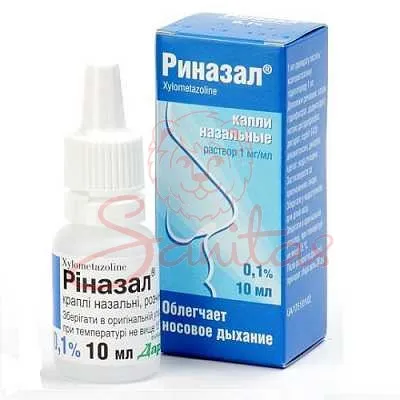
Table of Contents
INSTRUCTION FOR MEDICAL USE OF THE MEDICINAL PRODUCT RINAZAL® (RINAZAL)
Composition:
Active substance: xylometazoline;
1 ml of the preparation contains 1 mg of xylometazoline hydrochloride;
Excipients: disodium phosphate dodecahydrate, sodium dihydrogen phosphate dihydrate, sorbitol (E 420), decamethoxin, disodium edetate, purified water.
Pharmaceutical form. Nasal drops, solution.
Main physicochemical properties: clear, colorless liquid.
Pharmacotherapeutic group. Decongestants and other agents for local use in nasal cavity disorders. Sympathomimetics, simple preparations. Xylometazoline. ATC code R01A A07.
Pharmacological properties.
Pharmacodynamics.
Xylometazoline is an α-adrenomimetic agent that constricts peripheral blood vessels. When applied to the nasal mucosa, xylometazoline reduces swelling, decreases hyperemia and exudation, and facilitates nasal breathing.
Pharmacokinetics.
The effect begins within several minutes after application and lasts up to 12 hours. Prolonged use of xylometazoline (more than one week of continuous application) may lead to the development of tachyphylaxis with a reduction in therapeutic effect. At therapeutic concentrations, xylometazoline does not exhibit systemic effects.
Clinical characteristics.
Indications.
The medicinal product is indicated for symptomatic treatment of nasal congestion due to colds, hay fever, allergic rhinitis, and sinusitis; to facilitate drainage of secretions in diseases of the nasal accessory sinuses; as an adjunctive therapy in otitis media (to reduce mucosal swelling of nasal cavities); and to facilitate rhinoscopy.
Contraindications.
The medicinal product is contraindicated in hypersensitivity to any of its components; in dry inflammation of the nasal mucosa, atrophic or vasomotor rhinitis; in acute coronary diseases, coronary asthma; in hyperthyroidism; in closed-angle glaucoma; after transsphenoidal hypophysectomy or in patients with a history of transnasal/transoral surgical interventions involving exposure of the dura mater; during concomitant treatment with monoamine oxidase inhibitors (MAOIs) and within 2 weeks after discontinuation of such treatment.
Interaction with other medicinal products and other forms of interaction.
MAO inhibitors: xylometazoline should not be used in combination with MAO inhibitors or within 14 days after their discontinuation, as this may lead to increased blood pressure and potentiation of the effects of MAO inhibitors.
Local anesthetics: xylometazoline delays the absorption of local anesthetic agents.
Antidepressants: xylometazoline enhances the effects of antidepressants.
Antihypertensive agents: xylometazoline may affect the action of certain antihypertensive drugs, such as β-adrenoblockers (may cause bronchospasm or decreased blood pressure).
Xylometazoline may enhance the effects of sympathomimetics and reduce the effects of drugs that suppress sympathetic nerves.
Special precautions for use.
The bottle is intended for individual use.
Do not use the medicinal product for prolonged periods or exceed the recommended dosage (especially in children and elderly patients), as this may lead to rhinitis, atrophic rhinitis, reduced effectiveness of the medicinal product, and/or drug-induced atrophy of the nasal mucosa.
The medicinal product should be prescribed with caution to patients who experience strong reactions (insomnia, dizziness, tremor, cardiac arrhythmias, increased blood pressure) when using adrenergic medicinal products, and to patients with cardiovascular diseases, diabetes mellitus, thyroid disorders, porphyria, urinary retention, prostate hyperplasia, or pheochromocytoma due to the possible sympathomimetic effect.
Due to the vasoconstrictive action of the medicinal product, an increase in intraocular pressure is possible.
Do not use for longer than 10 days. Prolonged treatment with the medicinal product may cause a rebound effect.
Xylometazoline should be prescribed with caution to patients with prolonged QT interval syndrome due to an increased risk of developing serious ventricular arrhythmias.
Important information about excipients.
The medicinal product contains sorbitol (E 420); therefore, if you have been diagnosed with intolerance to certain sugars, consult your doctor before taking this medicinal product.
The medicinal product contains sodium; therefore, patients on a sodium-controlled diet should exercise caution when using this medicinal product.
Use during pregnancy or breastfeeding.
As the medicinal product has vasoconstrictive effects, its use during pregnancy is not recommended.
There is no evidence of any adverse effects on the infant. It is unknown whether xylometazoline passes into breast milk; therefore, use during breastfeeding is not recommended.
Fertility.
There are no adequate data on the effect of the medicinal product on fertility. Since systemic exposure to xylometazoline hydrochloride is very low, the likelihood of an effect on fertility is extremely small.
Ability to influence reaction speed when driving or operating machinery.
The medicinal product usually has no effect or only a minimal effect on the ability to drive or operate machinery (possible development of dizziness, seizures, or visual disturbances should be taken into account).
Dosage and Administration
The bottle is equipped with a tamper-evident seal. When used for the first time, it is necessary to twist the cap to separate it from the safety ring.
The bottle has a special design that ensures metered dispensing of the solution according to the principle "one squeeze – one drop". The firmness of the bottle walls significantly reduces the possibility of uncontrolled stream release of the medication—the most common cause of overdose with nasal drops.
Before administering the medication, the nasal cavity should be thoroughly cleaned.
For adults and children aged 12 years and older: administer 2–4 drops into each nostril three times daily.
Do not administer more than three times daily into each nostril (under adult supervision).
The duration of treatment depends on the course of the disease and should not exceed 10 consecutive days.
Children
Xylometazoline, 0.1% nasal drops, must not be used in children under 12 years of age.
The medication should be administered to children under adult supervision.
Overdose
The special design of the bottle makes accidental overdose highly unlikely. Overdose is possible only if the recommended single doses and frequency of administration stated in the instructions are not followed.
Overdose, especially in children, may significantly affect the central nervous system (CNS), including seizures, coma, bradycardia, apnea, and increased blood pressure, which may later shift to hypotension.
Administration of more than 0.2 mg/kg of the medication may lead to symptoms such as increased fatigue, rapid heartbeat, and elevated blood pressure. In very rare cases of severe overdose, particularly in children (e.g., following accidental ingestion of high doses), alternating stages of CNS and cardiovascular stimulation and depression may occur. Symptoms of CNS stimulation may include restlessness, agitation, hallucinations, and, in severe cases, seizures. Symptoms of CNS depression may include decreased body temperature, lethargy, drowsiness, and, in more severe cases, coma.
Other possible symptoms include pupillary constriction or dilation, sweating, pallor, cyanosis, nausea, vomiting, tachycardia, bradycardia, arrhythmia, asystole, hypotension, circulatory disturbances, pulmonary edema, respiratory disturbances, ataxia, and apnea.
Treatment of severe overdose (>1 mg/kg, which for a 20 kg child corresponds to the contents of 4 bottles of the medication) should ideally begin within 1 hour after administration. To treat seizures, anticonvulsant medications such as benzodiazepines should be used; to reduce blood pressure, non-selective α-blockers (e.g., doxazosin, terazosin) are recommended. The use of vasoconstrictors is contraindicated. Atropine should be used only in cases of clinically evident bradycardia associated with decreased blood pressure.
In cases of severe overdose accompanied by cardiac arrest, resuscitation measures should continue for at least 1 hour.
Adverse reactions.
Eye disorders: transient visual disturbances.
Gastrointestinal disorders: nausea, vomiting.
Nervous system disorders: headache, seizures, restlessness, increased fatigue (drowsiness, lethargy), hallucinations, dizziness, insomnia; with long-term use of high doses – depression.
Cardiovascular disorders: arrhythmia, tachycardia, increased blood pressure.
Immune system, skin and subcutaneous tissue disorders: hypersensitivity reactions, including angioneurotic edema, rash, pruritus, rarely – systemic allergic reactions.
Local site reactions: pruritus, burning sensation, dryness of the nasopharyngeal mucosa, sneezing, reactive hyperemia, hypersecretion, and increased nasal mucosal swelling after the decline of the drug effect, development of secondary rhinitis, epistaxis.
In individual cases, local intranasal administration may result in systemic sympathomimetic effects.
If any adverse reactions occur, treatment should be discontinued and medical advice sought.
Reporting of suspected adverse reactions.
Reporting of suspected adverse reactions after marketing authorization is an important procedure. It allows continuous monitoring of the benefit-risk balance of the medicinal product. Healthcare professionals are required to report any suspected adverse reactions through the national reporting system.
Shelf life. 2 years.
After opening the bottle, the product should not be stored for more than 28 days.
Storage conditions.
Store in the original packaging at a temperature not exceeding 15 °C. Do not freeze.
Keep out of reach of children.
Packaging.
10 ml in a bottle with dropper; 1 bottle per carton.
Availability. Over-the-counter.
Manufacturer. JSC "Pharmaceutical Company "Darnytsia".
Manufacturer's address and location of business activity.
13, Boryspilska Street, Kyiv, 02093, Ukraine.