Rezonativ
Ukraine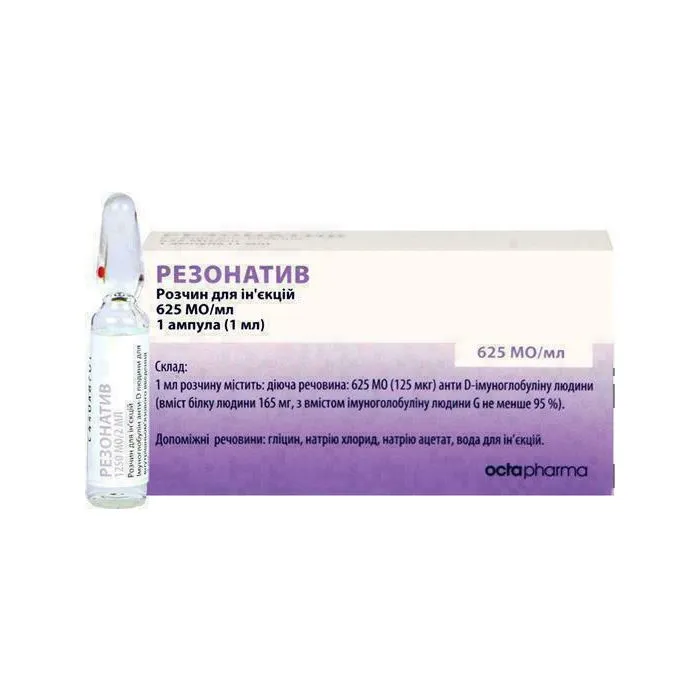
Table of Contents
INSTRUCTIONS FOR MEDICAL USE OF THE MEDICINAL PRODUCT REZONATIV
Composition:
Active substance: Human anti-D immunoglobulin;
1 ml of solution contains 750 IU (150 mcg) of human anti-D immunoglobulin (total protein content 165 mg, with human immunoglobulin G content not less than 95%);
Excipients: glycine, sodium chloride, sodium acetate, polysorbate 80, water for injections.
The content of immunoglobulin A (IgA) does not exceed 0.05% of the total protein content.
One ampoule (2 ml) contains 1500 IU (300 mcg) of human anti-Rhesus (anti-D) immunoglobulin.
Activity is determined by quantitative analysis according to the European Pharmacopoeia. International unit equivalence of the international reference preparation is specified by the World Health Organization.
Distribution of IgG subclasses (approximate values): IgG1 – 70.5%, IgG2 – 26.0%, IgG3 – 2.8%, IgG4 – 0.8%. Maximum IgA content – 82.5 mcg/ml. Produced from human blood plasma.
Pharmaceutical form. Solution for injection.
Main physicochemical properties: clear or slightly opalescent solution, colorless to pale yellow or light brown. During storage, slight cloudiness or a small amount of mechanical particles may form.
Pharmacotherapeutic group. Immune sera and immunoglobulins. Immunoglobulins. Specific immunoglobulins. ATC code J06B B01.
Pharmacological properties.
Pharmacodynamics.
Anti-D immunoglobulin contains specific antibodies (IgG) against the D rhesus (Rh) antigen of human red blood cells.
During pregnancy, and particularly during delivery, fetal red blood cells may enter the maternal circulation. If the woman is Rh(D)-negative and the fetus is Rh(D)-positive, the woman may become immunized against the Rh(D) antigen and produce anti-Rh(D) antibodies, which can cross the placenta and may cause hemolytic disease of the newborn. Passive immunization with anti-D immunoglobulin prevents Rh(D) immunization in more than 99% of cases, provided that an adequate dose of anti-D immunoglobulin is administered promptly after exposure to Rh(D)-positive fetal red blood cells.
The mechanism by which anti-D immunoglobulin suppresses immunization to Rh(D)-positive red blood cells is not known. This suppression may be related to the clearance of red blood cells from the circulation before they reach immunocompetent sites, or it may result from more complex mechanisms involved in the recognition of foreign antigen and antigen presentation by appropriate cells in the relevant sites, in the presence or absence of antibody.
Postnatal prophylaxis studies (studies 1–6) and antenatal prophylaxis (study 7) in patients
Clinical trials of the drug Rezonautiv were initiated to evaluate its efficacy and safety. Table 1 provides the most important efficacy data.
Table 1
| Identification number of study |
Indication, number of subjects |
Rh (Rh) status of mother/ infant |
Presence of anti-D antibodies |
Observation period |
| 1 |
PPP, n = 1,937 |
negative/positive |
0.4 % |
6 months |
| 2 |
PPP, n = 2,117 PPP, n = 723 |
negative/positive next Rh positive infant |
0.1 % 0.7 % |
4–6 months; during next pregnancy or delivery |
| 3 |
PPP, n = 917 |
negative/positive |
0.3 % |
6 months |
| 4 |
PPP, n = 665 |
negative/positive |
0.2 % |
6 months |
| 5 |
PPP, n = 608 ANP*, n = 103 |
negative/positive |
0.3 % 0 % |
6–8 months 8 months |
| 6 |
PPP, n = 475 |
negative/positive |
0 % |
n.r. |
| 7 |
ANP* & PPP, n = 529 |
negative/positive |
0.4 % |
8 months |
Rhesus prophylaxis – postnatal prophylaxis; ANP – antenatal prophylaxis;
n.r. – not reported.
* 6–8 weeks before the expected date of delivery.
Based on the study results, it can be concluded that treatment with Resonativ provides effective anti-D prophylaxis.
Study on transfusion of rhesus-incompatible blood components
In Study 8, the efficacy of Resonativ was evaluated in 21 Rh-negative volunteers who received Rh-positive, ABO-compatible fetal red blood cells in volumes corresponding to 10 mL (1 case), 25 mL (10 cases), and 50 mL (10 cases) of umbilical cord blood. Two to three days later, 260 mcg of Resonativ was administered intramuscularly. Six months (in one case, nine months) after the start of the experiment, no serological signs of Rh immunization were detected in any of the subjects. Between 6 months and 2.5 years after the initial exposure, 8 individuals from the 25 mL group and all 10 individuals from the 50 mL group received an additional 5 mL of Rh-positive, ABO-compatible umbilical cord blood. Two to three days later, 260 mcg and 333 mcg of Resonativ were administered, respectively. Six months later (in one case, eight months), no Rh antibodies were detected in any of the subjects.
From the results of this experimental study, it can be concluded that Rh prophylaxis is achieved with the use of anti-D immunoglobulin at a dose of 10 mcg per 1 mL of fetal blood. It was concluded that, since fetomaternal hemorrhage at the end of pregnancy poses a risk of Rh immunization, Resonativ at a dose of 260 mcg prevents serologically detectable Rh immunization in at least 998 out of 1,000 Rh-negative mothers.
Pharmacokinetic study of Resonativ
The main pharmacokinetic parameters and metabolism of Resonativ were studied in 15 Rh-negative pregnant women who received Resonativ intramuscularly at week 28 of pregnancy. Eight women received a dose of 125 mcg, and 7 women received 250 mcg. Additionally, 3 non-pregnant Rh-negative women received a lower dose.
The biological half-life of anti-D IgG after intramuscular injection at a dose of 125 mcg in these women was consistent with that reported in the literature (see section "Pharmacokinetics").
Pharmacokinetics.
Human anti-Rhesus (anti-D) immunoglobulin for intramuscular administration is slowly absorbed into the recipient's bloodstream and reaches peak levels within 2–3 days.
Human anti-Rhesus immunoglobulin has a half-life of approximately 3–4 weeks. This half-life may vary among different patients.
IgG and IgG complexes are degraded in cells of the reticuloendothelial system.
Clinical characteristics.
Indications.
Prevention of rhesus immunization (Rh(D)) in Rh(D)-negative women of childbearing age
- Antenatal prophylaxis.
- Planned antenatal prophylaxis.
- Antenatal prophylaxis following complications of previous pregnancy, including miscarriage/threatened miscarriage, ectopic pregnancy or hydatidiform mole, intrauterine fetal death, transplacental hemorrhage due to antepartum hemorrhage, amniocentesis, chorionic biopsy or obstetric manipulative procedures such as external cephalic version, invasive interventions, cordocentesis, blunt abdominal trauma or fetal therapy.
- Postnatal prophylaxis.
- Birth of an Rh(D)-positive (D, weak D, partial D) infant.
Treatment of Rh(D)-negative women of childbearing age following transfusion of Rh(D)-incompatible blood or other blood products containing red blood cells, such as platelet concentrate/platelet-rich plasma.
Contraindications.
Hypersensitivity to the active substances of the medicinal product or to any of the excipients.
Hypersensitivity to human immunoglobulin, especially in patients with antibodies to IgA.
Special precautions for use.
Traceability
To improve traceability of biological medicinal products, the name and batch number of the administered product should be clearly recorded.
Resonativ must not be administered intravascularly due to the risk of shock. Injections should be given intramuscularly, and before administration, the syringe plunger should be carefully withdrawn to ensure that the needle has not entered a blood vessel.
For postnatal use, the product is intended for administration to the mother. The product should not be administered to the newborn.
Resonativ is not intended for administration to Rh(D)-positive individuals or to individuals previously immunized against Rh(D) antigen.
After administration, patients should be observed for at least 20 minutes, and for at least 1 hour following accidental intravenous injection.
Hypersensitivity
True hypersensitivity reactions are rare, but allergic reactions to anti-D immunoglobulin may occur. Patients should be informed about early signs of hypersensitivity reactions such as urticaria, generalized rash, chest tightness, dyspnea, hypotension, and anaphylaxis. The required treatment depends on the nature and severity of the adverse reaction.
Resonativ contains a small amount of IgA. Although anti-D immunoglobulin has been successfully used in the treatment of individuals with IgA deficiency, patients with IgA deficiency may develop antibodies to IgA and may experience anaphylactic reactions after administration of medicinal products containing IgA derived from human plasma. Therefore, the physician must weigh the benefits of treatment with Resonativ against the potential risks of hypersensitivity reactions.
Rarely, human anti-D immunoglobulin may cause a drop in blood pressure with anaphylactic reaction, even in patients who have previously received treatment with human immunoglobulin.
Suspicion of allergic or anaphylactoid reactions requires immediate cessation of the injection. In case of shock, standard medical treatment for shock should be initiated.
Hemolytic reactions
Patients who have received transfusions of incompatible blood and are receiving high doses of anti-D immunoglobulin should be continuously monitored for clinical and biological parameters due to the risk of hemolytic reactions.
Thromboembolism
Arterial and venous thromboembolic complications, such as myocardial infarction, stroke, deep vein thrombosis, and pulmonary embolism, have been associated with the use of immunoglobulins. Although thromboembolic complications have not been observed with Resonativ, patients should have adequate hydration (appropriate fluid volume) prior to immunoglobulin administration. Caution is required when treating patients with pre-existing risk factors for thrombotic events (such as hypertension, diabetes, history of vascular disease or thrombotic complications, acquired or hereditary thrombophilic disorders, prolonged immobilization, severe hypovolemia, or conditions increasing blood viscosity), especially when higher doses of Resonativ are administered.
Patients should be informed about early symptoms of thromboembolic complications, such as difficulty breathing (dyspnea), pain and swelling of extremities, focal neurological symptoms, and chest pain; they should seek immediate medical advice if such symptoms occur.
Effect on serological testing
After administration of immunoglobulin, transient increases in various passively transferred antibodies in the patient's blood may lead to false-positive results in serological testing.
Passive transfer of antibodies against erythrocyte antigens, such as A, B, D, may affect certain serological tests for anti-erythrocyte antibodies, including the direct antiglobulin test (Coombs test), particularly in Rh-positive infants whose mothers received antenatal prophylaxis.
Patients with overweight/obesity
In patients with overweight/obesity, intravenous administration of anti-D immunoglobulin is recommended due to the potential for reduced efficacy of intramuscular administration.
Transmission of infectious agents
Standard measures to prevent infections arising from medicinal products derived from human blood or plasma include donor selection, testing of individual blood donations and plasma pools for specific infection markers, and implementation of effective manufacturing processes for virus inactivation or removal. Nevertheless, when using medicinal products derived from human blood or plasma, the possibility of transmission of infectious agents cannot be completely excluded, including unknown or emerging viruses and pathogens.
The measures taken are considered effective against enveloped viruses such as HIV, hepatitis B virus, and hepatitis C virus, as well as against the non-enveloped hepatitis A virus.
For certain non-enveloped viruses, such as parvovirus B19, the measures taken have limited effectiveness.
There is reassuring clinical experience regarding the absence of transmission of hepatitis A virus or parvovirus B19 with immunoglobulins, and it is assumed that the presence of antibodies is an important factor in viral safety.
It is strongly recommended that each time Resonativ is administered to a patient, the product name and batch number should be recorded to allow traceability between the patient and the specific batch of the product.
Important information about some ingredients of Resonativ
This medicinal product contains less than 1 mmol of sodium (23 mg) per 1 ml (750 IU), i.e., it is considered sodium-free.
Interaction with other medicinal products and other forms of interaction.
Live attenuated viral vaccines
Active immunization with live viral vaccines (e.g., measles, mumps, or rubella) should be postponed for 3 months after the last administration of anti-D immunoglobulin, as the efficacy of the live viral vaccine may be reduced.
If anti-D immunoglobulin must be administered within 2–4 weeks after vaccination with live viral vaccines, the efficacy of such vaccination may be reduced.
Special safety precautions.
Before administration, the product should be brought to room temperature or body temperature.
The solution may vary in color from colorless to pale yellow or light brown.
Do not use the solution if it is markedly cloudy or contains sediment.
Unused product or waste material should be disposed of in accordance with local regulations.
Use during pregnancy or breastfeeding.
Pregnancy
This medicinal product is intended for use during pregnancy.
Breastfeeding
This medicinal product may be used during breastfeeding.
Immunoglobulins are excreted in breast milk. No adverse reactions related to the investigational product have been reported in infants whose mothers (over 450 women) received standard doses of Resonativ in the postpartum period.
Fertility
No reproductive toxicity studies of Resonativ have been conducted in animals. Clinical experience with anti-D immunoglobulin indicates that its administration is not expected to have a harmful effect on fertility.
Ability to affect reaction speed when driving vehicles or operating machinery.
Resonativ has no influence on the ability to drive vehicles or use machinery.
Method of Administration and Dosage.
Doses
The dose of anti-D immunoglobulin should be determined according to the extent of exposure to Rh(D)-positive red blood cells, considering that approximately 10 mcg (50 IU) of anti-D immunoglobulin is required to neutralize 0.5 mL of Rh(D)-positive red cell mass or 1 mL of Rh(D)-positive whole blood.
Based on clinical study results of Rezonyativ, the following doses are recommended.
Prevention of Rh(D) Immunization in Rh-Negative Women
- Antenatal prophylaxis. According to current general recommendations, doses of 50–330 mcg, or 250–1650 IU, are prescribed.
- Planned antenatal prophylaxis:
a single dose (e.g., 300 mcg, or 1500 IU) is administered at 28–30 weeks of gestation, or two doses at 28 and 34 weeks of gestation.
- Antenatal prophylaxis after pregnancy complications:
a single dose (e.g., 150 mcg, or 750 IU, before 12 weeks of gestation and 300 mcg, or 1500 IU, after 12 weeks of gestation) should be administered as soon as possible within 72 hours; if necessary, repeat administration at 6–12 week intervals during pregnancy.
After amniocentesis or chorionic biopsy, a single dose (e.g., 300 mcg, or 1500 IU) should be administered.
Postnatal prophylaxis. According to current general recommendations, doses of 100–300 mcg, or 500–1500 IU, are prescribed. See "Pharmacological properties" section for clinical study information. If a lower dose (100 mcg, or 500 IU) is prescribed, tests to determine fetal-maternal hemorrhage should be performed.
Standard dose – 1500 IU (300 mcg).
For postnatal use, the drug should be administered to the mother as soon as possible within 72 hours after delivery of an Rh-positive (D, weak D, partial D) infant. Even if more than 72 hours have passed, the drug should still be administered as soon as possible.
The drug should be administered postnatally even if antenatal prophylaxis has been performed, and also when residual activity from antenatal prophylaxis is present in maternal serum.
If significant fetomaternal hemorrhage (> 4 mL; observed in 0.7–0.8% of women) is suspected, e.g., in cases of fetal/neonatal anemia or intrauterine fetal death, the extent should be determined by appropriate methods, such as the acid elution Kleihauer–Betke test for fetal hemoglobin (HbF) or flow cytometry for specific detection of Rh(D)-positive cells. Accordingly, additional doses of anti-D immunoglobulin (10 mcg, or 50 IU, per 0.5 mL of fetal red cells) should be administered.
Transfusion of Incompatible Red Blood Cells (RBCs)
The recommended dose is 20 mcg (100 IU) of anti-D immunoglobulin per 2 mL of transfused Rh(D)-positive whole blood or per 1 mL of packed red blood cells. It is recommended to consult a hematology specialist to assess the need for red cell exchange transfusion to reduce the Rh(D)-positive red cell load in circulation and to determine the required dose of anti-D immunoglobulin to suppress immunization. Additional tests to detect Rh(D)-positive red cells should be performed every 48 hours, and anti-D immunoglobulin administration should be continued until no Rh(D)-positive red cells are detectable in circulation. However, due to the potential risk of hemolysis, it is recommended not to exceed the maximum dose of 3000 mcg (15000 IU).
Administration of an alternative intravenous preparation is recommended as a means to achieve adequate plasma levels immediately. If an alternative intravenous preparation is unavailable, a very large volume should be administered intramuscularly over several days (see section "Special precautions").
Pediatric Patients
The safety and efficacy of the drug in children have not been established.
Patients with High Body Weight
For patients with high body weight, the use of intravenous anti-D preparation should be considered (see section "Special precautions").
Method of Administration
For intramuscular administration.
If a large volume of medication (> 2 mL for children or > 5 mL for adults) needs to be administered, the prescribed dose should be divided into several injections given at different sites.
If intramuscular injections are contraindicated (e.g., coagulation disorders), an alternative intravenous preparation should be used. Subcutaneous injection may be considered if an intravenous preparation is not available. After injection, a soft compressive dressing should be carefully applied to the injection site.
Children
The safety and efficacy of the drug in children have not been established.
Overdose
The consequences of overdose are unknown. Patients who have received transfusion of incompatible blood and are receiving very high doses of anti-D immunoglobulin require continuous monitoring of clinical and biological parameters due to the risk of hemolytic reaction.
In other Rh(D)-negative individuals, overdose does not lead to more frequent or more severe adverse effects than those observed with standard doses.
Adverse reactions.
Summary of safety profile
Adverse reactions such as chills, headache, dizziness, fever, vomiting, allergic reactions, nausea, arthralgia (joint pain), low blood pressure, and mild lower back pain may occur occasionally.
Rarely, human immunoglobulins may cause a sudden drop in blood pressure and, in individual cases, anaphylactic shock, even when the patient has not previously demonstrated hypersensitivity upon prior administration.
Reactions at the injection site: swelling, painful sensation, redness, induration, feeling of warmth, itching, hematoma, local pain, tenderness, and rash; some of these reactions may be prevented by dividing larger doses into several injections administered at different sites.
For information on safety regarding prevention of transmission of infectious agents, see section "Special precautions for use".
During clinical trials, reliable data on the frequency of adverse reactions were not obtained.
The adverse reactions listed below have been reported and are presented in the table according to the MedDRA (Medical Dictionary for Regulatory Activities) system organ class classification.
The frequency was estimated according to the following conventional categories: very common (> 1/10); common (> 1/100 to < 1/10); uncommon (> 1/1,000 to < 1/100); rare (> 1/10,000 to < 1/1,000); very rare (< 1/10,000); not known (cannot be estimated from the available data).
| MedDRA system organ class |
Adverse reaction |
Frequency |
| Blood and lymphatic system disorders |
hemolytic reaction |
unknown |
| Immune system disorders |
anaphylactic shock, anaphylactic/anaphylactoid reaction, hypersensitivity |
unknown |
| Nervous system disorders |
headache |
unknown |
| Cardiac disorders |
tachycardia |
unknown |
| Vascular disorders |
hypotension |
unknown |
| Respiratory, thoracic and mediastinal disorders |
wheezing |
unknown |
| Gastrointestinal disorders |
vomiting, nausea |
unknown |
| Skin and subcutaneous tissue disorders |
skin reaction, erythema, pruritus, urticaria |
unknown |
| Musculoskeletal and connective tissue disorders |
arthralgia (joint pain) |
unknown |
| General disorders and administration site conditions |
fever, chest discomfort, malaise (feeling unwell), chills |
unknown |
Reporting of suspected adverse reactions
Reporting of suspected adverse reactions after authorization of the medicinal product is important. It allows continuous monitoring of the benefit-risk balance of the medicinal product. Healthcare professionals are requested to report any suspected adverse reactions.
Shelf life.
2.5 years.
An opened ampoule must be used immediately.
Storage conditions.
Store at 2 to 8 °C (in the refrigerator). Do not freeze.
Keep ampoules in the original packaging to protect from light.
Keep out of the reach of children.
Within the shelf life, the medicinal product may be stored at temperatures up to 25 °C
(not in the refrigerator) for up to 1 month. If the medicinal product has not been used within
1 month, it must be disposed of.
Incompatibilities.
In the absence of compatibility studies, this medicinal product must not be mixed with other medicinal products.
Packaging.
Injection solution, 2 ml in a glass ampoule, 1 ampoule in a plastic blister pack.
1 plastic blister pack in a cardboard box.
Prescription status.
Prescription only.
Manufacturer.
Octapharma AB.
Manufacturer's name and address.
Lars Forssells gata 23, Stockholm, 11275, Sweden.