Resigar
Ukraine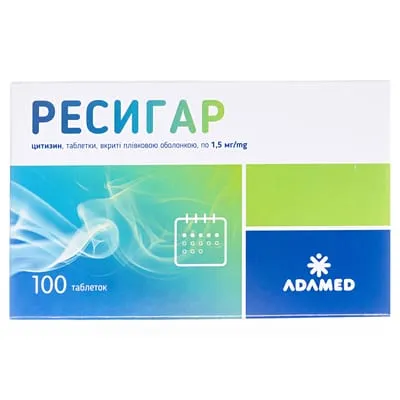
Table of Contents
I N S T R U C T I O N for medical use of the medicinal product Resigar (Resigar)
Composition:
active substance: cytisine;
one film-coated tablet contains 1.5 mg of cytisine;
excipients: mannitol, spray-dried mannitol, maize starch, magnesium aluminometasilicate, type A; hypromellose, type 2208, 3550 mPa*s; magnesium stearate, silicon dioxide, colloidal anhydrous; hypromellose, type 2910, 50 mPa*s; purified water;
coating of the tablet: AquaPolish P green 16712, menthol powder, aspartame E 951, purified water.
Pharmaceutical form. Film-coated tablets.
Main physicochemical characteristics: round, biconvex, film-coated tablets, light green or greenish in color, without engraving.
Pharmacotherapeutic group. Medicinal products used in nicotine dependence.
ATC code N07B A04.
Pharmacological properties
The active substance of the medicinal product Resigar is the plant alkaloid cytisine, which is found, in particular, in the seeds of the golden rain plant (Laburnum), has a chemical structure similar to nicotine, and affects nicotinic acetylcholine receptors. The mechanism of action of cytisine is similar to that of nicotine, although overall it is weaker. Cytisine competitively inhibits the interaction of nicotine with its corresponding receptors and, due to its stronger binding, gradually displaces nicotine from them. Cytisine exhibits partial agonistic activity towards nicotinic acetylcholine receptors, particularly high affinity for the α4β2 subtype. Thus, it prevents nicotine from binding to α4β2 receptors and stimulating the central mesolimbic dopaminergic system, which is associated with the mechanisms of nicotine dependence, due to nicotine's ability to activate these receptors.
The drug's effect involves stimulation of autonomic nervous system ganglia, reflex stimulation of respiration, release of adrenaline from the adrenal medulla, and elevation of arterial pressure, leading to the disappearance of symptoms of nicotine dependence.
| Pharmacokinetics |
Pharmacokinetic properties of cytisine were studied after a single 1.5 mg oral dose of cytisine in 36 healthy volunteers.
Absorption
Cytisine was rapidly absorbed from the gastrointestinal tract following oral administration. The mean maximum plasma concentration of 15.55 ng/mL was reached within 0.92 hours.
Distribution
There is no data available on the volume of distribution in humans.
Elimination
64% of the administered dose was excreted unchanged in urine within 24 hours. The elimination half-life was approximately 4 hours. The mean residence time of the drug in the body was approximately 6 hours.
Data in patients with renal or hepatic impairment are lacking, and the effect of food on the pharmacokinetics of cytisine is unknown.
Clinical Characteristics
Indications.
Treatment of nicotine dependence. The use of Resigar allows for a gradual reduction of nicotine dependence without withdrawal symptoms. The ultimate goal of using Resigar is to permanently stop using products such as traditional and electronic cigarettes, tobacco heating systems, and other nicotine-containing products.
Contraindications
Contraindicated in cases of hypersensitivity to the active substance or any of the excipients, as well as in unstable angina, recent myocardial infarction, clinically significant cardiac arrhythmia, recent stroke, and during pregnancy and breastfeeding.
Interaction with other medicinal products and other forms of interaction
Resigar should not be used concomitantly with anti-tuberculosis drugs. There are no other clinical data regarding significant interactions with other medicinal products.
The patient should be aware that simultaneous use of Resigar and smoking tobacco or consuming nicotine-containing products may lead to an increased incidence of nicotine-related adverse effects.
Hormonal contraception
Currently, it is unknown whether Resigar may reduce the efficacy of systemic hormonal contraceptives; therefore, women using systemic hormonal contraceptives should use an additional barrier method.
Special precautions for use
The medicinal product Resigar should only be used when the patient has a serious intention to quit smoking. The patient must understand that simultaneous use of Resigar and smoking tobacco or consuming nicotine-containing products may lead to an increased risk of nicotine-related adverse effects.
Resigar should be used with caution in patients with ischemic heart disease, heart failure, arterial hypertension, pheochromocytoma, atherosclerosis, and other peripheral vascular diseases, gastric and duodenal ulcers, gastroesophageal reflux disease, hyperthyroidism, diabetes mellitus, and schizophrenia.
Smoking cessation
Polycyclic aromatic hydrocarbons present in tobacco smoke induce the metabolism of drugs metabolized by cytochrome CYP1A2 (and possibly also CYP1A1). Cessation of smoking may lead to a slower metabolism of such drugs and, consequently, to increased blood concentrations. This has potential clinical significance for drugs with a narrow therapeutic index, such as theophylline, tacrine, clozapine, and ropinirole. Plasma concentrations of other medicinal products partially metabolized by CYP1A2, such as imipramine, olanzapine, clomipramine, and fluvoxamine, may also increase after smoking cessation, although evidence confirming this hypothesis is lacking, and the potential clinical significance of these effects for the aforementioned drugs is unknown. Limited data suggest that the metabolism of flecainide and pentazocine may also be induced by smoking.
Withdrawal from nicotine may result in mood deterioration, occasionally including suicidal thoughts and suicide attempts. Physicians should be aware of the possibility of severe neuropsychiatric symptoms occurring in patients attempting to quit smoking, regardless of whether they are using nicotine replacement therapy.
History of psychiatric disorders
Cessation of smoking, with or without pharmacotherapy, may be associated with exacerbation of previously diagnosed psychiatric disorders (e.g., depression). Caution should be exercised in patients with a history of psychiatric disorders. Such patients should be given appropriate counseling.
Women of childbearing potential
Women of childbearing potential should use effective contraceptive methods during therapy with Resigar.
Aspartame, present in the tablets, is a phenylalanine derivative and poses a risk for patients with phenylketonuria.
Use during pregnancy or breastfeeding
Pregnancy
There are no or insufficient data on the use of cytisine in pregnant women. Animal studies regarding reproductive toxicity are insufficient.
Resigar is contraindicated during pregnancy (see section "Contraindications").
Period of breastfeeding
Resigar is contraindicated during breastfeeding (see section "Contraindications").
Fertility
There are no data on the effect of the medicinal product Resigar on fertility.
Women of childbearing potential
Women of childbearing potential should use effective contraceptive methods during therapy with Resigar. Women using systemic hormonal contraceptives should additionally use a barrier method.
Ability to affect reaction speed when driving or operating machinery
Resigar has no effect or has a negligible effect on the ability to drive vehicles or operate machinery.
Dosage and Administration
One package of the medicinal product Resigar (100 tablets) is sufficient for complete treatment. The duration of therapy is 25 days.
The medicinal product Resigar should be taken orally with sufficient amount of water, according to the following schedule:
Days 1 to 3: 1 tablet every 2 hours (6 tablets per day).
Days 4 to 12: 1 tablet every 2.5 hours (5 tablets per day).
Days 13 to 16: 1 tablet every 3 hours (4 tablets per day).
Days 17 to 20: 1 tablet every 5 hours (3 tablets per day).
Days 21 to 25: 1–2 tablets per day.
Smoking should be discontinued no later than the fifth day from the beginning of treatment. Smoking during therapy should be avoided, as it may intensify adverse effects. If the treatment outcome is unsatisfactory, therapy should be discontinued. The treatment may be repeated after 2–3 months.
Patients with hepatic or renal impairment
There are no clinical studies on the use of Resigar in patients with hepatic or renal impairment; therefore, its use is not recommended in these patient groups.
Elderly patients
Due to insufficient clinical data, the use of Resigar is not recommended in elderly patients (over 65 years of age).
Children
The safety and efficacy of Resigar in children and adolescents (under 18 years of age) have not been established. Resigar is not recommended for use in children and adolescents (under 18 years of age).
Administration
Resigar should be administered orally with sufficient amount of water.
Children
Not to be used in children.
Overdose
Symptoms following cytisine overdose are similar to those of nicotine poisoning. Symptoms of overdose include nausea, vomiting, tachycardia, fluctuations in blood pressure, respiratory disturbances, visual disturbances, and clonic convulsions. In all cases of overdose, standard measures for acute poisoning should be applied: gastric lavage should be performed, and diuresis should be monitored using infusions and diuretics. Anticonvulsants, cardiotonics, and analeptics may be used if necessary. Respiratory function, arterial pressure, and heart rate should be closely monitored.
Adverse Reactions
Clinical studies and experience from use indicate that this medicinal product is generally well tolerated. The proportion of patients who discontinued cytisine treatment due to adverse reactions ranged from 6–15.5% and was comparable to that in the placebo group in controlled trials. Adverse effects were usually mild to moderate in severity and most commonly related to the gastrointestinal tract. Most of these occurred at the beginning of treatment and resolved during continued therapy. These symptoms could also be attributed to smoking cessation rather than to cytisine treatment.
Listed below are adverse effects grouped by organ systems and frequency of occurrence in patients during clinical trials. Frequency categories are defined as follows: very common (≥ 1/10), common (≥ 1/100 to < 1/10), uncommon (≥ 1/1,000 to < 1/100), rare (≥ 1/10,000 to < 1/1,000), very rare (< 1/10,000), frequency not known (cannot be estimated from available data).
Metabolism and nutrition disorders
Very common: change in appetite (mostly increased), weight gain.
Nervous system disorders
Very common: headache, increased irritability, sleep disturbances (insomnia, drowsiness, fatigue, unusual dreams, nightmares), mood changes, anxiety.
Common: dizziness, difficulty concentrating.
Uncommon: feeling of heaviness in the head, decreased libido.
Eye disorders
Uncommon: lacrimation.
Cardiac disorders
Very common: tachycardia.
Common: bradycardia.
Vascular disorders
Common: slight increase in blood pressure.
Respiratory, thoracic and mediastinal disorders
Uncommon: dyspnea, increased sputum production.
Gastrointestinal disorders
Very common: dry mouth, abdominal pain (mainly in the upper abdomen), nausea.
Common: vomiting, altered taste sensations, constipation, diarrhea, bloating, burning sensation of the tongue, heartburn.
Uncommon: excessive salivation.
Skin and subcutaneous tissue disorders
Common: rash.
Uncommon: increased sweating, decreased skin elasticity.
Musculoskeletal, connective tissue and bone disorders
Very common: myalgia.
General disorders
Common: fatigue, malaise.
Uncommon: tiredness.
Investigations
Uncommon: increased aminotransferase activity.
Reporting of suspected adverse reactions
Reporting suspected adverse reactions after authorization of the medicinal product is important. It allows continued monitoring of the benefit/risk balance of the medicinal product. Healthcare professionals, pharmacists, as well as patients or their legal representatives are encouraged to report all suspected adverse reactions and lack of efficacy via the Automated Pharmacovigilance Information System at the following link: https://aisf.dec.gov.ua.
Shelf life. 2 years.
Storage conditions. Store in the original packaging in a place protected from light.
Packaging. 50 tablets per blister, 2 blisters per cardboard box.
Availability. Over-the-counter (without prescription).
Manufacturer. Adamed Pharma S.A., Poland.
Manufacturer's address and location of its business operations
ul. marsz. J. Pilsudskiego 5, 95-200 Pabianice, Poland.