Respix® spray
Ukraine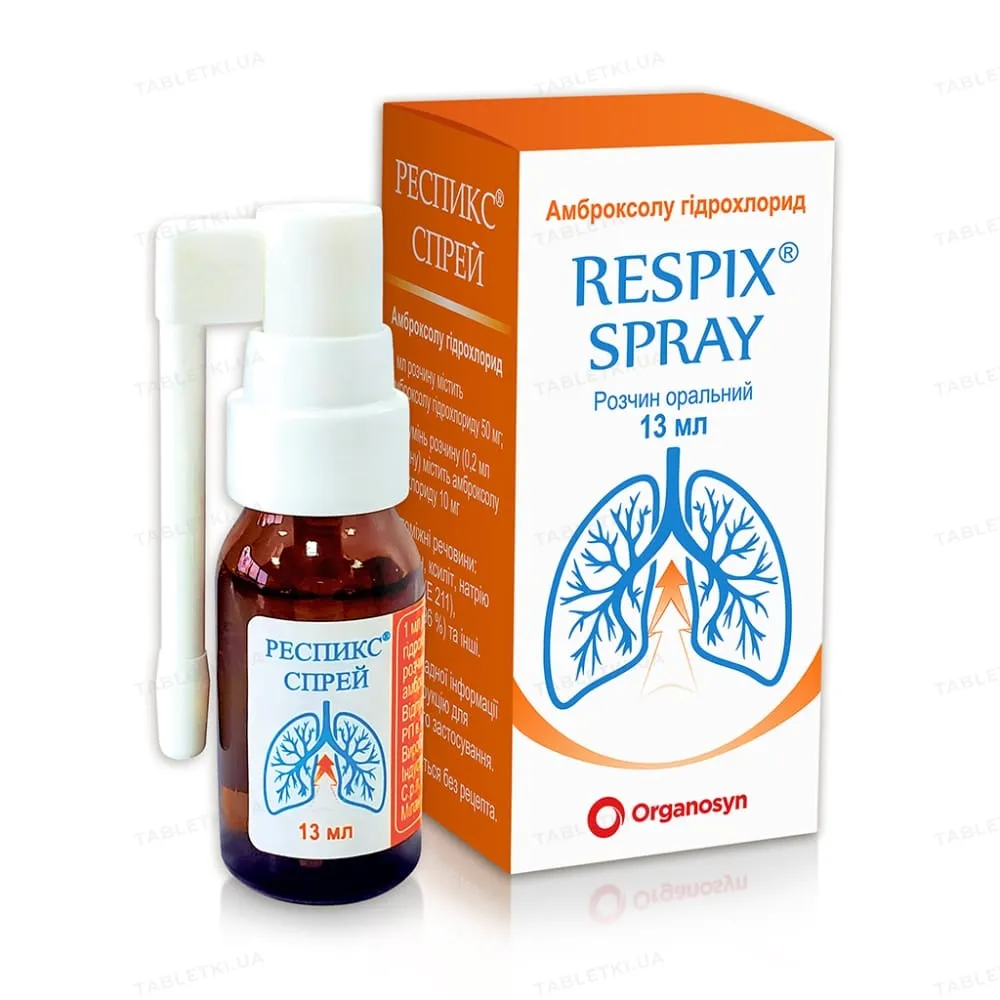
Table of Contents
INSTRUCTION FOR MEDICAL USE OF THE MEDICINAL PRODUCT RESPIX® SPRAY
Composition:
Active substance: ambroxol;
1 ml of solution contains ambroxol hydrochloride 50 mg;
1 spray (0.2 ml of solution) contains ambroxol hydrochloride 10 mg;
Excipients: trometamol, macrogol hydroxystearate, glycerol, acesulfame potassium, xylitol, sodium benzoate (E 211), levomenthol, ammonium glycyrrhizinate, ethanol 96%, sodium hydroxide, purified water.
Pharmaceutical form. Oral solution.
Main physicochemical properties: colorless or slightly yellowish, cloudy solution. With a slight menthol odor.
Pharmacotherapeutic group. Mucolytics. ATC code R05C B06.
Pharmacological Properties
Pharmacodynamics
Ambroxol, a substituted benzylamine, is a metabolite of bromhexine.
It differs from bromhexine by the absence of a methyl group and the presence of an additional hydroxyl group in the 4 (trans) position of the cyclohexyl ring. Although the exact mechanism of action has not been fully elucidated, various studies have demonstrated secretolytic and secretomotor effects.
After oral administration, the effect manifests on average within 30 minutes and lasts, depending on the dose administered, from 6 to 12 hours.
In preclinical studies, ambroxol increased the amount of serous bronchial secretion. It has been established that ambroxol enhances mucociliary transport by stimulating the motility of bronchial epithelial cilia and reducing mucus viscosity.
Ambroxol activates the surfactant system by directly affecting alveolar type II pneumocytes and secretory cells of bronchioles (terminal respiratory tract segments).
Ambroxol stimulates the formation and release of surfactant substances in alveolar and bronchial regions of the lungs in both fetuses and adult patients.
The local anesthetic effect of ambroxol hydrochloride has been observed in a rabbit eye model, which may be explained by its sodium channel-blocking properties. In vitro studies have shown that ambroxol hydrochloride blocks neuronal sodium channels; binding was reversible and concentration-dependent.
According to clinical study results, the use of Respiks® Spray demonstrated a reduction in the intensity of throat pain in patients with uncomplicated respiratory diseases.
Pharmacokinetics
After oral administration, ambroxol is almost completely absorbed, reaching maximum plasma concentrations within 1–3 hours. Absolute bioavailability after oral administration is reduced by one-third due to first-pass metabolism. Metabolites subject to renal excretion include compounds of dibromanilic and glucuronic acids.
Ambroxol binds readily to plasma proteins (80–90%). The elimination half-life from plasma ranges from 7 to 12 hours. The total elimination half-life of ambroxol and its metabolites from plasma is approximately 22 hours.
Ambroxol penetrates into the cerebrospinal fluid of the central nervous system. It crosses the placental barrier and also passes into breast milk.
Approximately 90% of the ambroxol dose is excreted by the kidneys in the form of metabolites produced in the liver. Less than 10% of ambroxol is excreted unchanged.
Due to its high ability to bind to serum proteins, large volume of distribution, and slow release from tissues back into the bloodstream, dialysis or forced diuresis do not affect the elimination rate of ambroxol.
Severe hepatic impairment may reduce ambroxol metabolism by 20–40%. Severe renal impairment may lead to accumulation of metabolites formed in the liver.
Clinical characteristics.
Indications.
Treatment of acute and chronic bronchopulmonary diseases associated with impaired mucus formation and elimination.
Relief of pronounced sore throat in uncomplicated respiratory tract infections in adults.
Contraindications.
Hypersensitivity to the active substance or to any of the excipients in Respiks® Spray.
Children under 12 years of age – due to the high content of active substance in the solution.
Interaction with other medicinal products and other forms of interaction.
Antitussives. Concomitant use of Respiks® Spray with antitussive agents may lead to accumulation of large amounts of bronchial secretion due to suppression of the cough reflex. Such drug combinations should be used with caution.
Antibiotics. Concomitant administration of ambroxol with certain antibiotics, such as amoxicillin, cefuroxime, erythromycin, and doxycycline, results in increased antibiotic concentrations in bronchopulmonary secretions and sputum.
Histamine. Ambroxol affects histamine metabolism; therefore, prolonged use of Respiks® Spray should be avoided in patients with established hypersensitivity to histamine.
Ethanol. Respiks® Spray contains a small amount of ethanol (ethyl alcohol) – less than 100 mg per single dose.
Special precautions for use.
There have been very rare reports of serious skin reactions with ambroxol, such as Stevens-Johnson syndrome (SJS), toxic epidermal necrolysis (TEN), and acute generalized exanthematous pustulosis (AGEP). If any skin or mucous membrane changes occur, ambroxol must be discontinued immediately and medical advice should be sought.
Patients with known impaired bronchial motor function should avoid using mucolytic agents unless under medical supervision, due to the risk of accumulation of large amounts of mucus.
In patients with moderate to severe renal or hepatic impairment, slowed elimination may lead to accumulation of ambroxol and/or its metabolites formed in the liver. In such cases, Respix® Spray should be used with particular caution, by prolonging the intervals between doses or reducing the dose.
Use during pregnancy or breastfeeding.
Ambroxol crosses the placental barrier. Animal studies have not revealed any direct or indirect harmful effects on pregnancy, embryonic/fetal development, delivery, or the postnatal period. However, its use is not recommended during the first trimester of pregnancy. During the second and third trimesters of pregnancy, the drug may be used only if the potential benefits of treatment are carefully weighed against the associated risks. Ambrox combusts into breast milk; therefore, its use during breastfeeding is not recommended.
Ability to affect reaction speed when driving or operating machinery.
Respix® Spray may occasionally have a slight effect on the ability to drive or operate machinery in sensitive individuals. The product contains 96% ethanol, which should be taken into account by drivers of vehicles.
Method of Administration and Dosage
Treatment of acute and chronic bronchopulmonary diseases accompanied by impaired mucus formation and elimination
Dosing regimen in adults and children over 12 years of age
The standard dose is 3 sprays three times daily, corresponding to 90 mg of ambroxol hydrochloride per day. One spray delivers 0.2 mL of solution and contains 10 mg of ambroxol hydrochloride.
Relief of severe sore throat in uncomplicated respiratory tract infections in adults
3 sprays four times daily, equivalent to 120 mg of ambroxol hydrochloride per day.
Patients aged 60 years and older
Respx® Spray is not recommended for the relief of severe sore throat in uncomplicated respiratory tract infections in patients aged 60 years and older due to lack of clinical data.
Patients with renal or hepatic impairment
In cases of moderate to severe renal or hepatic impairment, dosage adjustment of Respx® Spray should be discussed with a physician.
Method of administration
Respx® Spray is intended for oral use.
Before first use, prime the pump by pressing it three times.
The recommended dose is delivered from the bottle using the spray pump provided. The medication should be sprayed directly into the oral cavity and then swallowed.
Respx® Spray should not be taken with food or immediately after eating. Mucolytic activity of Respx® Spray is supported by drinking large amounts of fluids.
Duration of treatment
Without medical consultation, treatment should not exceed 4–5 days.
When used for relief of severe sore throat in uncomplicated respiratory tract infections without medical consultation, do not use for more than 3 days.
Children
For the treatment of acute and chronic bronchopulmonary diseases associated with impaired mucus formation and elimination, the product is indicated for children over 12 years of age.
For relief of severe sore throat in uncomplicated respiratory tract infections, the product is not recommended for children under 18 years of age due to lack of clinical data.
Overdose
Symptoms of overdose
There are no reports of severe intoxication following ambroxol overdose. Reported symptoms include transient excitation and diarrhea.
Overall, oral daily doses up to 25 mg/kg/day are very well tolerated.
Following significant overdose, based on preclinical study results, symptoms such as hypersalivation, nausea, vomiting, and decreased arterial blood pressure have been observed.
Treatment of overdose
In general, emergency measures such as induction of vomiting or gastric lavage are not indicated and should only be considered in cases of very severe overdose. In all suspected cases of overdose, symptomatic and supportive therapy should be administered.
Adverse Reactions
The frequency of adverse effects is defined as follows: very common (≥ 1/10); common (≥ 1/100, < 1/10); uncommon (≥ 1/1,000, < 1/100); rare (≥ 1/10,000, < 1/1,000); very rare (< 1/10,000); not known (cannot be estimated from the available data).
Gastrointestinal disorders: uncommon – heartburn, nausea, vomiting, stomach pain, decreased sensation in the oral cavity and pharynx, dryness of the mouth and throat, dysgeusia.
Allergic reactions: uncommon – hypersensitivity reactions (skin rash, angioedema, dyspnea, urticaria), fever, allergic contact dermatitis; rare – severe acute anaphylactic reactions including shock, severe skin reactions such as Stevens-Johnson syndrome and Lyell’s syndrome (toxic epidermal necrolysis); not known – acute generalized exanthematous pustulosis.
In sensitive patients, hypersensitivity reactions (including dyspnea) may be caused by levomenthol.
Reporting of suspected adverse reactions after drug registration is of great importance. It allows continuous monitoring of the benefit-risk balance of the medicinal product. Healthcare and pharmaceutical professionals, as well as patients or their legal representatives, are encouraged to report all suspected adverse reactions and lack of efficacy via the automated pharmacovigilance information system at: https://aisf.dec.gov.ua
Shelf life. 3 years
Shelf life after first opening – 1 month.
Storage conditions.
Keep out of reach and sight of children. Store at a temperature not exceeding 25°C. Do not refrigerate or freeze.
Packaging.
13 ml of solution in a bottle with a dosing device; 1 bottle per cardboard box.
Availability.
Over-the-counter (without prescription).
Manufacturer.
ITC PRODUCTION S.R.L., Italy
Manufacturer's address.
Via Pontina Km 29, Pomezia, 00071, Italy