Remotiv
Ukraine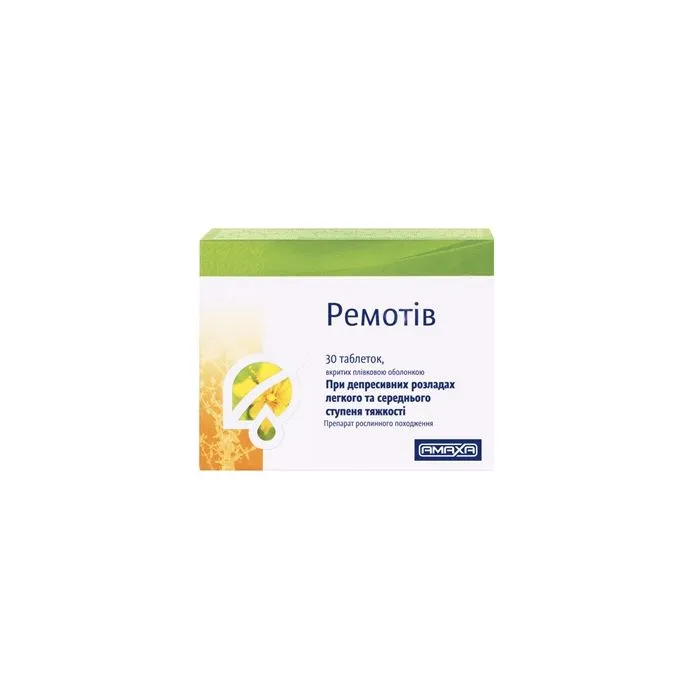
Table of Contents
INSTRUCTIONS FOR MEDICAL USE OF THE MEDICINAL PRODUCT REMOTIV
Composition:
Active substance: 1 tablet contains dry extract of St. John's wort herb (Hypericum perforatum L.) (4–7 : 1) [corresponds to 0.10–0.30% hypericin, not less than 6.0% flavonoids and not more than 0.2% hyperforin; extraction solvent – ethanol 57.9% (v/v)] – 500 mg;
Excipients: colloidal anhydrous silicon dioxide; tablet core: microcrystalline cellulose, sodium croscarmellose, magnesium stearate, macrogol 6000, colloidal anhydrous silicon dioxide; film coating: hypromellose, titanium dioxide (E 171), stearic acid, microcrystalline cellulose, iron oxide red (E 172); polishing: macrogol 20,000.
Pharmaceutical form. Film-coated tablets.
Main physicochemical properties: pink-colored, elongated, biconvex film-coated tablets with characteristic odor.
Pharmacotherapeutic group. Antidepressants. Other antidepressants.
ATC code N06AX25.
Pharmacological Properties.
Pharmacodynamics.
Mechanism of Action
The mechanism of action has not yet been fully elucidated. According to experimental data obtained from animal studies, reversible inhibition of monoaminergic neurotransmitters—norepinephrine, serotonin, and dopamine—within presynaptic neurons has been considered.
Additionally, in vitro data suggest a slowed regulation of central β-adrenergic receptors. The clinical effect is associated with increased neurotransmitter concentrations in the synaptic cleft and with the modulating influence of neurotransmitters on the postsynaptic membrane.
Other Information
Clinical study on interaction with 7 drugs and cytochrome P450, as well as P-glycoprotein transporter
A clinical interaction study with the low-hyperforin-content St. John’s wort extract Ze 117 contained in the medicinal product Remotiv evaluated the effects on 7 drugs in 20 patients. Administration of the St. John’s wort extract Ze 117 contained in Remotiv together with 50 mg caffeine (CYP1A2), 75 mg bupropion hydrochloride (CYP2B6), 10 mg flurbiprofen (CYP2C9), 10 mg omeprazole (CYP2C19), 10 mg dextromethorphan (CYP2D6), 1 mg midazolam (CYP3A4), and 25 mg fexofenadine (P-glycoprotein) showed no clinically significant pharmacokinetic interactions with these medicinal products.
Clinical study on interaction with oral hormonal contraceptives metabolized by cytochrome P450
An uncontrolled clinical study involving 16 healthy women evaluated the low-hyperforin-content common St. John’s wort extract Ze 117 (250 mg twice daily), contained in Remotiv, and hormonal contraceptives metabolized by cytochrome P450 (0.02 mg ethinylestradiol and 0.15 mg desogestrel). No negative impact on the pharmacokinetics of the active substances was observed.
Mean relative bioavailability parameters—Cmax (maximum plasma concentration of the active substance) and AUC (area under the pharmacokinetic curve)—increased by approximately 10% after 14 days of treatment with St. John’s wort extract Ze 117; Cmax and AUC confidence intervals remained within the 20% equivalence range. Serum concentrations of ethinylestradiol and 3-ketodesogestrel were equivalent before and after 14 days of concomitant administration of St. John’s wort extract Ze 117 and the oral hormonal contraceptive.
Clinical study on interaction with digoxin transported by P-glycoprotein
In a randomized, double-blind study, the inductive effect of the low-hyperforin-content common St. John’s wort extract contained in Remotiv on the P-glycoprotein transporter was investigated in 17 healthy subjects. Pharmacokinetic parameters of digoxin were assessed in 7 patients receiving St. John’s wort extract Ze 117 and 10 patients receiving placebo. After achieving a stable digoxin level of 1.0 ng/mL ± 20%, patients received either digoxin plus St. John’s wort extract Ze 117 or digoxin plus placebo for 14 days. However, the corresponding AUC values for digoxin in the placebo and treatment groups showed no significant differences (p = 0.1460). The percentage change in digoxin levels after 14 days of combination therapy compared to monotherapy with St. John’s wort extract Ze 117 was comparable to that with placebo. A one-sided t-test yielded a p-value of 0.05, indicating that the effects of St. John’s wort extract Ze 117 and placebo on digoxin levels within the predefined ±20% range are equivalent. Comparison between St. John’s wort extract Ze 117 and placebo revealed no significant differences in AUC changes between groups.
Pharmacokinetics.
According to current scientific knowledge, St. John’s wort extract is considered an active substance with a complex composition. Pharmacokinetic studies in humans have been conducted only for certain active components of the common St. John’s wort extract. Currently, hypericin and pseudohypericin are considered such components.
Absorption
In male patients, following administration of 250 mg and 500 mg doses of the extract, the maximum plasma concentration of hypericin was 0.67 µg/L and 1.3 µg/L, with tmax values of 7.1 hours and 7.0 hours, respectively. The elimination half-life of hypericin at doses of 250 mg and 500 mg was 21.4 hours and 24.6 hours, respectively. Since the full composition of active substances in common St. John’s wort extract has not yet been completely defined, additional studies on distribution, metabolism, and excretion have not been conducted.
Distribution
No studies have been conducted.
Metabolism
No studies have been conducted.
Excretion
No studies have been conducted.
Indications.
Mild to moderate depressive disorders associated with symptoms such as depressed mood, inner restlessness, feelings of chronic fatigue, and mood fluctuations.
Contraindications.
- Hypersensitivity to the active substance or to any of the excipients of the medicinal product.
- Photosensitivity.
- Concomitant use with antidepressants and other serotonergic agents.
For further information, see section «Interaction with other medicinal products and other forms of interaction».
Interaction with other medicinal products and other forms of interaction.
Pharmacokinetic interactions
Available data on interactions indicate induction of the cytochrome P450 system by common St. John’s wort extract with high hyperforin content (particularly CYP3A4) on one hand, and induction of transport proteins (e.g., P-glycoprotein, as observed with concomitant digoxin use) on the other. This may lead to reduced plasma concentrations and diminished therapeutic effects of co-administered drugs, potentially resulting in serious consequences (especially for substances with a narrow therapeutic index).
In three clinical interaction studies, the low-hyperforin-content common St. John’s wort extract contained in Remotiv demonstrated no clinically significant changes in the pharmacokinetics of 10 drugs metabolized by the cytochrome P450 system or transported by P-glycoprotein (see section «Pharmacological Properties»). Potential interactions with substances not metabolized or transported via the pathways studied in these three interaction trials cannot be excluded.
Pharmacodynamic interactions.
Antidepressants and other serotonergic agents (e.g., buspirone, amitriptyline, nortriptyline, citalopram, escitalopram, fluoxetine, paroxetine, sertraline, triptans, nefazodone, duloxetine, venlafaxine, L-tryptophan, lithium, tramadol, linezolid, and others).
Concomitant therapy with Remotiv and selective serotonin reuptake inhibitors or other serotonergic medicinal products should be administered with caution and under continuous medical supervision, as rare adverse effects (serotonin syndrome) may occur, manifesting as autonomic dysfunction (e.g., increased sweating, tachycardia, diarrhea, fever), mental changes (e.g., anxiety, confusion), and motor disturbances (e.g., tremor or myoclonus).
Special precautions for use.
Treatment with Remotiv should be discontinued at least 5 days before any surgical procedure and restarted only after consultation with a physician.
Very rarely, particularly in individuals with fair skin, adverse skin reactions (symptoms typical of sunburn) or eye reactions may occur after taking extract of Hypericum perforatum and subsequent exposure to sunlight. If such symptoms occur, treatment should be discontinued. During treatment with Remotiv, the skin and eyes should be protected from prolonged exposure to sunlight.
Preparations containing Hypericum perforatum extract should be used with caution in combination with serotonin inhibitors or other serotonergic medicinal products, as very rare undesirable effects (serotonin syndrome) may occur (see section "Interaction with other medicinal products and other forms of interaction").
Due to insufficient data, the use of the medicinal product in children and adolescents (under 18 years of age) is not recommended.
Remotiv contains sodium croscarmellose: this medicinal product contains less than 1 mmol (23 mg)/dose of sodium, i.e. essentially sodium-free.
The product contains 120 mg/dose of easily digestible carbohydrates.
Use during pregnancy or breastfeeding.
Pregnancy
Clinical data on treatment with Remotiv during pregnancy are lacking; therefore, its use is not recommended. Animal studies have shown no direct or indirect toxic effects on pregnancy, embryonic or fetal development. The potential risk for humans is unknown.
Lactation
It is unknown whether components of Remotiv pass into breast milk; therefore, use during lactation is not recommended.
Ability to influence reaction speed when driving or operating machinery.
In a study involving 19 healthy volunteers, Remotiv showed no effect on reaction speed when driving or operating machinery.
The ability to react, drive, and operate machinery may be impaired due to the underlying disease for which treatment has already been initiated, as well as due to described adverse reactions such as dizziness and fatigue.
Dosage and Administration
For oral use.
Adults: The recommended dose is 1 film-coated tablet (in the morning or evening), preferably taken with food or immediately after a meal. The tablet should be swallowed whole, without chewing, with a small amount of liquid.
The maximum recommended dose of 500 mg should not be exceeded to ensure a low risk of interaction with other medicinal products.
Treatment duration
Since the extract of Hypericum perforatum has a slow onset of action, the medicinal product Remotiv should be taken for at least 14 days. The recommended treatment period is 4–6 weeks. Longer-term treatment should be carried out only under medical supervision.
Special dosage instructions
Although Hypericum perforatum extract has been used for many years, clinical studies in patients with impaired liver or kidney function have not been conducted. Therefore, these patient groups should use Remotiv with caution and under medical supervision.
Elderly patients: The same dosage regimen as for adults is recommended.
Children
The use of the medicinal product in children and adolescents (under 18 years of age) is not recommended (see section "Special Warnings and Precautions for Use").
Overdose
Only one case of toxic overdose has been reported, which was accompanied by seizures and restlessness. It is assumed that the adverse reactions described below may be intensified in the event of a significant overdose. In addition, increased photosensitivity should be considered. Exposure of the skin and eyes to sunlight or other UV radiation (such as in solariums) should be avoided for 1–2 weeks.
Side effects.
The frequency of adverse reactions was assessed as follows:
| very common |
≥ 1/10; |
| common |
from ≥ 1/100 to < 1/10; |
| uncommon |
from ≥ 1/1000 to < 1/100; |
| rare |
from ≥ 1/10 000 to < 1/1000; |
| very rare |
< 1/10 000. |
From the nervous system
Common: headache.
Uncommon: dizziness.
Psychiatric disorders
Uncommon: anxiety.
General disorders
Common: asthenia.
Uncommon: fatigue.
From the gastrointestinal tract
Common: gastrointestinal disorders.
From the skin
Common: hyperhidrosis.
Uncommon: skin allergic reactions.
Rare: skin phototoxic reactions.
If skin-related adverse reactions occur, the use of film-coated tablets should be discontinued and a dermatological examination by a physician should be performed.
From the visual system
Adverse reactions related to eyes (phototoxic reactions) have been reported in scientific literature associated with the use of Hypericum perforatum and simultaneous exposure to sunlight. If ocular adverse reactions occur, the use of the medicinal product should be discontinued and medical advice should be sought.
Reporting of suspected adverse reactions
It is important to report suspected adverse reactions after the medicinal product has been authorized. This allows continuous monitoring of the benefit-risk balance of the medicinal product. Healthcare professionals should report any suspected adverse reactions via the Automated Pharmacovigilance Information System at the following link: https://aisf.dec.gov.ua.
Shelf life.
3 years.
Storage conditions.
Store at temperatures not exceeding 25 °C in the original packaging.
Keep out of reach and sight of children.
Packaging.
10 tablets per blister, 3 or 6 blisters per cardboard box.
Availability.
Over-the-counter (without prescription).
Manufacturer.
Max Zeller Sohne AG.
Manufacturer's address and location of operations.
Seeblickstrasse 4, 8590 Romanshorn, Switzerland.
Marketing Authorization Holder.
Amaxa Ltd.
Address of the Marketing Authorization Holder.
31 John Islip Street, London SW1P 4FE, United Kingdom.