Remantadine-kr
Ukraine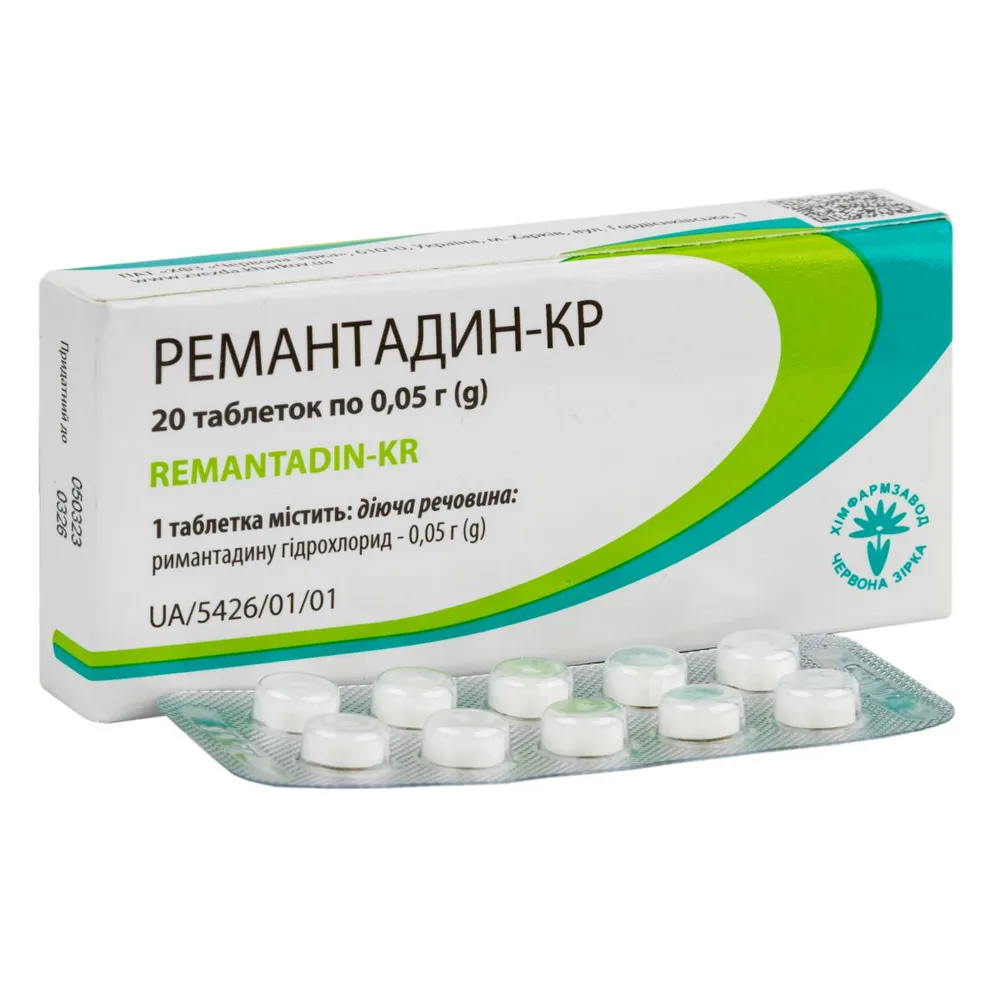
Table of Contents
INSTRUCTIONS FOR MEDICAL USE OF THE MEDICINAL PRODUCT REMANTADIN-KR (REMANTADIN-KR)
Composition:
Active substance: rimantadine hydrochloride;
1 tablet contains rimantadine hydrochloride – 0.05 g;
Excipients: lactose monohydrate, potato starch, microcrystalline cellulose, magnesium stearate, colloidal anhydrous silicon dioxide.
Pharmaceutical form. Tablets.
Main physicochemical properties: white tablets or white tablets with a yellowish tint.
Pharmacotherapeutic group.
Direct-acting antiviral agents.
ATC code J05A C02.
Pharmacological Properties
Pharmacodynamics
Rimantadine hydrochloride is a derivative of amantadine and has pronounced antiviral activity. It is effective against various influenza A viruses and also exhibits antitoxic effects in influenza caused by type B virus. Rimantadine inhibits viral replication at early stages of the cycle by disrupting the formation of the viral envelope. Genetic studies have shown that a specific M2 gene protein of the virion is important for the antiviral action of rimantadine against influenza A virus. In vitro, rimantadine inhibits replication of all three antigenic subtypes (H1N1, H2N2, H3N2) of influenza virus identified in humans. Rimantadine does not affect the immunogenic properties of inactivated influenza A vaccine.
Rimantadine is also effective against arboviruses, which are causative agents of tick-borne encephalitis.
Pharmacokinetics
After single and repeated administration of the drug to patients of different age groups, a correlation between plasma concentration of rimantadine and its antiviral activity has not been established.
After oral administration, the drug is almost completely absorbed.
Absorption is slow. Plasma protein binding is approximately 40%.
Metabolized in the liver. Elimination half-life is 24–36 hours; 75–85% of the administered dose is excreted by the kidneys, mainly as metabolites, and 15% in unchanged form.
In chronic renal insufficiency, the elimination half-life increases by two times. In patients with renal insufficiency and in elderly individuals, the concentration of the active substance may increase to toxic levels.
In patients with mild to moderate chronic liver disease, dosage adjustment is not required.
Clinical characteristics.
Indications.
Early treatment and prevention of influenza during epidemics in adults and children aged 7 years and older.
Contraindications.
Hypersensitivity to adamantane derivatives and to any component of the drug.
Acute and chronic liver diseases, acute and chronic kidney diseases, thyrotoxicosis.
Special precautions.
Remantadine-KR should be prescribed with caution to patients with gastrointestinal disorders, impaired liver function, severe heart diseases and cardiac arrhythmias, as well as elderly patients. In these cases, dose reduction is recommended.
In patients with a history of epilepsy or those receiving anticonvulsant therapy, the risk of epileptic seizures may increase during rimantadine treatment. In such cases, the dose should be reduced to 100 mg per day. If a seizure occurs, the drug should be discontinued.
The drug contains lactose; therefore, it should not be administered to patients with rare hereditary forms of galactose intolerance, lactase deficiency, or glucose-galactose malabsorption syndrome.
Interaction with other medicinal products and other types of interactions.
Remantadine-KR enhances the stimulating effect of caffeine and reduces the effectiveness of antiepileptic agents.
Adsorbents, astringents, and coating agents decrease the absorption of Remantadine-KR.
Cimetidine may potentiate the drug's effect.
Medicinal products that acidify urine (e.g., ammonium chloride, paracetamol, ascorbic acid, etc.) reduce the efficacy of Remantadine-KR due to accelerated renal excretion of the drug.
Agents that alkalinize urine (e.g., diacarb, sodium bicarbonate, etc.) increase the efficacy of Remantadine-KR by reducing its renal excretion.
Alcoholic beverages should be avoided, as they may cause undesirable effects on the central nervous system.
Features of use.
Use during pregnancy or breastfeeding.
Remantadine-KR is contraindicated during pregnancy or breastfeeding.
Ability to affect reaction speed when driving or operating machinery.
When using the drug, avoid driving vehicles or operating potentially hazardous machinery.
Method of administration and dosage.
Take tablets orally after meals, drinking water.
Remantadin-KR therapy should be initiated immediately after the appearance of the first flu symptoms. The therapeutic effect is more pronounced if treatment is started within the first 48 hours.
Treatment of influenza: Adults and children aged 14 years and older: on the first day – 100 mg (2 tablets) three times daily; on days 2 and 3 – 100 mg (2 tablets) twice daily; on days 4 and 5 – 100 mg (2 tablets) once daily.
If the patient's condition worsens or does not improve within 3 days, medical advice must be sought.
Prior to administering the drug to children, it is mandatory to consult a physician.
Children aged 7–10 years: 50 mg (1 tablet) twice daily;
11–14 years: 50 mg (1 tablet) three times daily.
The duration of treatment is 5 days.
For elderly patients (aged 65 years and older): 100 mg (2 tablets) once daily.
The duration of treatment is 5 days.
Influenza prophylaxis: For adults and children aged 7 years and older, 50 mg (1 tablet) once daily. Duration of administration – up to 15 days.
Drug administration should begin simultaneously with the onset of an influenza epidemic and continue during the epidemic period.
Children.
The drug is contraindicated for children under 7 years of age.
Overdose.
In cases of overdose – symptomatic therapy to support vital functions.
There is information regarding poisoning with a chemical analogue – amantadine.
Symptoms: Excitement, hallucinations, cardiac rhythm disturbances, fever, chills, sweating, arrhythmia, hypesthesia, increased lacrimation, dysphagia, constipation, increased urinary frequency, stomatitis, eye pain.
Treatment: Discontinue the drug, gastric lavage, intravenous administration of physostigmine: in children – 0.5 mg; if repeated administration is required, not exceeding 2 mg/hour. Rimantadine and amantadine are not removed by hemodialysis.
Adverse Reactions
Remantadin-KR is generally well tolerated.
Classification of adverse reactions by frequency of occurrence: very common (≥ 1/10); common (≥ 1/100 to < 1/10); uncommon (≥ 1/1,000 to < 1/100); rare (≥ 1/10,000 to < 1/1,000); very rare (< 1/10,000).
Gastrointestinal disorders: common – dyspepsia (nausea, vomiting); uncommon: abdominal pain, diarrhea, digestive disturbances, dry mouth, anorexia.
Neurological disorders: common – insomnia; uncommon – difficulty concentrating, dizziness, headache, increased fatigue, tremor, hallucinations, seizures, confusion, ataxia (impaired coordination), somnolence, increased excitation, depression, euphoria, hyperkinesia (involuntary movements), altered/loss of taste, parosmia.
Cardiac disorders: uncommon – palpitations, heart failure, edema, cardiac conduction disturbances (blockades), tachycardia.
Vascular disorders: uncommon – arterial hypertension, cerebrovascular disorders, syncope.
Reproductive system and breast disorders: uncommon – galactorrhea.
Disorders of the ear and labyrinth: uncommon – tinnitus (ringing in the ears).
Respiratory, thoracic and mediastinal disorders: uncommon – cough, dyspnea (shortness of breath), bronchospasm.
Skin and subcutaneous tissue disorders: uncommon – rash, pruritus, urticaria.
Immune system disorders; skin and subcutaneous tissue disorders: uncommon – pallor, possible hypersensitivity reactions including skin rash, pruritus, urticaria.
General disorders: uncommon – asthenia (weakness), exacerbation of concomitant chronic diseases.
Adverse effects usually disappear after discontinuation of the drug.
Shelf life. 3 years.
Do not use after the expiry date stated on the packaging.
Storage conditions.
Store in the original packaging at a temperature not exceeding 25 °C.
Keep out of reach of children.
Packaging.
10 tablets in a blister pack, 2 blisters in a cardboard box.
Prescription status.
Over-the-counter (without prescription).
Manufacturer.
PJSC "CHEMICAL PHARMACEUTICAL PLANT "CHERVONA ZIRKA".
Manufacturer's address.
1, Gordienkivska Street, Kharkiv, Kharkiv region, 61010, Ukraine.