Relief® ultra
Ukraine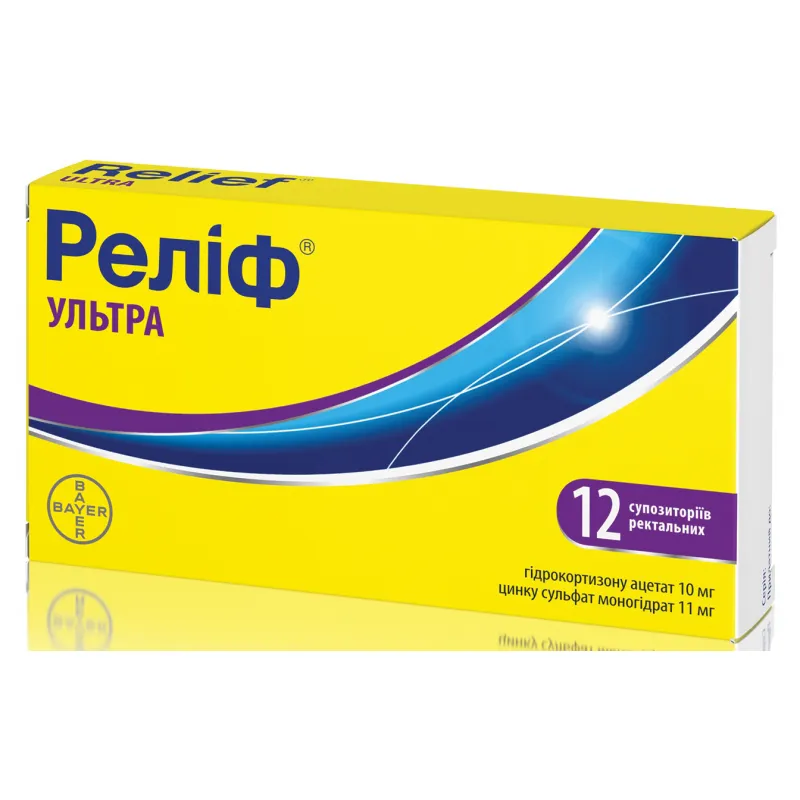
Table of Contents
INSTRUCTIONS FOR MEDICAL USE OF THE MEDICINAL PRODUCT RELIEF® ULTRA
Composition:
Active substances: hydrocortisone acetate, zinc sulfate monohydrate;
1 suppository contains hydrocortisone acetate 10 mg, zinc sulfate monohydrate 11 mg;
Excipients: methylparahydroxybenzoate (E 218), propylparahydroxybenzoate (E 216), calcium hydrogen phosphate, cocoa butter, magnesium stearate.
Pharmaceutical form. Rectal suppositories.
Main physicochemical properties: opaque, pale white to light yellow torpedo-shaped suppositories.
Pharmacotherapeutic group. Agents for the treatment of haemorrhoids and anal fissures for local use. ATC Code C05A A.
Pharmacological properties.
Pharmacodynamics.
Hydrocortisone acetate is a glucocorticosteroid that exerts anti-inflammatory, antiallergic, vasoconstrictive, and antipruritic effects when applied locally. It suppresses the release of inflammatory mediators and inhibits arachidonic acid metabolism.
Zinc sulfate monohydrate promotes wound and erosion healing and normalizes skin hydration.
Pharmacokinetics.
When applied topically, the drug's ingredients are eliminated with mucus or excreted in urine and bile in extremely small amounts. No signs of systemic (resorptive) effects are observed when the drug is used at recommended doses. The components of the drug do not penetrate into breast milk.
Clinical characteristics.
Indications.
External and internal hemorrhoids, fissures, fistulas, ulcers, erosions of the perianal area and rectum accompanied by pronounced inflammatory manifestations; proctitis, anal pruritus, eczema, dermatitis of the perianal region.
Contraindications.
Hypersensitivity to any component of the drug (allergic reactions), specific infections (bacterial, fungal, viral, tuberculosis) of the anorectal area, neoplasms in the anorectal region, thromboembolic disease, intestinal obstruction, abscesses, risk of perforation, peritonitis, extensive fistulas, fresh intestinal anastomoses or fistulous tracts.
Interaction with other medicinal products and other types of interactions.
Use with caution when administered concomitantly with anticoagulants, hypoglycemic agents, barbiturates, diuretics, cardiac glycosides.
Concomitant use with other corticosteroids (both topical and oral) may increase the likelihood of systemic effects.
Concomitant use with CYP3A inhibitors (including medicinal products containing cobicistat) may increase the risk of systemic adverse effects, including adrenal suppression. Concomitant use should be avoided unless the therapeutic benefit outweighs the risks of systemic corticosteroid effects, and only under mandatory patient monitoring.
Special precautions for use
In case of significant rectal bleeding, if symptoms persist for 7 days of treatment, or if the condition worsens, additional consultation with a proctologist is required. Accidental contact of the drug with the eyes should be avoided.
Rectal corticosteroids should be used with caution in patients with severe ulcerative disease and only after proctological examination due to the risk of intestinal perforation.
When using any topical corticosteroids, systemic absorption should be considered as a possibility.
To minimize systemic effects, the recommended dose should not be exceeded unless otherwise directed by a physician.
Use during pregnancy or breastfeeding
The safety of using Relif® Ultra (hydrocortisone acetate, zinc sulfate) during pregnancy has not been studied.
Current safety data on the use of topical corticosteroids during pregnancy indicate no association between their use in pregnant women and the development of cleft lip/palate, preterm birth, or fetal death.
Recent data suggest that the local use of potent/very potent topical corticosteroids during pregnancy may not be associated with placental insufficiency or low birth weight. However, these data come from one large and one small cohort study. A large population-based cohort study (including 84,133 pregnant women from general practice research databases) found a significant association between the use of potent/very potent topical corticosteroids by pregnant women and fetal growth restriction, but not with weak or moderate-potency topical corticosteroids. No association was found between the use of topical corticosteroids of any potency during pregnancy and the development of cleft lip/palate, preterm birth, or fetal death. Another cohort study conducted in Denmark also found no causal link between the use of topical corticosteroids and the development of cleft lip/palate.
It is unknown whether the active ingredients of Relif® Ultra (hydrocortisone acetate, zinc sulfate) are excreted in breast milk. Trace amounts of endogenous hydrocortisone (cortisol) are excreted in breast milk. The concentration of corticosteroids in milk ranges from 0.2 to 32 ng/mL, with the highest average concentration (25.5 ng/mL) found in colostrum at the end of pregnancy. The concentration of hydrocortisone in colostrum averages 7.5% of the plasma level.
There are no reports on the excretion of exogenous hydrocortisone or cortisone into breast milk. It is unlikely that these substances would have a negative effect on a breastfed newborn. Prednisolone, a corticosteroid more potent than hydrocortisone, is excreted into breast milk in minimal amounts and is considered compatible with breastfeeding.
During pregnancy and breastfeeding, the drug may be used only if, in the physician’s opinion, the potential benefit to the woman outweighs the potential risk to the fetus. Drugs of this class should not be widely used in pregnant women, especially at high doses or for prolonged periods.
Medical advice should be sought before starting treatment with this medicinal product.
No studies on the effect of Relif® Ultra (hydrocortisone acetate, zinc sulfate) on human fertility have been conducted.
Ability to influence reaction speed when driving or operating machinery. Data are lacking.
Method of Administration and Dosage.
Wash the skin around the anus with warm water, clean the affected area using a moist soft wipe, and gently dry with toilet paper or a soft cloth. Before insertion, remove the protective plastic wrapper from the suppository. Insert the suppository into the rectum as deeply as possible. Administer one suppository up to 4 times daily (at night, in the morning, and after each bowel movement). The treatment course should not exceed 7 days.
Do not use the medicinal product if the protective plastic wrapper is damaged or missing.
Children. Safety and efficacy of Relief® Ultra in children under 12 years of age have not been established. No data available. The drug can be used in children aged 12 years and older.
Overdose.
Prolonged use in high doses enhances resorption and increases the risk of systemic effects of hydrocortisone, such as menstrual cycle disturbances, increased blood pressure, delayed wound healing, muscle weakness, insomnia, elevated blood glucose levels, hirsutism, glaucoma, etc.
Accidental ingestion may cause gastrointestinal disorders (nausea, stomach pain).
Side effects.
Immune system disorders. Allergic reactions may rarely occur, including hyperemia (redness), swelling, itching; dryness of the mucous membrane.
Although systemic effects have not been reported with the use of Relif® Ultra, prolonged use in high doses may lead to endocrine disorders: adrenal cortical suppression, Cushing's syndrome, hyperglycemia, glucosuria, growth retardation, and intracranial hypertension.
Gastrointestinal tract disorders: rectal bleeding.
Skin and subcutaneous tissue disorders: perianal dermatitis, with or without skin atrophy; irritation, pain at application site, burning, rash, dry skin, pustular acne; "rebound effect" which may lead to steroid dependence; delayed wound healing.
Methylparahydroxybenzoate and propylparahydroxybenzoate may cause allergic reactions (possibly delayed) and, in isolated cases, bronchospasm.
Shelf life. 2 years.
Storage conditions.
Store in a place inaccessible to children, at a temperature not exceeding 25 °C.
Packaging. 2 plastic strips of 6 suppositories each in a cardboard box.
Prescription status. Over-the-counter.
Manufacturer.
Istituto De Angeli S.r.l.
Manufacturer's address and place of business.
Località Prulli, 103/c – 50066 Reggello (FI), Italy.