Relief
Ukraine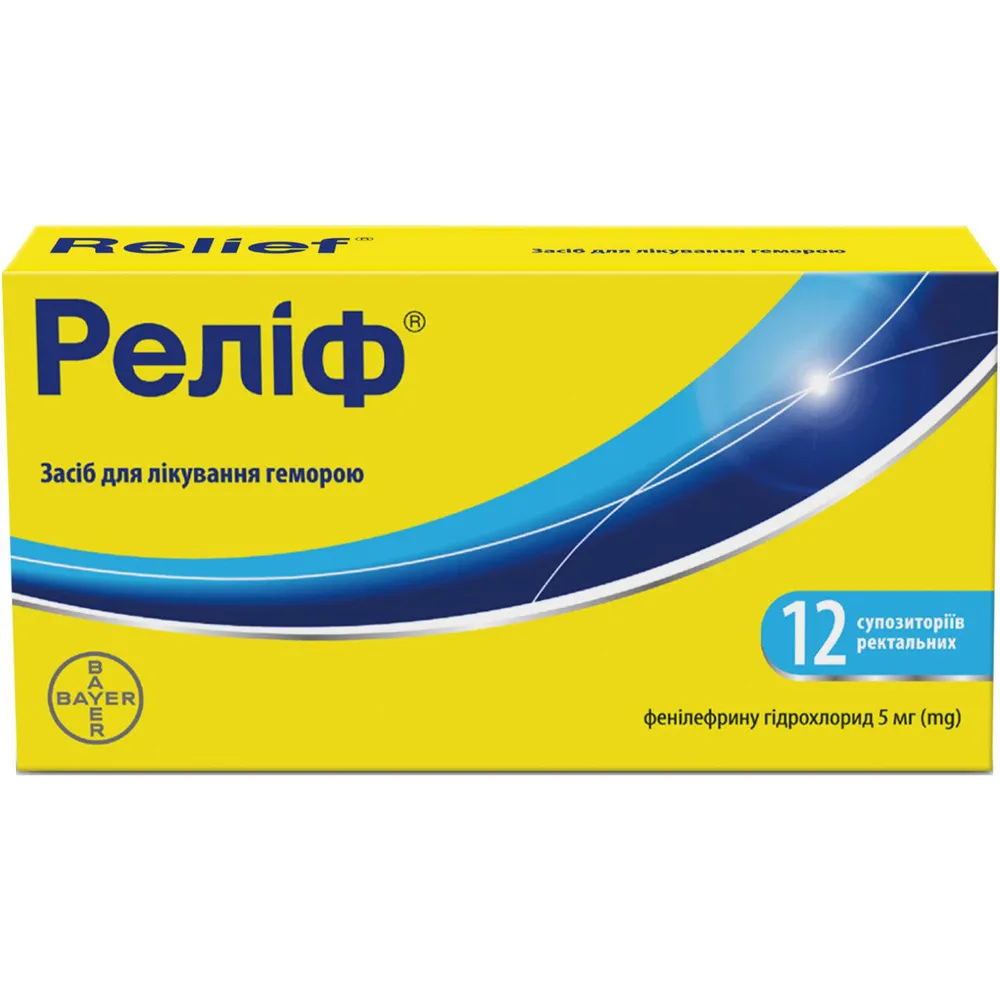
Table of Contents
INSTRUCTIONS FOR MEDICAL USE OF THE MEDICINAL PRODUCT RELIEF®
Composition:
Active substance: phenylephrine hydrochloride;
1 suppository contains 5 mg of phenylephrine hydrochloride;
Excipients: cocoa butter, methylparahydroxybenzoate (E 218), propylparahydroxybenzoate (E 216), maize starch.
Pharmaceutical form. Rectal suppositories.
Main physicochemical properties: homogeneous, opaque, pale white to light yellow torpedo-shaped suppositories.
Pharmacotherapeutic group.
Agents for the treatment of haemorrhoids and anal fissures for local use.
ATC code C05A X.
Pharmacological Properties.
Pharmacodynamics.
Phenylephrine hydrochloride is an adrenomimetic agent, the application of which results in a local vasoconstrictive effect. This normalizes the balance between blood inflow to the hemorrhoidal nodes and outflow from them, and also helps reduce exudation, swelling, itching, and serous discharge in hemorrhoids and other diseases of the anorectal area.
Pharmacokinetics.
Phenylephrine contained in the medicinal product Relief® is inactivated by tissue monoamine oxidase; inactive metabolites are excreted in mucus or in extremely small amounts by the kidneys.
Clinical characteristics.
Indications.
External and internal hemorrhoids, anal fissures, erosion and microtraumas of the anus, anal pruritus.
Contraindications.
Hypersensitivity to any component of the drug, significant increase in arterial pressure, tachysystolic cardiac rhythm disorders, decompensated heart failure, conduction disorders, severe renal and hepatic insufficiency, thyrotoxicosis, acute pancreatitis, concomitant use with monoamine oxidase inhibitors (MAOIs) or within 15 days after discontinuation of MAOI therapy, thromboembolic disease, granulocytopenia.
Interaction with other medicinal products and other types of interactions.
Should not be used concomitantly with other vasoconstrictive agents (by any route of administration), or with antihypertensive drugs (ß-adrenoblockers), since phenylephrine may cause severe hypertension in some individuals due to stimulation of α-adrenergic receptors.
Atropine sulfate blocks the reflex bradycardia caused by phenylephrine and enhances the vasopressor response to phenylephrine. Concomitant use of phenylephrine with ß-adrenoblockers may lead to arterial hypertension and excessive bradycardia with possible heart block. Use with caution when combined with thyroid hormones, drugs affecting cardiac conduction (cardiac glycosides, antiarrhythmic agents).
When used concomitantly with drugs causing potassium loss, such as certain diuretics like furosemide, hypokalemia may be intensified and arterial sensitivity to vasopressor agents such as phenylephrine may be reduced.
Concomitant use of phenylephrine and other sympathomimetic agents may lead to additive stimulation of the central nervous system to an extremely high level, resulting in nervousness, irritability, insomnia, and possible seizures.
Physicians should be consulted before using monoamine oxidase inhibitors (MAOIs) prior to initiating phenylephrine treatment in the anorectal area. MAOIs used prior to starting phenylephrine therapy potentiate its cardiac and pressor effects, as phenylephrine metabolism is reduced.
Special precautions for use
In case of significant bleeding from the anus or if disease symptoms persist for more than 7 days, or if the condition worsens, additional consultation with a physician is required.
This medicinal product should be used with caution in patients with arterial hypertension, cardiovascular or cerebrovascular diseases, hyperthyroidism (since phenylephrine may cause adverse cardiovascular effects, especially when high doses are used or in sensitive individuals), and in patients with closed-angle glaucoma.
Patients with diabetes mellitus should use this medicinal product with caution: phenylephrine may increase blood glucose concentration. These effects are usually temporary and insignificant but may increase if recommended doses are exceeded. Blood glucose levels should therefore be monitored more closely.
Patients with urinary retention due to prostatic hypertrophy or tumors: phenylephrine may worsen urination in patients with prostatic hypertrophy due to spasm of the smooth muscles of the bladder neck caused by stimulation of α1-adrenergic receptors.
Use of the drug in patients with hepatitis or urinary disorders is permissible only after careful assessment of the benefit-risk ratio as determined by the physician.
Potential interaction between phenylephrine applied locally in the anorectal area and monoamine oxidase inhibitors (MAO inhibitors) should be considered, particularly if sufficient systemic absorption occurs, as this may potentiate hypertensive effects.
Potential for phenylephrine, when applied locally in the anorectal area, to cause severe hypertension due to stimulation of α-adrenergic receptors in certain individuals, especially when used concomitantly with antihypertensive agents, should be taken into account.
To minimize systemic effects, the recommended dose should not be exceeded unless otherwise directed by a physician.
Do not use the product if the protective plastic seal is damaged or missing.
Use during pregnancy or breastfeeding
Use of the drug during pregnancy or breastfeeding is possible only if, in the opinion of the physician, the expected benefit to the mother outweighs the potential risk to the fetus/infant.
Ability to affect reaction speed when driving or operating machinery
No effects on the ability to drive or operate machinery have been observed.
Method of Administration and Dosage
For adults and children aged 12 years and older, the medication should be used after performing hygiene procedures. Wash the skin around the anus with warm water, clean the affected area using a moist soft wipe, then gently dry with toilet paper or a soft cloth, removing excess moisture. Before inserting the suppository, remove its plastic protective covering. Insert the suppository into the anal canal.
Administer 1 suppository up to 4 times daily, particularly at night, in the morning, and after each bowel movement. The treatment duration is 7–14 days. Regular use of the medication ensures a sustained therapeutic effect and alleviates hemorrhoid symptoms.
Do not use if the protective covering is missing or damaged.
Children.
The efficacy and safety of Relief® in children under 12 years of age have not been studied. Data are lacking.
Overdose.
Overdose has not been reported in medical practice, and there are no data on systemic, including toxic, reactions of the body in response to rectal administration of Relief®. However, in case of overdose, the manifestations of adverse reactions may be intensified, especially with prolonged use. Possible symptoms include arterial hypertension, chest pain and discomfort, palpitations, dyspnea, non-cardiogenic pulmonary edema, excitement, seizures, sleep disturbances, anxiety, paranoia, irritability, hallucinatory psychoses, weakness, anorexia, nausea, vomiting, oliguria, urinary retention, facial flushing, cold sensation in the extremities, paresthesia, increased sensitivity, hyperglycemia, hypokalemia, reduced blood flow to vital organs, which may lead to impaired renal perfusion, metabolic acidosis, and increased cardiac workload due to elevated total peripheral vascular resistance. Treatment is symptomatic.
Adverse Reactions.
This medicinal product is generally well tolerated, but in isolated cases adverse reactions related to phenylephrine hydrochloride may occur.
Cardiovascular system: reflex bradycardia, arrhythmia, possible disturbances in heart rhythm, increased blood pressure.
Endocrine system: worsening of symptoms of hyperthyroidism.
Immune system: allergic reactions, including cross-reactions in patients allergic to other sympathomimetics, which may manifest as rashes, itching, angioneurotic edema.
Skin and subcutaneous tissues: contact dermatitis.
Nervous system: dizziness, nervousness, headache, tremor, insomnia, feeling of fear, sensation of flushing.
At the application site: possible irritation, hyperemia, rash, itching, swelling, mild pain/burning sensation in case of injury or bleeding from the anus. Methylparahydroxybenzoate and propylparahydroxybenzoate may cause allergic reactions (possibly delayed) and, in rare cases, bronchospasm.
Shelf life.
2 years.
Do not use the medicinal product after the expiry date.
Storage conditions.
Store at a temperature not exceeding 25 °C.
Keep out of reach of children.
It is prohibited to store suppositories without or with damaged protective plastic wrapping.
Packaging.
6 suppositories in a plastic strip, 2 strips in a cardboard box.
Availability.
Over-the-counter.
Manufacturer.
Istituto De Angeli S.r.l.
Manufacturer's location and address of business operations.
Località Prulli, n. 103/c - 50066 Reggello (FI), Italy.