Rectodelt 100
Ukraine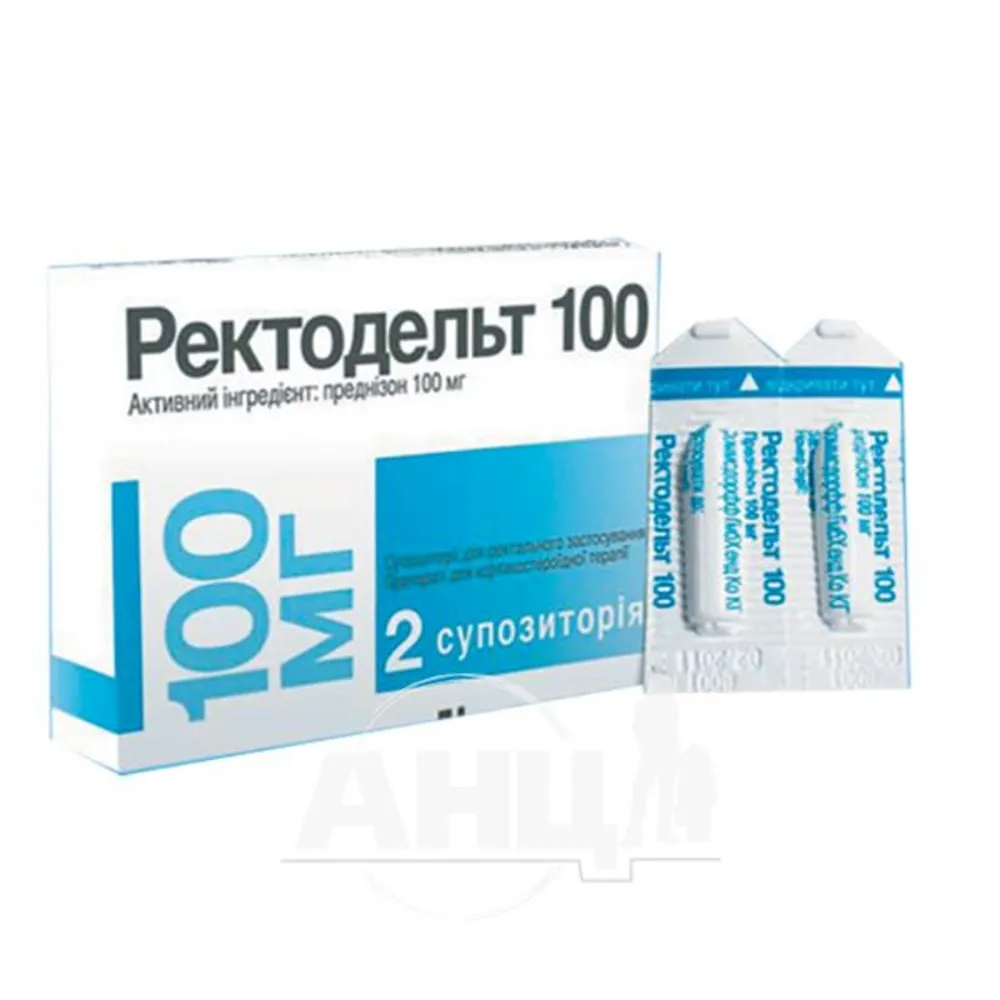
Table of Contents
INSTRUCTIONS FOR MEDICAL USE OF THE MEDICINAL PRODUCT Rectodelt 100 (Rectodelt® 100)
Composition:
Active substance: prednisone;
1 suppository contains 100 mg of prednisone;
Excipient: hard fat.
Pharmaceutical form. Rectal suppositories.
Main physicochemical properties: torpedo-shaped suppositories with a smooth surface.
Pharmacotherapeutic group.
Corticosteroids for systemic use. Glucocorticoids. ATC code H02AB07.
Pharmacological properties.
Pharmacodynamics.
Prednisone is a non-fluorinated glucocorticoid intended for systemic use.
Prednisone exerts a dose-dependent effect on the metabolism of almost all tissues. At physiological levels, its action is essential for maintaining homeostasis of the body at rest and during physical stress, as well as for regulating immune system activity.
At doses exceeding replacement levels, prednisone exhibits a rapid anti-inflammatory effect (anti-exudative and anti-proliferative action) and a delayed immunosuppressive effect. It inhibits chemotaxis and activity of immune system cells, as well as the release and effects of mediators of inflammation and immune reactions, such as lysosomal enzymes, prostaglandins, and leukotrienes.
In cases of bronchial obstruction, prednisone enhances the bronchodilatory action of beta-mimetics (permissive effect).
Prolonged high-dose treatment leads to involution of the immune system and adrenal cortex.
Mineralocorticoid activity (significant for hydrocortisone, noticeable for prednisone) may necessitate monitoring of serum electrolytes.
The effect of prednisone on impaired airway patency is mediated through suppression of inflammatory processes, inhibition or prevention of mucosal edema, reduction of bronchial stenosis, inhibition or reduction of mucus production, and decreased mucus viscosity. The underlying mechanism includes reduced vascular permeability and membrane stabilization, normalization of bronchial muscle sensitivity to β2-sympathomimetics if reduced due to their prolonged use, and suppression of type I reactions beginning from the second week of treatment.
Pharmacokinetics.
Absorption: the level of corticosteroids in blood plasma can be detected shortly after administration of the "Rectodelt 100" suppository.
Metabolism: after administration, prednisone is rapidly metabolized to prednisolone. Prednisone and prednisolone are generally interconverted in the body, with prednisolone forming the major portion. Absolute bioavailability is approximately 29%.
Distribution: prednisolone binds to transcortin and plasma proteins. The volume of distribution is approximately 1.5 ml/min/kg.
Elimination: about 2–5% of the absorbed dose is excreted in urine as prednisone, approximately 11–24% as prednisolone, and the remainder as other metabolites.
Clinical characteristics.
Indications.
"Rectodelt 100" suppositories are indicated in children for intensive treatment of pseudocroup (acute stenosing laryngotracheitis), croup, and spasmodic bronchitis.
Contraindications.
Hypersensitivity to prednisone or to any other component of the medicinal product. There are no other contraindications for short-term use of prednisone in the treatment of acute, potentially life-threatening, and emergency conditions.
Parasitic and infectious diseases of viral, fungal, or bacterial etiology, either present or recently experienced: herpes simplex, herpes zoster (viremic phase), varicella, measles; amebiasis, strongyloidiasis (confirmed or suspected); systemic mycosis; active or latent tuberculosis.
Post-vaccination period (duration of 10 weeks: 8 weeks before and 2 weeks after vaccination), lymphadenitis following BCG vaccination.
Immunodeficiency states caused by HIV infection.
Cardiovascular diseases: recent myocardial infarction, decompensated chronic heart failure, arterial hypertension, predisposition to thromboembolic disease.
Endocrine disorders: diabetes mellitus and impaired glucose tolerance, thyrotoxicosis, hypothyroidism, Cushing's disease.
Severe chronic renal and/or hepatic insufficiency, nephrolithiasis.
Hypoalbuminemia. Systemic osteoporosis. Myasthenia gravis. Acute psychosis. Obesity (grade III–IV). Poliomyelitis (except for the bulbar encephalitis form). Open-angle and closed-angle glaucoma.
Interaction with other medicinal products and other forms of interaction.
Enzyme inducers such as barbiturates, phenytoin, primidone, carbamazepine, rifampicin may reduce the effects of "Rectodelt 100".
Estrogens may enhance the clinical and toxic effects of "Rectodelt 100".
Concomitant use of "Rectodelt 100" with atropine or other anticholinergic drugs, antihistamines, or nitrates may lead to increased intraocular pressure and reduced efficacy of antihistamines.
Combined use with salicylates or nonsteroidal anti-inflammatory drugs increases the risk of gastrointestinal bleeding.
The effects of antidiabetic agents, insulin, and coumarin derivatives may be reduced when used concomitantly with "Rectodelt 100".
Concomitant use of cardiac glycosides may enhance glycoside activity due to steroid-induced potassium loss.
Simultaneous administration with antacids reduces absorption of prednisone and prednisolone.
Concomitant use with diuretics, laxatives, and amphotericin B may increase potassium loss. Increased risk of osteoporosis when used simultaneously with amphotericin B and carbonic anhydrase inhibitors.
Corticosteroids may lead to decreased blood concentrations of isoniazid, mexiletine, and praziquantel.
When used concomitantly with angiotensin-converting enzyme (ACE) inhibitors, there is an increased risk of changes in hemogram and reduced efficacy of antihypertensive drugs.
Chloroquine, hydroxychloroquine, and mefloquine increase the risk of myopathies and cardiomyopathies.
The effect of somatotropin may be reduced.
The effect of protirelin on increasing thyroid-stimulating hormone (TSH) levels may be diminished.
Blood levels of cyclosporine increase, raising the risk of cerebral-origin seizures.
Tricyclic antidepressants may intensify depressive symptoms caused by prednisolone and increase intraocular pressure.
Immunosuppressants increase the risk of infections and lymphoma or other lymphoproliferative disorders associated with Epstein-Barr virus.
Neuroleptics, carbuthamide, azathioprine increase the risk of cataract development.
Estrogens, anabolic agents, and oral contraceptives may cause manifestations of hirsutism and acne.
Live antiviral vaccines and other types of immunization increase the risk of viral activation and infection development.
Concomitant use with muscle relaxants in the context of hypokalemia increases the intensity and duration of muscle blockade induced by muscle relaxants.
Concomitant use with anticholinesterase agents may lead to muscle weakness in patients with myasthenia (especially in patients with myasthenia gravis).
Concomitant use with mitotane and other adrenal cortex function inhibitors may require an increased dose of the drug.
Concomitant use with antiemetics enhances the antiemetic effect.
Concomitant use with fluoroquinolones increases the risk of tendon damage.
During prolonged therapy, prednisolone increases folate levels.
The drug reduces the effect of vitamin D on intestinal Ca²⁺ absorption.
Concomitant administration of glucocorticoids and CYP3A inhibitors, including drugs containing cobicistat, is expected to increase the risk of systemic adverse reactions.
Cases of Cushing's syndrome and adrenal suppression have been reported.
Such interactions should be avoided unless the benefits outweigh the increased risk of adverse effects. If systemic glucocorticoids must be used in such cases, patients should be monitored for adverse effects associated with systemic glucocorticoid use.
Special precautions for use.
The drug "Rectodelt 100" should primarily be used in acute conditions. Administration of "Rectodelt 100" is possible only after careful analysis of the risk/benefit ratio. Prolonged use (more than 2 days) is permissible only under strict medical supervision.
During treatment with "Rectodelt 100", a positive doping test may occur.
Pheochromocytoma crisis: pheochromocytoma crisis, which may be fatal, can occur after administration of systemic corticosteroids. Corticosteroids should be prescribed to patients with suspected or diagnosed pheochromocytoma only after appropriate assessment of the risk/benefit ratio.
Visual disturbances may occur with both systemic and local administration of corticosteroids. If a patient experiences symptoms such as blurred vision or other visual disturbances, the patient should be referred to an ophthalmologist to evaluate possible causes, including cataract, glaucoma, or rare conditions such as central serous chorioretinopathy (CSCR), which has been reported after systemic and local corticosteroid use.
Scleroderma renal crisis: caution is required when treating patients with systemic sclerosis due to increased risk of developing scleroderma renal crisis with hypertension (possibly fatal) and reduced urine output at a daily prednisolone dose of 15 mg or higher. Therefore, blood pressure and renal function (serum creatinine) should be monitored regularly. In case of suspected renal crisis, blood pressure should be closely monitored.
Use during pregnancy or breastfeeding.
There is insufficient data on the use of "Rectodelt 100" during pregnancy. In animal studies, systemic administration of prednisone caused embryotoxic and teratogenic effects. Typical embryotoxic and teratogenic effects observed in animal studies with other glucocorticoids (besides prednisone) included cleft palate, skeletal developmental abnormalities, intrauterine growth retardation, and embryonic-period lethality.
An increased risk of fetal cleft palate in humans has also been reported following systemic administration of glucocorticoids during the first trimester. Animal studies have further shown that administration of subteratogenic doses during pregnancy may increase the risk of intrauterine growth retardation, cardiovascular diseases and metabolic disorders in adulthood, as well as long-term changes in glucocorticoid receptor density, nerve impulse transmission, and reactions.
If glucocorticoids are administered during the third trimester, there is a risk of adrenal cortex atrophy. In such cases, the newborn's replacement therapy doses should be reduced.
Therefore, Rectodelt 100 should be used during pregnancy only after careful risk/benefit assessment.
Prednisone and prednisolone pass into breast milk. Data on negative effects on the newborn are lacking. If higher doses are required, breastfeeding should be discontinued.
Ability to affect reaction speed when driving or operating machinery.
"Rectodelt 100" does not affect reaction speed when driving or operating machinery.
Method of Administration and Dosage.
For children aged 6 months and older, administer 1 suppository per day, corresponding to 100 mg of prednisone. The duration of treatment depends on the course of the disease. In acute conditions, short-term therapy is generally sufficient. If necessary, treatment may be repeated once. Further use is not recommended. Treatment with "Rectodelt 100" suppositories should not exceed 2 days (corresponding to 200 mg of prednisone).
Suppositories should be inserted deeply into the rectum.
Rectal administration is particularly recommended for young children when intravenous, intramuscular, or oral administration of glucocorticoids causes difficulties and additional stress.
It is forbidden to exceed the recommended dose or duration of treatment. Failure to follow these recommendations may lead to severe adverse reactions (see section "Adverse Reactions").
Children.
The medicinal product should be used in children aged 6 months and older.
Overdose.
Acute intoxication with prednisone has not been described to date. The risk of overdose increases with prolonged use of the drug, especially in high doses.
In case of overdose, possible intensification of adverse reactions should be considered, primarily affecting the endocrine system, as well as disturbances in metabolism and electrolyte balance.
Symptoms: increased arterial pressure, peripheral edema, increased incidence of adverse effects.
Treatment of overdose: immediate gastric lavage or induction of vomiting. There is no specific antidote.
Side effects
In the case of emergency therapy, the only possible adverse reaction may be:
Immune system disorders: hypersensitivity to Rectodelt 100.
Long-term use of glucocorticoids may cause the following adverse reactions:
Endocrine system disorders: Cushing's syndrome of varying intensity, with manifestations such as moon face, obesity, development of diabetic metabolic syndrome, hyperglycemia up to steroid-induced diabetes, exhaustion (up to atrophy) of adrenal cortex function, growth retardation in children, disturbances in sex hormone secretion, hirsutism, changes in hemogram;
Metabolic disorders: hypokalemia, sodium and fluid retention in the body, negative nitrogen balance;
Cardiovascular system disorders: increased arterial pressure, bradycardia (with high-dose administration);
Hemostatic system disorders: increased blood coagulation;
Musculoskeletal system disorders: aseptic necrosis of bones, osteoporosis, muscle atrophy;
Gastrointestinal disorders: gastric or intestinal ulcers (due to ulcerogenic effects on the gastrointestinal tract and increased gastric juice acidity), pancreatitis;
Skin disorders: skin changes (skin atrophy, telangiectasias, striae, acneiform eruptions; hematomas, bruising, skin discoloration);
Cardiovascular system disorders: vascular fragility;
Eye disorders: steroid cataract, precipitation of latent glaucoma;
Central nervous system disorders: psychiatric disturbances.
Effects due to immunosuppressive action: decreased resistance to infections, delayed wound healing.
Prednisolone
The frequency and severity of adverse effects depend on the duration of treatment, the dose used, and the possibility of maintaining a circadian rhythm of administration:
Cardiovascular system disorders: arrhythmia, bradycardia, arterial hypertension, development or worsening of chronic heart failure symptoms, ECG changes characteristic of hypokalemia. In patients with acute and subacute myocardial infarction – spreading of the necrotic area, delayed scar formation, which may lead to rupture of the myocardium;
Blood and lymphatic system disorders: leukocytosis, hypercoagulability leading to thrombosis and thromboembolism;
Nervous system disorders: headache, dizziness, pseudotumor cerebri, increased intracranial pressure, seizures;
Eye disorders: posterior subcapsular cataract, increased intraocular pressure with possible damage to the optic nerve, predisposition to secondary bacterial, fungal, or viral eye infections, trophic changes in the cornea, exophthalmos;
Gastrointestinal tract disorders: nausea, vomiting, epigastric pain, diarrhea, pancreatitis, "steroid" gastric and duodenal ulcers, erosive esophagitis, gastrointestinal bleeding and perforation, increased or decreased appetite, flatulence, hiccup. In individual cases – increased activity of liver transaminases and alkaline phosphatase;
Skin and subcutaneous tissue disorders: delayed regeneration process, petechiae, bruising, hematomas, ecchymoses, striae, thinning of the skin, hyper- or hypopigmentation, acne, predisposition to pyoderma;
Musculoskeletal and connective tissue disorders: growth retardation and ossification processes in children (premature closure of epiphyseal growth zones), osteoporosis, very rarely – pathological fractures, aseptic necrosis of the femoral or humeral head; tendon rupture, "steroid" myopathy, reduction of muscle mass (atrophy);
Endocrine system disorders: decreased glucose tolerance, "steroid" diabetes or manifestation of latent diabetes, suppression of the hypothalamic-pituitary-adrenal system, menstrual cycle disturbances, growth retardation in children and adolescents, delayed sexual development in children, Cushing's syndrome (moon face, pituitary-type obesity, hirsutism, increased arterial pressure, dysmenorrhea, amenorrhea, myasthenia, striae);
Metabolic disorders: hypocalcemia, negative nitrogen balance (increased protein breakdown), weight gain. Adverse effects due to glucocorticosteroid activity of prednisolone: fluid and Na+ retention (peripheral edema), hypernatremia, hypokalemic syndrome – arrhythmia, myalgia or muscle cramps, unusual weakness and fatigue;
Infections and infestations: decreased resistance to infections;
Immune system disorders: rash, itching, hyperemia, urticaria, angioedema (Quincke's edema), anaphylactic shock;
Psychiatric disorders: delirium, disorientation, euphoria, hallucinations, manic-depressive psychosis, depression, paranoia, nervousness, restlessness, insomnia;
Other: withdrawal syndrome, edema, aphthous ulcers, increased risk of urolithiasis;
Eye disorders: blurred vision (see section "Special precautions");
Renal and urinary tract disorders: scleroderma renal crisis (see section "Special precautions"). The incidence of scleroderma renal crisis varies among different subpopulations. The highest risk is observed in patients with diffuse systemic sclerosis. The lowest risk was recorded in patients with limited systemic sclerosis (2%) and systemic sclerosis at a young age (1%).
Reporting of adverse reactions after drug registration is of great importance. It allows continuous monitoring of the benefit-risk balance of the drug. Medical and pharmaceutical professionals, as well as patients or their legal representatives, should report all suspected adverse reactions and lack of drug efficacy through the automated pharmacovigilance information system at the following link: https://aisf.dec.gov.ua/.
Shelf life. 3 years.
Storage conditions.
Store at a temperature not exceeding 25 °C.
Keep out of reach of children.
Packaging.
2 or 6 suppositories per blister pack, 1 blister pack per cardboard box.
Prescription status.
Prescription only.
Manufacturer.
Trommsdorff GmbH & Co. KG, Germany.
Manufacturer's address and location of business activity. Trommsdorffstrasse 2-6, 52477, Aachen, Germany.